SUBSCRIBE TO OUR FREE NEWSLETTER
Daily news & progressive opinion—funded by the people, not the corporations—delivered straight to your inbox.
5
#000000
#FFFFFF
To donate by check, phone, or other method, see our More Ways to Give page.
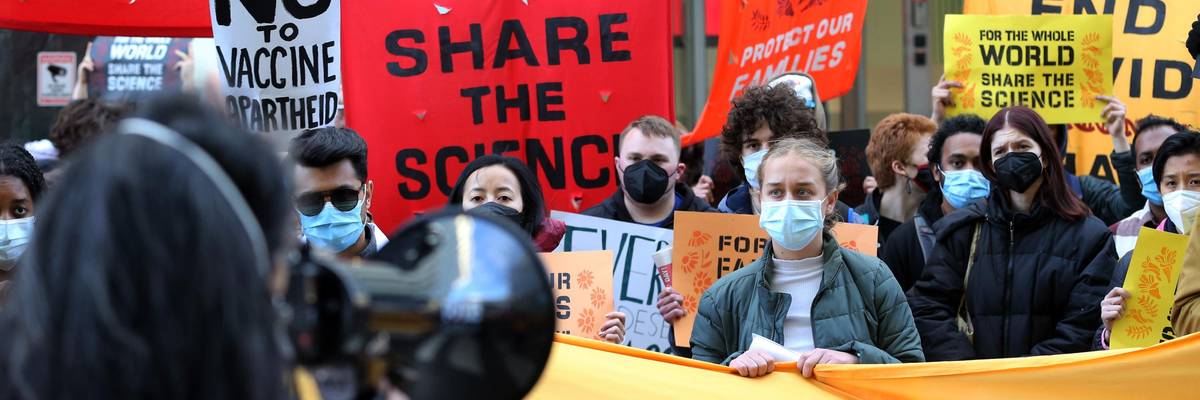
The Massachusetts-based pharmaceutical giant Moderna disclosed in a financial filing this week that it received another $300 million in U.S. government funding for coronavirus vaccine development in March even as the company hoarded its technology from the world--and attempted to undermine a critical vaccine project in South Africa.
"The corporation must give it back by sharing the tech with others and make this vaccine available to everyone, everywhere."
In its quarterly report to the U.S. Securities and Exchange Commission, Moderna revealed that "in March 2022, we entered into a further amendment to [its Covid-19 vaccine contract with the federal government], increasing the amount of potential reimbursements by $308 million, in connection with costs associated with the clinical development for the adolescent and pediatric studies and the Phase 3 pivotal study."
"The maximum award from [the Biomedical Advanced Research and Development Authority], inclusive of the 2020, 2021, and 2022 amendments, was approximately $1.7 billion," the filing reads. "All contract options have been exercised. As of March 31, 2022, the remaining available funding, net of revenue earned was $378 million."
Zain Rizvi, a researcher with Public Citizen's Access to Medicines program, called the sum of public funding that has flowed to Moderna "staggering."
Moderna reported Wednesday that it sold $5.9 billion worth of its Covid-19 vaccine in the first quarter of 2022, far surpassing analysts' revenue and profit expectations and briefly sending the company's stock price soaring.
The biotechnology corporation has repeatedly come under fire in recent months for selling much of its vaccine supply to rich countries, even as billions of people in poor nations remain without access to shots more than two years into the pandemic--which has killed nearly 15 million people worldwide. The company has also faced criticism for massively overcharging for doses.
Known as mRNA-1273, the coronavirus vaccine is Moderna's only product on the market, and the company has previously admitted that "100%" of the funding for its vaccine development program has come from the U.S. government.
"Moderna received $1.7 billion dollars as public investment for R&D but still refuses to be accountable to the public," Shailly Gupta, communications adviser at Doctors Without Borders, said Thursday. "The corporation must give it back by sharing the tech with others and make this vaccine available to everyone, everywhere."
David Mitchell, the founder of Patients for Affordable Drugs, summarized the arrangement between Moderna and the U.S. government as: "We take on the risk. They take away the profits."
Last week, Moderna shareholders voted down resolutions urging the company--led by billionaire CEO Stephane Bancel--to take part in technology transfer efforts such as the World Health Organization's South Africa hub, which has thus far succeeded in creating a close replica of Moderna's mRNA-based coronavirus shot without the corporation's help.
Far from supporting the WHO's groundbreaking work, Moderna has been accused of trying to derail it by shielding its vaccine technology with sweeping and long-term patents. Moderna has even fought with the U.S. government over ownership of key vaccine technology that National Institutes of Health (NIH) scientists helped develop.
Spike-protein technology developed by NIH researchers has been used in at least five coronavirus vaccines, including Moderna's shot. Moderna is currently seeking emergency-use authorization for its coronavirus vaccine for children between the ages of six months and six years.
While Biden administration officials have reportedly grown frustrated over Moderna's refusal to share its publicly funded vaccine technology, the federal government has yet to use its leverage to force the company's hand.
Related Content

In a joint statement on Thursday, four House Democrats lamented that "Big Pharma continues to shamelessly protect its monopoly pricing scheme, despite receiving tens of billions of public dollars to develop Covid-19 vaccines."
"As such, the progress of global vaccination has been slower than we had hoped," said Reps. Jan Schakowsky (Ill.), Rosa DeLauro (Conn.), Lloyd Doggett (Texas), and Earl Blumenauer (Ore.).
The statement was issued on the one-year anniversary of the Biden administration's endorsement of efforts to temporarily waive vaccine-related patents at the World Trade Organization (WTO).
Since the administration's announcement last May, however, little discernible progress has been made toward a final waiver agreement as the U.S. has dragged its feet and leading European nations have obstructed the process at every turn. Earlier this week, the WTO unveiled a purported compromise plan that vaccine equity campaigners slammed as "complete garbage."
"Now, second-generation vaccines are being developed to protect people from being infected by recent variants," the four House Democrats noted Thursday. "If the world repeats the grotesque inequity of access to the new vaccines and the most effective treatments, we know what will happen, because we just lived through it."
"Millions of people will suffer in raging outbreaks, which will also foster the development of new variants that can evade the new generation of vaccines," they added. "The only way to end the pandemic is to expand the production of vaccines and treatments. We cannot wait."
The Massachusetts-based pharmaceutical giant Moderna disclosed in a financial filing this week that it received another $300 million in U.S. government funding for coronavirus vaccine development in March even as the company hoarded its technology from the world--and attempted to undermine a critical vaccine project in South Africa.
"The corporation must give it back by sharing the tech with others and make this vaccine available to everyone, everywhere."
In its quarterly report to the U.S. Securities and Exchange Commission, Moderna revealed that "in March 2022, we entered into a further amendment to [its Covid-19 vaccine contract with the federal government], increasing the amount of potential reimbursements by $308 million, in connection with costs associated with the clinical development for the adolescent and pediatric studies and the Phase 3 pivotal study."
"The maximum award from [the Biomedical Advanced Research and Development Authority], inclusive of the 2020, 2021, and 2022 amendments, was approximately $1.7 billion," the filing reads. "All contract options have been exercised. As of March 31, 2022, the remaining available funding, net of revenue earned was $378 million."
Zain Rizvi, a researcher with Public Citizen's Access to Medicines program, called the sum of public funding that has flowed to Moderna "staggering."
Moderna reported Wednesday that it sold $5.9 billion worth of its Covid-19 vaccine in the first quarter of 2022, far surpassing analysts' revenue and profit expectations and briefly sending the company's stock price soaring.
The biotechnology corporation has repeatedly come under fire in recent months for selling much of its vaccine supply to rich countries, even as billions of people in poor nations remain without access to shots more than two years into the pandemic--which has killed nearly 15 million people worldwide. The company has also faced criticism for massively overcharging for doses.
Known as mRNA-1273, the coronavirus vaccine is Moderna's only product on the market, and the company has previously admitted that "100%" of the funding for its vaccine development program has come from the U.S. government.
"Moderna received $1.7 billion dollars as public investment for R&D but still refuses to be accountable to the public," Shailly Gupta, communications adviser at Doctors Without Borders, said Thursday. "The corporation must give it back by sharing the tech with others and make this vaccine available to everyone, everywhere."
David Mitchell, the founder of Patients for Affordable Drugs, summarized the arrangement between Moderna and the U.S. government as: "We take on the risk. They take away the profits."
Last week, Moderna shareholders voted down resolutions urging the company--led by billionaire CEO Stephane Bancel--to take part in technology transfer efforts such as the World Health Organization's South Africa hub, which has thus far succeeded in creating a close replica of Moderna's mRNA-based coronavirus shot without the corporation's help.
Far from supporting the WHO's groundbreaking work, Moderna has been accused of trying to derail it by shielding its vaccine technology with sweeping and long-term patents. Moderna has even fought with the U.S. government over ownership of key vaccine technology that National Institutes of Health (NIH) scientists helped develop.
Spike-protein technology developed by NIH researchers has been used in at least five coronavirus vaccines, including Moderna's shot. Moderna is currently seeking emergency-use authorization for its coronavirus vaccine for children between the ages of six months and six years.
While Biden administration officials have reportedly grown frustrated over Moderna's refusal to share its publicly funded vaccine technology, the federal government has yet to use its leverage to force the company's hand.
Related Content
In a joint statement on Thursday, four House Democrats lamented that "Big Pharma continues to shamelessly protect its monopoly pricing scheme, despite receiving tens of billions of public dollars to develop Covid-19 vaccines."
"As such, the progress of global vaccination has been slower than we had hoped," said Reps. Jan Schakowsky (Ill.), Rosa DeLauro (Conn.), Lloyd Doggett (Texas), and Earl Blumenauer (Ore.).
The statement was issued on the one-year anniversary of the Biden administration's endorsement of efforts to temporarily waive vaccine-related patents at the World Trade Organization (WTO).
Since the administration's announcement last May, however, little discernible progress has been made toward a final waiver agreement as the U.S. has dragged its feet and leading European nations have obstructed the process at every turn. Earlier this week, the WTO unveiled a purported compromise plan that vaccine equity campaigners slammed as "complete garbage."
"Now, second-generation vaccines are being developed to protect people from being infected by recent variants," the four House Democrats noted Thursday. "If the world repeats the grotesque inequity of access to the new vaccines and the most effective treatments, we know what will happen, because we just lived through it."
"Millions of people will suffer in raging outbreaks, which will also foster the development of new variants that can evade the new generation of vaccines," they added. "The only way to end the pandemic is to expand the production of vaccines and treatments. We cannot wait."
The Massachusetts-based pharmaceutical giant Moderna disclosed in a financial filing this week that it received another $300 million in U.S. government funding for coronavirus vaccine development in March even as the company hoarded its technology from the world--and attempted to undermine a critical vaccine project in South Africa.
"The corporation must give it back by sharing the tech with others and make this vaccine available to everyone, everywhere."
In its quarterly report to the U.S. Securities and Exchange Commission, Moderna revealed that "in March 2022, we entered into a further amendment to [its Covid-19 vaccine contract with the federal government], increasing the amount of potential reimbursements by $308 million, in connection with costs associated with the clinical development for the adolescent and pediatric studies and the Phase 3 pivotal study."
"The maximum award from [the Biomedical Advanced Research and Development Authority], inclusive of the 2020, 2021, and 2022 amendments, was approximately $1.7 billion," the filing reads. "All contract options have been exercised. As of March 31, 2022, the remaining available funding, net of revenue earned was $378 million."
Zain Rizvi, a researcher with Public Citizen's Access to Medicines program, called the sum of public funding that has flowed to Moderna "staggering."
Moderna reported Wednesday that it sold $5.9 billion worth of its Covid-19 vaccine in the first quarter of 2022, far surpassing analysts' revenue and profit expectations and briefly sending the company's stock price soaring.
The biotechnology corporation has repeatedly come under fire in recent months for selling much of its vaccine supply to rich countries, even as billions of people in poor nations remain without access to shots more than two years into the pandemic--which has killed nearly 15 million people worldwide. The company has also faced criticism for massively overcharging for doses.
Known as mRNA-1273, the coronavirus vaccine is Moderna's only product on the market, and the company has previously admitted that "100%" of the funding for its vaccine development program has come from the U.S. government.
"Moderna received $1.7 billion dollars as public investment for R&D but still refuses to be accountable to the public," Shailly Gupta, communications adviser at Doctors Without Borders, said Thursday. "The corporation must give it back by sharing the tech with others and make this vaccine available to everyone, everywhere."
David Mitchell, the founder of Patients for Affordable Drugs, summarized the arrangement between Moderna and the U.S. government as: "We take on the risk. They take away the profits."
Last week, Moderna shareholders voted down resolutions urging the company--led by billionaire CEO Stephane Bancel--to take part in technology transfer efforts such as the World Health Organization's South Africa hub, which has thus far succeeded in creating a close replica of Moderna's mRNA-based coronavirus shot without the corporation's help.
Far from supporting the WHO's groundbreaking work, Moderna has been accused of trying to derail it by shielding its vaccine technology with sweeping and long-term patents. Moderna has even fought with the U.S. government over ownership of key vaccine technology that National Institutes of Health (NIH) scientists helped develop.
Spike-protein technology developed by NIH researchers has been used in at least five coronavirus vaccines, including Moderna's shot. Moderna is currently seeking emergency-use authorization for its coronavirus vaccine for children between the ages of six months and six years.
While Biden administration officials have reportedly grown frustrated over Moderna's refusal to share its publicly funded vaccine technology, the federal government has yet to use its leverage to force the company's hand.
Related Content
In a joint statement on Thursday, four House Democrats lamented that "Big Pharma continues to shamelessly protect its monopoly pricing scheme, despite receiving tens of billions of public dollars to develop Covid-19 vaccines."
"As such, the progress of global vaccination has been slower than we had hoped," said Reps. Jan Schakowsky (Ill.), Rosa DeLauro (Conn.), Lloyd Doggett (Texas), and Earl Blumenauer (Ore.).
The statement was issued on the one-year anniversary of the Biden administration's endorsement of efforts to temporarily waive vaccine-related patents at the World Trade Organization (WTO).
Since the administration's announcement last May, however, little discernible progress has been made toward a final waiver agreement as the U.S. has dragged its feet and leading European nations have obstructed the process at every turn. Earlier this week, the WTO unveiled a purported compromise plan that vaccine equity campaigners slammed as "complete garbage."
"Now, second-generation vaccines are being developed to protect people from being infected by recent variants," the four House Democrats noted Thursday. "If the world repeats the grotesque inequity of access to the new vaccines and the most effective treatments, we know what will happen, because we just lived through it."
"Millions of people will suffer in raging outbreaks, which will also foster the development of new variants that can evade the new generation of vaccines," they added. "The only way to end the pandemic is to expand the production of vaccines and treatments. We cannot wait."