SUBSCRIBE TO OUR FREE NEWSLETTER
Daily news & progressive opinion—funded by the people, not the corporations—delivered straight to your inbox.
5
#000000
#FFFFFF
To donate by check, phone, or other method, see our More Ways to Give page.
Daily news & progressive opinion—funded by the people, not the corporations—delivered straight to your inbox.
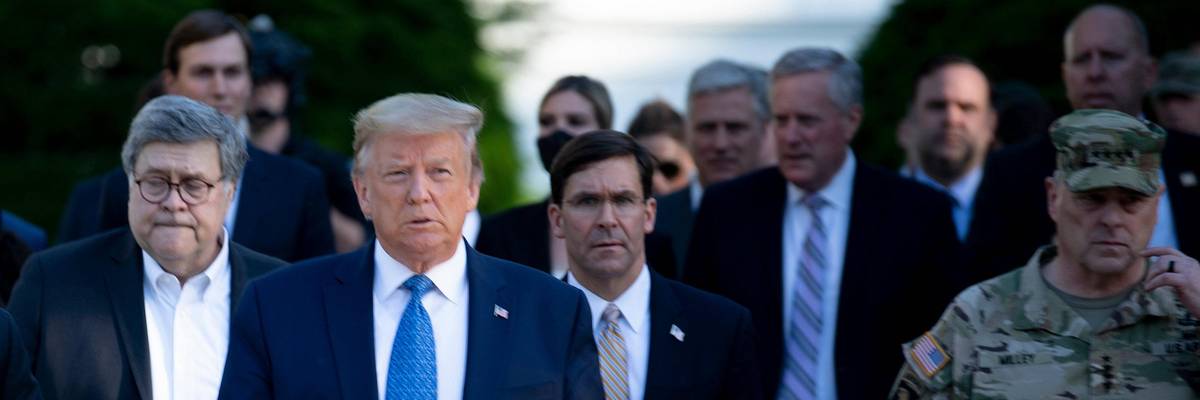
Then-President Donald Trump walks with U.S. Attorney General William Barr (L), Secretary of Defense Mark T. Esper (C), Chairman of the Joint Chiefs of Staff Mark A. Milley (R), and others from the White House to visit St. John's Church after the area was cleared of people protesting the death of George Floyd June 1, 2020, in Washington, DC. (Photo: Brendan Smialowski/AFP via Getty Images)
Former President Donald Trump suggested protesters in Washington, D.C. denouncing police brutality back in the spring of 2020 should be shot, according to former Defense Secretary Mark Esper.
The revelation scooped by Axios Monday comes in Esper's memoir--A Sacred Oath: Memoirs of a Secretary of Defense During Extraordinary Times--to be released May 10.
Referencing the protesters outside the White House the first week of June 2020, Trump asked: "Can't you just shoot them? Just shoot them in the legs or something?"
The moment inside the Oval Office was "surreal," writes Esper, who describes Trump as "red faced and complaining loudly about the protests under way in Washington, D.C."
Esper writes that he wanted to "figure out a way to walk Trump back without creating the mess I was trying to avoid."
The allegation in Esper's memoir mirrors one laid out last year in then-Wall Street Journal reporter Michael Bender's book Frankly, We Did Win This Election: The Inside Story of How Trump Lost.
"Crack their skulls!" Trump told his top law enforcement and military officials as to how to respond to the June 2020 protesters, according to Bender's book.
"Just shoot them," Trump reportedly said multiple times in the Oval Office, Bender's book charges. Then, after pushback from then-Joint Chiefs Chairman Gen. Mark Milley and then-Attorney General William Barr, Trump said, "Well, shoot them in the leg--or maybe the foot."
At the start of June 2020, Trump publicly threatened to use the Insurrection Act of 1807 to deploy the military to U.S. cities to suppress nationwide demonstrations over the police killing of George Floyd.
"If a city or state refuses to take the actions necessary to defend the life and property of their residents, then I will deploy the United States military and quickly solve the problem for them," said Trump.
Days later, Esper rebuffed the then-president's call, saying at a Pentagon press briefing that "the option to use active-duty forces in a law enforcement role should only be used as a matter of last resort, and only in the most urgent and dire of situations."
"We are not in one of those situations now," he said. "I do not support invoking the Insurrection Act."
Five months later, Trump fired Esper, announcing the news in a tweet.
Esper, NPR reported at the time, had "earned the derogatory nickname 'Yesper' for seemingly acquiescing or remaining silent over the president's kneejerk moves. Those ranged from reducing U.S. troops in Afghanistan and Syria with little or no deliberation to stopping Pentagon efforts to rename military bases named after Confederate generals."
The ex-defense chief, however, has rejected the characterization.
This country and this world are at a monumental crossroads. US voters have an opportunity to beat back the forces of fascism and confront the billionaires who are rigging the economy, our media system, and our democracy, making it increasingly impossible for ordinary people to get by. We’re not just talking about the election. We’re talking about what must be done once these fascist elements are vanquished from power. We need a bolder set of solutions than what either major party has so far been willing to offer and a working-class movement ready to fight like hell for it. Trump didn't emerge from nowhere. The conditions that fueled MAGA authoritarianism were created by decades of radical neoliberal economic policies and a corrupt political system dominated by corporate interests. They slashed taxes on the super-rich, promising that the benefits would trickle down. They said giveaways to the corporate titans would make life more affordable for the rest of us. It was all bullshit. And when a bitter, betrayed populace searches for someone to blame, right-wing demagogues have little trouble finding scapegoats. People know when they're being lied to, but you won't hear any of this from the corporate media. Only independent journalism—powered and funded by people who believe in building a better world—can deliver truly trustworthy daily news. If you share our vision, please contribute whatever you can to sustain our work. |
Former President Donald Trump suggested protesters in Washington, D.C. denouncing police brutality back in the spring of 2020 should be shot, according to former Defense Secretary Mark Esper.
The revelation scooped by Axios Monday comes in Esper's memoir--A Sacred Oath: Memoirs of a Secretary of Defense During Extraordinary Times--to be released May 10.
Referencing the protesters outside the White House the first week of June 2020, Trump asked: "Can't you just shoot them? Just shoot them in the legs or something?"
The moment inside the Oval Office was "surreal," writes Esper, who describes Trump as "red faced and complaining loudly about the protests under way in Washington, D.C."
Esper writes that he wanted to "figure out a way to walk Trump back without creating the mess I was trying to avoid."
The allegation in Esper's memoir mirrors one laid out last year in then-Wall Street Journal reporter Michael Bender's book Frankly, We Did Win This Election: The Inside Story of How Trump Lost.
"Crack their skulls!" Trump told his top law enforcement and military officials as to how to respond to the June 2020 protesters, according to Bender's book.
"Just shoot them," Trump reportedly said multiple times in the Oval Office, Bender's book charges. Then, after pushback from then-Joint Chiefs Chairman Gen. Mark Milley and then-Attorney General William Barr, Trump said, "Well, shoot them in the leg--or maybe the foot."
At the start of June 2020, Trump publicly threatened to use the Insurrection Act of 1807 to deploy the military to U.S. cities to suppress nationwide demonstrations over the police killing of George Floyd.
"If a city or state refuses to take the actions necessary to defend the life and property of their residents, then I will deploy the United States military and quickly solve the problem for them," said Trump.
Days later, Esper rebuffed the then-president's call, saying at a Pentagon press briefing that "the option to use active-duty forces in a law enforcement role should only be used as a matter of last resort, and only in the most urgent and dire of situations."
"We are not in one of those situations now," he said. "I do not support invoking the Insurrection Act."
Five months later, Trump fired Esper, announcing the news in a tweet.
Esper, NPR reported at the time, had "earned the derogatory nickname 'Yesper' for seemingly acquiescing or remaining silent over the president's kneejerk moves. Those ranged from reducing U.S. troops in Afghanistan and Syria with little or no deliberation to stopping Pentagon efforts to rename military bases named after Confederate generals."
The ex-defense chief, however, has rejected the characterization.