

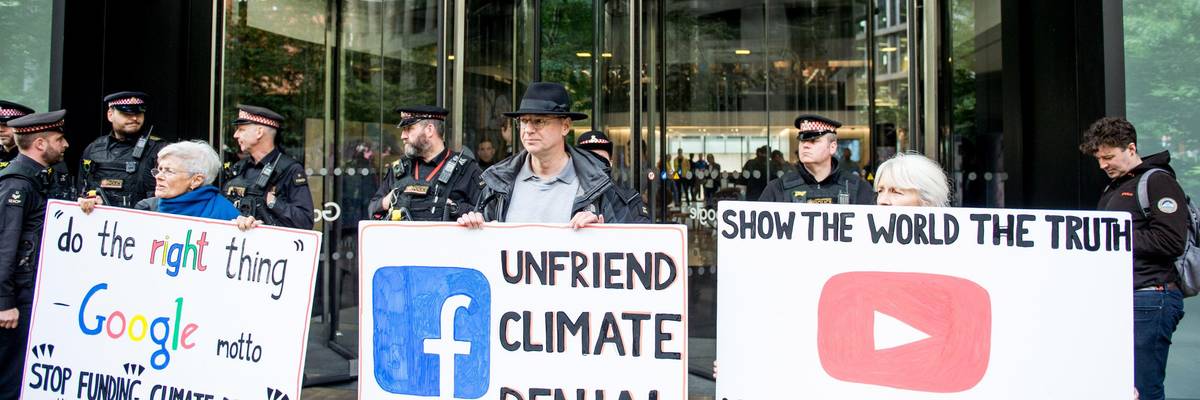
Extinction Rebellion activists protesting outside Google's London offices on October 16, 2019 demand social media companies do more to fight climate change denial. (Photo: Ollie Millington/Getty Images)
Social Media Giants' Climate Misinformation Policies Leave Users 'In the Dark': Report
"Despite half of U.S. and U.K. adults getting their news from social media, social media companies have not taken the steps necessary to fight industry-backed deception," reads the report.
Weeks after the Intergovernmental Panel on Climate Change identified disinformation as a key driver of the planetary crisis, three advocacy groups published a report Wednesday ranking social media companies on their efforts to ensure users can get accurate data about the climate on their platforms--and found that major companies like Twitter and Facebook are failing to combat misinformation.
The report, titled In the Dark: How Social Media Companies' Climate Disinformation Problem is Hidden from the Public and released by Friends of the Earth (FOE), Greenpeace, and online activist network Avaaz, detailed whether the companies have met 27 different benchmarks to stop the spread of anti-science misinformation and ensure transparency about how inaccurate data is analyzed.
"Despite half of U.S. and U.K. adults getting their news from social media, social media companies have not taken the steps necessary to fight industry-backed deception," reads the report. "In fact, they continue to allow these climate lies to pollute users' feeds."
The groups assessed five major social media platforms--Facebook, Twitter, YouTube, Pinterest, and TikTok--and found that the two best-performing companies, Pinterest and YouTube, scored 14 out of the 27 possible points.
As Common Dreams reported earlier this month, Pinterest has won praise from groups including FOE for establishing "clearly defined guidelines against false or misleading climate change information, including conspiracy theories, across content and ads."
"One of the key objectives of this report is to allow for fact-based deliberation, discussion, and debate to flourish in an information ecosystem that is healthy and fair, and that allows both citizens and policymakers to make decisions based on the best available data."
The company also garnered points in Wednesday's report for being the only major social media platform to make clear the average time or views it allows for a piece of scientifically inaccurate content before it will take action to combat the misinformation and including "omission or cherry-picking" of data in its definition of mis- or disinformation.
Pinterest and YouTube were the only companies that won points for consulting with climate scientists to develop a climate mis- and disinformation policy.
The top-performing companies, however, joined the other firms in failing to articulate exactly how their misinformation policy is enforced and to detail how climate misinformation is prioritized for fact-checking.
"Social media companies are largely leaving the public in the dark about their efforts to combat the problem," the report reads. "There is a gross lack of transparency, as these companies conceal much of the data about the prevalence of digital climate dis/misinformation and any internal measures taken to address its spread."
Twitter was the worst-performing company, meeting only five of the 27 criteria.
"Twitter is not clear about how content is verified as dis/misinformation, nor explicit about engaging with climate experts to review dis/misinformation policies or flagged content," reads the report. "Twitter's total lack of reference to climate dis/misinformation, both in their policies and throughout their enforcement reports, earned them no points in either category."
TikTok scored seven points, while Facebook garnered nine.
The report, using criteria developed by the Climate Disinformation Coalition, was released three weeks after NPR reported that inaccurate information about renewable energy sources has been disseminated widely in Facebook groups, and the spread has been linked to slowing progress on or shutting down local projects.
In rural Ohio, posts in two anti-wind power Facebook groups spread misinformation about wind turbines causing birth defects in horses, failing to reduce carbon emissions, and causing so-called "wind turbine syndrome" from low-frequency sounds--a supposed ailment that is not backed by scientific evidence. The posts increased "perceptions of human health and public safety risks related to wind" power, according to a study published last October in the journal Energy Research & Social Science.
As those false perceptions spread through the local community, NPR reported, the Ohio Power Siting Board rejected a wind farm proposal "citing geological concerns and the local opposition."
Misinformation on social media "can really slow down the clean energy transition, and that has just as dire life and death consequences, not just in terms of climate change, but also in terms of air pollution, which overwhelmingly hits communities of color," University of California, Santa Barbara professor Leah Stokes told NPR.
As the IPCC reported in its February report, "rhetoric and misinformation on climate change and the deliberate undermining of science have contributed to misperceptions of the scientific consensus, uncertainty, disregarded risk and urgency, and dissent."
Wednesday's report called on all social media companies to:
- Establish, disclose, and enforce policies to reduce climate change dis- and misinformation;
- Release in full the company's current labeling, fact-checking, policy review, and algorithmic ranking systems related to climate change disinformation policies;
- Disclose weekly reports on the scale and prevalence of climate change dis- and misinformation on the platform and mitigation efforts taken internally; and
- Adopt privacy and data protection policies to protect individuals and communities who may be climate dis/misinformation targets.
"One of the key objectives of this report is to allow for fact-based deliberation, discussion, and debate to flourish in an information ecosystem that is healthy and fair, and that allows both citizens and policymakers to make decisions based on the best available data," reads the report.
"We see a clear boundary between freedom of speech and freedom of reach," it continues, "and believe that transparency on climate dis/misinformation and accountability for the actors who spread it is a precondition for a robust and constructive debate on climate change and the response to the climate crisis."
We are at a crossroads
This country and this world are at a monumental crossroads. In a few short weeks, US voters will have an opportunity to beat back the forces of fascism and confront the billionaires who are rigging the economy, our media system, and our democracy, making it increasingly impossible for ordinary people to get by. We’re not just talking about the election. We’re talking about what must be done once these fascist elements are vanquished from power. We need a bolder set of solutions than what either major party has so far been willing to offer and a working-class movement ready to fight like hell for it. Trump didn't emerge from nowhere. The conditions that fueled MAGA authoritarianism were created by decades of radical neoliberal economic policies and a corrupt political system dominated by corporate interests. They slashed taxes on the super-rich, promising that the benefits would trickle down. They said giveaways to the corporate titans would make life more affordable for the rest of us. It was all bullshit. And when a bitter, betrayed populace searches for someone to blame, right-wing demagogues have little trouble finding scapegoats. People know when they're being lied to, but you won't hear any of this from the corporate media. Only independent journalism—powered and funded by people who believe in building a better world—can deliver truly trustworthy daily news. Our Fall Campaign is underway, and we need your help. To power our newsroom through the rest of the year, we need to raise $125,000 by midnight on October 31. So if you share our vision, please contribute whatever you can to sustain our work. |
Weeks after the Intergovernmental Panel on Climate Change identified disinformation as a key driver of the planetary crisis, three advocacy groups published a report Wednesday ranking social media companies on their efforts to ensure users can get accurate data about the climate on their platforms--and found that major companies like Twitter and Facebook are failing to combat misinformation.
The report, titled In the Dark: How Social Media Companies' Climate Disinformation Problem is Hidden from the Public and released by Friends of the Earth (FOE), Greenpeace, and online activist network Avaaz, detailed whether the companies have met 27 different benchmarks to stop the spread of anti-science misinformation and ensure transparency about how inaccurate data is analyzed.
"Despite half of U.S. and U.K. adults getting their news from social media, social media companies have not taken the steps necessary to fight industry-backed deception," reads the report. "In fact, they continue to allow these climate lies to pollute users' feeds."
The groups assessed five major social media platforms--Facebook, Twitter, YouTube, Pinterest, and TikTok--and found that the two best-performing companies, Pinterest and YouTube, scored 14 out of the 27 possible points.
As Common Dreams reported earlier this month, Pinterest has won praise from groups including FOE for establishing "clearly defined guidelines against false or misleading climate change information, including conspiracy theories, across content and ads."
"One of the key objectives of this report is to allow for fact-based deliberation, discussion, and debate to flourish in an information ecosystem that is healthy and fair, and that allows both citizens and policymakers to make decisions based on the best available data."
The company also garnered points in Wednesday's report for being the only major social media platform to make clear the average time or views it allows for a piece of scientifically inaccurate content before it will take action to combat the misinformation and including "omission or cherry-picking" of data in its definition of mis- or disinformation.
Pinterest and YouTube were the only companies that won points for consulting with climate scientists to develop a climate mis- and disinformation policy.
The top-performing companies, however, joined the other firms in failing to articulate exactly how their misinformation policy is enforced and to detail how climate misinformation is prioritized for fact-checking.
"Social media companies are largely leaving the public in the dark about their efforts to combat the problem," the report reads. "There is a gross lack of transparency, as these companies conceal much of the data about the prevalence of digital climate dis/misinformation and any internal measures taken to address its spread."
Twitter was the worst-performing company, meeting only five of the 27 criteria.
"Twitter is not clear about how content is verified as dis/misinformation, nor explicit about engaging with climate experts to review dis/misinformation policies or flagged content," reads the report. "Twitter's total lack of reference to climate dis/misinformation, both in their policies and throughout their enforcement reports, earned them no points in either category."
TikTok scored seven points, while Facebook garnered nine.
The report, using criteria developed by the Climate Disinformation Coalition, was released three weeks after NPR reported that inaccurate information about renewable energy sources has been disseminated widely in Facebook groups, and the spread has been linked to slowing progress on or shutting down local projects.
In rural Ohio, posts in two anti-wind power Facebook groups spread misinformation about wind turbines causing birth defects in horses, failing to reduce carbon emissions, and causing so-called "wind turbine syndrome" from low-frequency sounds--a supposed ailment that is not backed by scientific evidence. The posts increased "perceptions of human health and public safety risks related to wind" power, according to a study published last October in the journal Energy Research & Social Science.
As those false perceptions spread through the local community, NPR reported, the Ohio Power Siting Board rejected a wind farm proposal "citing geological concerns and the local opposition."
Misinformation on social media "can really slow down the clean energy transition, and that has just as dire life and death consequences, not just in terms of climate change, but also in terms of air pollution, which overwhelmingly hits communities of color," University of California, Santa Barbara professor Leah Stokes told NPR.
As the IPCC reported in its February report, "rhetoric and misinformation on climate change and the deliberate undermining of science have contributed to misperceptions of the scientific consensus, uncertainty, disregarded risk and urgency, and dissent."
Wednesday's report called on all social media companies to:
- Establish, disclose, and enforce policies to reduce climate change dis- and misinformation;
- Release in full the company's current labeling, fact-checking, policy review, and algorithmic ranking systems related to climate change disinformation policies;
- Disclose weekly reports on the scale and prevalence of climate change dis- and misinformation on the platform and mitigation efforts taken internally; and
- Adopt privacy and data protection policies to protect individuals and communities who may be climate dis/misinformation targets.
"One of the key objectives of this report is to allow for fact-based deliberation, discussion, and debate to flourish in an information ecosystem that is healthy and fair, and that allows both citizens and policymakers to make decisions based on the best available data," reads the report.
"We see a clear boundary between freedom of speech and freedom of reach," it continues, "and believe that transparency on climate dis/misinformation and accountability for the actors who spread it is a precondition for a robust and constructive debate on climate change and the response to the climate crisis."
Weeks after the Intergovernmental Panel on Climate Change identified disinformation as a key driver of the planetary crisis, three advocacy groups published a report Wednesday ranking social media companies on their efforts to ensure users can get accurate data about the climate on their platforms--and found that major companies like Twitter and Facebook are failing to combat misinformation.
The report, titled In the Dark: How Social Media Companies' Climate Disinformation Problem is Hidden from the Public and released by Friends of the Earth (FOE), Greenpeace, and online activist network Avaaz, detailed whether the companies have met 27 different benchmarks to stop the spread of anti-science misinformation and ensure transparency about how inaccurate data is analyzed.
"Despite half of U.S. and U.K. adults getting their news from social media, social media companies have not taken the steps necessary to fight industry-backed deception," reads the report. "In fact, they continue to allow these climate lies to pollute users' feeds."
The groups assessed five major social media platforms--Facebook, Twitter, YouTube, Pinterest, and TikTok--and found that the two best-performing companies, Pinterest and YouTube, scored 14 out of the 27 possible points.
As Common Dreams reported earlier this month, Pinterest has won praise from groups including FOE for establishing "clearly defined guidelines against false or misleading climate change information, including conspiracy theories, across content and ads."
"One of the key objectives of this report is to allow for fact-based deliberation, discussion, and debate to flourish in an information ecosystem that is healthy and fair, and that allows both citizens and policymakers to make decisions based on the best available data."
The company also garnered points in Wednesday's report for being the only major social media platform to make clear the average time or views it allows for a piece of scientifically inaccurate content before it will take action to combat the misinformation and including "omission or cherry-picking" of data in its definition of mis- or disinformation.
Pinterest and YouTube were the only companies that won points for consulting with climate scientists to develop a climate mis- and disinformation policy.
The top-performing companies, however, joined the other firms in failing to articulate exactly how their misinformation policy is enforced and to detail how climate misinformation is prioritized for fact-checking.
"Social media companies are largely leaving the public in the dark about their efforts to combat the problem," the report reads. "There is a gross lack of transparency, as these companies conceal much of the data about the prevalence of digital climate dis/misinformation and any internal measures taken to address its spread."
Twitter was the worst-performing company, meeting only five of the 27 criteria.
"Twitter is not clear about how content is verified as dis/misinformation, nor explicit about engaging with climate experts to review dis/misinformation policies or flagged content," reads the report. "Twitter's total lack of reference to climate dis/misinformation, both in their policies and throughout their enforcement reports, earned them no points in either category."
TikTok scored seven points, while Facebook garnered nine.
The report, using criteria developed by the Climate Disinformation Coalition, was released three weeks after NPR reported that inaccurate information about renewable energy sources has been disseminated widely in Facebook groups, and the spread has been linked to slowing progress on or shutting down local projects.
In rural Ohio, posts in two anti-wind power Facebook groups spread misinformation about wind turbines causing birth defects in horses, failing to reduce carbon emissions, and causing so-called "wind turbine syndrome" from low-frequency sounds--a supposed ailment that is not backed by scientific evidence. The posts increased "perceptions of human health and public safety risks related to wind" power, according to a study published last October in the journal Energy Research & Social Science.
As those false perceptions spread through the local community, NPR reported, the Ohio Power Siting Board rejected a wind farm proposal "citing geological concerns and the local opposition."
Misinformation on social media "can really slow down the clean energy transition, and that has just as dire life and death consequences, not just in terms of climate change, but also in terms of air pollution, which overwhelmingly hits communities of color," University of California, Santa Barbara professor Leah Stokes told NPR.
As the IPCC reported in its February report, "rhetoric and misinformation on climate change and the deliberate undermining of science have contributed to misperceptions of the scientific consensus, uncertainty, disregarded risk and urgency, and dissent."
Wednesday's report called on all social media companies to:
- Establish, disclose, and enforce policies to reduce climate change dis- and misinformation;
- Release in full the company's current labeling, fact-checking, policy review, and algorithmic ranking systems related to climate change disinformation policies;
- Disclose weekly reports on the scale and prevalence of climate change dis- and misinformation on the platform and mitigation efforts taken internally; and
- Adopt privacy and data protection policies to protect individuals and communities who may be climate dis/misinformation targets.
"One of the key objectives of this report is to allow for fact-based deliberation, discussion, and debate to flourish in an information ecosystem that is healthy and fair, and that allows both citizens and policymakers to make decisions based on the best available data," reads the report.
"We see a clear boundary between freedom of speech and freedom of reach," it continues, "and believe that transparency on climate dis/misinformation and accountability for the actors who spread it is a precondition for a robust and constructive debate on climate change and the response to the climate crisis."