

SUBSCRIBE TO OUR FREE NEWSLETTER
Daily news & progressive opinion—funded by the people, not the corporations—delivered straight to your inbox.
5
#000000
#FFFFFF
To donate by check, phone, or other method, see our More Ways to Give page.
Daily news & progressive opinion—funded by the people, not the corporations—delivered straight to your inbox.
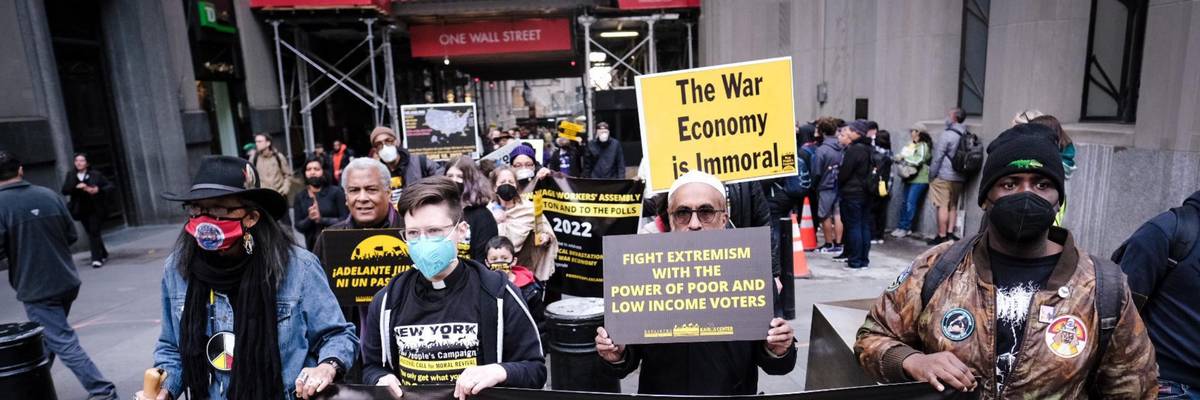
Participants in the Moral March on Wall Street, led by the New York Poor People's Campaign, rally in New York City on April 11, 2022. (Photo: Poor People's Campaign/Twitter)
Demanding a new political discourse in which the poor are no longer blamed for their poverty in the wealthiest nation in history, hundreds of impoverished and low-income activists on Monday rallied in New York City and marched on Wall Street to take their demands directly to the center of U.S. wealth.
"Our politics are trapped in the lies of scarcity to keep alive the lies of trickle-down economics and the lies of neoliberalism, which leave people out."
The Moral March on Wall Street, led by the New York Poor People's Campaign, began at the Museum of the American Indian before heading to the New York Stock Exchange and then Trinity Church Wall Street for a mass meeting where activists and faith leaders spoke.
"We are here to tell the stock exchange and Wall Street to stop trading our lives, that we want living wages and healthcare and clean air and voting rights," Rev. Dr. Liz Theoharis, co-chair of the Poor People's Campaign: A National Call for Moral Revival, said during the march. "And we want them now! And if we don't get them, we'll shut it down."
Addressing the church meeting, Kelly Smith, a tri-chair of the New York Poor People's Campaign, confided: "I worry for my son. I worry that he'll be able to find a living wage. I worry that he lives in a world where his Black skin is valued less than my white skin."
"And I could worry and worry and worry and wring my hands. Or, I could stand up. I could speak up. I could fight," she added. "Well, we are going to stand up. We are going to speak out. And we are going to mobilize for June 18th in Washington, D.C."
That's when Poor People's Campaign co-chair Bishop William J. Barber II, Theoharis, and movement activists from across the United States will hold a Poor People's and Low-Wage Workers' Assembly and Moral March on Washington and the Polls.
More than just a day of action, the event is billed as "a declaration of an ongoing, committed moral movement" to "build power, shift the political narrative, and make real policies to fully address poverty and low wealth from the bottom up."
Speaking Monday in New York, Barber said that "we've got to do this" on June 18 "because our politics are trapped in the lies of scarcity to keep alive the lies of trickle-down economics and the lies of neoliberalism, which leave people out."
Condemning "the false narrative of Christian nationalism and racism and militarism and climate devastation," Barber continued:
You've got a mess. These kinds of politics turn us against each other, blame the poor for their poverty even though we live in the midst of abundance. And we know that poverty is not so much a personal choice as a political consequence of policies. We have the resources to meet the needs of everybody. The only thing we don't have enough of is moral consciousness and the will to do what's right. And that's our job--to shift the moral narrative of this nation.
Marcher Volney Gordon, a Vermonter who has been homeless for 15 years since being priced out of New York City, said at Monday's march that he "became an expert in poverty on these very streets--in the shadow of obscene wealth and amidst the headquarters of institutions that, having built their wealth on the backs of our class, have waged an all-out war on those very same people."
"The ruling class doesn't want us to strategize across lines of division because our strength, the strength of the working class, the poor, is what powers this machine," he added.
Dear Common Dreams reader, It’s been nearly 30 years since I co-founded Common Dreams with my late wife, Lina Newhouser. We had the radical notion that journalism should serve the public good, not corporate profits. It was clear to us from the outset what it would take to build such a project. No paid advertisements. No corporate sponsors. No millionaire publisher telling us what to think or do. Many people said we wouldn't last a year, but we proved those doubters wrong. Together with a tremendous team of journalists and dedicated staff, we built an independent media outlet free from the constraints of profits and corporate control. Our mission has always been simple: To inform. To inspire. To ignite change for the common good. Building Common Dreams was not easy. Our survival was never guaranteed. When you take on the most powerful forces—Wall Street greed, fossil fuel industry destruction, Big Tech lobbyists, and uber-rich oligarchs who have spent billions upon billions rigging the economy and democracy in their favor—the only bulwark you have is supporters who believe in your work. But here’s the urgent message from me today. It's never been this bad out there. And it's never been this hard to keep us going. At the very moment Common Dreams is most needed, the threats we face are intensifying. We need your support now more than ever. We don't accept corporate advertising and never will. We don't have a paywall because we don't think people should be blocked from critical news based on their ability to pay. Everything we do is funded by the donations of readers like you. When everyone does the little they can afford, we are strong. But if that support retreats or dries up, so do we. Will you donate now to make sure Common Dreams not only survives but thrives? —Craig Brown, Co-founder |
Demanding a new political discourse in which the poor are no longer blamed for their poverty in the wealthiest nation in history, hundreds of impoverished and low-income activists on Monday rallied in New York City and marched on Wall Street to take their demands directly to the center of U.S. wealth.
"Our politics are trapped in the lies of scarcity to keep alive the lies of trickle-down economics and the lies of neoliberalism, which leave people out."
The Moral March on Wall Street, led by the New York Poor People's Campaign, began at the Museum of the American Indian before heading to the New York Stock Exchange and then Trinity Church Wall Street for a mass meeting where activists and faith leaders spoke.
"We are here to tell the stock exchange and Wall Street to stop trading our lives, that we want living wages and healthcare and clean air and voting rights," Rev. Dr. Liz Theoharis, co-chair of the Poor People's Campaign: A National Call for Moral Revival, said during the march. "And we want them now! And if we don't get them, we'll shut it down."
Addressing the church meeting, Kelly Smith, a tri-chair of the New York Poor People's Campaign, confided: "I worry for my son. I worry that he'll be able to find a living wage. I worry that he lives in a world where his Black skin is valued less than my white skin."
"And I could worry and worry and worry and wring my hands. Or, I could stand up. I could speak up. I could fight," she added. "Well, we are going to stand up. We are going to speak out. And we are going to mobilize for June 18th in Washington, D.C."
That's when Poor People's Campaign co-chair Bishop William J. Barber II, Theoharis, and movement activists from across the United States will hold a Poor People's and Low-Wage Workers' Assembly and Moral March on Washington and the Polls.
More than just a day of action, the event is billed as "a declaration of an ongoing, committed moral movement" to "build power, shift the political narrative, and make real policies to fully address poverty and low wealth from the bottom up."
Speaking Monday in New York, Barber said that "we've got to do this" on June 18 "because our politics are trapped in the lies of scarcity to keep alive the lies of trickle-down economics and the lies of neoliberalism, which leave people out."
Condemning "the false narrative of Christian nationalism and racism and militarism and climate devastation," Barber continued:
You've got a mess. These kinds of politics turn us against each other, blame the poor for their poverty even though we live in the midst of abundance. And we know that poverty is not so much a personal choice as a political consequence of policies. We have the resources to meet the needs of everybody. The only thing we don't have enough of is moral consciousness and the will to do what's right. And that's our job--to shift the moral narrative of this nation.
Marcher Volney Gordon, a Vermonter who has been homeless for 15 years since being priced out of New York City, said at Monday's march that he "became an expert in poverty on these very streets--in the shadow of obscene wealth and amidst the headquarters of institutions that, having built their wealth on the backs of our class, have waged an all-out war on those very same people."
"The ruling class doesn't want us to strategize across lines of division because our strength, the strength of the working class, the poor, is what powers this machine," he added.
Demanding a new political discourse in which the poor are no longer blamed for their poverty in the wealthiest nation in history, hundreds of impoverished and low-income activists on Monday rallied in New York City and marched on Wall Street to take their demands directly to the center of U.S. wealth.
"Our politics are trapped in the lies of scarcity to keep alive the lies of trickle-down economics and the lies of neoliberalism, which leave people out."
The Moral March on Wall Street, led by the New York Poor People's Campaign, began at the Museum of the American Indian before heading to the New York Stock Exchange and then Trinity Church Wall Street for a mass meeting where activists and faith leaders spoke.
"We are here to tell the stock exchange and Wall Street to stop trading our lives, that we want living wages and healthcare and clean air and voting rights," Rev. Dr. Liz Theoharis, co-chair of the Poor People's Campaign: A National Call for Moral Revival, said during the march. "And we want them now! And if we don't get them, we'll shut it down."
Addressing the church meeting, Kelly Smith, a tri-chair of the New York Poor People's Campaign, confided: "I worry for my son. I worry that he'll be able to find a living wage. I worry that he lives in a world where his Black skin is valued less than my white skin."
"And I could worry and worry and worry and wring my hands. Or, I could stand up. I could speak up. I could fight," she added. "Well, we are going to stand up. We are going to speak out. And we are going to mobilize for June 18th in Washington, D.C."
That's when Poor People's Campaign co-chair Bishop William J. Barber II, Theoharis, and movement activists from across the United States will hold a Poor People's and Low-Wage Workers' Assembly and Moral March on Washington and the Polls.
More than just a day of action, the event is billed as "a declaration of an ongoing, committed moral movement" to "build power, shift the political narrative, and make real policies to fully address poverty and low wealth from the bottom up."
Speaking Monday in New York, Barber said that "we've got to do this" on June 18 "because our politics are trapped in the lies of scarcity to keep alive the lies of trickle-down economics and the lies of neoliberalism, which leave people out."
Condemning "the false narrative of Christian nationalism and racism and militarism and climate devastation," Barber continued:
You've got a mess. These kinds of politics turn us against each other, blame the poor for their poverty even though we live in the midst of abundance. And we know that poverty is not so much a personal choice as a political consequence of policies. We have the resources to meet the needs of everybody. The only thing we don't have enough of is moral consciousness and the will to do what's right. And that's our job--to shift the moral narrative of this nation.
Marcher Volney Gordon, a Vermonter who has been homeless for 15 years since being priced out of New York City, said at Monday's march that he "became an expert in poverty on these very streets--in the shadow of obscene wealth and amidst the headquarters of institutions that, having built their wealth on the backs of our class, have waged an all-out war on those very same people."
"The ruling class doesn't want us to strategize across lines of division because our strength, the strength of the working class, the poor, is what powers this machine," he added.

