SUBSCRIBE TO OUR FREE NEWSLETTER
Daily news & progressive opinion—funded by the people, not the corporations—delivered straight to your inbox.
5
#000000
#FFFFFF
To donate by check, phone, or other method, see our More Ways to Give page.
Daily news & progressive opinion—funded by the people, not the corporations—delivered straight to your inbox.
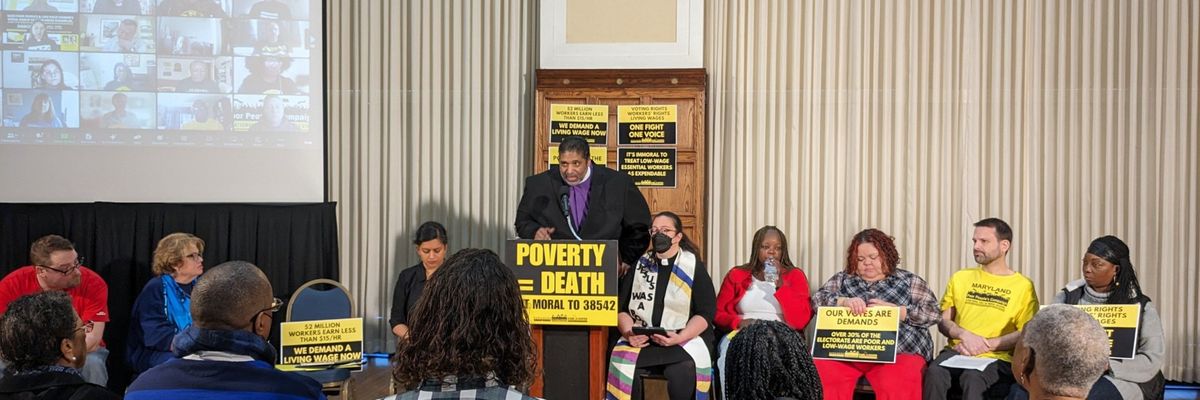
Rev. Dr. William Barber II speaks during the launch of a 2024 election mobilization campaign on February 5, 2024 in Washington, D.C.
"Forty-seven percent of the voters are poor or low-wage," said one activist. "Getting that vote in is very important."
The Poor People's Campaign on Monday launched a 42-week nationwide mobilization of poor and low-income Americans to "wake the sleeping giant" of a voting bloc with the potential to determine the outcome of the 2024 elections.
"It is time for a resurrection and not an insurrection," Poor People's Campaign co-chair Rev. Dr. William Barber II said during a press conference in Washington, D.C. "We must engage poor and low-wealth people to change the political landscape."
"For far too long extremists have blamed poor people and low-wage people for their plight, while moderates too often have ignored poor people, appealing instead to the so-called middle class," he continued. "Meanwhile, poor and low-income people have become nearly half of this country and we are here today to make one thing clear: Poor and low-wage brothers and sisters have the power to determine and decide the 2024 elections and elections beyond."
"Economic justice and saving this democracy are deeply connected."
Poor People's Campaign co-chair Rev. Dr. Liz Theoharis stressed that "economic justice and saving this democracy are deeply connected."
"In this rich nation that has the wherewithal to end poverty tomorrow where there's the political will, we must not overlook the voices and votes of poor and low-income people," she added. "We are mobilizing and organizing, registering and educating people for a movement that votes... for healthcare and debt cancellation. Votes for living wages and strong anti-poverty programs. Votes for fair taxes and demilitarization of our communities and our world. Votes for immigrant rights and more."
Democratic pollster Celinda Lake said at the press conference: "In 2024, the election is going to be about mobilization... Democrats have an enthusiasm gap today and the progressive alliance and Democrats have fissures within their constituencies that make getting out the vote even more important."
"The biggest bloc of potential voters by far is low-income, low-wage voters," Lake noted. "Where the margin of victory is projected to be less than 3% in 2024, 30-45% of the voters are low-wage voters or low-income families... The turnout among low-wage voters and low-income voters today is... 20-22% below the average turnout. This is a huge bloc of voters, and it is a bloc of voters that votes 58-60%—at minimum—progressive, no matter how conservative the state."
"You're talking about a huge number—a game-changing number—of voters," she added.
The campaign's main scheduled events are a Mass Poor People's & Low-Wage Workers' Moral March to State House Assemblies on March 2 and a rally and march in Washington, D.C. on June 15.
"I have been struggling to pay my bills since I've been working at 16 years old. I work full time, 64 hours a week, seven days a week," said Beth Schafer of Raise Up for $15 during a video promoting the new campaign. "I am exhausted."
Crow Roberts, an organizer with the Indiana Poor People's Campaign, said in the video that "our government finds it necessary to ban abortion to say that they are saving our children, but more children die as a result of poverty in this country."
Guadalupe de la Cruz of the Florida Poor People's Campaign asserted that "we should not be cornered and forced to choose between one necessity or another."
Speaking at the press conference, Alabama activist Linda Burns said that "for three years I worked the assembly line at Amazon in Bessemer, Alabama. The work was grueling. We were expected to work like robots, moving like 1,000 pieces per hour."
"I got badly injured. My left arm," she continued. "I had two surgeries. I had to get a third surgery, but I didn't have no more insurance. Amazon, they cut my insurance off a year after. They let me go last October."
"Amazon let me go because I was helping organize the union," said Burns. "We didn't get the union in Alabama but I'm gonna do everything in my power to stand in solidarity. Organizing the union showed me just how many people were in the same situation I was. Not just in Alabama, but all over the world."
"Forty-seven percent of the voters are poor or low-wage. Getting that vote in is very important," she added. "We cannot settle for less, we've got to stand up for our rights. We are forward together—not one step back."
Dear Common Dreams reader, It’s been nearly 30 years since I co-founded Common Dreams with my late wife, Lina Newhouser. We had the radical notion that journalism should serve the public good, not corporate profits. It was clear to us from the outset what it would take to build such a project. No paid advertisements. No corporate sponsors. No millionaire publisher telling us what to think or do. Many people said we wouldn't last a year, but we proved those doubters wrong. Together with a tremendous team of journalists and dedicated staff, we built an independent media outlet free from the constraints of profits and corporate control. Our mission has always been simple: To inform. To inspire. To ignite change for the common good. Building Common Dreams was not easy. Our survival was never guaranteed. When you take on the most powerful forces—Wall Street greed, fossil fuel industry destruction, Big Tech lobbyists, and uber-rich oligarchs who have spent billions upon billions rigging the economy and democracy in their favor—the only bulwark you have is supporters who believe in your work. But here’s the urgent message from me today. It's never been this bad out there. And it's never been this hard to keep us going. At the very moment Common Dreams is most needed, the threats we face are intensifying. We need your support now more than ever. We don't accept corporate advertising and never will. We don't have a paywall because we don't think people should be blocked from critical news based on their ability to pay. Everything we do is funded by the donations of readers like you. When everyone does the little they can afford, we are strong. But if that support retreats or dries up, so do we. Will you donate now to make sure Common Dreams not only survives but thrives? —Craig Brown, Co-founder |
The Poor People's Campaign on Monday launched a 42-week nationwide mobilization of poor and low-income Americans to "wake the sleeping giant" of a voting bloc with the potential to determine the outcome of the 2024 elections.
"It is time for a resurrection and not an insurrection," Poor People's Campaign co-chair Rev. Dr. William Barber II said during a press conference in Washington, D.C. "We must engage poor and low-wealth people to change the political landscape."
"For far too long extremists have blamed poor people and low-wage people for their plight, while moderates too often have ignored poor people, appealing instead to the so-called middle class," he continued. "Meanwhile, poor and low-income people have become nearly half of this country and we are here today to make one thing clear: Poor and low-wage brothers and sisters have the power to determine and decide the 2024 elections and elections beyond."
"Economic justice and saving this democracy are deeply connected."
Poor People's Campaign co-chair Rev. Dr. Liz Theoharis stressed that "economic justice and saving this democracy are deeply connected."
"In this rich nation that has the wherewithal to end poverty tomorrow where there's the political will, we must not overlook the voices and votes of poor and low-income people," she added. "We are mobilizing and organizing, registering and educating people for a movement that votes... for healthcare and debt cancellation. Votes for living wages and strong anti-poverty programs. Votes for fair taxes and demilitarization of our communities and our world. Votes for immigrant rights and more."
Democratic pollster Celinda Lake said at the press conference: "In 2024, the election is going to be about mobilization... Democrats have an enthusiasm gap today and the progressive alliance and Democrats have fissures within their constituencies that make getting out the vote even more important."
"The biggest bloc of potential voters by far is low-income, low-wage voters," Lake noted. "Where the margin of victory is projected to be less than 3% in 2024, 30-45% of the voters are low-wage voters or low-income families... The turnout among low-wage voters and low-income voters today is... 20-22% below the average turnout. This is a huge bloc of voters, and it is a bloc of voters that votes 58-60%—at minimum—progressive, no matter how conservative the state."
"You're talking about a huge number—a game-changing number—of voters," she added.
The campaign's main scheduled events are a Mass Poor People's & Low-Wage Workers' Moral March to State House Assemblies on March 2 and a rally and march in Washington, D.C. on June 15.
"I have been struggling to pay my bills since I've been working at 16 years old. I work full time, 64 hours a week, seven days a week," said Beth Schafer of Raise Up for $15 during a video promoting the new campaign. "I am exhausted."
Crow Roberts, an organizer with the Indiana Poor People's Campaign, said in the video that "our government finds it necessary to ban abortion to say that they are saving our children, but more children die as a result of poverty in this country."
Guadalupe de la Cruz of the Florida Poor People's Campaign asserted that "we should not be cornered and forced to choose between one necessity or another."
Speaking at the press conference, Alabama activist Linda Burns said that "for three years I worked the assembly line at Amazon in Bessemer, Alabama. The work was grueling. We were expected to work like robots, moving like 1,000 pieces per hour."
"I got badly injured. My left arm," she continued. "I had two surgeries. I had to get a third surgery, but I didn't have no more insurance. Amazon, they cut my insurance off a year after. They let me go last October."
"Amazon let me go because I was helping organize the union," said Burns. "We didn't get the union in Alabama but I'm gonna do everything in my power to stand in solidarity. Organizing the union showed me just how many people were in the same situation I was. Not just in Alabama, but all over the world."
"Forty-seven percent of the voters are poor or low-wage. Getting that vote in is very important," she added. "We cannot settle for less, we've got to stand up for our rights. We are forward together—not one step back."
The Poor People's Campaign on Monday launched a 42-week nationwide mobilization of poor and low-income Americans to "wake the sleeping giant" of a voting bloc with the potential to determine the outcome of the 2024 elections.
"It is time for a resurrection and not an insurrection," Poor People's Campaign co-chair Rev. Dr. William Barber II said during a press conference in Washington, D.C. "We must engage poor and low-wealth people to change the political landscape."
"For far too long extremists have blamed poor people and low-wage people for their plight, while moderates too often have ignored poor people, appealing instead to the so-called middle class," he continued. "Meanwhile, poor and low-income people have become nearly half of this country and we are here today to make one thing clear: Poor and low-wage brothers and sisters have the power to determine and decide the 2024 elections and elections beyond."
"Economic justice and saving this democracy are deeply connected."
Poor People's Campaign co-chair Rev. Dr. Liz Theoharis stressed that "economic justice and saving this democracy are deeply connected."
"In this rich nation that has the wherewithal to end poverty tomorrow where there's the political will, we must not overlook the voices and votes of poor and low-income people," she added. "We are mobilizing and organizing, registering and educating people for a movement that votes... for healthcare and debt cancellation. Votes for living wages and strong anti-poverty programs. Votes for fair taxes and demilitarization of our communities and our world. Votes for immigrant rights and more."
Democratic pollster Celinda Lake said at the press conference: "In 2024, the election is going to be about mobilization... Democrats have an enthusiasm gap today and the progressive alliance and Democrats have fissures within their constituencies that make getting out the vote even more important."
"The biggest bloc of potential voters by far is low-income, low-wage voters," Lake noted. "Where the margin of victory is projected to be less than 3% in 2024, 30-45% of the voters are low-wage voters or low-income families... The turnout among low-wage voters and low-income voters today is... 20-22% below the average turnout. This is a huge bloc of voters, and it is a bloc of voters that votes 58-60%—at minimum—progressive, no matter how conservative the state."
"You're talking about a huge number—a game-changing number—of voters," she added.
The campaign's main scheduled events are a Mass Poor People's & Low-Wage Workers' Moral March to State House Assemblies on March 2 and a rally and march in Washington, D.C. on June 15.
"I have been struggling to pay my bills since I've been working at 16 years old. I work full time, 64 hours a week, seven days a week," said Beth Schafer of Raise Up for $15 during a video promoting the new campaign. "I am exhausted."
Crow Roberts, an organizer with the Indiana Poor People's Campaign, said in the video that "our government finds it necessary to ban abortion to say that they are saving our children, but more children die as a result of poverty in this country."
Guadalupe de la Cruz of the Florida Poor People's Campaign asserted that "we should not be cornered and forced to choose between one necessity or another."
Speaking at the press conference, Alabama activist Linda Burns said that "for three years I worked the assembly line at Amazon in Bessemer, Alabama. The work was grueling. We were expected to work like robots, moving like 1,000 pieces per hour."
"I got badly injured. My left arm," she continued. "I had two surgeries. I had to get a third surgery, but I didn't have no more insurance. Amazon, they cut my insurance off a year after. They let me go last October."
"Amazon let me go because I was helping organize the union," said Burns. "We didn't get the union in Alabama but I'm gonna do everything in my power to stand in solidarity. Organizing the union showed me just how many people were in the same situation I was. Not just in Alabama, but all over the world."
"Forty-seven percent of the voters are poor or low-wage. Getting that vote in is very important," she added. "We cannot settle for less, we've got to stand up for our rights. We are forward together—not one step back."