SUBSCRIBE TO OUR FREE NEWSLETTER
Daily news & progressive opinion—funded by the people, not the corporations—delivered straight to your inbox.
5
#000000
#FFFFFF
To donate by check, phone, or other method, see our More Ways to Give page.
Daily news & progressive opinion—funded by the people, not the corporations—delivered straight to your inbox.
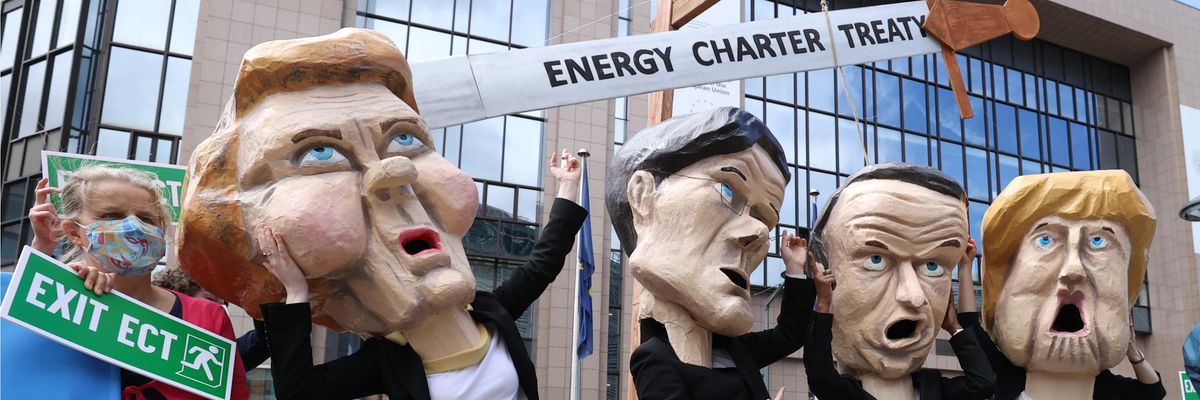
Climate activists stage a demonstration in front of the E.U. Council building to highlight the threat of the Energy Charter Treaty (ECT) to the planet as they wear huge model heads of European Commission President Ursula von der Leyen, Dutch Prime Minister Mark Rutte, French President Emmanuel Macron, and then-German Chancellor Angela Merkel in Brussels, Belgium on July 6, 2021. (Photo: Dursun Aydemir/Anadolu Agency via Getty Images)
Fossil fuel companies in Europe are using an international treaty signed nearly three decades ago to challenge several governments' ability to take climate action--exemplifying why, critics said Monday, the 1994 Energy Charter Treaty is a major impediment to transitioning away from planet-heating fossil fuels and toward renewable energy.
"Time to throw this treaty out."
Under the treaty, companies including RWE and Uniper in Germany and Rockhopper in the United Kingdom are suing the governments of Italy, the Netherlands, Poland, and other countries over their phasing out of coal power plants, requirements for environmental impact assessments, and blocking of extraction projects.
The Energy Charter Treaty was signed by more than 50 countries with the intention of protecting energy investments by individuals and foreign companies in former Soviet states.
Since 2014, when investors in the Moscow-based energy Yukos were awarded $50 billion under the treaty after it was found that Russian President Vladimir Putin had seized their assets, more than two-thirds of cases using the treaty have involved companies suing European Union governments.
The trend, and cases like those currently being argued by the German and British fossil fuel companies, has made the ECT "a major blocker to the shift from fossil fuels," tweeted Climate Action Network Europe.
"It is literally insane that the global fossil fuel phase-out is being actively sabotaged by antiquated treaties and corporate greed," Romain Ioualalen, global policy campaign manager for Oil Change International, said Monday.
The companies are seeking more than $4 billion. RWE's and Uniper's lawsuits center around the Dutch government's decision to phase out the use of coal power by 2030.
A lawyer representing Italy in the case brought by Rockhopper told the Financial Times that a legal victory for the companies would have "extremely serious" consequences and could encourage other companies to "emulate" the oil firm. Italy has stopped Rockhopper from developing an oil field in the Adriatic Sea.
Court hearings under the ECT are kept confidential, and according to the International Institute for Sustainable Development, "the majority of known fossil fuel [investor-state dispute] cases are decided in favor of investors." In investor-state disputes, fossil fuel companies have been awarded an average sum nearly five times more than the amount awarded in non-fossil fuel cases.
The European Commission has proposed a phase-out of ECT protections for fossil fuel firms, but signatories have thus far rejected the idea.
By allowing companies to seek often-secret awards as they challenge governments' right to protect public health and the planet, the ECT undermines "environmental protection and climate" as well as "democracy," said Daniel Lutaaya, a journalist in Uganda.
"Time to throw this treaty out," said Mark Campanale, founder and executive chair of the Carbon Tracker Initiative.
Dear Common Dreams reader, It’s been nearly 30 years since I co-founded Common Dreams with my late wife, Lina Newhouser. We had the radical notion that journalism should serve the public good, not corporate profits. It was clear to us from the outset what it would take to build such a project. No paid advertisements. No corporate sponsors. No millionaire publisher telling us what to think or do. Many people said we wouldn't last a year, but we proved those doubters wrong. Together with a tremendous team of journalists and dedicated staff, we built an independent media outlet free from the constraints of profits and corporate control. Our mission has always been simple: To inform. To inspire. To ignite change for the common good. Building Common Dreams was not easy. Our survival was never guaranteed. When you take on the most powerful forces—Wall Street greed, fossil fuel industry destruction, Big Tech lobbyists, and uber-rich oligarchs who have spent billions upon billions rigging the economy and democracy in their favor—the only bulwark you have is supporters who believe in your work. But here’s the urgent message from me today. It's never been this bad out there. And it's never been this hard to keep us going. At the very moment Common Dreams is most needed, the threats we face are intensifying. We need your support now more than ever. We don't accept corporate advertising and never will. We don't have a paywall because we don't think people should be blocked from critical news based on their ability to pay. Everything we do is funded by the donations of readers like you. When everyone does the little they can afford, we are strong. But if that support retreats or dries up, so do we. Will you donate now to make sure Common Dreams not only survives but thrives? —Craig Brown, Co-founder |
Fossil fuel companies in Europe are using an international treaty signed nearly three decades ago to challenge several governments' ability to take climate action--exemplifying why, critics said Monday, the 1994 Energy Charter Treaty is a major impediment to transitioning away from planet-heating fossil fuels and toward renewable energy.
"Time to throw this treaty out."
Under the treaty, companies including RWE and Uniper in Germany and Rockhopper in the United Kingdom are suing the governments of Italy, the Netherlands, Poland, and other countries over their phasing out of coal power plants, requirements for environmental impact assessments, and blocking of extraction projects.
The Energy Charter Treaty was signed by more than 50 countries with the intention of protecting energy investments by individuals and foreign companies in former Soviet states.
Since 2014, when investors in the Moscow-based energy Yukos were awarded $50 billion under the treaty after it was found that Russian President Vladimir Putin had seized their assets, more than two-thirds of cases using the treaty have involved companies suing European Union governments.
The trend, and cases like those currently being argued by the German and British fossil fuel companies, has made the ECT "a major blocker to the shift from fossil fuels," tweeted Climate Action Network Europe.
"It is literally insane that the global fossil fuel phase-out is being actively sabotaged by antiquated treaties and corporate greed," Romain Ioualalen, global policy campaign manager for Oil Change International, said Monday.
The companies are seeking more than $4 billion. RWE's and Uniper's lawsuits center around the Dutch government's decision to phase out the use of coal power by 2030.
A lawyer representing Italy in the case brought by Rockhopper told the Financial Times that a legal victory for the companies would have "extremely serious" consequences and could encourage other companies to "emulate" the oil firm. Italy has stopped Rockhopper from developing an oil field in the Adriatic Sea.
Court hearings under the ECT are kept confidential, and according to the International Institute for Sustainable Development, "the majority of known fossil fuel [investor-state dispute] cases are decided in favor of investors." In investor-state disputes, fossil fuel companies have been awarded an average sum nearly five times more than the amount awarded in non-fossil fuel cases.
The European Commission has proposed a phase-out of ECT protections for fossil fuel firms, but signatories have thus far rejected the idea.
By allowing companies to seek often-secret awards as they challenge governments' right to protect public health and the planet, the ECT undermines "environmental protection and climate" as well as "democracy," said Daniel Lutaaya, a journalist in Uganda.
"Time to throw this treaty out," said Mark Campanale, founder and executive chair of the Carbon Tracker Initiative.
Fossil fuel companies in Europe are using an international treaty signed nearly three decades ago to challenge several governments' ability to take climate action--exemplifying why, critics said Monday, the 1994 Energy Charter Treaty is a major impediment to transitioning away from planet-heating fossil fuels and toward renewable energy.
"Time to throw this treaty out."
Under the treaty, companies including RWE and Uniper in Germany and Rockhopper in the United Kingdom are suing the governments of Italy, the Netherlands, Poland, and other countries over their phasing out of coal power plants, requirements for environmental impact assessments, and blocking of extraction projects.
The Energy Charter Treaty was signed by more than 50 countries with the intention of protecting energy investments by individuals and foreign companies in former Soviet states.
Since 2014, when investors in the Moscow-based energy Yukos were awarded $50 billion under the treaty after it was found that Russian President Vladimir Putin had seized their assets, more than two-thirds of cases using the treaty have involved companies suing European Union governments.
The trend, and cases like those currently being argued by the German and British fossil fuel companies, has made the ECT "a major blocker to the shift from fossil fuels," tweeted Climate Action Network Europe.
"It is literally insane that the global fossil fuel phase-out is being actively sabotaged by antiquated treaties and corporate greed," Romain Ioualalen, global policy campaign manager for Oil Change International, said Monday.
The companies are seeking more than $4 billion. RWE's and Uniper's lawsuits center around the Dutch government's decision to phase out the use of coal power by 2030.
A lawyer representing Italy in the case brought by Rockhopper told the Financial Times that a legal victory for the companies would have "extremely serious" consequences and could encourage other companies to "emulate" the oil firm. Italy has stopped Rockhopper from developing an oil field in the Adriatic Sea.
Court hearings under the ECT are kept confidential, and according to the International Institute for Sustainable Development, "the majority of known fossil fuel [investor-state dispute] cases are decided in favor of investors." In investor-state disputes, fossil fuel companies have been awarded an average sum nearly five times more than the amount awarded in non-fossil fuel cases.
The European Commission has proposed a phase-out of ECT protections for fossil fuel firms, but signatories have thus far rejected the idea.
By allowing companies to seek often-secret awards as they challenge governments' right to protect public health and the planet, the ECT undermines "environmental protection and climate" as well as "democracy," said Daniel Lutaaya, a journalist in Uganda.
"Time to throw this treaty out," said Mark Campanale, founder and executive chair of the Carbon Tracker Initiative.