

SUBSCRIBE TO OUR FREE NEWSLETTER
Daily news & progressive opinion—funded by the people, not the corporations—delivered straight to your inbox.
5
#000000
#FFFFFF
To donate by check, phone, or other method, see our More Ways to Give page.
Daily news & progressive opinion—funded by the people, not the corporations—delivered straight to your inbox.
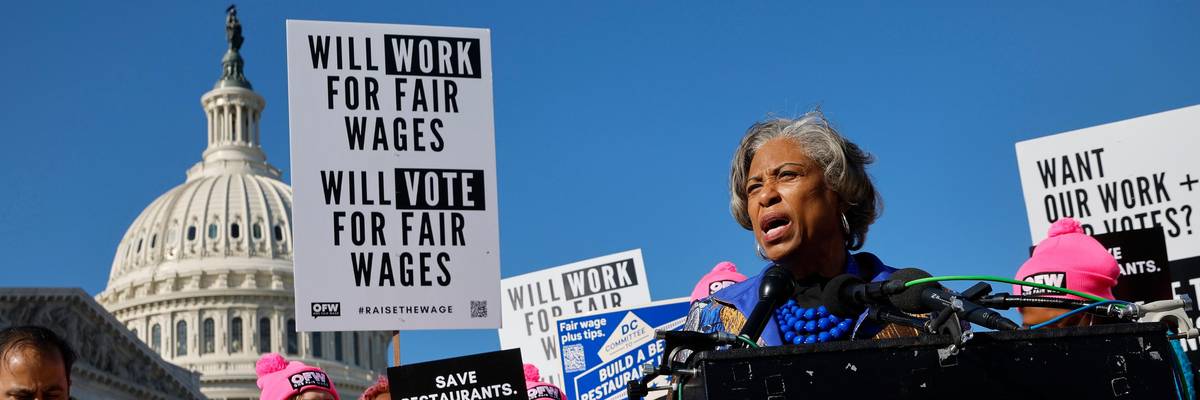
Rep. Brenda Lawrence (D-Mich.) rallies with restaurant workers and owners outside the U.S. Capitol on February 8, 2022 in Washington, D.C. (Photo: Chip Somodevilla/Getty Images)
An alliance of grassroots advocacy groups, progressive lawmakers, and high-profile celebrities kicked off a new $25 million campaign Monday with the goal of ending the subminimum wage and raising the base pay of millions of workers in 25 U.S. states, from Michigan to Massachusetts to California.
"A strong majority of all Americans support ending the subminimum wage and raising the overall minimum wage."
Deliberately launched to coincide with Valentine's Day--one of the most profitable days of the year for the low-paying restaurant industry--the initiative aims to mobilize support for ballot measures and legislation that would hike state-level hourly wages and end deeply rooted and discriminatory tipped minimums, which are set at the federal level of $2.13 an hour in 16 states.
The campaign hopes to achieve its goals by 2026, the 250th anniversary of the nation's founding.
Angela Glover Blackwell, founder in residence at PolicyLink, said Monday that people across the U.S. "overwhelmingly agree that we should face and fix our nation's history of racial justice."
"That includes, for instance, the subminimum wage--a direct legacy of slavery where white owners didn't want to pay newly freed Black workers and so invented the idea that customers would pay workers instead through tips," said Blackwell. "It remains policy today in 43 states and at the federal level, where the subminimum wage is just $2.13 an hour."
"Nationwide," Blackwell added, "a strong majority of all Americans support ending the subminimum wage and raising the overall minimum wage to $15 an hour with tips on top."
Led by One Fair Wage and supported by the Patriotic Millionaires, the ACLU, actress and activist Jane Fonda, Rep. Pramila Jayapal (D-Wash.), and others, the new effort to secure much-needed wage hikes across the country comes at a period of tumult for U.S. workers, many of whom have been forced by their low-paying employers to endure unsafe conditions and grueling hours throughout the coronavirus pandemic.
The restaurant industry, in particular, has seen overburdened and exploited workers quit at historic rates, compelling some companies to offer better pay and benefits to hold onto and lure employees back.
"Since 2009, the cost of living has skyrocketed, while the federal minimum wage remains at a starvation wage of $7.25."
"It's a historic moment," Saru Jayaraman, president of One Fair Wage, said Monday. "The subminimum wage for tipped workers was created at Emancipation; it's taken 150 years and a global pandemic for tipped workers to refuse to work for subminimum wages en masse."
"It's time for states--and the policymakers who represent them--to follow the lead of millions of workers refusing to work for poverty wages and thousands of independent restaurants raising wages to recruit staff, and permanently raise wages and end subminimum wages once and for all," Jayaraman added. "This is the only future for the service sector and the economy overall: wages must go up or there will be no future."
While wages have ticked up since 2020 as workers exert newfound leverage, modest gains have largely been eaten away by soaring inflation.
The federal minimum wage--which still prevails in seven states--has not been increased since 2009, when it was boosted from $6.55 to $7.25 an hour. Since then, according to economist Dean Baker, the federal minimum has lost nearly 30% of its purchasing power to inflation.
The new state-focused minimum wage push comes after right-wing Democrats and Republicans in Congress last year blocked a legislative proposal to gradually raise the federal minimum wage to $15 an hour. In the absence of federal action, a record-breaking 81 jurisdictions across the U.S. are set to raise their minimum wages in 2022.
"America isn't often united around major policy shifts--but on at least one thing we agree: millions of working people in both red and blue states understand the need for a living wage," said investor and anti-poverty activist Joe Sanberg, who is leading the effort to get an $18-an-hour minimum wage proposal on the California ballot in November.
"Since 2009, the cost of living has skyrocketed, while the federal minimum wage remains at a starvation wage of $7.25," Sanberg noted. "In a consumer economy, a living wage isn't just a moral imperative--it is a political priority. Until Congress decides to act for the betterment of the American people, we'll make the change for ourselves, and bring ballot measures to raise the minimum wage to states all over the country."
The campaign will initially focus its attention on building grassroots support for proposed ballot measures in Washington, D.C., Michigan, and California as well as backing ongoing legislative efforts in Illinois, Massachusetts, and New York.
"Hard-working Americans have been left behind for far too long, and this pandemic has only worsened that problem," Rep. Brenda Lawrence (D-Mich.), a campaign supporter, said Monday. "Raising the minimum wage to $15 is long overdue."
"This increase will significantly help our workers recover while also reducing racial and gender inequality," Lawrence added. "This is a top priority in the fight for economic justice. During a time when so many are struggling, raising the wage and ending the subminimum wage are strong steps to helping countless Americans, especially women and people of color, across the country."
Dear Common Dreams reader, It’s been nearly 30 years since I co-founded Common Dreams with my late wife, Lina Newhouser. We had the radical notion that journalism should serve the public good, not corporate profits. It was clear to us from the outset what it would take to build such a project. No paid advertisements. No corporate sponsors. No millionaire publisher telling us what to think or do. Many people said we wouldn't last a year, but we proved those doubters wrong. Together with a tremendous team of journalists and dedicated staff, we built an independent media outlet free from the constraints of profits and corporate control. Our mission has always been simple: To inform. To inspire. To ignite change for the common good. Building Common Dreams was not easy. Our survival was never guaranteed. When you take on the most powerful forces—Wall Street greed, fossil fuel industry destruction, Big Tech lobbyists, and uber-rich oligarchs who have spent billions upon billions rigging the economy and democracy in their favor—the only bulwark you have is supporters who believe in your work. But here’s the urgent message from me today. It's never been this bad out there. And it's never been this hard to keep us going. At the very moment Common Dreams is most needed, the threats we face are intensifying. We need your support now more than ever. We don't accept corporate advertising and never will. We don't have a paywall because we don't think people should be blocked from critical news based on their ability to pay. Everything we do is funded by the donations of readers like you. When everyone does the little they can afford, we are strong. But if that support retreats or dries up, so do we. Will you donate now to make sure Common Dreams not only survives but thrives? —Craig Brown, Co-founder |
An alliance of grassroots advocacy groups, progressive lawmakers, and high-profile celebrities kicked off a new $25 million campaign Monday with the goal of ending the subminimum wage and raising the base pay of millions of workers in 25 U.S. states, from Michigan to Massachusetts to California.
"A strong majority of all Americans support ending the subminimum wage and raising the overall minimum wage."
Deliberately launched to coincide with Valentine's Day--one of the most profitable days of the year for the low-paying restaurant industry--the initiative aims to mobilize support for ballot measures and legislation that would hike state-level hourly wages and end deeply rooted and discriminatory tipped minimums, which are set at the federal level of $2.13 an hour in 16 states.
The campaign hopes to achieve its goals by 2026, the 250th anniversary of the nation's founding.
Angela Glover Blackwell, founder in residence at PolicyLink, said Monday that people across the U.S. "overwhelmingly agree that we should face and fix our nation's history of racial justice."
"That includes, for instance, the subminimum wage--a direct legacy of slavery where white owners didn't want to pay newly freed Black workers and so invented the idea that customers would pay workers instead through tips," said Blackwell. "It remains policy today in 43 states and at the federal level, where the subminimum wage is just $2.13 an hour."
"Nationwide," Blackwell added, "a strong majority of all Americans support ending the subminimum wage and raising the overall minimum wage to $15 an hour with tips on top."
Led by One Fair Wage and supported by the Patriotic Millionaires, the ACLU, actress and activist Jane Fonda, Rep. Pramila Jayapal (D-Wash.), and others, the new effort to secure much-needed wage hikes across the country comes at a period of tumult for U.S. workers, many of whom have been forced by their low-paying employers to endure unsafe conditions and grueling hours throughout the coronavirus pandemic.
The restaurant industry, in particular, has seen overburdened and exploited workers quit at historic rates, compelling some companies to offer better pay and benefits to hold onto and lure employees back.
"Since 2009, the cost of living has skyrocketed, while the federal minimum wage remains at a starvation wage of $7.25."
"It's a historic moment," Saru Jayaraman, president of One Fair Wage, said Monday. "The subminimum wage for tipped workers was created at Emancipation; it's taken 150 years and a global pandemic for tipped workers to refuse to work for subminimum wages en masse."
"It's time for states--and the policymakers who represent them--to follow the lead of millions of workers refusing to work for poverty wages and thousands of independent restaurants raising wages to recruit staff, and permanently raise wages and end subminimum wages once and for all," Jayaraman added. "This is the only future for the service sector and the economy overall: wages must go up or there will be no future."
While wages have ticked up since 2020 as workers exert newfound leverage, modest gains have largely been eaten away by soaring inflation.
The federal minimum wage--which still prevails in seven states--has not been increased since 2009, when it was boosted from $6.55 to $7.25 an hour. Since then, according to economist Dean Baker, the federal minimum has lost nearly 30% of its purchasing power to inflation.
The new state-focused minimum wage push comes after right-wing Democrats and Republicans in Congress last year blocked a legislative proposal to gradually raise the federal minimum wage to $15 an hour. In the absence of federal action, a record-breaking 81 jurisdictions across the U.S. are set to raise their minimum wages in 2022.
"America isn't often united around major policy shifts--but on at least one thing we agree: millions of working people in both red and blue states understand the need for a living wage," said investor and anti-poverty activist Joe Sanberg, who is leading the effort to get an $18-an-hour minimum wage proposal on the California ballot in November.
"Since 2009, the cost of living has skyrocketed, while the federal minimum wage remains at a starvation wage of $7.25," Sanberg noted. "In a consumer economy, a living wage isn't just a moral imperative--it is a political priority. Until Congress decides to act for the betterment of the American people, we'll make the change for ourselves, and bring ballot measures to raise the minimum wage to states all over the country."
The campaign will initially focus its attention on building grassroots support for proposed ballot measures in Washington, D.C., Michigan, and California as well as backing ongoing legislative efforts in Illinois, Massachusetts, and New York.
"Hard-working Americans have been left behind for far too long, and this pandemic has only worsened that problem," Rep. Brenda Lawrence (D-Mich.), a campaign supporter, said Monday. "Raising the minimum wage to $15 is long overdue."
"This increase will significantly help our workers recover while also reducing racial and gender inequality," Lawrence added. "This is a top priority in the fight for economic justice. During a time when so many are struggling, raising the wage and ending the subminimum wage are strong steps to helping countless Americans, especially women and people of color, across the country."
An alliance of grassroots advocacy groups, progressive lawmakers, and high-profile celebrities kicked off a new $25 million campaign Monday with the goal of ending the subminimum wage and raising the base pay of millions of workers in 25 U.S. states, from Michigan to Massachusetts to California.
"A strong majority of all Americans support ending the subminimum wage and raising the overall minimum wage."
Deliberately launched to coincide with Valentine's Day--one of the most profitable days of the year for the low-paying restaurant industry--the initiative aims to mobilize support for ballot measures and legislation that would hike state-level hourly wages and end deeply rooted and discriminatory tipped minimums, which are set at the federal level of $2.13 an hour in 16 states.
The campaign hopes to achieve its goals by 2026, the 250th anniversary of the nation's founding.
Angela Glover Blackwell, founder in residence at PolicyLink, said Monday that people across the U.S. "overwhelmingly agree that we should face and fix our nation's history of racial justice."
"That includes, for instance, the subminimum wage--a direct legacy of slavery where white owners didn't want to pay newly freed Black workers and so invented the idea that customers would pay workers instead through tips," said Blackwell. "It remains policy today in 43 states and at the federal level, where the subminimum wage is just $2.13 an hour."
"Nationwide," Blackwell added, "a strong majority of all Americans support ending the subminimum wage and raising the overall minimum wage to $15 an hour with tips on top."
Led by One Fair Wage and supported by the Patriotic Millionaires, the ACLU, actress and activist Jane Fonda, Rep. Pramila Jayapal (D-Wash.), and others, the new effort to secure much-needed wage hikes across the country comes at a period of tumult for U.S. workers, many of whom have been forced by their low-paying employers to endure unsafe conditions and grueling hours throughout the coronavirus pandemic.
The restaurant industry, in particular, has seen overburdened and exploited workers quit at historic rates, compelling some companies to offer better pay and benefits to hold onto and lure employees back.
"Since 2009, the cost of living has skyrocketed, while the federal minimum wage remains at a starvation wage of $7.25."
"It's a historic moment," Saru Jayaraman, president of One Fair Wage, said Monday. "The subminimum wage for tipped workers was created at Emancipation; it's taken 150 years and a global pandemic for tipped workers to refuse to work for subminimum wages en masse."
"It's time for states--and the policymakers who represent them--to follow the lead of millions of workers refusing to work for poverty wages and thousands of independent restaurants raising wages to recruit staff, and permanently raise wages and end subminimum wages once and for all," Jayaraman added. "This is the only future for the service sector and the economy overall: wages must go up or there will be no future."
While wages have ticked up since 2020 as workers exert newfound leverage, modest gains have largely been eaten away by soaring inflation.
The federal minimum wage--which still prevails in seven states--has not been increased since 2009, when it was boosted from $6.55 to $7.25 an hour. Since then, according to economist Dean Baker, the federal minimum has lost nearly 30% of its purchasing power to inflation.
The new state-focused minimum wage push comes after right-wing Democrats and Republicans in Congress last year blocked a legislative proposal to gradually raise the federal minimum wage to $15 an hour. In the absence of federal action, a record-breaking 81 jurisdictions across the U.S. are set to raise their minimum wages in 2022.
"America isn't often united around major policy shifts--but on at least one thing we agree: millions of working people in both red and blue states understand the need for a living wage," said investor and anti-poverty activist Joe Sanberg, who is leading the effort to get an $18-an-hour minimum wage proposal on the California ballot in November.
"Since 2009, the cost of living has skyrocketed, while the federal minimum wage remains at a starvation wage of $7.25," Sanberg noted. "In a consumer economy, a living wage isn't just a moral imperative--it is a political priority. Until Congress decides to act for the betterment of the American people, we'll make the change for ourselves, and bring ballot measures to raise the minimum wage to states all over the country."
The campaign will initially focus its attention on building grassroots support for proposed ballot measures in Washington, D.C., Michigan, and California as well as backing ongoing legislative efforts in Illinois, Massachusetts, and New York.
"Hard-working Americans have been left behind for far too long, and this pandemic has only worsened that problem," Rep. Brenda Lawrence (D-Mich.), a campaign supporter, said Monday. "Raising the minimum wage to $15 is long overdue."
"This increase will significantly help our workers recover while also reducing racial and gender inequality," Lawrence added. "This is a top priority in the fight for economic justice. During a time when so many are struggling, raising the wage and ending the subminimum wage are strong steps to helping countless Americans, especially women and people of color, across the country."

