SUBSCRIBE TO OUR FREE NEWSLETTER
Daily news & progressive opinion—funded by the people, not the corporations—delivered straight to your inbox.
5
#000000
#FFFFFF
To donate by check, phone, or other method, see our More Ways to Give page.
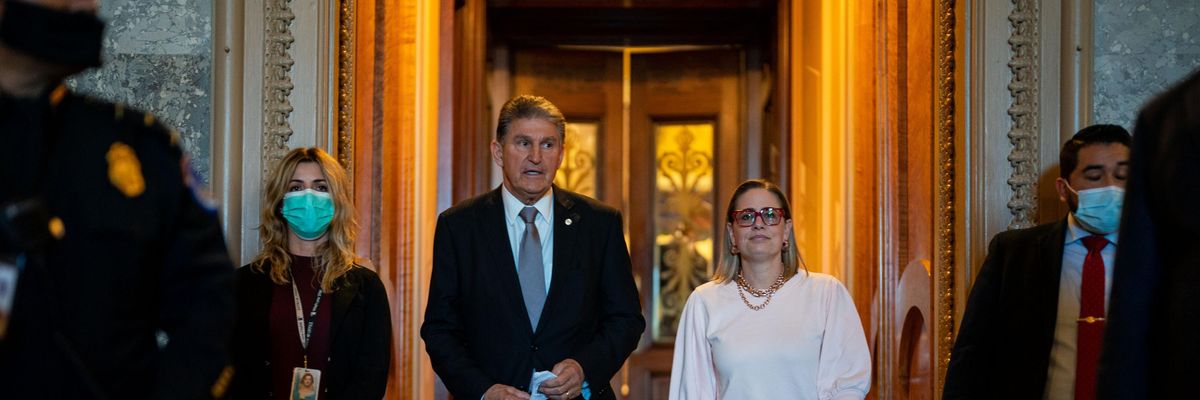
Just hours ahead of a pivotal Senate showdown over voting rights and the legislative filibuster, Sen. Bernie Sanders on Monday focused his attention on the two primary internal obstacles to the Democratic Party's success on both fronts: right-wing Sens. Joe Manchin and Kyrsten Sinema.
"As the voting rights bill finally comes to the floor of the Senate, there is only one vote which will really matter," Sanders (I-Vt.) argued in a Twitter post. "Will 50 Democrats vote to override the filibuster, protect American democracy, and pass the bill, or will Manchin and Sinema vote with the GOP and let the bill die?"
Sanders' question came on the eve of Senate Democrats' expected effort to debate and push through voting rights legislation that the GOP has blocked for months using the 60-vote filibuster rule, which--in an evenly divided upper chamber--gives the minority party veto power over most bills.
If Republicans obstruct a final vote on the Freedom to Vote: John R. Lewis Act--a combination of Democrats' two key voting rights measures--Majority Leader Chuck Schumer (D-N.Y.) has vowed to press ahead with an attempt to change the Senate rules, a move that would require the support of all 50 members of the Democratic caucus. A vote on Senate rules is expected as early as Wednesday.
Last week, as Common Dreams reported, both Manchin (D-W.Va.) and Sinema (D-Ariz.) said they would not weaken the 60-vote threshold even to pass legislation that would help thwart GOP-led disenfranchisement efforts across the country.
Related Content

Marking Martin Luther King Jr. Day, activists on Monday marched and rallied in Washington, D.C. to demand that Manchin and Sinema drop their support for the Senate filibuster, which has long been used to block progress on civil rights.
"Today is not just a holiday; it's a call to action on voting rights," said LaTosha Brown, co-founder of Black Voters Matter. "If Senate Majority Leader Schumer and the rest of Senate Democrats really want to honor Dr. King's legacy, then they must pass federal voting rights legislation immediately. And if the Republicans continue to perpetrate the big lie and aid in this slow-motion insurrection, the Senate Democrats must go it alone and carve out an exception to the filibuster to pass the legislation now."
Sen. Raphael Warnock (D-Ga.), an outspoken proponent of filibuster reform, tweeted Monday that "you cannot remember Dr. King and dismember his legacy at the same time."
"To celebrate him," Warnock wrote, "is to support voting rights, a livable wage, and healthcare."
Over the course of 2021, Republican-led state legislatures passed an estimated 34 laws restricting ballot access, and more than 440 voter suppression measures were introduced.
If passed, the Freedom to Vote: John R. Lewis Act would negate parts of the new GOP-authored laws by bolstering voter protections at the federal level. But activists fear that congressional Democrats might already be too late to enact reforms before the 2022 midterms, in which Republicans are widely favored to take back the House.
In an interview with the New York Times late last week, Sanders warned that the Democratic majority's failure to get voting rights and other key priorities across the finish line has "demoralized" voters, imperiling the party's prospects in upcoming elections.
"They're asking, 'What do the Democrats stand for?'" Sanders, the chair of the Senate Budget Committee, said of voters. "Clearly, the current strategy is failing and we need a major course correction."
"In my view, we are not going to win the elections in 2022 unless our base is energized and ordinary people understand what we are fighting for, and how we are different than the Republicans," he added. "That's not the case now."
Just hours ahead of a pivotal Senate showdown over voting rights and the legislative filibuster, Sen. Bernie Sanders on Monday focused his attention on the two primary internal obstacles to the Democratic Party's success on both fronts: right-wing Sens. Joe Manchin and Kyrsten Sinema.
"As the voting rights bill finally comes to the floor of the Senate, there is only one vote which will really matter," Sanders (I-Vt.) argued in a Twitter post. "Will 50 Democrats vote to override the filibuster, protect American democracy, and pass the bill, or will Manchin and Sinema vote with the GOP and let the bill die?"
Sanders' question came on the eve of Senate Democrats' expected effort to debate and push through voting rights legislation that the GOP has blocked for months using the 60-vote filibuster rule, which--in an evenly divided upper chamber--gives the minority party veto power over most bills.
If Republicans obstruct a final vote on the Freedom to Vote: John R. Lewis Act--a combination of Democrats' two key voting rights measures--Majority Leader Chuck Schumer (D-N.Y.) has vowed to press ahead with an attempt to change the Senate rules, a move that would require the support of all 50 members of the Democratic caucus. A vote on Senate rules is expected as early as Wednesday.
Last week, as Common Dreams reported, both Manchin (D-W.Va.) and Sinema (D-Ariz.) said they would not weaken the 60-vote threshold even to pass legislation that would help thwart GOP-led disenfranchisement efforts across the country.
Related Content
Marking Martin Luther King Jr. Day, activists on Monday marched and rallied in Washington, D.C. to demand that Manchin and Sinema drop their support for the Senate filibuster, which has long been used to block progress on civil rights.
"Today is not just a holiday; it's a call to action on voting rights," said LaTosha Brown, co-founder of Black Voters Matter. "If Senate Majority Leader Schumer and the rest of Senate Democrats really want to honor Dr. King's legacy, then they must pass federal voting rights legislation immediately. And if the Republicans continue to perpetrate the big lie and aid in this slow-motion insurrection, the Senate Democrats must go it alone and carve out an exception to the filibuster to pass the legislation now."
Sen. Raphael Warnock (D-Ga.), an outspoken proponent of filibuster reform, tweeted Monday that "you cannot remember Dr. King and dismember his legacy at the same time."
"To celebrate him," Warnock wrote, "is to support voting rights, a livable wage, and healthcare."
Over the course of 2021, Republican-led state legislatures passed an estimated 34 laws restricting ballot access, and more than 440 voter suppression measures were introduced.
If passed, the Freedom to Vote: John R. Lewis Act would negate parts of the new GOP-authored laws by bolstering voter protections at the federal level. But activists fear that congressional Democrats might already be too late to enact reforms before the 2022 midterms, in which Republicans are widely favored to take back the House.
In an interview with the New York Times late last week, Sanders warned that the Democratic majority's failure to get voting rights and other key priorities across the finish line has "demoralized" voters, imperiling the party's prospects in upcoming elections.
"They're asking, 'What do the Democrats stand for?'" Sanders, the chair of the Senate Budget Committee, said of voters. "Clearly, the current strategy is failing and we need a major course correction."
"In my view, we are not going to win the elections in 2022 unless our base is energized and ordinary people understand what we are fighting for, and how we are different than the Republicans," he added. "That's not the case now."
Just hours ahead of a pivotal Senate showdown over voting rights and the legislative filibuster, Sen. Bernie Sanders on Monday focused his attention on the two primary internal obstacles to the Democratic Party's success on both fronts: right-wing Sens. Joe Manchin and Kyrsten Sinema.
"As the voting rights bill finally comes to the floor of the Senate, there is only one vote which will really matter," Sanders (I-Vt.) argued in a Twitter post. "Will 50 Democrats vote to override the filibuster, protect American democracy, and pass the bill, or will Manchin and Sinema vote with the GOP and let the bill die?"
Sanders' question came on the eve of Senate Democrats' expected effort to debate and push through voting rights legislation that the GOP has blocked for months using the 60-vote filibuster rule, which--in an evenly divided upper chamber--gives the minority party veto power over most bills.
If Republicans obstruct a final vote on the Freedom to Vote: John R. Lewis Act--a combination of Democrats' two key voting rights measures--Majority Leader Chuck Schumer (D-N.Y.) has vowed to press ahead with an attempt to change the Senate rules, a move that would require the support of all 50 members of the Democratic caucus. A vote on Senate rules is expected as early as Wednesday.
Last week, as Common Dreams reported, both Manchin (D-W.Va.) and Sinema (D-Ariz.) said they would not weaken the 60-vote threshold even to pass legislation that would help thwart GOP-led disenfranchisement efforts across the country.
Related Content
Marking Martin Luther King Jr. Day, activists on Monday marched and rallied in Washington, D.C. to demand that Manchin and Sinema drop their support for the Senate filibuster, which has long been used to block progress on civil rights.
"Today is not just a holiday; it's a call to action on voting rights," said LaTosha Brown, co-founder of Black Voters Matter. "If Senate Majority Leader Schumer and the rest of Senate Democrats really want to honor Dr. King's legacy, then they must pass federal voting rights legislation immediately. And if the Republicans continue to perpetrate the big lie and aid in this slow-motion insurrection, the Senate Democrats must go it alone and carve out an exception to the filibuster to pass the legislation now."
Sen. Raphael Warnock (D-Ga.), an outspoken proponent of filibuster reform, tweeted Monday that "you cannot remember Dr. King and dismember his legacy at the same time."
"To celebrate him," Warnock wrote, "is to support voting rights, a livable wage, and healthcare."
Over the course of 2021, Republican-led state legislatures passed an estimated 34 laws restricting ballot access, and more than 440 voter suppression measures were introduced.
If passed, the Freedom to Vote: John R. Lewis Act would negate parts of the new GOP-authored laws by bolstering voter protections at the federal level. But activists fear that congressional Democrats might already be too late to enact reforms before the 2022 midterms, in which Republicans are widely favored to take back the House.
In an interview with the New York Times late last week, Sanders warned that the Democratic majority's failure to get voting rights and other key priorities across the finish line has "demoralized" voters, imperiling the party's prospects in upcoming elections.
"They're asking, 'What do the Democrats stand for?'" Sanders, the chair of the Senate Budget Committee, said of voters. "Clearly, the current strategy is failing and we need a major course correction."
"In my view, we are not going to win the elections in 2022 unless our base is energized and ordinary people understand what we are fighting for, and how we are different than the Republicans," he added. "That's not the case now."