

SUBSCRIBE TO OUR FREE NEWSLETTER
Daily news & progressive opinion—funded by the people, not the corporations—delivered straight to your inbox.
5
#000000
#FFFFFF
To donate by check, phone, or other method, see our More Ways to Give page.
Daily news & progressive opinion—funded by the people, not the corporations—delivered straight to your inbox.
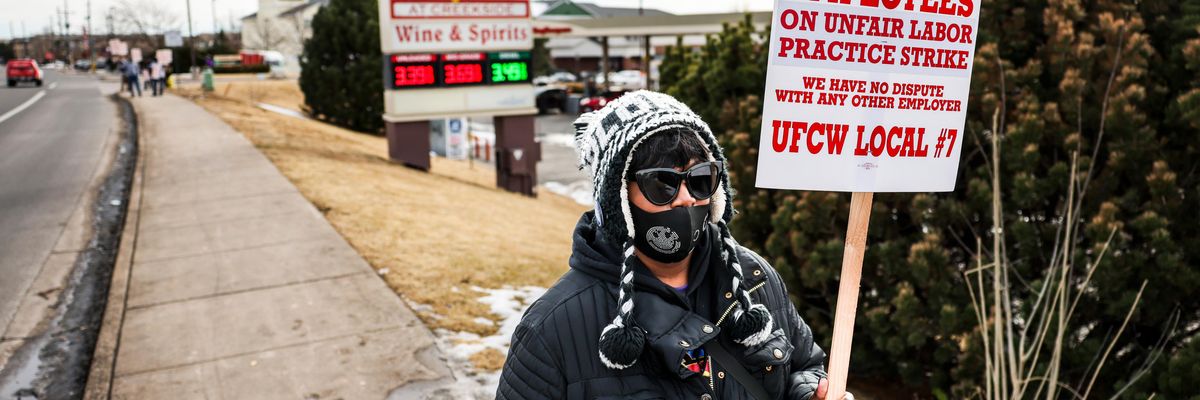
King Soopers employee Susan Hester, who has worked for the grocery chain for 18 years, walks the picket line during a strike on January 12, 2022 in Glendale, Colorado. (Photo: Michael Ciaglo/Getty Images)
On the heels of a new report showing significant financial insecurity, including homelessness, among workers at Kroger grocery stores, more than 8,000 of the chain's employees in Colorado went on strike Wednesday to demand fair wages and better healthcare benefits.
"The companies were thriving, but our workers didn't thrive. Know what our workers got? Covid. Attacked. Beat up. Spit on. Slapped. Overworked. And the company? They did great."
Amid a recent wave of successful strikes at companies including John Deere and Kellogg's, the work stoppage is taking place at nearly 80 King Sooper grocery stores, which are owned by the Kroger Company, across the Denver metropolitan area. According to the Colorado Sun, 10 additional stores in Colorado Springs could also go on strike in the coming weeks.
The workers' union, United Food and Commercial Workers Local 7, rejected the company's "best and final offer" on Tuesday, saying the $84 billion company did not offer enough for employees to afford basic necessities.
"King Soopers is enjoying record profits while leaving its workers to struggle with low wages," union president Kim Cordova said in a statement. "Grocery workers ensure that our communities have access to food, but they cannot even afford to feed their own families. This is grossly unfair."
The union is demanding better health benefits and working conditions, particularly considering that Covid-19 cases are rising and employees have continued working on the front lines of the pandemic for nearly two years.
"The companies were thriving, but our workers didn't thrive," Cordova said of the early months of the pandemic at a recent press conference. "Know what our workers got? Covid. Attacked. Beat up. Spit on. Slapped. Overworked. And the company? They did great. They did absolutely great, sitting behind their desk doing their job by Zoom."
Sen. Bernie Sanders (I-Vt.) expressed solidarity with the workers on Wednesday, calling out the high salary of Kroger's CEO, Rodney McMullen.
The company's offer came the same day that the research firm Economic Roundtable released a report showing the economic realities facing workers at the chain, who earn an average of $29,655 per year for 30-hour work weeks.
The firm surveyed 10,000 workers in Colorado, California, and Washington and found 70% of respondents work only part time--with many working erratic schedules "so they can't have a second job even if they want it," Peter Dreier, a professor at Occidental College who worked on the report, told the Sun.
Two-thirds of the respondents said they couldn't afford basic monthly expenses, 39% couldn't afford groceries, and 14% said they had experienced homelessness in the past year. More than a third said they are currently worried about being evicted.
As Common Dreams reported in November 2020, Kroger offered hazard pay to workers after the pandemic began--but ended the payment after just two months, despite the chain's sales going up by 30% in 2020.
"They've given huge pay increases to top executives. The CEO makes over $22 million a year," Dreier told the Sun. "Their cash on hand has gone up since February 2020."
Meanwhile, adjusted for inflation, wages for the highest-paid grocery workers at King Soopers in Colorado have gone down in the past decade, according to Dreier:
He said his team found that net income rates tripled while sales increased 15.8%, while payroll and benefits shrank as a percentage of sales. The wage analysis of the top-paid King Soopers food clerk in Colorado between 2010 and 2020 showed a 16% increase to $19.16 an hour. Adjusted for inflation though, he said that's a 3% reduction in pay.
The offer made to the union included an hourly pay raise of $1.50 for full-time checkout workers, giving them just over $21 per hour and $22.61 by 2024.
Those raises would be too little, too late for King Soopers workers, according to Dreier.
"If they are going to be able to pay the rent and pay the groceries and all the other things, they need to make $45,760 a year," or $22 per hour, he said.
Dear Common Dreams reader, It’s been nearly 30 years since I co-founded Common Dreams with my late wife, Lina Newhouser. We had the radical notion that journalism should serve the public good, not corporate profits. It was clear to us from the outset what it would take to build such a project. No paid advertisements. No corporate sponsors. No millionaire publisher telling us what to think or do. Many people said we wouldn't last a year, but we proved those doubters wrong. Together with a tremendous team of journalists and dedicated staff, we built an independent media outlet free from the constraints of profits and corporate control. Our mission has always been simple: To inform. To inspire. To ignite change for the common good. Building Common Dreams was not easy. Our survival was never guaranteed. When you take on the most powerful forces—Wall Street greed, fossil fuel industry destruction, Big Tech lobbyists, and uber-rich oligarchs who have spent billions upon billions rigging the economy and democracy in their favor—the only bulwark you have is supporters who believe in your work. But here’s the urgent message from me today. It's never been this bad out there. And it's never been this hard to keep us going. At the very moment Common Dreams is most needed, the threats we face are intensifying. We need your support now more than ever. We don't accept corporate advertising and never will. We don't have a paywall because we don't think people should be blocked from critical news based on their ability to pay. Everything we do is funded by the donations of readers like you. When everyone does the little they can afford, we are strong. But if that support retreats or dries up, so do we. Will you donate now to make sure Common Dreams not only survives but thrives? —Craig Brown, Co-founder |
On the heels of a new report showing significant financial insecurity, including homelessness, among workers at Kroger grocery stores, more than 8,000 of the chain's employees in Colorado went on strike Wednesday to demand fair wages and better healthcare benefits.
"The companies were thriving, but our workers didn't thrive. Know what our workers got? Covid. Attacked. Beat up. Spit on. Slapped. Overworked. And the company? They did great."
Amid a recent wave of successful strikes at companies including John Deere and Kellogg's, the work stoppage is taking place at nearly 80 King Sooper grocery stores, which are owned by the Kroger Company, across the Denver metropolitan area. According to the Colorado Sun, 10 additional stores in Colorado Springs could also go on strike in the coming weeks.
The workers' union, United Food and Commercial Workers Local 7, rejected the company's "best and final offer" on Tuesday, saying the $84 billion company did not offer enough for employees to afford basic necessities.
"King Soopers is enjoying record profits while leaving its workers to struggle with low wages," union president Kim Cordova said in a statement. "Grocery workers ensure that our communities have access to food, but they cannot even afford to feed their own families. This is grossly unfair."
The union is demanding better health benefits and working conditions, particularly considering that Covid-19 cases are rising and employees have continued working on the front lines of the pandemic for nearly two years.
"The companies were thriving, but our workers didn't thrive," Cordova said of the early months of the pandemic at a recent press conference. "Know what our workers got? Covid. Attacked. Beat up. Spit on. Slapped. Overworked. And the company? They did great. They did absolutely great, sitting behind their desk doing their job by Zoom."
Sen. Bernie Sanders (I-Vt.) expressed solidarity with the workers on Wednesday, calling out the high salary of Kroger's CEO, Rodney McMullen.
The company's offer came the same day that the research firm Economic Roundtable released a report showing the economic realities facing workers at the chain, who earn an average of $29,655 per year for 30-hour work weeks.
The firm surveyed 10,000 workers in Colorado, California, and Washington and found 70% of respondents work only part time--with many working erratic schedules "so they can't have a second job even if they want it," Peter Dreier, a professor at Occidental College who worked on the report, told the Sun.
Two-thirds of the respondents said they couldn't afford basic monthly expenses, 39% couldn't afford groceries, and 14% said they had experienced homelessness in the past year. More than a third said they are currently worried about being evicted.
As Common Dreams reported in November 2020, Kroger offered hazard pay to workers after the pandemic began--but ended the payment after just two months, despite the chain's sales going up by 30% in 2020.
"They've given huge pay increases to top executives. The CEO makes over $22 million a year," Dreier told the Sun. "Their cash on hand has gone up since February 2020."
Meanwhile, adjusted for inflation, wages for the highest-paid grocery workers at King Soopers in Colorado have gone down in the past decade, according to Dreier:
He said his team found that net income rates tripled while sales increased 15.8%, while payroll and benefits shrank as a percentage of sales. The wage analysis of the top-paid King Soopers food clerk in Colorado between 2010 and 2020 showed a 16% increase to $19.16 an hour. Adjusted for inflation though, he said that's a 3% reduction in pay.
The offer made to the union included an hourly pay raise of $1.50 for full-time checkout workers, giving them just over $21 per hour and $22.61 by 2024.
Those raises would be too little, too late for King Soopers workers, according to Dreier.
"If they are going to be able to pay the rent and pay the groceries and all the other things, they need to make $45,760 a year," or $22 per hour, he said.
On the heels of a new report showing significant financial insecurity, including homelessness, among workers at Kroger grocery stores, more than 8,000 of the chain's employees in Colorado went on strike Wednesday to demand fair wages and better healthcare benefits.
"The companies were thriving, but our workers didn't thrive. Know what our workers got? Covid. Attacked. Beat up. Spit on. Slapped. Overworked. And the company? They did great."
Amid a recent wave of successful strikes at companies including John Deere and Kellogg's, the work stoppage is taking place at nearly 80 King Sooper grocery stores, which are owned by the Kroger Company, across the Denver metropolitan area. According to the Colorado Sun, 10 additional stores in Colorado Springs could also go on strike in the coming weeks.
The workers' union, United Food and Commercial Workers Local 7, rejected the company's "best and final offer" on Tuesday, saying the $84 billion company did not offer enough for employees to afford basic necessities.
"King Soopers is enjoying record profits while leaving its workers to struggle with low wages," union president Kim Cordova said in a statement. "Grocery workers ensure that our communities have access to food, but they cannot even afford to feed their own families. This is grossly unfair."
The union is demanding better health benefits and working conditions, particularly considering that Covid-19 cases are rising and employees have continued working on the front lines of the pandemic for nearly two years.
"The companies were thriving, but our workers didn't thrive," Cordova said of the early months of the pandemic at a recent press conference. "Know what our workers got? Covid. Attacked. Beat up. Spit on. Slapped. Overworked. And the company? They did great. They did absolutely great, sitting behind their desk doing their job by Zoom."
Sen. Bernie Sanders (I-Vt.) expressed solidarity with the workers on Wednesday, calling out the high salary of Kroger's CEO, Rodney McMullen.
The company's offer came the same day that the research firm Economic Roundtable released a report showing the economic realities facing workers at the chain, who earn an average of $29,655 per year for 30-hour work weeks.
The firm surveyed 10,000 workers in Colorado, California, and Washington and found 70% of respondents work only part time--with many working erratic schedules "so they can't have a second job even if they want it," Peter Dreier, a professor at Occidental College who worked on the report, told the Sun.
Two-thirds of the respondents said they couldn't afford basic monthly expenses, 39% couldn't afford groceries, and 14% said they had experienced homelessness in the past year. More than a third said they are currently worried about being evicted.
As Common Dreams reported in November 2020, Kroger offered hazard pay to workers after the pandemic began--but ended the payment after just two months, despite the chain's sales going up by 30% in 2020.
"They've given huge pay increases to top executives. The CEO makes over $22 million a year," Dreier told the Sun. "Their cash on hand has gone up since February 2020."
Meanwhile, adjusted for inflation, wages for the highest-paid grocery workers at King Soopers in Colorado have gone down in the past decade, according to Dreier:
He said his team found that net income rates tripled while sales increased 15.8%, while payroll and benefits shrank as a percentage of sales. The wage analysis of the top-paid King Soopers food clerk in Colorado between 2010 and 2020 showed a 16% increase to $19.16 an hour. Adjusted for inflation though, he said that's a 3% reduction in pay.
The offer made to the union included an hourly pay raise of $1.50 for full-time checkout workers, giving them just over $21 per hour and $22.61 by 2024.
Those raises would be too little, too late for King Soopers workers, according to Dreier.
"If they are going to be able to pay the rent and pay the groceries and all the other things, they need to make $45,760 a year," or $22 per hour, he said.

