SUBSCRIBE TO OUR FREE NEWSLETTER
Daily news & progressive opinion—funded by the people, not the corporations—delivered straight to your inbox.
5
#000000
#FFFFFF
To donate by check, phone, or other method, see our More Ways to Give page.
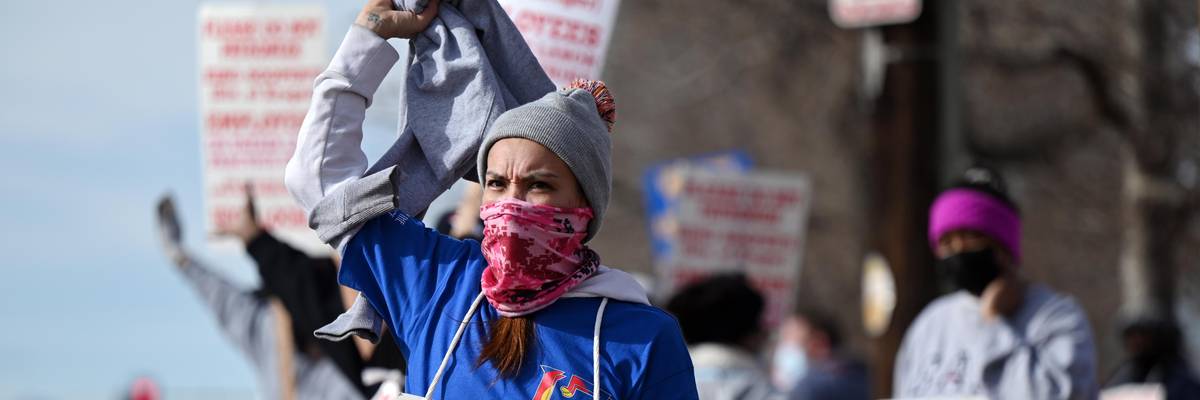
Progressives are celebrating after unionized workers at Denver-area King Soopers grocery stores approved a new three-year contract on Monday following a 10-day strike by more than 8,000 low-wage employees in Colorado.
"Strikes absolutely work," said Kim Cordova, president of United Food and Commercial Workers (UFCW) Local 7, which organized the work stoppage. "It shows the company that they can't run without workers."
"It shows that where the real power is is with the people," added Cordova, who was part of a panel convened by Sen. Bernie Sanders (I-Vt.) late Monday. "We're hoping that we set the bar so that other workers in this country follow suit."
Sanders, who expressed support for grocery store workers during the strike in Colorado, said this victory over Kroger--a nationwide chain that owns King Soopers--"proves that when workers stand together they can defeat corporate greed."
Although details of the new contract have not been shared by UFCW Local 7, the Colorado Sun reported that the deal includes pay raises of more than $5 an hour for some employees, which the union called "the most significant wage increase ever secured by a UFCW local for grocery workers." The contract also creates more full-time employment opportunities and secures better healthcare and pension benefits as well as stronger workplace safety measures.
"From the beginning of this process, we promised our members that we would procure the very best contract we could," Cordova said in a statement. "We are excited that our members voted overwhelmingly to ratify this industry-leading contract that will ensure King Soopers will respect and protect essential workers as well as pay them fairly."
From January 12 until the strike ended Friday, workers at nearly 80 stores across the Denver metropolitan area, from Parker to Boulder, took to the picket lines to demand a living wage and improved conditions.
Despite frontline employees' continued susceptibility to coronavirus transmission, Kroger--a corporate giant worth $84 billion and one of the nation's largest private employers--revoked a $2-an-hour hazard raise in May 2020, just two months into the ongoing global health crisis. A year later, the grocery mega-chain hiked prices at its stores.
Related Content

The strike started one day after UFCW Local 7 rejected what Cordova called a "grossly unfair" offer from King Soopers management.
That offer coincided with the publication of a report showing that as a result of Kroger's poverty wages and erratic scheduling practices, two-thirds of surveyed workers couldn't afford basic monthly expenses, 39% couldn't afford groceries, and 14% have experienced homelessness in the past year.
Meanwhile, the company's top brass has thrived during the Covid-19 pandemic, especially CEO Rodney McMullen. After receiving a large bonus in 2020, his total compensation that year reached $22.4 million, which was 909 times what the median worker earned.
Furthermore, Sanders' staff director Warren Gunnels pointed out Monday night, Kroger spent more than $1.5 billion on stock buybacks between April 2020 and July 2021 "to enrich its wealthy shareholders."
Workers at King Soopers, Gunnels noted, responded by standing up and fighting back.
Union members at King Soopers grocery stores in Colorado Springs, Pueblo, Grand Junction, and Northern Colorado will have an opportunity to vote on the same contract in the coming days, the Sun reported.
Progressives are celebrating after unionized workers at Denver-area King Soopers grocery stores approved a new three-year contract on Monday following a 10-day strike by more than 8,000 low-wage employees in Colorado.
"Strikes absolutely work," said Kim Cordova, president of United Food and Commercial Workers (UFCW) Local 7, which organized the work stoppage. "It shows the company that they can't run without workers."
"It shows that where the real power is is with the people," added Cordova, who was part of a panel convened by Sen. Bernie Sanders (I-Vt.) late Monday. "We're hoping that we set the bar so that other workers in this country follow suit."
Sanders, who expressed support for grocery store workers during the strike in Colorado, said this victory over Kroger--a nationwide chain that owns King Soopers--"proves that when workers stand together they can defeat corporate greed."
Although details of the new contract have not been shared by UFCW Local 7, the Colorado Sun reported that the deal includes pay raises of more than $5 an hour for some employees, which the union called "the most significant wage increase ever secured by a UFCW local for grocery workers." The contract also creates more full-time employment opportunities and secures better healthcare and pension benefits as well as stronger workplace safety measures.
"From the beginning of this process, we promised our members that we would procure the very best contract we could," Cordova said in a statement. "We are excited that our members voted overwhelmingly to ratify this industry-leading contract that will ensure King Soopers will respect and protect essential workers as well as pay them fairly."
From January 12 until the strike ended Friday, workers at nearly 80 stores across the Denver metropolitan area, from Parker to Boulder, took to the picket lines to demand a living wage and improved conditions.
Despite frontline employees' continued susceptibility to coronavirus transmission, Kroger--a corporate giant worth $84 billion and one of the nation's largest private employers--revoked a $2-an-hour hazard raise in May 2020, just two months into the ongoing global health crisis. A year later, the grocery mega-chain hiked prices at its stores.
Related Content
The strike started one day after UFCW Local 7 rejected what Cordova called a "grossly unfair" offer from King Soopers management.
That offer coincided with the publication of a report showing that as a result of Kroger's poverty wages and erratic scheduling practices, two-thirds of surveyed workers couldn't afford basic monthly expenses, 39% couldn't afford groceries, and 14% have experienced homelessness in the past year.
Meanwhile, the company's top brass has thrived during the Covid-19 pandemic, especially CEO Rodney McMullen. After receiving a large bonus in 2020, his total compensation that year reached $22.4 million, which was 909 times what the median worker earned.
Furthermore, Sanders' staff director Warren Gunnels pointed out Monday night, Kroger spent more than $1.5 billion on stock buybacks between April 2020 and July 2021 "to enrich its wealthy shareholders."
Workers at King Soopers, Gunnels noted, responded by standing up and fighting back.
Union members at King Soopers grocery stores in Colorado Springs, Pueblo, Grand Junction, and Northern Colorado will have an opportunity to vote on the same contract in the coming days, the Sun reported.
Progressives are celebrating after unionized workers at Denver-area King Soopers grocery stores approved a new three-year contract on Monday following a 10-day strike by more than 8,000 low-wage employees in Colorado.
"Strikes absolutely work," said Kim Cordova, president of United Food and Commercial Workers (UFCW) Local 7, which organized the work stoppage. "It shows the company that they can't run without workers."
"It shows that where the real power is is with the people," added Cordova, who was part of a panel convened by Sen. Bernie Sanders (I-Vt.) late Monday. "We're hoping that we set the bar so that other workers in this country follow suit."
Sanders, who expressed support for grocery store workers during the strike in Colorado, said this victory over Kroger--a nationwide chain that owns King Soopers--"proves that when workers stand together they can defeat corporate greed."
Although details of the new contract have not been shared by UFCW Local 7, the Colorado Sun reported that the deal includes pay raises of more than $5 an hour for some employees, which the union called "the most significant wage increase ever secured by a UFCW local for grocery workers." The contract also creates more full-time employment opportunities and secures better healthcare and pension benefits as well as stronger workplace safety measures.
"From the beginning of this process, we promised our members that we would procure the very best contract we could," Cordova said in a statement. "We are excited that our members voted overwhelmingly to ratify this industry-leading contract that will ensure King Soopers will respect and protect essential workers as well as pay them fairly."
From January 12 until the strike ended Friday, workers at nearly 80 stores across the Denver metropolitan area, from Parker to Boulder, took to the picket lines to demand a living wage and improved conditions.
Despite frontline employees' continued susceptibility to coronavirus transmission, Kroger--a corporate giant worth $84 billion and one of the nation's largest private employers--revoked a $2-an-hour hazard raise in May 2020, just two months into the ongoing global health crisis. A year later, the grocery mega-chain hiked prices at its stores.
Related Content
The strike started one day after UFCW Local 7 rejected what Cordova called a "grossly unfair" offer from King Soopers management.
That offer coincided with the publication of a report showing that as a result of Kroger's poverty wages and erratic scheduling practices, two-thirds of surveyed workers couldn't afford basic monthly expenses, 39% couldn't afford groceries, and 14% have experienced homelessness in the past year.
Meanwhile, the company's top brass has thrived during the Covid-19 pandemic, especially CEO Rodney McMullen. After receiving a large bonus in 2020, his total compensation that year reached $22.4 million, which was 909 times what the median worker earned.
Furthermore, Sanders' staff director Warren Gunnels pointed out Monday night, Kroger spent more than $1.5 billion on stock buybacks between April 2020 and July 2021 "to enrich its wealthy shareholders."
Workers at King Soopers, Gunnels noted, responded by standing up and fighting back.
Union members at King Soopers grocery stores in Colorado Springs, Pueblo, Grand Junction, and Northern Colorado will have an opportunity to vote on the same contract in the coming days, the Sun reported.