SUBSCRIBE TO OUR FREE NEWSLETTER
Daily news & progressive opinion—funded by the people, not the corporations—delivered straight to your inbox.
5
#000000
#FFFFFF
To donate by check, phone, or other method, see our More Ways to Give page.
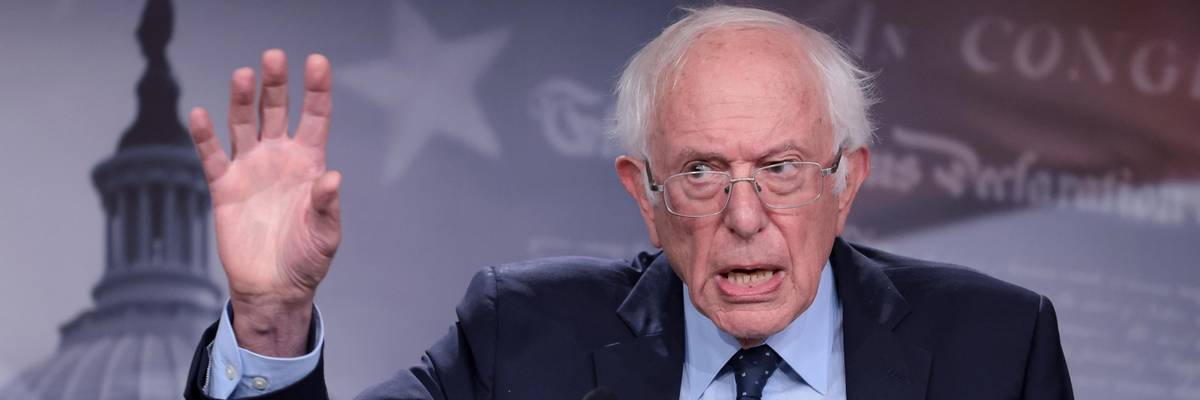
Sen. Bernie Sanders on Thursday countered fellow Sen. Joe Manchin's recent Fox News appearance with an op-ed on the right-wing outlet's website aimed at rebutting the West Virginia Democrat's falsehood-laden talking points against the Build Back Better Act.
"Manchin, the Republicans, and corporate America say this bill will add to our national debt and make inflation worse. Not true," wrote Sanders (I-Vt.), the chair of the Senate Budget Committee. "Unlike the bloated military budget that Manchin recently voted for, which adds $778 billion to the deficit this year alone and costs four times more than the Build Back Better Act over a 10-year period, the White House has said this bill is fully paid for" with tax hikes on the wealthy.
"It's time for the American people to understand which side their senators are on."
Manchin has voted for 11 consecutive military budgets, including the latest version of the National Defense Authorization Act, which the West Virginia Democrat approved without complaining about the price tag.
"And to add insult to injury, this military budget came after we ended the longest war in recent U.S. history and was $25 billion more than what President Biden requested," the Vermont senator continued.
"I should also add that, despite Manchin's 'deep concerns' about the national debt, he voted for $53 billion in corporate welfare that would go to a handful of profitable microchip companies--completely unpaid for," Sanders wrote, a reference to the Senate-passed Endless Frontier Act, which would lavish taxpayer subsidies on U.S. semiconductor firms.
Sanders' Fox News op-ed came days after Manchin--flush with corporate cash--appeared on the network's Sunday program to announce his opposition to the Build Back Better Act, a centerpiece of President Joe Biden's domestic policy agenda.
"This is a no on this legislation," Manchin told Fox's Bret Baier. "We have inflation that basically could harm--really harm a lot of Americans and especially those who are most needy and having a hard time struggling right now."
But economists have disputed Manchin's narrative that the $1.75 trillion Build Back Better package would fuel rising inflation, which analysts say is driven by a number of factors including pandemic-related supply chain disruptions to corporate profiteering. In fact, experts have warned that not passing the legislation could harm the nation's fragile economic recovery.
Mark Zandi, the chief economist at Moody's Analytics, argued last month that the Build Back Better Act and the bipartisan infrastructure law together would actually "take the edge off of inflation" by helping to "lift long-term economic growth via stronger productivity and labor force growth."
Writing for The Conversation earlier this week, economist Michael Klein noted that "the price tag of the Build Back Better plan passed by the House of Representatives is about $2 trillion, to be spent over a 10-year period."
"If the spending is spread out evenly, that would amount to about $200 billion a year. That's only about 3% of how much the government planned to spend in 2021," Klein observed. "At the same time, what's in the bill would make a big difference to improving the lives of average Americans by providing more of them with affordable child and healthcare and reducing child poverty--areas where the U.S. seriously lags behind other rich countries. And it would help the U.S. fight the ever-worsening effects of climate change."
"While the $2 trillion in spending would be unlikely to worsen inflation if it were to become law," Klein concluded, "I believe it could do a lot to materially address these challenges America faces."
Related Content

Manchin's opposition to the Build Back Better package threatens to tank what campaigners view as a once-in-a-generation opportunity to meaningfully invest in combating the climate crisis, which is wreaking havoc in the U.S. and across the globe.
Failure to pass the reconciliation bill would also mean the expiration of the boosted child tax credit program, potentially pushing millions of children back into poverty amid rising hunger.
In his op-ed on Thursday, Sanders wrote that "at this pivotal moment in U.S. history, it's time for the Senate to vote on a bill that will substantially improve the lives of working families, the elderly, the sick, and the poor, while taking on the unbridled greed of the wealthy and the powerful."
Senate Majority Leader Chuck Schumer (D-N.Y.) vowed this week to put the Build Back Better Act on the floor for a vote early in the new year, but the path forward for the legislation remains highly uncertain.
"It's time for the American people to understand which side their senators are on," Sanders wrote. "No more excuses. No more delays. It's time for the U.S. Senate to vote."
Sen. Bernie Sanders on Thursday countered fellow Sen. Joe Manchin's recent Fox News appearance with an op-ed on the right-wing outlet's website aimed at rebutting the West Virginia Democrat's falsehood-laden talking points against the Build Back Better Act.
"Manchin, the Republicans, and corporate America say this bill will add to our national debt and make inflation worse. Not true," wrote Sanders (I-Vt.), the chair of the Senate Budget Committee. "Unlike the bloated military budget that Manchin recently voted for, which adds $778 billion to the deficit this year alone and costs four times more than the Build Back Better Act over a 10-year period, the White House has said this bill is fully paid for" with tax hikes on the wealthy.
"It's time for the American people to understand which side their senators are on."
Manchin has voted for 11 consecutive military budgets, including the latest version of the National Defense Authorization Act, which the West Virginia Democrat approved without complaining about the price tag.
"And to add insult to injury, this military budget came after we ended the longest war in recent U.S. history and was $25 billion more than what President Biden requested," the Vermont senator continued.
"I should also add that, despite Manchin's 'deep concerns' about the national debt, he voted for $53 billion in corporate welfare that would go to a handful of profitable microchip companies--completely unpaid for," Sanders wrote, a reference to the Senate-passed Endless Frontier Act, which would lavish taxpayer subsidies on U.S. semiconductor firms.
Sanders' Fox News op-ed came days after Manchin--flush with corporate cash--appeared on the network's Sunday program to announce his opposition to the Build Back Better Act, a centerpiece of President Joe Biden's domestic policy agenda.
"This is a no on this legislation," Manchin told Fox's Bret Baier. "We have inflation that basically could harm--really harm a lot of Americans and especially those who are most needy and having a hard time struggling right now."
But economists have disputed Manchin's narrative that the $1.75 trillion Build Back Better package would fuel rising inflation, which analysts say is driven by a number of factors including pandemic-related supply chain disruptions to corporate profiteering. In fact, experts have warned that not passing the legislation could harm the nation's fragile economic recovery.
Mark Zandi, the chief economist at Moody's Analytics, argued last month that the Build Back Better Act and the bipartisan infrastructure law together would actually "take the edge off of inflation" by helping to "lift long-term economic growth via stronger productivity and labor force growth."
Writing for The Conversation earlier this week, economist Michael Klein noted that "the price tag of the Build Back Better plan passed by the House of Representatives is about $2 trillion, to be spent over a 10-year period."
"If the spending is spread out evenly, that would amount to about $200 billion a year. That's only about 3% of how much the government planned to spend in 2021," Klein observed. "At the same time, what's in the bill would make a big difference to improving the lives of average Americans by providing more of them with affordable child and healthcare and reducing child poverty--areas where the U.S. seriously lags behind other rich countries. And it would help the U.S. fight the ever-worsening effects of climate change."
"While the $2 trillion in spending would be unlikely to worsen inflation if it were to become law," Klein concluded, "I believe it could do a lot to materially address these challenges America faces."
Related Content
Manchin's opposition to the Build Back Better package threatens to tank what campaigners view as a once-in-a-generation opportunity to meaningfully invest in combating the climate crisis, which is wreaking havoc in the U.S. and across the globe.
Failure to pass the reconciliation bill would also mean the expiration of the boosted child tax credit program, potentially pushing millions of children back into poverty amid rising hunger.
In his op-ed on Thursday, Sanders wrote that "at this pivotal moment in U.S. history, it's time for the Senate to vote on a bill that will substantially improve the lives of working families, the elderly, the sick, and the poor, while taking on the unbridled greed of the wealthy and the powerful."
Senate Majority Leader Chuck Schumer (D-N.Y.) vowed this week to put the Build Back Better Act on the floor for a vote early in the new year, but the path forward for the legislation remains highly uncertain.
"It's time for the American people to understand which side their senators are on," Sanders wrote. "No more excuses. No more delays. It's time for the U.S. Senate to vote."
Sen. Bernie Sanders on Thursday countered fellow Sen. Joe Manchin's recent Fox News appearance with an op-ed on the right-wing outlet's website aimed at rebutting the West Virginia Democrat's falsehood-laden talking points against the Build Back Better Act.
"Manchin, the Republicans, and corporate America say this bill will add to our national debt and make inflation worse. Not true," wrote Sanders (I-Vt.), the chair of the Senate Budget Committee. "Unlike the bloated military budget that Manchin recently voted for, which adds $778 billion to the deficit this year alone and costs four times more than the Build Back Better Act over a 10-year period, the White House has said this bill is fully paid for" with tax hikes on the wealthy.
"It's time for the American people to understand which side their senators are on."
Manchin has voted for 11 consecutive military budgets, including the latest version of the National Defense Authorization Act, which the West Virginia Democrat approved without complaining about the price tag.
"And to add insult to injury, this military budget came after we ended the longest war in recent U.S. history and was $25 billion more than what President Biden requested," the Vermont senator continued.
"I should also add that, despite Manchin's 'deep concerns' about the national debt, he voted for $53 billion in corporate welfare that would go to a handful of profitable microchip companies--completely unpaid for," Sanders wrote, a reference to the Senate-passed Endless Frontier Act, which would lavish taxpayer subsidies on U.S. semiconductor firms.
Sanders' Fox News op-ed came days after Manchin--flush with corporate cash--appeared on the network's Sunday program to announce his opposition to the Build Back Better Act, a centerpiece of President Joe Biden's domestic policy agenda.
"This is a no on this legislation," Manchin told Fox's Bret Baier. "We have inflation that basically could harm--really harm a lot of Americans and especially those who are most needy and having a hard time struggling right now."
But economists have disputed Manchin's narrative that the $1.75 trillion Build Back Better package would fuel rising inflation, which analysts say is driven by a number of factors including pandemic-related supply chain disruptions to corporate profiteering. In fact, experts have warned that not passing the legislation could harm the nation's fragile economic recovery.
Mark Zandi, the chief economist at Moody's Analytics, argued last month that the Build Back Better Act and the bipartisan infrastructure law together would actually "take the edge off of inflation" by helping to "lift long-term economic growth via stronger productivity and labor force growth."
Writing for The Conversation earlier this week, economist Michael Klein noted that "the price tag of the Build Back Better plan passed by the House of Representatives is about $2 trillion, to be spent over a 10-year period."
"If the spending is spread out evenly, that would amount to about $200 billion a year. That's only about 3% of how much the government planned to spend in 2021," Klein observed. "At the same time, what's in the bill would make a big difference to improving the lives of average Americans by providing more of them with affordable child and healthcare and reducing child poverty--areas where the U.S. seriously lags behind other rich countries. And it would help the U.S. fight the ever-worsening effects of climate change."
"While the $2 trillion in spending would be unlikely to worsen inflation if it were to become law," Klein concluded, "I believe it could do a lot to materially address these challenges America faces."
Related Content
Manchin's opposition to the Build Back Better package threatens to tank what campaigners view as a once-in-a-generation opportunity to meaningfully invest in combating the climate crisis, which is wreaking havoc in the U.S. and across the globe.
Failure to pass the reconciliation bill would also mean the expiration of the boosted child tax credit program, potentially pushing millions of children back into poverty amid rising hunger.
In his op-ed on Thursday, Sanders wrote that "at this pivotal moment in U.S. history, it's time for the Senate to vote on a bill that will substantially improve the lives of working families, the elderly, the sick, and the poor, while taking on the unbridled greed of the wealthy and the powerful."
Senate Majority Leader Chuck Schumer (D-N.Y.) vowed this week to put the Build Back Better Act on the floor for a vote early in the new year, but the path forward for the legislation remains highly uncertain.
"It's time for the American people to understand which side their senators are on," Sanders wrote. "No more excuses. No more delays. It's time for the U.S. Senate to vote."