

SUBSCRIBE TO OUR FREE NEWSLETTER
Daily news & progressive opinion—funded by the people, not the corporations—delivered straight to your inbox.
5
#000000
#FFFFFF
To donate by check, phone, or other method, see our More Ways to Give page.
Daily news & progressive opinion—funded by the people, not the corporations—delivered straight to your inbox.
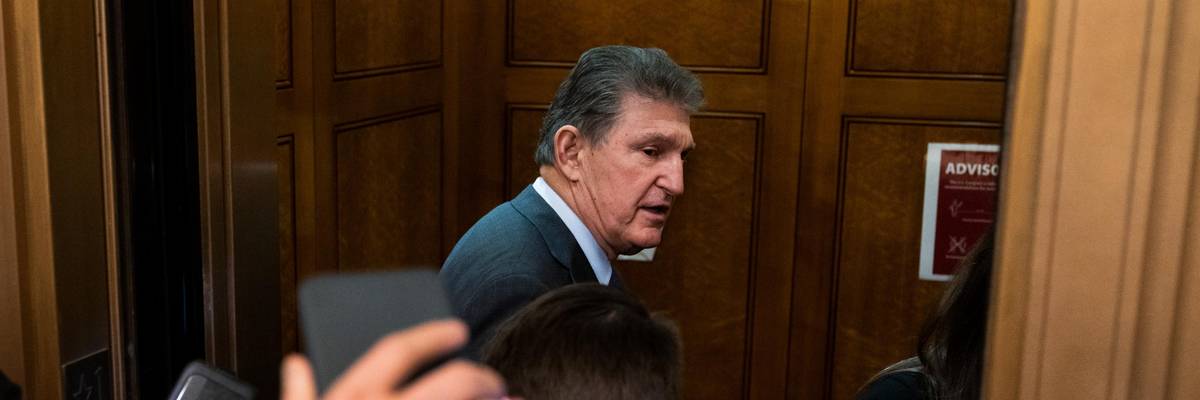
Sen. Joe Manchin (D-W.Va.) enters an elevator at the U.S. Capitol on December 15, 2021. (Photo: Tom Williams/CQ-Roll Call, Inc via Getty Images)
Beyond its near-immediate--and potentially devastating--impact on millions of families with children, Democratic Sen. Joe Manchin's obstruction of his party's Build Back Better package could have far-reaching consequences for the overall U.S. economy as the coronavirus pandemic continues to rage at home and abroad.
"Without BBB, the economic recovery will be vulnerable to stalling out."
According to a Business Insider calculation derived from Goldman Sachs' new adjusted growth projections, the death of Democrats' $1.75 trillion reconciliation measure could deprive the U.S. economy of $60 billion in gross domestic product (GDP) over the next three quarters, hampering the nation's fragile recovery.
"Economists are already forecasting what a BBB-free economy will look like, and early projections are gloomy," the outlet noted. "Goldman Sachs economists led by Jan Hatzius now expect U.S. GDP to grow 2% in the first quarter, 3% in the second quarter, and 2.75% in the third quarter, according to estimates published Monday. Those projections are down from 3%, 3.5%, and 3%, respectively."
The financial services firm Moody's Analytics, for its part, projected earlier this year that passage of both the reconciliation bill and the bipartisan infrastructure package--which President Joe Biden signed into law last month--would boost real GDP growth to 4.8% next year.
Mark Zandi, the chief economist at Moody's, warned in a series of tweets Monday that "if BBB doesn't become law, real GDP growth in 2022 will be lower by 0.5% and reaching full-employment next year will prove elusive."
"Fallout will be quick as families with children will lose a tax break," he continued. "Without BBB, the economic recovery will be vulnerable to stalling out if we suffer another serious wave of the pandemic, an increasingly likely scenario with Omicron spreading rapidly. Detractors of BBB worry about inflation, but without it, the worry is more likely to be growth."
Democrats' flagship social spending and climate legislation proposed investing billions of dollars in safety-net programs--including an expanded child tax credit, Medicaid, and pre-K--and renewable energy initiatives over the next decade in an effort to cut poverty, bolster healthcare coverage, and combat the planetary emergency.
"On a per-person basis, West Virginians would be among the biggest beneficiaries of the legislation."
According to an analysis conducted by the Economic Policy Institute in October, the slate of policy proposals in the Build Back Better Act combined with the bipartisan infrastructure package would have supported four million jobs annually.
But over several months of negotiations, Manchin (D-W.Va.) and other right-wing Democrats slowly chipped away at the legislation, removing key climate and healthcare provisions and ultimately cutting the bill's proposed spending level in half.
On Sunday, Manchin dealt what many saw as the death blow, telling Fox News that he would vote no on the Build Back Better Act should it reach the floor in its current form--likely spelling the end of programs like the expanded child tax credit, which reduced poverty and bolstered consumer spending by putting money directly in families' pockets.
Behind the scenes, Manchin reportedly told colleagues that "he thought parents would waste monthly child tax credit (CTC) payments on drugs instead of providing for their children," ignoring research showing that families have largely spent the money on groceries and other necessities.
In a statement released to the public on Sunday, the West Virginia Democrat offered several other objections to the bill that economists and other analysts slammed as nonsensical.
"He says he's worried about inflation and the national debt, but Build Back Better will be paid for with tax increases on big corporations and the wealthy--so it won't have any bearing on inflation or the debt," former Labor Secretary Robert Reich wrote in a blog post following Manchin's statement.
Reich continued:
He says he's worried about the impact of the latest Covid surge on the economy, but if Covid slows the economy there's even more justification for federal spending that strengthens social safety nets.
He says he can't face his constituents in West Virginia without renouncing 'Build Back Better.' But on a per-person basis, West Virginians would be among the biggest beneficiaries of the legislation in all of America. One out of four West Virginians over 65 have no natural teeth, for example--the highest rate in the nation. Biden's original bill provided dental benefits under Medicare.
Despite Manchin's opposition, Senate Majority Leader Chuck Schumer (D-N.Y.) wrote in a letter to his caucus on Monday that he intends to bring the Build Back Better Act to the floor for a vote early in the new year "so that every member of this body has the opportunity to make their position known on the Senate floor, not just on television."
"We are going to vote on a revised version of the House-passed Build Back Better Act--and we will keep voting until we get something done," Schumer added, without offering specific details on what the adjusted bill would look like.
In a statement on Tuesday, Groundwork Collaborative executive director Lindsay Owens argued that "if Sen. Manchin is concerned about inflation, then he should join us in fighting back against the corporate profiteering that is driving it--rather than trying to derail legislation that will not impact inflation one bit."
"The economic case for Build Back Better is crystal clear: putting more money into people's pockets helps families participate fully in our economy; investing in child care and paid leave helps workers stay healthy and return to work; and tackling the climate crisis is essential to building a more resilient and sustainable future," Owens said.
"Passing the Build Back Better Act isn't just about ensuring that Sen. Manchin honors his commitments--it's about building an economy that works for all families, not just the wealthy and well-connected," she continued. "Especially given the new Covid variant and rising economic uncertainty, it's more important than ever for Congress to stand up to the corporate interests who benefit from this broken status quo and put us on the path to economic resilience by passing the Build Back Better Act, in full, without further delay."
Dear Common Dreams reader, It’s been nearly 30 years since I co-founded Common Dreams with my late wife, Lina Newhouser. We had the radical notion that journalism should serve the public good, not corporate profits. It was clear to us from the outset what it would take to build such a project. No paid advertisements. No corporate sponsors. No millionaire publisher telling us what to think or do. Many people said we wouldn't last a year, but we proved those doubters wrong. Together with a tremendous team of journalists and dedicated staff, we built an independent media outlet free from the constraints of profits and corporate control. Our mission has always been simple: To inform. To inspire. To ignite change for the common good. Building Common Dreams was not easy. Our survival was never guaranteed. When you take on the most powerful forces—Wall Street greed, fossil fuel industry destruction, Big Tech lobbyists, and uber-rich oligarchs who have spent billions upon billions rigging the economy and democracy in their favor—the only bulwark you have is supporters who believe in your work. But here’s the urgent message from me today. It's never been this bad out there. And it's never been this hard to keep us going. At the very moment Common Dreams is most needed, the threats we face are intensifying. We need your support now more than ever. We don't accept corporate advertising and never will. We don't have a paywall because we don't think people should be blocked from critical news based on their ability to pay. Everything we do is funded by the donations of readers like you. When everyone does the little they can afford, we are strong. But if that support retreats or dries up, so do we. Will you donate now to make sure Common Dreams not only survives but thrives? —Craig Brown, Co-founder |
Beyond its near-immediate--and potentially devastating--impact on millions of families with children, Democratic Sen. Joe Manchin's obstruction of his party's Build Back Better package could have far-reaching consequences for the overall U.S. economy as the coronavirus pandemic continues to rage at home and abroad.
"Without BBB, the economic recovery will be vulnerable to stalling out."
According to a Business Insider calculation derived from Goldman Sachs' new adjusted growth projections, the death of Democrats' $1.75 trillion reconciliation measure could deprive the U.S. economy of $60 billion in gross domestic product (GDP) over the next three quarters, hampering the nation's fragile recovery.
"Economists are already forecasting what a BBB-free economy will look like, and early projections are gloomy," the outlet noted. "Goldman Sachs economists led by Jan Hatzius now expect U.S. GDP to grow 2% in the first quarter, 3% in the second quarter, and 2.75% in the third quarter, according to estimates published Monday. Those projections are down from 3%, 3.5%, and 3%, respectively."
The financial services firm Moody's Analytics, for its part, projected earlier this year that passage of both the reconciliation bill and the bipartisan infrastructure package--which President Joe Biden signed into law last month--would boost real GDP growth to 4.8% next year.
Mark Zandi, the chief economist at Moody's, warned in a series of tweets Monday that "if BBB doesn't become law, real GDP growth in 2022 will be lower by 0.5% and reaching full-employment next year will prove elusive."
"Fallout will be quick as families with children will lose a tax break," he continued. "Without BBB, the economic recovery will be vulnerable to stalling out if we suffer another serious wave of the pandemic, an increasingly likely scenario with Omicron spreading rapidly. Detractors of BBB worry about inflation, but without it, the worry is more likely to be growth."
Democrats' flagship social spending and climate legislation proposed investing billions of dollars in safety-net programs--including an expanded child tax credit, Medicaid, and pre-K--and renewable energy initiatives over the next decade in an effort to cut poverty, bolster healthcare coverage, and combat the planetary emergency.
"On a per-person basis, West Virginians would be among the biggest beneficiaries of the legislation."
According to an analysis conducted by the Economic Policy Institute in October, the slate of policy proposals in the Build Back Better Act combined with the bipartisan infrastructure package would have supported four million jobs annually.
But over several months of negotiations, Manchin (D-W.Va.) and other right-wing Democrats slowly chipped away at the legislation, removing key climate and healthcare provisions and ultimately cutting the bill's proposed spending level in half.
On Sunday, Manchin dealt what many saw as the death blow, telling Fox News that he would vote no on the Build Back Better Act should it reach the floor in its current form--likely spelling the end of programs like the expanded child tax credit, which reduced poverty and bolstered consumer spending by putting money directly in families' pockets.
Behind the scenes, Manchin reportedly told colleagues that "he thought parents would waste monthly child tax credit (CTC) payments on drugs instead of providing for their children," ignoring research showing that families have largely spent the money on groceries and other necessities.
In a statement released to the public on Sunday, the West Virginia Democrat offered several other objections to the bill that economists and other analysts slammed as nonsensical.
"He says he's worried about inflation and the national debt, but Build Back Better will be paid for with tax increases on big corporations and the wealthy--so it won't have any bearing on inflation or the debt," former Labor Secretary Robert Reich wrote in a blog post following Manchin's statement.
Reich continued:
He says he's worried about the impact of the latest Covid surge on the economy, but if Covid slows the economy there's even more justification for federal spending that strengthens social safety nets.
He says he can't face his constituents in West Virginia without renouncing 'Build Back Better.' But on a per-person basis, West Virginians would be among the biggest beneficiaries of the legislation in all of America. One out of four West Virginians over 65 have no natural teeth, for example--the highest rate in the nation. Biden's original bill provided dental benefits under Medicare.
Despite Manchin's opposition, Senate Majority Leader Chuck Schumer (D-N.Y.) wrote in a letter to his caucus on Monday that he intends to bring the Build Back Better Act to the floor for a vote early in the new year "so that every member of this body has the opportunity to make their position known on the Senate floor, not just on television."
"We are going to vote on a revised version of the House-passed Build Back Better Act--and we will keep voting until we get something done," Schumer added, without offering specific details on what the adjusted bill would look like.
In a statement on Tuesday, Groundwork Collaborative executive director Lindsay Owens argued that "if Sen. Manchin is concerned about inflation, then he should join us in fighting back against the corporate profiteering that is driving it--rather than trying to derail legislation that will not impact inflation one bit."
"The economic case for Build Back Better is crystal clear: putting more money into people's pockets helps families participate fully in our economy; investing in child care and paid leave helps workers stay healthy and return to work; and tackling the climate crisis is essential to building a more resilient and sustainable future," Owens said.
"Passing the Build Back Better Act isn't just about ensuring that Sen. Manchin honors his commitments--it's about building an economy that works for all families, not just the wealthy and well-connected," she continued. "Especially given the new Covid variant and rising economic uncertainty, it's more important than ever for Congress to stand up to the corporate interests who benefit from this broken status quo and put us on the path to economic resilience by passing the Build Back Better Act, in full, without further delay."
Beyond its near-immediate--and potentially devastating--impact on millions of families with children, Democratic Sen. Joe Manchin's obstruction of his party's Build Back Better package could have far-reaching consequences for the overall U.S. economy as the coronavirus pandemic continues to rage at home and abroad.
"Without BBB, the economic recovery will be vulnerable to stalling out."
According to a Business Insider calculation derived from Goldman Sachs' new adjusted growth projections, the death of Democrats' $1.75 trillion reconciliation measure could deprive the U.S. economy of $60 billion in gross domestic product (GDP) over the next three quarters, hampering the nation's fragile recovery.
"Economists are already forecasting what a BBB-free economy will look like, and early projections are gloomy," the outlet noted. "Goldman Sachs economists led by Jan Hatzius now expect U.S. GDP to grow 2% in the first quarter, 3% in the second quarter, and 2.75% in the third quarter, according to estimates published Monday. Those projections are down from 3%, 3.5%, and 3%, respectively."
The financial services firm Moody's Analytics, for its part, projected earlier this year that passage of both the reconciliation bill and the bipartisan infrastructure package--which President Joe Biden signed into law last month--would boost real GDP growth to 4.8% next year.
Mark Zandi, the chief economist at Moody's, warned in a series of tweets Monday that "if BBB doesn't become law, real GDP growth in 2022 will be lower by 0.5% and reaching full-employment next year will prove elusive."
"Fallout will be quick as families with children will lose a tax break," he continued. "Without BBB, the economic recovery will be vulnerable to stalling out if we suffer another serious wave of the pandemic, an increasingly likely scenario with Omicron spreading rapidly. Detractors of BBB worry about inflation, but without it, the worry is more likely to be growth."
Democrats' flagship social spending and climate legislation proposed investing billions of dollars in safety-net programs--including an expanded child tax credit, Medicaid, and pre-K--and renewable energy initiatives over the next decade in an effort to cut poverty, bolster healthcare coverage, and combat the planetary emergency.
"On a per-person basis, West Virginians would be among the biggest beneficiaries of the legislation."
According to an analysis conducted by the Economic Policy Institute in October, the slate of policy proposals in the Build Back Better Act combined with the bipartisan infrastructure package would have supported four million jobs annually.
But over several months of negotiations, Manchin (D-W.Va.) and other right-wing Democrats slowly chipped away at the legislation, removing key climate and healthcare provisions and ultimately cutting the bill's proposed spending level in half.
On Sunday, Manchin dealt what many saw as the death blow, telling Fox News that he would vote no on the Build Back Better Act should it reach the floor in its current form--likely spelling the end of programs like the expanded child tax credit, which reduced poverty and bolstered consumer spending by putting money directly in families' pockets.
Behind the scenes, Manchin reportedly told colleagues that "he thought parents would waste monthly child tax credit (CTC) payments on drugs instead of providing for their children," ignoring research showing that families have largely spent the money on groceries and other necessities.
In a statement released to the public on Sunday, the West Virginia Democrat offered several other objections to the bill that economists and other analysts slammed as nonsensical.
"He says he's worried about inflation and the national debt, but Build Back Better will be paid for with tax increases on big corporations and the wealthy--so it won't have any bearing on inflation or the debt," former Labor Secretary Robert Reich wrote in a blog post following Manchin's statement.
Reich continued:
He says he's worried about the impact of the latest Covid surge on the economy, but if Covid slows the economy there's even more justification for federal spending that strengthens social safety nets.
He says he can't face his constituents in West Virginia without renouncing 'Build Back Better.' But on a per-person basis, West Virginians would be among the biggest beneficiaries of the legislation in all of America. One out of four West Virginians over 65 have no natural teeth, for example--the highest rate in the nation. Biden's original bill provided dental benefits under Medicare.
Despite Manchin's opposition, Senate Majority Leader Chuck Schumer (D-N.Y.) wrote in a letter to his caucus on Monday that he intends to bring the Build Back Better Act to the floor for a vote early in the new year "so that every member of this body has the opportunity to make their position known on the Senate floor, not just on television."
"We are going to vote on a revised version of the House-passed Build Back Better Act--and we will keep voting until we get something done," Schumer added, without offering specific details on what the adjusted bill would look like.
In a statement on Tuesday, Groundwork Collaborative executive director Lindsay Owens argued that "if Sen. Manchin is concerned about inflation, then he should join us in fighting back against the corporate profiteering that is driving it--rather than trying to derail legislation that will not impact inflation one bit."
"The economic case for Build Back Better is crystal clear: putting more money into people's pockets helps families participate fully in our economy; investing in child care and paid leave helps workers stay healthy and return to work; and tackling the climate crisis is essential to building a more resilient and sustainable future," Owens said.
"Passing the Build Back Better Act isn't just about ensuring that Sen. Manchin honors his commitments--it's about building an economy that works for all families, not just the wealthy and well-connected," she continued. "Especially given the new Covid variant and rising economic uncertainty, it's more important than ever for Congress to stand up to the corporate interests who benefit from this broken status quo and put us on the path to economic resilience by passing the Build Back Better Act, in full, without further delay."

