SUBSCRIBE TO OUR FREE NEWSLETTER
Daily news & progressive opinion—funded by the people, not the corporations—delivered straight to your inbox.
5
#000000
#FFFFFF
To donate by check, phone, or other method, see our More Ways to Give page.
Daily news & progressive opinion—funded by the people, not the corporations—delivered straight to your inbox.
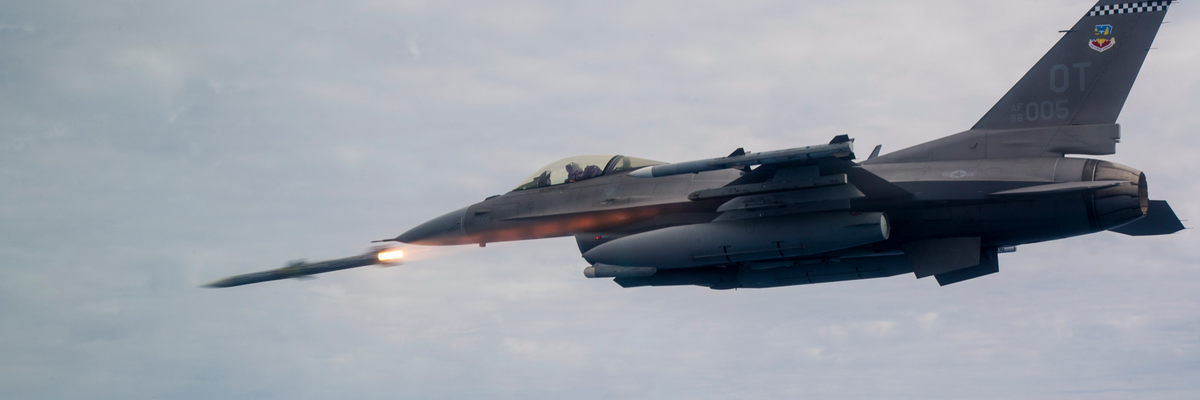
A United States Air Force F-16 fighter jet test-fires a Raytheon AIM-120 air-to-air missile over the Gulf of Mexico near Eglin Air Force Base in Okaloosa County, Florida. (Photo: Capt. Justin Marsh/USAF)
Anti-war activists on Thursday accused the Biden administration of throwing fuel on the flames of the Saudi-led war in Yemen after the U.S. State Department notified Congress it approved a new $650 million missile sale to the repressive Middle Eastern monarchy.
Defense News reports the Pentagon said the Saudi government requested to purchase 280 AIM-120C-7/C-8 advanced medium-range air-to-air missiles and 596 LAU-128 missile rail launchers in a deal that would also include spare parts, support, and logistical services. The missiles would be fitted to Saudi warplanes including Eurofighter Typhoons and McDonnell-Douglas F-15s.
"Meanwhile," tweeted the women-led peace group CodePink, "one Yemeni child continues to die every 10 minutes as a result of the humanitarian crisis caused by the Saudi-led war on Yemen."
The missiles are made by Raytheon, whose board Defense Secretary Lloyd Austin joined upon retiring as head of U.S. Central Command (CENTCOM) in 2016.
A State Department spokesperson called the proposed sale "fully consistent with the administration's pledge to lead with diplomacy to end the conflict in Yemen while also ensuring Saudi Arabia has the means to defend itself from Iranian-backed Houthi air attacks."
Peace advocates scoffed at the claim that selling more weapons to the Saudis would help bring about peace.
Unless blocked by Congress, the sale would be the first to Saudi Arabia since President Joe Biden's February announcement that the U.S. was ending support for "offensive operations"--including weapons transfers--in the atrocity-laden Saudi-led war that has killed and wounded hundreds of thousands of Yemenis, while displacing hundreds of thousands more and exacerbating famine-like conditions through a crippling economic blockade.
Prior to February's announcement, the Biden administration imposed a temporary freeze on all arms sales to Saudi Arabia and the United Arab Emirates pending a review of deals inked during the tenure of former President Donald Trump.
Critics say the new sale is at least the third violation of Biden's "offensive operations" promise this fall. In May, Pentagon officials acknowledged the U.S. was still servicing Saudi warplanes via contractors, and in September, peace and human advocates denounced the State Department's approval of a $500 million contract to maintain the kingdom's military helicopters.
In late September, the U.S. House passed an amendment by Rep. Ro Khanna (D-Calif.) to the 2022 National Defense Authorization Act (NDAA) that, if approved by the Senate and signed by Biden, would end U.S. logistical support and weapons transfers to Saudi Arabia.
This post has been updated to clarify that Congress does not need to approve weapons sales but can block them.
Dear Common Dreams reader, It’s been nearly 30 years since I co-founded Common Dreams with my late wife, Lina Newhouser. We had the radical notion that journalism should serve the public good, not corporate profits. It was clear to us from the outset what it would take to build such a project. No paid advertisements. No corporate sponsors. No millionaire publisher telling us what to think or do. Many people said we wouldn't last a year, but we proved those doubters wrong. Together with a tremendous team of journalists and dedicated staff, we built an independent media outlet free from the constraints of profits and corporate control. Our mission has always been simple: To inform. To inspire. To ignite change for the common good. Building Common Dreams was not easy. Our survival was never guaranteed. When you take on the most powerful forces—Wall Street greed, fossil fuel industry destruction, Big Tech lobbyists, and uber-rich oligarchs who have spent billions upon billions rigging the economy and democracy in their favor—the only bulwark you have is supporters who believe in your work. But here’s the urgent message from me today. It's never been this bad out there. And it's never been this hard to keep us going. At the very moment Common Dreams is most needed, the threats we face are intensifying. We need your support now more than ever. We don't accept corporate advertising and never will. We don't have a paywall because we don't think people should be blocked from critical news based on their ability to pay. Everything we do is funded by the donations of readers like you. When everyone does the little they can afford, we are strong. But if that support retreats or dries up, so do we. Will you donate now to make sure Common Dreams not only survives but thrives? —Craig Brown, Co-founder |
Anti-war activists on Thursday accused the Biden administration of throwing fuel on the flames of the Saudi-led war in Yemen after the U.S. State Department notified Congress it approved a new $650 million missile sale to the repressive Middle Eastern monarchy.
Defense News reports the Pentagon said the Saudi government requested to purchase 280 AIM-120C-7/C-8 advanced medium-range air-to-air missiles and 596 LAU-128 missile rail launchers in a deal that would also include spare parts, support, and logistical services. The missiles would be fitted to Saudi warplanes including Eurofighter Typhoons and McDonnell-Douglas F-15s.
"Meanwhile," tweeted the women-led peace group CodePink, "one Yemeni child continues to die every 10 minutes as a result of the humanitarian crisis caused by the Saudi-led war on Yemen."
The missiles are made by Raytheon, whose board Defense Secretary Lloyd Austin joined upon retiring as head of U.S. Central Command (CENTCOM) in 2016.
A State Department spokesperson called the proposed sale "fully consistent with the administration's pledge to lead with diplomacy to end the conflict in Yemen while also ensuring Saudi Arabia has the means to defend itself from Iranian-backed Houthi air attacks."
Peace advocates scoffed at the claim that selling more weapons to the Saudis would help bring about peace.
Unless blocked by Congress, the sale would be the first to Saudi Arabia since President Joe Biden's February announcement that the U.S. was ending support for "offensive operations"--including weapons transfers--in the atrocity-laden Saudi-led war that has killed and wounded hundreds of thousands of Yemenis, while displacing hundreds of thousands more and exacerbating famine-like conditions through a crippling economic blockade.
Prior to February's announcement, the Biden administration imposed a temporary freeze on all arms sales to Saudi Arabia and the United Arab Emirates pending a review of deals inked during the tenure of former President Donald Trump.
Critics say the new sale is at least the third violation of Biden's "offensive operations" promise this fall. In May, Pentagon officials acknowledged the U.S. was still servicing Saudi warplanes via contractors, and in September, peace and human advocates denounced the State Department's approval of a $500 million contract to maintain the kingdom's military helicopters.
In late September, the U.S. House passed an amendment by Rep. Ro Khanna (D-Calif.) to the 2022 National Defense Authorization Act (NDAA) that, if approved by the Senate and signed by Biden, would end U.S. logistical support and weapons transfers to Saudi Arabia.
This post has been updated to clarify that Congress does not need to approve weapons sales but can block them.
Anti-war activists on Thursday accused the Biden administration of throwing fuel on the flames of the Saudi-led war in Yemen after the U.S. State Department notified Congress it approved a new $650 million missile sale to the repressive Middle Eastern monarchy.
Defense News reports the Pentagon said the Saudi government requested to purchase 280 AIM-120C-7/C-8 advanced medium-range air-to-air missiles and 596 LAU-128 missile rail launchers in a deal that would also include spare parts, support, and logistical services. The missiles would be fitted to Saudi warplanes including Eurofighter Typhoons and McDonnell-Douglas F-15s.
"Meanwhile," tweeted the women-led peace group CodePink, "one Yemeni child continues to die every 10 minutes as a result of the humanitarian crisis caused by the Saudi-led war on Yemen."
The missiles are made by Raytheon, whose board Defense Secretary Lloyd Austin joined upon retiring as head of U.S. Central Command (CENTCOM) in 2016.
A State Department spokesperson called the proposed sale "fully consistent with the administration's pledge to lead with diplomacy to end the conflict in Yemen while also ensuring Saudi Arabia has the means to defend itself from Iranian-backed Houthi air attacks."
Peace advocates scoffed at the claim that selling more weapons to the Saudis would help bring about peace.
Unless blocked by Congress, the sale would be the first to Saudi Arabia since President Joe Biden's February announcement that the U.S. was ending support for "offensive operations"--including weapons transfers--in the atrocity-laden Saudi-led war that has killed and wounded hundreds of thousands of Yemenis, while displacing hundreds of thousands more and exacerbating famine-like conditions through a crippling economic blockade.
Prior to February's announcement, the Biden administration imposed a temporary freeze on all arms sales to Saudi Arabia and the United Arab Emirates pending a review of deals inked during the tenure of former President Donald Trump.
Critics say the new sale is at least the third violation of Biden's "offensive operations" promise this fall. In May, Pentagon officials acknowledged the U.S. was still servicing Saudi warplanes via contractors, and in September, peace and human advocates denounced the State Department's approval of a $500 million contract to maintain the kingdom's military helicopters.
In late September, the U.S. House passed an amendment by Rep. Ro Khanna (D-Calif.) to the 2022 National Defense Authorization Act (NDAA) that, if approved by the Senate and signed by Biden, would end U.S. logistical support and weapons transfers to Saudi Arabia.
This post has been updated to clarify that Congress does not need to approve weapons sales but can block them.