SUBSCRIBE TO OUR FREE NEWSLETTER
Daily news & progressive opinion—funded by the people, not the corporations—delivered straight to your inbox.
5
#000000
#FFFFFF
To donate by check, phone, or other method, see our More Ways to Give page.
Daily news & progressive opinion—funded by the people, not the corporations—delivered straight to your inbox.
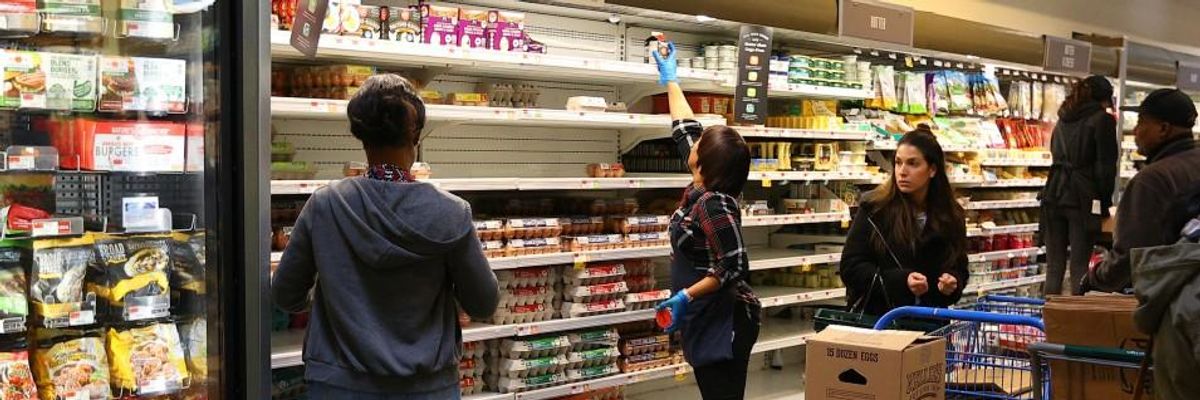
People shopping in the egg and dairy case on March 13, 2020 at Whole Foods Market in Vauxhall, New Jersey.
Amid mounting data showing that people are paying more for food at grocery stores around the United States, a new analysis out Wednesday reveals how corporate power is "the real culprit behind rising prices at the checkout line."
"Addressing this crisis means recognizing these price increases for what they are: the result of deeply entrenched concentrated corporate power."
After the U.S. Labor Department announced that the Consumer Price Index increased by 0.4% in September, researchers at the Groundwork Collaborative, a progressive think tank, explained the connections between "price hikes, monopoly, and corporate greed."
"The more sway mega-corporations have over our economy, the more power they have to gouge customers, squeeze Main Street, and exploit workers," Rakeen Mabud, chief economist at the Groundwork Collaborative, said in a statement.
Since September 2020, food prices overall have increased by 4.6%, with the price of meats, poultry, fish, and eggs surging the most over the past 12 months, at 10.5%.
The higher inflation rate in those industries, researchers noted, can be attributed to decades of consolidation, which has given a handful of corporations an ever-greater degree of market control and with it, the power to set prices.
According to the Groundwork Collaborative:
Just four meat processing conglomerates control more than 80% of the beef industry and more than 60% of the pork industry. This enables them to dictate prices that both flatten returns for farmers and ranchers and inflate prices for consumers at the meat counter. As a result, consumers have seen a 12% increase in the cost of beef and a nearly 10% increase in the cost of pork over the last year. Meanwhile, the four major meat processors doled out billions of dollars to their shareholders in dividends and bought back millions of dollars of their own stocks.
The price of eggs, meanwhile, has risen 9.9% since August 2020.
"State governments, including Minnesota, Texas, California, and New York have sued egg producers and distributors for illegally raising the price of eggs during the pandemic," the Groundwork Collaborative pointed out. "As one lawsuit put it, jacking up egg prices is allowing these companies, including some of the largest producers and wholesale distributors of eggs, to 'profit from the misery of millions.'"
The Groundwork Collaborative also spotlighted how Kroger grocery stores have charged customers more and simultaneously suppressed wages amid the Covid-19 pandemic.
Researchers explained:
Kroger, a grocery mega-chain, spent the summer of 2021 gloating that "a little bit of inflation is always good in our business" before citing inflation to justify price hikes. Kroger publicly acknowledged that they could get away with increasing prices on consumers as long as prices didn't rise by more than 3 or 4%.
Charging consumers more for supermarket staples has lined the pockets of Kroger executives and shareholders, even as median worker pay decreased by 8% in 2020. That same year, the Kroger CEO earned 909 times what the median worker earned.
While the company was publicly calling their workers heroes, they were simultaneously cutting essential hazard pay for employees during a global pandemic. Meanwhile, the company spent $1.498 billion on stock buybacks between April 2020 and July 2021 to enrich its shareholders.
"Addressing this crisis," said Mabud, "means recognizing these price increases for what they are: the result of deeply entrenched concentrated corporate power that has systematically stripped down supply chains and created room for pandemic profiteers as well as longstanding underinvestment in our economy."
Dear Common Dreams reader, It’s been nearly 30 years since I co-founded Common Dreams with my late wife, Lina Newhouser. We had the radical notion that journalism should serve the public good, not corporate profits. It was clear to us from the outset what it would take to build such a project. No paid advertisements. No corporate sponsors. No millionaire publisher telling us what to think or do. Many people said we wouldn't last a year, but we proved those doubters wrong. Together with a tremendous team of journalists and dedicated staff, we built an independent media outlet free from the constraints of profits and corporate control. Our mission has always been simple: To inform. To inspire. To ignite change for the common good. Building Common Dreams was not easy. Our survival was never guaranteed. When you take on the most powerful forces—Wall Street greed, fossil fuel industry destruction, Big Tech lobbyists, and uber-rich oligarchs who have spent billions upon billions rigging the economy and democracy in their favor—the only bulwark you have is supporters who believe in your work. But here’s the urgent message from me today. It's never been this bad out there. And it's never been this hard to keep us going. At the very moment Common Dreams is most needed, the threats we face are intensifying. We need your support now more than ever. We don't accept corporate advertising and never will. We don't have a paywall because we don't think people should be blocked from critical news based on their ability to pay. Everything we do is funded by the donations of readers like you. When everyone does the little they can afford, we are strong. But if that support retreats or dries up, so do we. Will you donate now to make sure Common Dreams not only survives but thrives? —Craig Brown, Co-founder |
Amid mounting data showing that people are paying more for food at grocery stores around the United States, a new analysis out Wednesday reveals how corporate power is "the real culprit behind rising prices at the checkout line."
"Addressing this crisis means recognizing these price increases for what they are: the result of deeply entrenched concentrated corporate power."
After the U.S. Labor Department announced that the Consumer Price Index increased by 0.4% in September, researchers at the Groundwork Collaborative, a progressive think tank, explained the connections between "price hikes, monopoly, and corporate greed."
"The more sway mega-corporations have over our economy, the more power they have to gouge customers, squeeze Main Street, and exploit workers," Rakeen Mabud, chief economist at the Groundwork Collaborative, said in a statement.
Since September 2020, food prices overall have increased by 4.6%, with the price of meats, poultry, fish, and eggs surging the most over the past 12 months, at 10.5%.
The higher inflation rate in those industries, researchers noted, can be attributed to decades of consolidation, which has given a handful of corporations an ever-greater degree of market control and with it, the power to set prices.
According to the Groundwork Collaborative:
Just four meat processing conglomerates control more than 80% of the beef industry and more than 60% of the pork industry. This enables them to dictate prices that both flatten returns for farmers and ranchers and inflate prices for consumers at the meat counter. As a result, consumers have seen a 12% increase in the cost of beef and a nearly 10% increase in the cost of pork over the last year. Meanwhile, the four major meat processors doled out billions of dollars to their shareholders in dividends and bought back millions of dollars of their own stocks.
The price of eggs, meanwhile, has risen 9.9% since August 2020.
"State governments, including Minnesota, Texas, California, and New York have sued egg producers and distributors for illegally raising the price of eggs during the pandemic," the Groundwork Collaborative pointed out. "As one lawsuit put it, jacking up egg prices is allowing these companies, including some of the largest producers and wholesale distributors of eggs, to 'profit from the misery of millions.'"
The Groundwork Collaborative also spotlighted how Kroger grocery stores have charged customers more and simultaneously suppressed wages amid the Covid-19 pandemic.
Researchers explained:
Kroger, a grocery mega-chain, spent the summer of 2021 gloating that "a little bit of inflation is always good in our business" before citing inflation to justify price hikes. Kroger publicly acknowledged that they could get away with increasing prices on consumers as long as prices didn't rise by more than 3 or 4%.
Charging consumers more for supermarket staples has lined the pockets of Kroger executives and shareholders, even as median worker pay decreased by 8% in 2020. That same year, the Kroger CEO earned 909 times what the median worker earned.
While the company was publicly calling their workers heroes, they were simultaneously cutting essential hazard pay for employees during a global pandemic. Meanwhile, the company spent $1.498 billion on stock buybacks between April 2020 and July 2021 to enrich its shareholders.
"Addressing this crisis," said Mabud, "means recognizing these price increases for what they are: the result of deeply entrenched concentrated corporate power that has systematically stripped down supply chains and created room for pandemic profiteers as well as longstanding underinvestment in our economy."
Amid mounting data showing that people are paying more for food at grocery stores around the United States, a new analysis out Wednesday reveals how corporate power is "the real culprit behind rising prices at the checkout line."
"Addressing this crisis means recognizing these price increases for what they are: the result of deeply entrenched concentrated corporate power."
After the U.S. Labor Department announced that the Consumer Price Index increased by 0.4% in September, researchers at the Groundwork Collaborative, a progressive think tank, explained the connections between "price hikes, monopoly, and corporate greed."
"The more sway mega-corporations have over our economy, the more power they have to gouge customers, squeeze Main Street, and exploit workers," Rakeen Mabud, chief economist at the Groundwork Collaborative, said in a statement.
Since September 2020, food prices overall have increased by 4.6%, with the price of meats, poultry, fish, and eggs surging the most over the past 12 months, at 10.5%.
The higher inflation rate in those industries, researchers noted, can be attributed to decades of consolidation, which has given a handful of corporations an ever-greater degree of market control and with it, the power to set prices.
According to the Groundwork Collaborative:
Just four meat processing conglomerates control more than 80% of the beef industry and more than 60% of the pork industry. This enables them to dictate prices that both flatten returns for farmers and ranchers and inflate prices for consumers at the meat counter. As a result, consumers have seen a 12% increase in the cost of beef and a nearly 10% increase in the cost of pork over the last year. Meanwhile, the four major meat processors doled out billions of dollars to their shareholders in dividends and bought back millions of dollars of their own stocks.
The price of eggs, meanwhile, has risen 9.9% since August 2020.
"State governments, including Minnesota, Texas, California, and New York have sued egg producers and distributors for illegally raising the price of eggs during the pandemic," the Groundwork Collaborative pointed out. "As one lawsuit put it, jacking up egg prices is allowing these companies, including some of the largest producers and wholesale distributors of eggs, to 'profit from the misery of millions.'"
The Groundwork Collaborative also spotlighted how Kroger grocery stores have charged customers more and simultaneously suppressed wages amid the Covid-19 pandemic.
Researchers explained:
Kroger, a grocery mega-chain, spent the summer of 2021 gloating that "a little bit of inflation is always good in our business" before citing inflation to justify price hikes. Kroger publicly acknowledged that they could get away with increasing prices on consumers as long as prices didn't rise by more than 3 or 4%.
Charging consumers more for supermarket staples has lined the pockets of Kroger executives and shareholders, even as median worker pay decreased by 8% in 2020. That same year, the Kroger CEO earned 909 times what the median worker earned.
While the company was publicly calling their workers heroes, they were simultaneously cutting essential hazard pay for employees during a global pandemic. Meanwhile, the company spent $1.498 billion on stock buybacks between April 2020 and July 2021 to enrich its shareholders.
"Addressing this crisis," said Mabud, "means recognizing these price increases for what they are: the result of deeply entrenched concentrated corporate power that has systematically stripped down supply chains and created room for pandemic profiteers as well as longstanding underinvestment in our economy."