SUBSCRIBE TO OUR FREE NEWSLETTER
Daily news & progressive opinion—funded by the people, not the corporations—delivered straight to your inbox.
5
#000000
#FFFFFF
To donate by check, phone, or other method, see our More Ways to Give page.
Daily news & progressive opinion—funded by the people, not the corporations—delivered straight to your inbox.
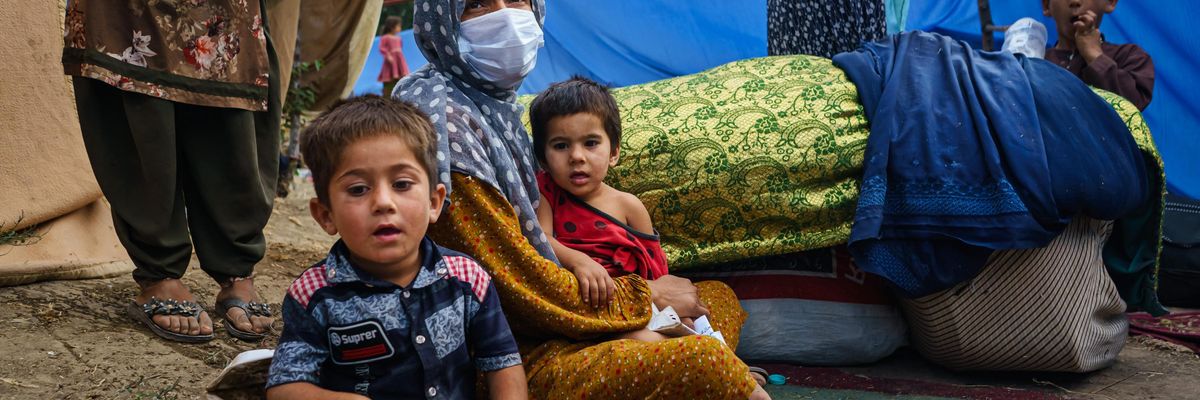
Afghans seek shelter from fighting between the Taliban and Afghan security forces on August 14, 2021. (Photo: Marcus Yam/Los Angeles Times)
As the Biden administration faces criticism for not doing enough to assist those fleeing Afghanistan, an analysis released Monday showed that the roughly $19 billion the Pentagon budgeted for the U.S. occupation of the country in 2020 alone could cover initial resettlement costs for 1.2 million refugees.
"We have a duty to save lives--and to do so, we must welcome many, many more refugees as quickly as possible."
--Rep. Cori Bush
Lindsay Koshgarian of the National Priorities Project estimated that the $18.6 billion the Pentagon allocated for its 2020 operations in Afghanistan--where the Taliban is in the process of retaking power after two decades of deadly U.S. occupation--could pay up-front refugee relocation costs of $15,148 for the more than "250,000 Afghans displaced since the end of May (and growing)" and "a significant chunk of the 3.5 million Afghans who were internally displaced as of July."
"Refugees typically receive some assistance after their arrival, but even if we expanded to cover an additional four years of the approximately $4,600 in annualized social service aid that refugees typically receive, we could still resettle more than half a million people, for just one year's worth of the cost of fighting," Koshgarian noted. "We'd face even lower costs to help resettle Afghans in countries closer to home--all the more reason after 20 years of war to step up with some serious resources and get it done."
"After twenty years," she added, "we owe the Afghan people at least that much."
The analysis came as progressive lawmakers in the U.S. and global humanitarian organizations implored the Biden administration to open the U.S. to vulnerable Afghans attempting to escape a growing humanitarian crisis and Taliban rule. According to the United Nations Refugee Agency, 80% of those currently trying to flee Afghanistan are women and children.
In a speech on Monday, U.S. President Joe Biden said that "in the coming days, the U.S. military will provide assistance to move more [Special Immigrant Visa]-eligible Afghans and their families out of Afghanistan." The Pentagon confirmed Monday that it is planning to house up to 22,000 Afghans at two U.S. bases--Fort Bliss in Texas and Fort McCoy in Wisconsin.
"We're also expanding refugee access to cover other vulnerable Afghans who worked for our embassy: U.S. non-governmental agencies--or the U.S. non-governmental organizations; and Afghans who otherwise are at great risk; and U.S. news agencies," the president added.
Following his remarks, Biden directed the U.S. State Department to use up to $500 million from the nation's Emergency Refugee and Migration Assistance Fund to meet "unexpected urgent refugee and migration needs of refugees, victims of conflict, and other persons at risk as a result of the situation in Afghanistan, including applicants for Special Immigrant Visas."
But critics have accused the Biden administration of failing to adequately plan for the rapid collapse of the Afghan government that followed the ongoing withdrawal of U.S. forces from the country--a still-deteriorating situation that has left countless people in limbo as they seek safety for themselves and their families.
In his speech Monday, Biden claimed the administration didn't begin evacuating at-risk civilians sooner "because the Afghan government and its supporters discouraged us from organizing a mass exodus to avoid triggering, as they said, 'a crisis of confidence.'"
Earlier this month, the U.S. State Department expanded eligibility for the Special Immigrant Visa (SIV) program, opening it to tens of thousands of Afghans who worked for U.S. government contractors, U.S.-based media outlets, and U.S.-based non-governmental organizations. The families of eligible Afghans also have access to the program, whose application process consists of an arduous 14 steps.
And as the Wall Street Journal observed on Monday, the program excludes the poorest Afghans by design. "To claim refugee status," the Journal noted, "the Afghans must enter through a third country and cover the costs of travel and lodging on their own--a hurdle that is nearly impossible to surmount under the current, chaotic circumstances."
In a letter to Biden on Monday, the advocacy organization Refugees International called on the administration to "express its willingness initially to resettle up to 200,000 Afghan refugees, as part of an international responsibility-sharing effort to rescue and resettle Afghans at risk."
"While most would be resettled from countries of asylum," the group wrote, "a program ultimately could involve direct resettlement from Afghanistan, akin to the Orderly Departure program that resulted in the resettlement of many hundreds of thousands of Vietnamese directly from their country of origin."
Rep. Cori Bush (D-Mo.), part of a chorus of progressive lawmakers pushing Biden to do more to welcome refugees--in addition to ending the interventionist foreign policy approach that creates such humanitarian crises--noted in a tweet Monday that the U.S. "welcomed 120,000 refugees in a single year" in the aftermath of the Vietnam War.
"Yet the United States has only taken in ~2,000 Afghan refugees thus far," Bush wrote. "We have a duty to save lives--and to do so, we must welcome many, many more refugees as quickly as possible."
Dear Common Dreams reader, It’s been nearly 30 years since I co-founded Common Dreams with my late wife, Lina Newhouser. We had the radical notion that journalism should serve the public good, not corporate profits. It was clear to us from the outset what it would take to build such a project. No paid advertisements. No corporate sponsors. No millionaire publisher telling us what to think or do. Many people said we wouldn't last a year, but we proved those doubters wrong. Together with a tremendous team of journalists and dedicated staff, we built an independent media outlet free from the constraints of profits and corporate control. Our mission has always been simple: To inform. To inspire. To ignite change for the common good. Building Common Dreams was not easy. Our survival was never guaranteed. When you take on the most powerful forces—Wall Street greed, fossil fuel industry destruction, Big Tech lobbyists, and uber-rich oligarchs who have spent billions upon billions rigging the economy and democracy in their favor—the only bulwark you have is supporters who believe in your work. But here’s the urgent message from me today. It's never been this bad out there. And it's never been this hard to keep us going. At the very moment Common Dreams is most needed, the threats we face are intensifying. We need your support now more than ever. We don't accept corporate advertising and never will. We don't have a paywall because we don't think people should be blocked from critical news based on their ability to pay. Everything we do is funded by the donations of readers like you. When everyone does the little they can afford, we are strong. But if that support retreats or dries up, so do we. Will you donate now to make sure Common Dreams not only survives but thrives? —Craig Brown, Co-founder |
As the Biden administration faces criticism for not doing enough to assist those fleeing Afghanistan, an analysis released Monday showed that the roughly $19 billion the Pentagon budgeted for the U.S. occupation of the country in 2020 alone could cover initial resettlement costs for 1.2 million refugees.
"We have a duty to save lives--and to do so, we must welcome many, many more refugees as quickly as possible."
--Rep. Cori Bush
Lindsay Koshgarian of the National Priorities Project estimated that the $18.6 billion the Pentagon allocated for its 2020 operations in Afghanistan--where the Taliban is in the process of retaking power after two decades of deadly U.S. occupation--could pay up-front refugee relocation costs of $15,148 for the more than "250,000 Afghans displaced since the end of May (and growing)" and "a significant chunk of the 3.5 million Afghans who were internally displaced as of July."
"Refugees typically receive some assistance after their arrival, but even if we expanded to cover an additional four years of the approximately $4,600 in annualized social service aid that refugees typically receive, we could still resettle more than half a million people, for just one year's worth of the cost of fighting," Koshgarian noted. "We'd face even lower costs to help resettle Afghans in countries closer to home--all the more reason after 20 years of war to step up with some serious resources and get it done."
"After twenty years," she added, "we owe the Afghan people at least that much."
The analysis came as progressive lawmakers in the U.S. and global humanitarian organizations implored the Biden administration to open the U.S. to vulnerable Afghans attempting to escape a growing humanitarian crisis and Taliban rule. According to the United Nations Refugee Agency, 80% of those currently trying to flee Afghanistan are women and children.
In a speech on Monday, U.S. President Joe Biden said that "in the coming days, the U.S. military will provide assistance to move more [Special Immigrant Visa]-eligible Afghans and their families out of Afghanistan." The Pentagon confirmed Monday that it is planning to house up to 22,000 Afghans at two U.S. bases--Fort Bliss in Texas and Fort McCoy in Wisconsin.
"We're also expanding refugee access to cover other vulnerable Afghans who worked for our embassy: U.S. non-governmental agencies--or the U.S. non-governmental organizations; and Afghans who otherwise are at great risk; and U.S. news agencies," the president added.
Following his remarks, Biden directed the U.S. State Department to use up to $500 million from the nation's Emergency Refugee and Migration Assistance Fund to meet "unexpected urgent refugee and migration needs of refugees, victims of conflict, and other persons at risk as a result of the situation in Afghanistan, including applicants for Special Immigrant Visas."
But critics have accused the Biden administration of failing to adequately plan for the rapid collapse of the Afghan government that followed the ongoing withdrawal of U.S. forces from the country--a still-deteriorating situation that has left countless people in limbo as they seek safety for themselves and their families.
In his speech Monday, Biden claimed the administration didn't begin evacuating at-risk civilians sooner "because the Afghan government and its supporters discouraged us from organizing a mass exodus to avoid triggering, as they said, 'a crisis of confidence.'"
Earlier this month, the U.S. State Department expanded eligibility for the Special Immigrant Visa (SIV) program, opening it to tens of thousands of Afghans who worked for U.S. government contractors, U.S.-based media outlets, and U.S.-based non-governmental organizations. The families of eligible Afghans also have access to the program, whose application process consists of an arduous 14 steps.
And as the Wall Street Journal observed on Monday, the program excludes the poorest Afghans by design. "To claim refugee status," the Journal noted, "the Afghans must enter through a third country and cover the costs of travel and lodging on their own--a hurdle that is nearly impossible to surmount under the current, chaotic circumstances."
In a letter to Biden on Monday, the advocacy organization Refugees International called on the administration to "express its willingness initially to resettle up to 200,000 Afghan refugees, as part of an international responsibility-sharing effort to rescue and resettle Afghans at risk."
"While most would be resettled from countries of asylum," the group wrote, "a program ultimately could involve direct resettlement from Afghanistan, akin to the Orderly Departure program that resulted in the resettlement of many hundreds of thousands of Vietnamese directly from their country of origin."
Rep. Cori Bush (D-Mo.), part of a chorus of progressive lawmakers pushing Biden to do more to welcome refugees--in addition to ending the interventionist foreign policy approach that creates such humanitarian crises--noted in a tweet Monday that the U.S. "welcomed 120,000 refugees in a single year" in the aftermath of the Vietnam War.
"Yet the United States has only taken in ~2,000 Afghan refugees thus far," Bush wrote. "We have a duty to save lives--and to do so, we must welcome many, many more refugees as quickly as possible."
As the Biden administration faces criticism for not doing enough to assist those fleeing Afghanistan, an analysis released Monday showed that the roughly $19 billion the Pentagon budgeted for the U.S. occupation of the country in 2020 alone could cover initial resettlement costs for 1.2 million refugees.
"We have a duty to save lives--and to do so, we must welcome many, many more refugees as quickly as possible."
--Rep. Cori Bush
Lindsay Koshgarian of the National Priorities Project estimated that the $18.6 billion the Pentagon allocated for its 2020 operations in Afghanistan--where the Taliban is in the process of retaking power after two decades of deadly U.S. occupation--could pay up-front refugee relocation costs of $15,148 for the more than "250,000 Afghans displaced since the end of May (and growing)" and "a significant chunk of the 3.5 million Afghans who were internally displaced as of July."
"Refugees typically receive some assistance after their arrival, but even if we expanded to cover an additional four years of the approximately $4,600 in annualized social service aid that refugees typically receive, we could still resettle more than half a million people, for just one year's worth of the cost of fighting," Koshgarian noted. "We'd face even lower costs to help resettle Afghans in countries closer to home--all the more reason after 20 years of war to step up with some serious resources and get it done."
"After twenty years," she added, "we owe the Afghan people at least that much."
The analysis came as progressive lawmakers in the U.S. and global humanitarian organizations implored the Biden administration to open the U.S. to vulnerable Afghans attempting to escape a growing humanitarian crisis and Taliban rule. According to the United Nations Refugee Agency, 80% of those currently trying to flee Afghanistan are women and children.
In a speech on Monday, U.S. President Joe Biden said that "in the coming days, the U.S. military will provide assistance to move more [Special Immigrant Visa]-eligible Afghans and their families out of Afghanistan." The Pentagon confirmed Monday that it is planning to house up to 22,000 Afghans at two U.S. bases--Fort Bliss in Texas and Fort McCoy in Wisconsin.
"We're also expanding refugee access to cover other vulnerable Afghans who worked for our embassy: U.S. non-governmental agencies--or the U.S. non-governmental organizations; and Afghans who otherwise are at great risk; and U.S. news agencies," the president added.
Following his remarks, Biden directed the U.S. State Department to use up to $500 million from the nation's Emergency Refugee and Migration Assistance Fund to meet "unexpected urgent refugee and migration needs of refugees, victims of conflict, and other persons at risk as a result of the situation in Afghanistan, including applicants for Special Immigrant Visas."
But critics have accused the Biden administration of failing to adequately plan for the rapid collapse of the Afghan government that followed the ongoing withdrawal of U.S. forces from the country--a still-deteriorating situation that has left countless people in limbo as they seek safety for themselves and their families.
In his speech Monday, Biden claimed the administration didn't begin evacuating at-risk civilians sooner "because the Afghan government and its supporters discouraged us from organizing a mass exodus to avoid triggering, as they said, 'a crisis of confidence.'"
Earlier this month, the U.S. State Department expanded eligibility for the Special Immigrant Visa (SIV) program, opening it to tens of thousands of Afghans who worked for U.S. government contractors, U.S.-based media outlets, and U.S.-based non-governmental organizations. The families of eligible Afghans also have access to the program, whose application process consists of an arduous 14 steps.
And as the Wall Street Journal observed on Monday, the program excludes the poorest Afghans by design. "To claim refugee status," the Journal noted, "the Afghans must enter through a third country and cover the costs of travel and lodging on their own--a hurdle that is nearly impossible to surmount under the current, chaotic circumstances."
In a letter to Biden on Monday, the advocacy organization Refugees International called on the administration to "express its willingness initially to resettle up to 200,000 Afghan refugees, as part of an international responsibility-sharing effort to rescue and resettle Afghans at risk."
"While most would be resettled from countries of asylum," the group wrote, "a program ultimately could involve direct resettlement from Afghanistan, akin to the Orderly Departure program that resulted in the resettlement of many hundreds of thousands of Vietnamese directly from their country of origin."
Rep. Cori Bush (D-Mo.), part of a chorus of progressive lawmakers pushing Biden to do more to welcome refugees--in addition to ending the interventionist foreign policy approach that creates such humanitarian crises--noted in a tweet Monday that the U.S. "welcomed 120,000 refugees in a single year" in the aftermath of the Vietnam War.
"Yet the United States has only taken in ~2,000 Afghan refugees thus far," Bush wrote. "We have a duty to save lives--and to do so, we must welcome many, many more refugees as quickly as possible."