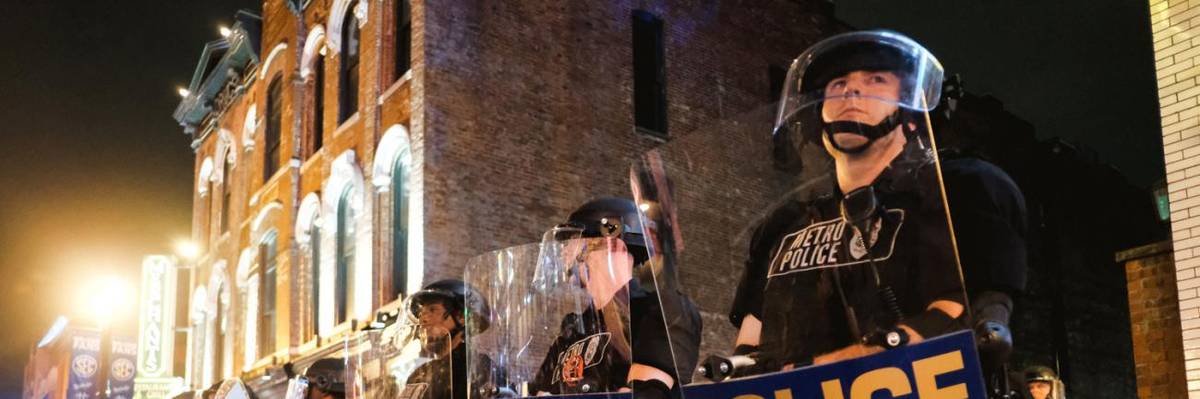
Police are seen on June 4, 2020 in Nashville, Tennessee as residents hold a racial justice protest following the police killing of George Floyd in Minneapolis. (Photo: Jason Kempin/Getty Images)
Tennessee Compiled Secret Dossiers on Civil Rights Protesters
"You can't even keep these files because there's potential for abuse," said the ACLU of Tennessee.
Aug 11, 2021
In the latest reported attempt by Tennessee officials to chill First Amendment rights in the state following last year's racial justice uprising, the state Department of Safety and Homeland Security collected personal data of dozens of civil rights protesters and held the information in a secret database.
News Channel 5 in Nashville reported Monday that a demonstrator named Justin Jones discovered a document called "People's Plaza TN Significant Personnel (more than 2 arrests)" when he filed a records request with the department.
The document included dossiers on more than 50 activists who attended protests at the People's Plaza in Nashville last summer, where civil rights advocates spent weeks camped out to demand Gov. Bill Lee speak with them about racial injustice in Tennessee.
The dossiers include names, social security numbers, addresses, social media photos, and in some cases, information about the demonstrators' personal relationships.
In several cases the demonstrators had never been arrested, but they were listed as "persons of interest" according to Channel 5.
Jones found out about the dossiers when he filed the records request in an attempt to determine whether state authorities had treated the People's Plaza demonstration differently than the so-called "Stop the Steal" protests that were attended by former President Doinald Trump's supporters after the 2020 election, where attendees repeated false claims that Trump had won a second term.
Jones wrote on social media Monday that it was "telling" that law enforcement saw racial justice advocates, but not protests that culminated in the violent attempted insurrection at the U.S. Capitol in January, as a threat.
Allegra Harpootlian, a communications strategist for the ACLU, called the report of Jones' discovery "concerning anti-protest news" in a state where, earlier this year, Republicans proposed legislation to make obstructing a highway during a demonstration a felony and giving legal immunity to people who unintentionally injure or kill demonstrators.
Channel 5 reported that the Department of Safety and Homeland Security did not respond to a question about whether authorities collected personal information of activists at other kinds of protests.
According to the ACLU of Tennessee, law enforcement agencies typically need to provide a compelling reason to collect and store data about members of the community. The organization worked to revise a consent decree dating back to the 1970s regarding police surveillance.
"We had an order from the court saying you can't even keep these files because there's potential for abuse," Thomas Castelli, legal director for the group, told Channel 5.
Urgent. It's never been this bad.
Dear Common Dreams reader, It’s been nearly 30 years since I co-founded Common Dreams with my late wife, Lina Newhouser. We had the radical notion that journalism should serve the public good, not corporate profits. It was clear to us from the outset what it would take to build such a project. No paid advertisements. No corporate sponsors. No millionaire publisher telling us what to think or do. Many people said we wouldn't last a year, but we proved those doubters wrong. Together with a tremendous team of journalists and dedicated staff, we built an independent media outlet free from the constraints of profits and corporate control. Our mission from the outset was simple. To inform. To inspire. To ignite change for the common good. Building Common Dreams was not easy. Our survival was never guaranteed. When you take on the most powerful forces—Wall Street greed, fossil fuel industry destruction, Big Tech lobbyists, and uber-rich oligarchs who have spent billions upon billions rigging the economy and democracy in their favor—the only bulwark you have is supporters who believe in your work. But here’s the urgent message from me today. It’s never been this bad out there. And it’s never been this hard to keep us going. At the very moment Common Dreams is most needed and doing some of its best and most important work, the threats we face are intensifying. Right now, with just three days to go in our Spring Campaign, we're falling short of our make-or-break goal. When everyone does the little they can afford, we are strong. But if that support retreats or dries up, so do we. Can you make a gift right now to make sure Common Dreams not only survives but thrives? There is no backup plan or rainy day fund. There is only you. —Craig Brown, Co-founder |
Our work is licensed under Creative Commons (CC BY-NC-ND 3.0). Feel free to republish and share widely.
In the latest reported attempt by Tennessee officials to chill First Amendment rights in the state following last year's racial justice uprising, the state Department of Safety and Homeland Security collected personal data of dozens of civil rights protesters and held the information in a secret database.
News Channel 5 in Nashville reported Monday that a demonstrator named Justin Jones discovered a document called "People's Plaza TN Significant Personnel (more than 2 arrests)" when he filed a records request with the department.
The document included dossiers on more than 50 activists who attended protests at the People's Plaza in Nashville last summer, where civil rights advocates spent weeks camped out to demand Gov. Bill Lee speak with them about racial injustice in Tennessee.
The dossiers include names, social security numbers, addresses, social media photos, and in some cases, information about the demonstrators' personal relationships.
In several cases the demonstrators had never been arrested, but they were listed as "persons of interest" according to Channel 5.
Jones found out about the dossiers when he filed the records request in an attempt to determine whether state authorities had treated the People's Plaza demonstration differently than the so-called "Stop the Steal" protests that were attended by former President Doinald Trump's supporters after the 2020 election, where attendees repeated false claims that Trump had won a second term.
Jones wrote on social media Monday that it was "telling" that law enforcement saw racial justice advocates, but not protests that culminated in the violent attempted insurrection at the U.S. Capitol in January, as a threat.
Allegra Harpootlian, a communications strategist for the ACLU, called the report of Jones' discovery "concerning anti-protest news" in a state where, earlier this year, Republicans proposed legislation to make obstructing a highway during a demonstration a felony and giving legal immunity to people who unintentionally injure or kill demonstrators.
Channel 5 reported that the Department of Safety and Homeland Security did not respond to a question about whether authorities collected personal information of activists at other kinds of protests.
According to the ACLU of Tennessee, law enforcement agencies typically need to provide a compelling reason to collect and store data about members of the community. The organization worked to revise a consent decree dating back to the 1970s regarding police surveillance.
"We had an order from the court saying you can't even keep these files because there's potential for abuse," Thomas Castelli, legal director for the group, told Channel 5.
In the latest reported attempt by Tennessee officials to chill First Amendment rights in the state following last year's racial justice uprising, the state Department of Safety and Homeland Security collected personal data of dozens of civil rights protesters and held the information in a secret database.
News Channel 5 in Nashville reported Monday that a demonstrator named Justin Jones discovered a document called "People's Plaza TN Significant Personnel (more than 2 arrests)" when he filed a records request with the department.
The document included dossiers on more than 50 activists who attended protests at the People's Plaza in Nashville last summer, where civil rights advocates spent weeks camped out to demand Gov. Bill Lee speak with them about racial injustice in Tennessee.
The dossiers include names, social security numbers, addresses, social media photos, and in some cases, information about the demonstrators' personal relationships.
In several cases the demonstrators had never been arrested, but they were listed as "persons of interest" according to Channel 5.
Jones found out about the dossiers when he filed the records request in an attempt to determine whether state authorities had treated the People's Plaza demonstration differently than the so-called "Stop the Steal" protests that were attended by former President Doinald Trump's supporters after the 2020 election, where attendees repeated false claims that Trump had won a second term.
Jones wrote on social media Monday that it was "telling" that law enforcement saw racial justice advocates, but not protests that culminated in the violent attempted insurrection at the U.S. Capitol in January, as a threat.
Allegra Harpootlian, a communications strategist for the ACLU, called the report of Jones' discovery "concerning anti-protest news" in a state where, earlier this year, Republicans proposed legislation to make obstructing a highway during a demonstration a felony and giving legal immunity to people who unintentionally injure or kill demonstrators.
Channel 5 reported that the Department of Safety and Homeland Security did not respond to a question about whether authorities collected personal information of activists at other kinds of protests.
According to the ACLU of Tennessee, law enforcement agencies typically need to provide a compelling reason to collect and store data about members of the community. The organization worked to revise a consent decree dating back to the 1970s regarding police surveillance.
"We had an order from the court saying you can't even keep these files because there's potential for abuse," Thomas Castelli, legal director for the group, told Channel 5.
We've had enough. The 1% own and operate the corporate media. They are doing everything they can to defend the status quo, squash dissent and protect the wealthy and the powerful. The Common Dreams media model is different. We cover the news that matters to the 99%. Our mission? To inform. To inspire. To ignite change for the common good. How? Nonprofit. Independent. Reader-supported. Free to read. Free to republish. Free to share. With no advertising. No paywalls. No selling of your data. Thousands of small donations fund our newsroom and allow us to continue publishing. Can you chip in? We can't do it without you. Thank you.