SUBSCRIBE TO OUR FREE NEWSLETTER
Daily news & progressive opinion—funded by the people, not the corporations—delivered straight to your inbox.
5
#000000
#FFFFFF
To donate by check, phone, or other method, see our More Ways to Give page.
Daily news & progressive opinion—funded by the people, not the corporations—delivered straight to your inbox.
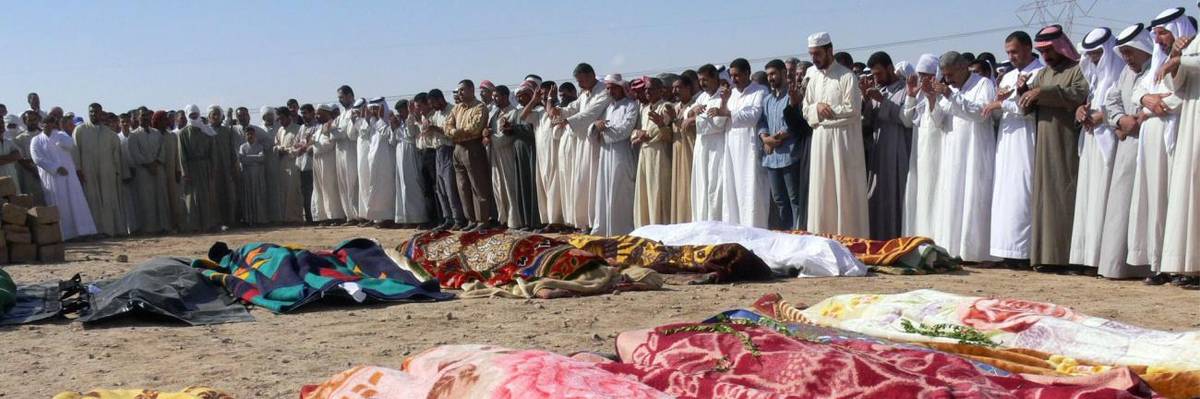
Iraqis grieve at the funeral of their relatives, who were killed during a U.S. air strike in Samarra, Iraq in October 2007. (Photo: Dia Hamid/AFP via Getty Images)
Sen. Elizabeth Warren on Tuesday called on the U.S. Department of Defense to review "significant discrepancies in civilian casualty counts," a month after the Pentagon released its annual report on civilian deaths and injuries as a result of U.S. operations in Iraq, Afghanistan, Syria, Yemen, Nigeria, and Somalia.
The Massachusetts Democrat spoke out on social media days after joining Rep. Ro Khanna (D-Calif.) in writing (pdf) to Defense Secretary Lloyd Austin III regarding the annual report.
The Pentagon stated in its "Annual Report on Civilian Casualties In Connection With United States Military Operations in 2020" (pdf) findingthat there were "approximately 23 civilians killed and approximately 10 civilians injured" in U.S. military actions last year--numbers which did not match the findings of independent outside researchers including Airwars and Brown University's Costs of War Project.
"Sources say the real number [of casualties] is almost five times higher," than the Pentagon reported, said Warren. "Protecting civilians must be a priority--Rep. Khanna and I want Secretary Austin to investigate."
In their letter, Khanna and Warren cited research from Airwars, a U.K.-based monitoring group run by journalists and international conflict researchers, which reported at least 34 civilian deaths caused by U.S.-led attacks last year in Iraq and Syria alone. The groups also counted between seven and 13 civilian deaths in Somalia.
"Using the same sources of information that were used to plan the strike or raid and to verify its results without seeking information from witnesses or survivors of attacks or by visiting the site of strikes cannot give a clear and accurate account of the civilian casualties."
--Sen. Elizabeth Warren and Rep. Ro Khanna
"The minimum public estimate of civilian deaths caused by U.S. forces during 2020 across five conflict nations was 102 fatalities," said Airwars in its own annual report last month.
As Common Dreams reported, Airwars and the Costs of War Project found an even greater discrepancy in the Pentagon's official tally last year after the DoD claimed responsibility for 132 civilian deaths, compared to 1,100 reported by the two groups in Iraq, Afghanistan, and Syria.
This year, the Pentagon claimed responsibility for 20 deaths and five injuries in Afghanistan, but as Airwars reported, the United Nations Mission in Afghanistan (UNAMA) "attributed 120 civilian casualties (89 killed and 31 injured) to international military forces."
Warren and Khanna called on Austin "to ensure that U.S. military investigations into civilian casualties give greater weight to external sources of information rather than relying solely on its own internal records and sources when assessing third party reports of civilian harm."
"Using the same sources of information that were used to plan the strike or raid and to verify its results without seeking information from witnesses or survivors of attacks or by visiting the site of strikes cannot give a clear and accurate account of the civilian casualties," they wrote.
The lawmakers also questioned the DoD's approach to officially expressing condolences to the families of victims of U.S. military operations--which the Pentagon's report suggested officials had not done last year.
Despite the allocation of $3 million for payments to grieving families, Warren and Khanna noted, the Pentagon report "said the department offered zero ex gratia payments in 2020."
"This is despite repeated authorization and funding from Congress, the congressionally mandated development of a new interim policy on ex gratia, and the large number of cases over many years where the department has confirmed civilian casualties and has a means of contacting survivors," they wrote. "It's especially striking this year, given that the DoD could have used its $3 million allocation to offer ex gratia to every single civilian confirmed harmed in 2020, with significant funding to spare."
Warren and Khanna called on Austin to put into practice the measures proposed in the two Democrats' bicameral legislation, the Protection of Civilians in Military Operations Act, which they introduced in June 2020, including:
"We need to openly consider all the costs, benefits, and consequences of military action, and that includes doing everything we can to prevent and respond to civilian harm," said the lawmakers. "Strengthening investigations, accurately and transparently reporting on civilian harm, expressing condolences for harm when it happens, and learning from these incidents to prevent harm in the future are all essential steps that reinforce the importance of protecting civilians as a national security priority and as a moral and ethical imperative."
Dear Common Dreams reader, It’s been nearly 30 years since I co-founded Common Dreams with my late wife, Lina Newhouser. We had the radical notion that journalism should serve the public good, not corporate profits. It was clear to us from the outset what it would take to build such a project. No paid advertisements. No corporate sponsors. No millionaire publisher telling us what to think or do. Many people said we wouldn't last a year, but we proved those doubters wrong. Together with a tremendous team of journalists and dedicated staff, we built an independent media outlet free from the constraints of profits and corporate control. Our mission has always been simple: To inform. To inspire. To ignite change for the common good. Building Common Dreams was not easy. Our survival was never guaranteed. When you take on the most powerful forces—Wall Street greed, fossil fuel industry destruction, Big Tech lobbyists, and uber-rich oligarchs who have spent billions upon billions rigging the economy and democracy in their favor—the only bulwark you have is supporters who believe in your work. But here’s the urgent message from me today. It's never been this bad out there. And it's never been this hard to keep us going. At the very moment Common Dreams is most needed, the threats we face are intensifying. We need your support now more than ever. We don't accept corporate advertising and never will. We don't have a paywall because we don't think people should be blocked from critical news based on their ability to pay. Everything we do is funded by the donations of readers like you. When everyone does the little they can afford, we are strong. But if that support retreats or dries up, so do we. Will you donate now to make sure Common Dreams not only survives but thrives? —Craig Brown, Co-founder |
Sen. Elizabeth Warren on Tuesday called on the U.S. Department of Defense to review "significant discrepancies in civilian casualty counts," a month after the Pentagon released its annual report on civilian deaths and injuries as a result of U.S. operations in Iraq, Afghanistan, Syria, Yemen, Nigeria, and Somalia.
The Massachusetts Democrat spoke out on social media days after joining Rep. Ro Khanna (D-Calif.) in writing (pdf) to Defense Secretary Lloyd Austin III regarding the annual report.
The Pentagon stated in its "Annual Report on Civilian Casualties In Connection With United States Military Operations in 2020" (pdf) findingthat there were "approximately 23 civilians killed and approximately 10 civilians injured" in U.S. military actions last year--numbers which did not match the findings of independent outside researchers including Airwars and Brown University's Costs of War Project.
"Sources say the real number [of casualties] is almost five times higher," than the Pentagon reported, said Warren. "Protecting civilians must be a priority--Rep. Khanna and I want Secretary Austin to investigate."
In their letter, Khanna and Warren cited research from Airwars, a U.K.-based monitoring group run by journalists and international conflict researchers, which reported at least 34 civilian deaths caused by U.S.-led attacks last year in Iraq and Syria alone. The groups also counted between seven and 13 civilian deaths in Somalia.
"Using the same sources of information that were used to plan the strike or raid and to verify its results without seeking information from witnesses or survivors of attacks or by visiting the site of strikes cannot give a clear and accurate account of the civilian casualties."
--Sen. Elizabeth Warren and Rep. Ro Khanna
"The minimum public estimate of civilian deaths caused by U.S. forces during 2020 across five conflict nations was 102 fatalities," said Airwars in its own annual report last month.
As Common Dreams reported, Airwars and the Costs of War Project found an even greater discrepancy in the Pentagon's official tally last year after the DoD claimed responsibility for 132 civilian deaths, compared to 1,100 reported by the two groups in Iraq, Afghanistan, and Syria.
This year, the Pentagon claimed responsibility for 20 deaths and five injuries in Afghanistan, but as Airwars reported, the United Nations Mission in Afghanistan (UNAMA) "attributed 120 civilian casualties (89 killed and 31 injured) to international military forces."
Warren and Khanna called on Austin "to ensure that U.S. military investigations into civilian casualties give greater weight to external sources of information rather than relying solely on its own internal records and sources when assessing third party reports of civilian harm."
"Using the same sources of information that were used to plan the strike or raid and to verify its results without seeking information from witnesses or survivors of attacks or by visiting the site of strikes cannot give a clear and accurate account of the civilian casualties," they wrote.
The lawmakers also questioned the DoD's approach to officially expressing condolences to the families of victims of U.S. military operations--which the Pentagon's report suggested officials had not done last year.
Despite the allocation of $3 million for payments to grieving families, Warren and Khanna noted, the Pentagon report "said the department offered zero ex gratia payments in 2020."
"This is despite repeated authorization and funding from Congress, the congressionally mandated development of a new interim policy on ex gratia, and the large number of cases over many years where the department has confirmed civilian casualties and has a means of contacting survivors," they wrote. "It's especially striking this year, given that the DoD could have used its $3 million allocation to offer ex gratia to every single civilian confirmed harmed in 2020, with significant funding to spare."
Warren and Khanna called on Austin to put into practice the measures proposed in the two Democrats' bicameral legislation, the Protection of Civilians in Military Operations Act, which they introduced in June 2020, including:
"We need to openly consider all the costs, benefits, and consequences of military action, and that includes doing everything we can to prevent and respond to civilian harm," said the lawmakers. "Strengthening investigations, accurately and transparently reporting on civilian harm, expressing condolences for harm when it happens, and learning from these incidents to prevent harm in the future are all essential steps that reinforce the importance of protecting civilians as a national security priority and as a moral and ethical imperative."
Sen. Elizabeth Warren on Tuesday called on the U.S. Department of Defense to review "significant discrepancies in civilian casualty counts," a month after the Pentagon released its annual report on civilian deaths and injuries as a result of U.S. operations in Iraq, Afghanistan, Syria, Yemen, Nigeria, and Somalia.
The Massachusetts Democrat spoke out on social media days after joining Rep. Ro Khanna (D-Calif.) in writing (pdf) to Defense Secretary Lloyd Austin III regarding the annual report.
The Pentagon stated in its "Annual Report on Civilian Casualties In Connection With United States Military Operations in 2020" (pdf) findingthat there were "approximately 23 civilians killed and approximately 10 civilians injured" in U.S. military actions last year--numbers which did not match the findings of independent outside researchers including Airwars and Brown University's Costs of War Project.
"Sources say the real number [of casualties] is almost five times higher," than the Pentagon reported, said Warren. "Protecting civilians must be a priority--Rep. Khanna and I want Secretary Austin to investigate."
In their letter, Khanna and Warren cited research from Airwars, a U.K.-based monitoring group run by journalists and international conflict researchers, which reported at least 34 civilian deaths caused by U.S.-led attacks last year in Iraq and Syria alone. The groups also counted between seven and 13 civilian deaths in Somalia.
"Using the same sources of information that were used to plan the strike or raid and to verify its results without seeking information from witnesses or survivors of attacks or by visiting the site of strikes cannot give a clear and accurate account of the civilian casualties."
--Sen. Elizabeth Warren and Rep. Ro Khanna
"The minimum public estimate of civilian deaths caused by U.S. forces during 2020 across five conflict nations was 102 fatalities," said Airwars in its own annual report last month.
As Common Dreams reported, Airwars and the Costs of War Project found an even greater discrepancy in the Pentagon's official tally last year after the DoD claimed responsibility for 132 civilian deaths, compared to 1,100 reported by the two groups in Iraq, Afghanistan, and Syria.
This year, the Pentagon claimed responsibility for 20 deaths and five injuries in Afghanistan, but as Airwars reported, the United Nations Mission in Afghanistan (UNAMA) "attributed 120 civilian casualties (89 killed and 31 injured) to international military forces."
Warren and Khanna called on Austin "to ensure that U.S. military investigations into civilian casualties give greater weight to external sources of information rather than relying solely on its own internal records and sources when assessing third party reports of civilian harm."
"Using the same sources of information that were used to plan the strike or raid and to verify its results without seeking information from witnesses or survivors of attacks or by visiting the site of strikes cannot give a clear and accurate account of the civilian casualties," they wrote.
The lawmakers also questioned the DoD's approach to officially expressing condolences to the families of victims of U.S. military operations--which the Pentagon's report suggested officials had not done last year.
Despite the allocation of $3 million for payments to grieving families, Warren and Khanna noted, the Pentagon report "said the department offered zero ex gratia payments in 2020."
"This is despite repeated authorization and funding from Congress, the congressionally mandated development of a new interim policy on ex gratia, and the large number of cases over many years where the department has confirmed civilian casualties and has a means of contacting survivors," they wrote. "It's especially striking this year, given that the DoD could have used its $3 million allocation to offer ex gratia to every single civilian confirmed harmed in 2020, with significant funding to spare."
Warren and Khanna called on Austin to put into practice the measures proposed in the two Democrats' bicameral legislation, the Protection of Civilians in Military Operations Act, which they introduced in June 2020, including:
"We need to openly consider all the costs, benefits, and consequences of military action, and that includes doing everything we can to prevent and respond to civilian harm," said the lawmakers. "Strengthening investigations, accurately and transparently reporting on civilian harm, expressing condolences for harm when it happens, and learning from these incidents to prevent harm in the future are all essential steps that reinforce the importance of protecting civilians as a national security priority and as a moral and ethical imperative."