SUBSCRIBE TO OUR FREE NEWSLETTER
Daily news & progressive opinion—funded by the people, not the corporations—delivered straight to your inbox.
5
#000000
#FFFFFF
To donate by check, phone, or other method, see our More Ways to Give page.
Daily news & progressive opinion—funded by the people, not the corporations—delivered straight to your inbox.
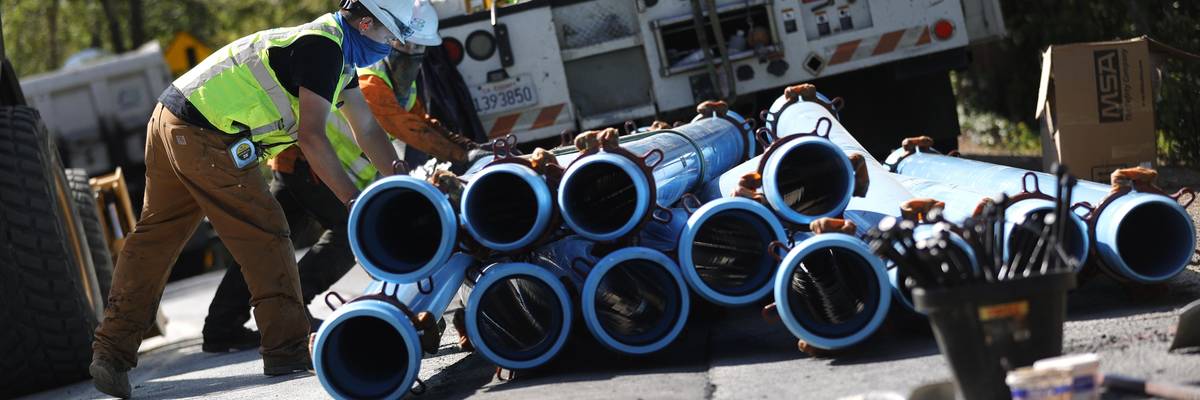
Workers with East Bay Municipal Utility District (EBMUD) stack water pipes before being installed on April 22, 2021 in Walnut Creek, California. (Photo: Justin Sullivan/Getty Images)
A number of progressive advocacy groups welcomed as a critical step forward the U.S. House's Thursday approval of a water and transportation infrastructure bill, the INVEST in America Act.
"This act is the real clean transportation and water plan people in our country deserve," said Deron Lovaas, a senior policy advocate in NRDC's Healthy People & Thriving Communities program, calling the bill "what we need to tackle the crises of crumbling roads and bridges, unsafe water, racial inequality, and climate change."
The bill passed in a 221-201 vote, with just two Republicans joining Democrats in voting yes. The GOP's near unanimous rejection came "even though it included earmarks proposed by Republican members that would explicitly help their districts," CBS News noted.
The vote came as progressive Democrats continue to demand that the bipartisan infrastructure bill be tied to a broader reconciliation package that includes spending on safety-net programs and investments in green energy.
As CNN reported:
House Democrats say the bill--known as the INVEST in America Act--will deliver on key priorities in President Joe Biden's American Jobs Plan, and they hope the legislative text can be used to negotiate with the Senate and the White House to determine what specific policy proposals can be included as part of the recently announced bipartisan infrastructure framework.
Democratic Rep. Peter DeFazio of Oregon, the lead sponsor of the INVEST Act and chair of the House Transportation and Infrastructure Committee, said at a news conference on Wednesday, "I'm suggesting that substantial amounts of the policy in our bill should be negotiated by the White House, and the Senate and the House to be part of that bipartisan proposal."
DeFazio introduced the bill last month, saying at the time that it would put "a core piece of President Biden's American Jobs Plan into legislative text--seizing this once-in-a-generation opportunity to move our transportation planning out of the 1950s and toward our clean energy future."
According to a fact sheet, the bill puts $343 billion towards roads, bridges, and safety, including $8.3 billion "for activities targeted to reduce carbon pollution and... $6.2 billion for mitigation and resiliency improvements"; $109 billion in transit with "record investments" to increase routes and service; $95 billion for passenger and freight rail, including a tripling of Amtrak funding; $117 billion in drinking water infrastructure and assistance. Water improvements also include "fully" replacing the nation's lead service lines and directing the Environmental Protection Agency to set national standards for PFAS and other toxins, as well as investing $51.25 million in wastewater infrastructure.
Environment America president Wendy Wendlandt called the INVEST in America Act "the approach we need to tackle today's problems, including the greatest challenge of our time: climate change."
She further welcomed the "bill's investments in clean, electric, and zero-carbon transportation options such as walking and biking" as "good news for people and the planet."
While welcoming parts of the bill, Mary Grant, the Public Water for All Campaign Director at Food & Water Watch, expressed concern that the INVEST Act's water infrastructure funding was insufficient and that the bipartisan infrastructure deal could facilitate privatization of public services including water.
"We applaud the House for its commitment to eliminate lead service lines and provide significant household water debt relief with a five-year shutoff moratorium," Grant said, referring to provision of the INVEST Act.
"This legislation offers a bolder response than the Senate's water bill," yet, she said, "the funding levels for water improvements are still not enough." Grant said it was crucial to "seize the opportunity provided by ongoing infrastructure negotiations and ensure the critical, transformative water funding the country really needs."
She suggested the Water Affordability, Transparency, Equity, and Reliability (WATER) Act be included in any infrastructure package as a way to help "provide a permanent water solution and ensure stronger, more resilient and more accessible water systems."
"Congress must reject the White House's ill-conceived bipartisan framework that would privatize water systems through public-private partnerships and asset recycling," she continued. "Our communities cannot afford that compromise on water."
For now, the manner the INVEST Act advances is unclear, Politico reported following the House vote.
"A surface transportation bill, considered must-pass legislation, will eventually be enacted in some way," the outlet noted. "But it's looking increasingly likely to be linked to broader efforts on infrastructure, which would mean an uncharted path ahead for the legislation, which has a deadline of the end of September."
Dear Common Dreams reader, It’s been nearly 30 years since I co-founded Common Dreams with my late wife, Lina Newhouser. We had the radical notion that journalism should serve the public good, not corporate profits. It was clear to us from the outset what it would take to build such a project. No paid advertisements. No corporate sponsors. No millionaire publisher telling us what to think or do. Many people said we wouldn't last a year, but we proved those doubters wrong. Together with a tremendous team of journalists and dedicated staff, we built an independent media outlet free from the constraints of profits and corporate control. Our mission has always been simple: To inform. To inspire. To ignite change for the common good. Building Common Dreams was not easy. Our survival was never guaranteed. When you take on the most powerful forces—Wall Street greed, fossil fuel industry destruction, Big Tech lobbyists, and uber-rich oligarchs who have spent billions upon billions rigging the economy and democracy in their favor—the only bulwark you have is supporters who believe in your work. But here’s the urgent message from me today. It's never been this bad out there. And it's never been this hard to keep us going. At the very moment Common Dreams is most needed, the threats we face are intensifying. We need your support now more than ever. We don't accept corporate advertising and never will. We don't have a paywall because we don't think people should be blocked from critical news based on their ability to pay. Everything we do is funded by the donations of readers like you. When everyone does the little they can afford, we are strong. But if that support retreats or dries up, so do we. Will you donate now to make sure Common Dreams not only survives but thrives? —Craig Brown, Co-founder |
A number of progressive advocacy groups welcomed as a critical step forward the U.S. House's Thursday approval of a water and transportation infrastructure bill, the INVEST in America Act.
"This act is the real clean transportation and water plan people in our country deserve," said Deron Lovaas, a senior policy advocate in NRDC's Healthy People & Thriving Communities program, calling the bill "what we need to tackle the crises of crumbling roads and bridges, unsafe water, racial inequality, and climate change."
The bill passed in a 221-201 vote, with just two Republicans joining Democrats in voting yes. The GOP's near unanimous rejection came "even though it included earmarks proposed by Republican members that would explicitly help their districts," CBS News noted.
The vote came as progressive Democrats continue to demand that the bipartisan infrastructure bill be tied to a broader reconciliation package that includes spending on safety-net programs and investments in green energy.
As CNN reported:
House Democrats say the bill--known as the INVEST in America Act--will deliver on key priorities in President Joe Biden's American Jobs Plan, and they hope the legislative text can be used to negotiate with the Senate and the White House to determine what specific policy proposals can be included as part of the recently announced bipartisan infrastructure framework.
Democratic Rep. Peter DeFazio of Oregon, the lead sponsor of the INVEST Act and chair of the House Transportation and Infrastructure Committee, said at a news conference on Wednesday, "I'm suggesting that substantial amounts of the policy in our bill should be negotiated by the White House, and the Senate and the House to be part of that bipartisan proposal."
DeFazio introduced the bill last month, saying at the time that it would put "a core piece of President Biden's American Jobs Plan into legislative text--seizing this once-in-a-generation opportunity to move our transportation planning out of the 1950s and toward our clean energy future."
According to a fact sheet, the bill puts $343 billion towards roads, bridges, and safety, including $8.3 billion "for activities targeted to reduce carbon pollution and... $6.2 billion for mitigation and resiliency improvements"; $109 billion in transit with "record investments" to increase routes and service; $95 billion for passenger and freight rail, including a tripling of Amtrak funding; $117 billion in drinking water infrastructure and assistance. Water improvements also include "fully" replacing the nation's lead service lines and directing the Environmental Protection Agency to set national standards for PFAS and other toxins, as well as investing $51.25 million in wastewater infrastructure.
Environment America president Wendy Wendlandt called the INVEST in America Act "the approach we need to tackle today's problems, including the greatest challenge of our time: climate change."
She further welcomed the "bill's investments in clean, electric, and zero-carbon transportation options such as walking and biking" as "good news for people and the planet."
While welcoming parts of the bill, Mary Grant, the Public Water for All Campaign Director at Food & Water Watch, expressed concern that the INVEST Act's water infrastructure funding was insufficient and that the bipartisan infrastructure deal could facilitate privatization of public services including water.
"We applaud the House for its commitment to eliminate lead service lines and provide significant household water debt relief with a five-year shutoff moratorium," Grant said, referring to provision of the INVEST Act.
"This legislation offers a bolder response than the Senate's water bill," yet, she said, "the funding levels for water improvements are still not enough." Grant said it was crucial to "seize the opportunity provided by ongoing infrastructure negotiations and ensure the critical, transformative water funding the country really needs."
She suggested the Water Affordability, Transparency, Equity, and Reliability (WATER) Act be included in any infrastructure package as a way to help "provide a permanent water solution and ensure stronger, more resilient and more accessible water systems."
"Congress must reject the White House's ill-conceived bipartisan framework that would privatize water systems through public-private partnerships and asset recycling," she continued. "Our communities cannot afford that compromise on water."
For now, the manner the INVEST Act advances is unclear, Politico reported following the House vote.
"A surface transportation bill, considered must-pass legislation, will eventually be enacted in some way," the outlet noted. "But it's looking increasingly likely to be linked to broader efforts on infrastructure, which would mean an uncharted path ahead for the legislation, which has a deadline of the end of September."
A number of progressive advocacy groups welcomed as a critical step forward the U.S. House's Thursday approval of a water and transportation infrastructure bill, the INVEST in America Act.
"This act is the real clean transportation and water plan people in our country deserve," said Deron Lovaas, a senior policy advocate in NRDC's Healthy People & Thriving Communities program, calling the bill "what we need to tackle the crises of crumbling roads and bridges, unsafe water, racial inequality, and climate change."
The bill passed in a 221-201 vote, with just two Republicans joining Democrats in voting yes. The GOP's near unanimous rejection came "even though it included earmarks proposed by Republican members that would explicitly help their districts," CBS News noted.
The vote came as progressive Democrats continue to demand that the bipartisan infrastructure bill be tied to a broader reconciliation package that includes spending on safety-net programs and investments in green energy.
As CNN reported:
House Democrats say the bill--known as the INVEST in America Act--will deliver on key priorities in President Joe Biden's American Jobs Plan, and they hope the legislative text can be used to negotiate with the Senate and the White House to determine what specific policy proposals can be included as part of the recently announced bipartisan infrastructure framework.
Democratic Rep. Peter DeFazio of Oregon, the lead sponsor of the INVEST Act and chair of the House Transportation and Infrastructure Committee, said at a news conference on Wednesday, "I'm suggesting that substantial amounts of the policy in our bill should be negotiated by the White House, and the Senate and the House to be part of that bipartisan proposal."
DeFazio introduced the bill last month, saying at the time that it would put "a core piece of President Biden's American Jobs Plan into legislative text--seizing this once-in-a-generation opportunity to move our transportation planning out of the 1950s and toward our clean energy future."
According to a fact sheet, the bill puts $343 billion towards roads, bridges, and safety, including $8.3 billion "for activities targeted to reduce carbon pollution and... $6.2 billion for mitigation and resiliency improvements"; $109 billion in transit with "record investments" to increase routes and service; $95 billion for passenger and freight rail, including a tripling of Amtrak funding; $117 billion in drinking water infrastructure and assistance. Water improvements also include "fully" replacing the nation's lead service lines and directing the Environmental Protection Agency to set national standards for PFAS and other toxins, as well as investing $51.25 million in wastewater infrastructure.
Environment America president Wendy Wendlandt called the INVEST in America Act "the approach we need to tackle today's problems, including the greatest challenge of our time: climate change."
She further welcomed the "bill's investments in clean, electric, and zero-carbon transportation options such as walking and biking" as "good news for people and the planet."
While welcoming parts of the bill, Mary Grant, the Public Water for All Campaign Director at Food & Water Watch, expressed concern that the INVEST Act's water infrastructure funding was insufficient and that the bipartisan infrastructure deal could facilitate privatization of public services including water.
"We applaud the House for its commitment to eliminate lead service lines and provide significant household water debt relief with a five-year shutoff moratorium," Grant said, referring to provision of the INVEST Act.
"This legislation offers a bolder response than the Senate's water bill," yet, she said, "the funding levels for water improvements are still not enough." Grant said it was crucial to "seize the opportunity provided by ongoing infrastructure negotiations and ensure the critical, transformative water funding the country really needs."
She suggested the Water Affordability, Transparency, Equity, and Reliability (WATER) Act be included in any infrastructure package as a way to help "provide a permanent water solution and ensure stronger, more resilient and more accessible water systems."
"Congress must reject the White House's ill-conceived bipartisan framework that would privatize water systems through public-private partnerships and asset recycling," she continued. "Our communities cannot afford that compromise on water."
For now, the manner the INVEST Act advances is unclear, Politico reported following the House vote.
"A surface transportation bill, considered must-pass legislation, will eventually be enacted in some way," the outlet noted. "But it's looking increasingly likely to be linked to broader efforts on infrastructure, which would mean an uncharted path ahead for the legislation, which has a deadline of the end of September."