

SUBSCRIBE TO OUR FREE NEWSLETTER
Daily news & progressive opinion—funded by the people, not the corporations—delivered straight to your inbox.
5
#000000
#FFFFFF
To donate by check, phone, or other method, see our More Ways to Give page.
Daily news & progressive opinion—funded by the people, not the corporations—delivered straight to your inbox.
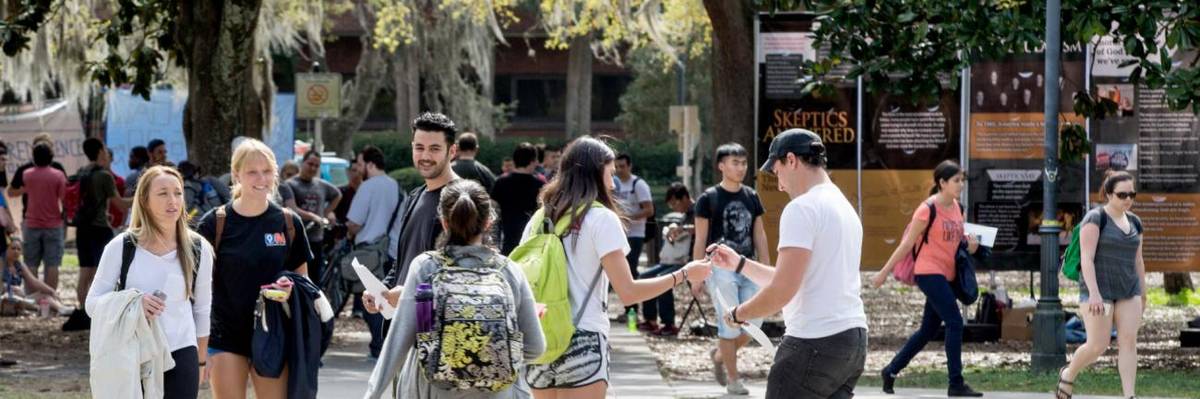
University of Florida students walk the campus on a spring afternoon in 2015. (Photo: Willie J. Allen Jr./Getty Images)
Democratic lawmakers and educators nationwide are expressing alarm over legislation signed this week by Florida Gov. Ron DeSantis which is ostensibly aimed at ensuring college students and educators in the state feel permitted to express a variety of political views--and which critics say could end up punishing professors whose opinions don't line up with those of the state's right-wing leaders.
DeSantis on Tuesday signed House Bill 233 into law, requiring more than three dozen public colleges and universities in Florida to conduct yearly surveys of their students' and faculty members' beliefs to determine the institutions' levels of "intellectual freedom and viewpoint diversity."
The state university system and board of education will be tasked with creating the surveys, which will ask whether campus community members "feel free to express their beliefs and viewpoints."
"[Faculty members] with controversial views, be they liberal or conservative, may find themselves increasingly vulnerable to political or ideological pressure, including from legislation like this." --AAUP
The law is vague regarding how state authorities can proceed if a university is found to be insufficiently welcoming to certain viewpoints; state Rep. Spencer Roach, a Republican who sponsored the bill in the House, told the Chronicle of Higher Education the survey results "could shape whatever action a university president may want to take or whatever action a future legislative body may want to take."
At a news conference on Tuesday, DeSantis said his government could intervene if it finds universities to be "hotbeds for stale ideology"--without specifying what that ideology might be--and suggesting funding cuts could ensue.
"That's not worth tax dollars and not something we're going to be supporting moving forward," the governor said.
The law does not ensure that surveys will be taken anonymously, raising concerns that faculty members could also face retaliation if they express progressive views or share that they would not welcome certain viewpoints--for example, discriminatory or abusive comments directed at a student--in their classrooms.
Under the law, students will also be permitted to record professors without their consent "in connection with a complaint," according to the Chronicle.
The measure "sounds like fascism to me!" tweeted Democratic state Rep. Anna V. Eskamani.
The legislation bars universities from "shielding" community members from views that they "may find uncomfortable, unwelcome, disagreeable, or offensive," noted the American Association of University Professors (AAUP).
"But does this mean that a professor could be barred from enforcing respectful and appropriate classroom conduct by students?" the group asked.
AAUP senior program officer Anita Levy called the law "a solution in search of a problem," while a union representing 20,000 college instructors in Florida questioned state Republicans' claims that the public university system is currently chilling free speech rights in classrooms.
The United Faculty of Florida has seen no rise in complaints against university instructors regarding their attitudes toward left-leaning viewpoints versus conservative opinions, or vice versa, union president Karen Morian told the Chronicle.
The AAUP pointed out that the University of Florida poured hundreds of thousands of dollars into campus safety measures in 2017 when Richard Spencer, a white nationalist, spoke at the school.
"Such expression is already protected by the First Amendment, as the state's universities have recognized," the organization said.
If DeSantis and state Republican legislators were truly concerned about ensuring "viewpoint diversity" on college campuses, the AAUP said, they would not threaten funding cuts but would instead "consider increasing funding for higher education so that a larger proportion of the faculty might be offered the prospect of tenure, which protects a faculty member's right to free expression."
"As it is, with nearly three-fourths of all U.S. faculty on short-term contingent contracts, often subject to arbitrary non-renewal, those with controversial views, be they liberal or conservative, may find themselves increasingly vulnerable to political or ideological pressure, including from legislation like this," the group said.
Dear Common Dreams reader, It’s been nearly 30 years since I co-founded Common Dreams with my late wife, Lina Newhouser. We had the radical notion that journalism should serve the public good, not corporate profits. It was clear to us from the outset what it would take to build such a project. No paid advertisements. No corporate sponsors. No millionaire publisher telling us what to think or do. Many people said we wouldn't last a year, but we proved those doubters wrong. Together with a tremendous team of journalists and dedicated staff, we built an independent media outlet free from the constraints of profits and corporate control. Our mission has always been simple: To inform. To inspire. To ignite change for the common good. Building Common Dreams was not easy. Our survival was never guaranteed. When you take on the most powerful forces—Wall Street greed, fossil fuel industry destruction, Big Tech lobbyists, and uber-rich oligarchs who have spent billions upon billions rigging the economy and democracy in their favor—the only bulwark you have is supporters who believe in your work. But here’s the urgent message from me today. It's never been this bad out there. And it's never been this hard to keep us going. At the very moment Common Dreams is most needed, the threats we face are intensifying. We need your support now more than ever. We don't accept corporate advertising and never will. We don't have a paywall because we don't think people should be blocked from critical news based on their ability to pay. Everything we do is funded by the donations of readers like you. When everyone does the little they can afford, we are strong. But if that support retreats or dries up, so do we. Will you donate now to make sure Common Dreams not only survives but thrives? —Craig Brown, Co-founder |
Democratic lawmakers and educators nationwide are expressing alarm over legislation signed this week by Florida Gov. Ron DeSantis which is ostensibly aimed at ensuring college students and educators in the state feel permitted to express a variety of political views--and which critics say could end up punishing professors whose opinions don't line up with those of the state's right-wing leaders.
DeSantis on Tuesday signed House Bill 233 into law, requiring more than three dozen public colleges and universities in Florida to conduct yearly surveys of their students' and faculty members' beliefs to determine the institutions' levels of "intellectual freedom and viewpoint diversity."
The state university system and board of education will be tasked with creating the surveys, which will ask whether campus community members "feel free to express their beliefs and viewpoints."
"[Faculty members] with controversial views, be they liberal or conservative, may find themselves increasingly vulnerable to political or ideological pressure, including from legislation like this." --AAUP
The law is vague regarding how state authorities can proceed if a university is found to be insufficiently welcoming to certain viewpoints; state Rep. Spencer Roach, a Republican who sponsored the bill in the House, told the Chronicle of Higher Education the survey results "could shape whatever action a university president may want to take or whatever action a future legislative body may want to take."
At a news conference on Tuesday, DeSantis said his government could intervene if it finds universities to be "hotbeds for stale ideology"--without specifying what that ideology might be--and suggesting funding cuts could ensue.
"That's not worth tax dollars and not something we're going to be supporting moving forward," the governor said.
The law does not ensure that surveys will be taken anonymously, raising concerns that faculty members could also face retaliation if they express progressive views or share that they would not welcome certain viewpoints--for example, discriminatory or abusive comments directed at a student--in their classrooms.
Under the law, students will also be permitted to record professors without their consent "in connection with a complaint," according to the Chronicle.
The measure "sounds like fascism to me!" tweeted Democratic state Rep. Anna V. Eskamani.
The legislation bars universities from "shielding" community members from views that they "may find uncomfortable, unwelcome, disagreeable, or offensive," noted the American Association of University Professors (AAUP).
"But does this mean that a professor could be barred from enforcing respectful and appropriate classroom conduct by students?" the group asked.
AAUP senior program officer Anita Levy called the law "a solution in search of a problem," while a union representing 20,000 college instructors in Florida questioned state Republicans' claims that the public university system is currently chilling free speech rights in classrooms.
The United Faculty of Florida has seen no rise in complaints against university instructors regarding their attitudes toward left-leaning viewpoints versus conservative opinions, or vice versa, union president Karen Morian told the Chronicle.
The AAUP pointed out that the University of Florida poured hundreds of thousands of dollars into campus safety measures in 2017 when Richard Spencer, a white nationalist, spoke at the school.
"Such expression is already protected by the First Amendment, as the state's universities have recognized," the organization said.
If DeSantis and state Republican legislators were truly concerned about ensuring "viewpoint diversity" on college campuses, the AAUP said, they would not threaten funding cuts but would instead "consider increasing funding for higher education so that a larger proportion of the faculty might be offered the prospect of tenure, which protects a faculty member's right to free expression."
"As it is, with nearly three-fourths of all U.S. faculty on short-term contingent contracts, often subject to arbitrary non-renewal, those with controversial views, be they liberal or conservative, may find themselves increasingly vulnerable to political or ideological pressure, including from legislation like this," the group said.
Democratic lawmakers and educators nationwide are expressing alarm over legislation signed this week by Florida Gov. Ron DeSantis which is ostensibly aimed at ensuring college students and educators in the state feel permitted to express a variety of political views--and which critics say could end up punishing professors whose opinions don't line up with those of the state's right-wing leaders.
DeSantis on Tuesday signed House Bill 233 into law, requiring more than three dozen public colleges and universities in Florida to conduct yearly surveys of their students' and faculty members' beliefs to determine the institutions' levels of "intellectual freedom and viewpoint diversity."
The state university system and board of education will be tasked with creating the surveys, which will ask whether campus community members "feel free to express their beliefs and viewpoints."
"[Faculty members] with controversial views, be they liberal or conservative, may find themselves increasingly vulnerable to political or ideological pressure, including from legislation like this." --AAUP
The law is vague regarding how state authorities can proceed if a university is found to be insufficiently welcoming to certain viewpoints; state Rep. Spencer Roach, a Republican who sponsored the bill in the House, told the Chronicle of Higher Education the survey results "could shape whatever action a university president may want to take or whatever action a future legislative body may want to take."
At a news conference on Tuesday, DeSantis said his government could intervene if it finds universities to be "hotbeds for stale ideology"--without specifying what that ideology might be--and suggesting funding cuts could ensue.
"That's not worth tax dollars and not something we're going to be supporting moving forward," the governor said.
The law does not ensure that surveys will be taken anonymously, raising concerns that faculty members could also face retaliation if they express progressive views or share that they would not welcome certain viewpoints--for example, discriminatory or abusive comments directed at a student--in their classrooms.
Under the law, students will also be permitted to record professors without their consent "in connection with a complaint," according to the Chronicle.
The measure "sounds like fascism to me!" tweeted Democratic state Rep. Anna V. Eskamani.
The legislation bars universities from "shielding" community members from views that they "may find uncomfortable, unwelcome, disagreeable, or offensive," noted the American Association of University Professors (AAUP).
"But does this mean that a professor could be barred from enforcing respectful and appropriate classroom conduct by students?" the group asked.
AAUP senior program officer Anita Levy called the law "a solution in search of a problem," while a union representing 20,000 college instructors in Florida questioned state Republicans' claims that the public university system is currently chilling free speech rights in classrooms.
The United Faculty of Florida has seen no rise in complaints against university instructors regarding their attitudes toward left-leaning viewpoints versus conservative opinions, or vice versa, union president Karen Morian told the Chronicle.
The AAUP pointed out that the University of Florida poured hundreds of thousands of dollars into campus safety measures in 2017 when Richard Spencer, a white nationalist, spoke at the school.
"Such expression is already protected by the First Amendment, as the state's universities have recognized," the organization said.
If DeSantis and state Republican legislators were truly concerned about ensuring "viewpoint diversity" on college campuses, the AAUP said, they would not threaten funding cuts but would instead "consider increasing funding for higher education so that a larger proportion of the faculty might be offered the prospect of tenure, which protects a faculty member's right to free expression."
"As it is, with nearly three-fourths of all U.S. faculty on short-term contingent contracts, often subject to arbitrary non-renewal, those with controversial views, be they liberal or conservative, may find themselves increasingly vulnerable to political or ideological pressure, including from legislation like this," the group said.

