SUBSCRIBE TO OUR FREE NEWSLETTER
Daily news & progressive opinion—funded by the people, not the corporations—delivered straight to your inbox.
5
#000000
#FFFFFF
To donate by check, phone, or other method, see our More Ways to Give page.
Daily news & progressive opinion—funded by the people, not the corporations—delivered straight to your inbox.
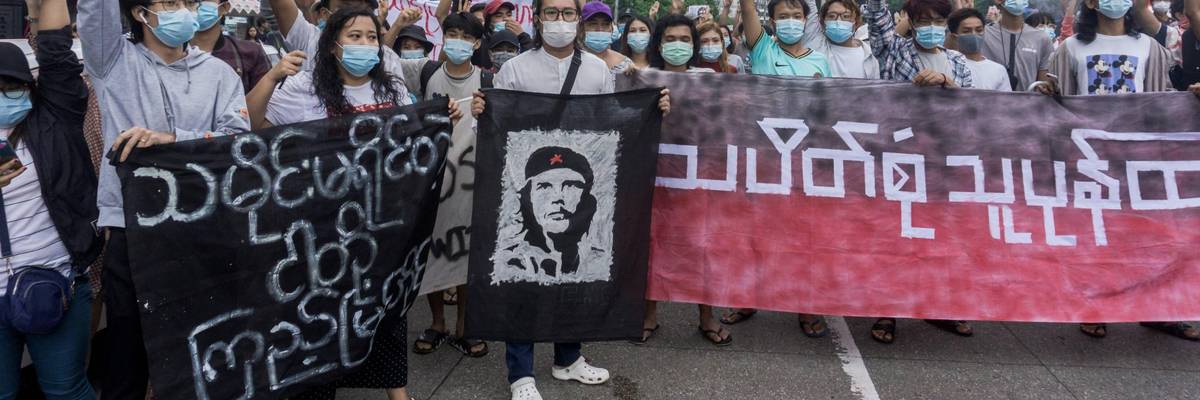
Protesters make the three-finger salute as they take part in a flash mob demonstration against the Myanmar military coup in Yangon on June 14, 2021. (Photo: STR/AFP via Getty Images)
Human rights defenders on Friday mostly welcomed a United Nations General Assembly resolution "strongly condemning" deadly violence perpetrated by Myanmar's military coup regime in recent months and calling on member nations to "prevent the flow of arms" into the country.
The 193-member U.N. General Assembly voted 119 to 1--with Belarus casting the sole dissenting vote--in favor of the resolution. There were 36 abstentions, including China, Egypt, India, Iran, Pakistan, Russia, and the United Arab Emirates. Thirty-seven other U.N. member states did not vote.
The resolution expresses "deep concern about the arbitrary detention and arrest of President Win Myint, State Counsellor Aung San Suu Kyi, and other government officials and politicians, human rights defenders, journalists, civil society members, foreign experts, and others," while "strongly condemning the use of lethal force" by the coup regime.
The junta's deadly crackdown, the resolution says, "has led to injuries and fatalities in many cases, against peaceful demonstrators, as well as members of civil society, women, youth, children, and others."
"We absolutely must create the conditions for democracy to be reinstated."
--U.N. Secretary-General Antonio Guterres
The resolution also expressed concern over "the human rights situation of persons belonging to ethnic, religious, and other minorities in Myanmar, including the Rohingya Muslim minority," as well as "the ongoing conflict in Kachin, Kayin, Rakhine, Shan, and southern Chin states between the Myanmar armed forces and other groups, and at the persistent impunity for crimes committed by the Myanmar armed forces."
Since Myanmar's military seized control of the country on February 1, regime forces have killed hundreds of men, women, and children during a nationwide crackdown on dissent. State security forces have been accused of widespread arbitrary arrests and torture--sometimes deadly--forced disappearances, and other grave human rights crimes.
The Associated Press reports the resolution is the product of lengthy negotiations by the so-called Core Group, which includes the 10 members of the Association of Southeast Asian Nations (ASEAN), the European Union, and numerous Western nations.
Four members of ASEAN--Brunei, Cambodia, Laos, and Thailand--did not vote for the resolution. Myanmar is also a member of the bloc. On Wednesday, ASEAN defense ministers, including Myanmar junta representative Myan Tun Oo, convened for a virtual meeting also attended by U.S. Defense Secretary Lloyd Austin, who called on the coup regime to "change course."
U.N. Secretary-General Antonio Guterres addressed the situation in Myanmar during a news conference earlier on Friday, asserting that "we absolutely must create the conditions for democracy to be reinstated, even if it was not a perfect democracy."
Guterres called for "those that were... put in prison to be liberated, and for the horrible violations of human rights and the killings that have taken place to stop," while imploring U.N. member states to "send a very clear message" that "we cannot live in a world where military coups become a norm."
"It is totally unacceptable," he said.
Some human rights groups applauded Friday's resolution.
"Today the General Assembly, as the voice of the entire international community, joins the Human Rights Council and the U.N. Security Council in condemning the Myanmar military's killing spree against its own people," Lawrence Moss, senior U.N. advocate for Amnesty International, said in a statement. "The Myanmar military must immediately meet these calls, and the U.N. Security Council must act to enforce them."
"All countries should heed the resolution's call to prevent the flow of arms into Myanmar, and the Security Council should immediately make this mandatory by imposing a comprehensive global arms embargo on Myanmar," Moss continued.
However, some rights defenders expressed disappointment with the General Assembly, with Justice for Myanmar tweeting that "ASEAN shamefully watered down" calls for an international arms embargo against the coup regime.
The resolution came as anti-coup resistance and brutal repression continued around Myanmar. On Thursday, regime forces burned the village of Kin Ma in Magway region, killing at least two people and destroying around 200 homes, The Guardian reported.
The human rights group AAPP Burma tweeted late Friday that 870 people have been killed by the junta, with nearly 5,000 others currently sentenced or detained by the regime.
Dear Common Dreams reader, It’s been nearly 30 years since I co-founded Common Dreams with my late wife, Lina Newhouser. We had the radical notion that journalism should serve the public good, not corporate profits. It was clear to us from the outset what it would take to build such a project. No paid advertisements. No corporate sponsors. No millionaire publisher telling us what to think or do. Many people said we wouldn't last a year, but we proved those doubters wrong. Together with a tremendous team of journalists and dedicated staff, we built an independent media outlet free from the constraints of profits and corporate control. Our mission has always been simple: To inform. To inspire. To ignite change for the common good. Building Common Dreams was not easy. Our survival was never guaranteed. When you take on the most powerful forces—Wall Street greed, fossil fuel industry destruction, Big Tech lobbyists, and uber-rich oligarchs who have spent billions upon billions rigging the economy and democracy in their favor—the only bulwark you have is supporters who believe in your work. But here’s the urgent message from me today. It's never been this bad out there. And it's never been this hard to keep us going. At the very moment Common Dreams is most needed, the threats we face are intensifying. We need your support now more than ever. We don't accept corporate advertising and never will. We don't have a paywall because we don't think people should be blocked from critical news based on their ability to pay. Everything we do is funded by the donations of readers like you. When everyone does the little they can afford, we are strong. But if that support retreats or dries up, so do we. Will you donate now to make sure Common Dreams not only survives but thrives? —Craig Brown, Co-founder |
Human rights defenders on Friday mostly welcomed a United Nations General Assembly resolution "strongly condemning" deadly violence perpetrated by Myanmar's military coup regime in recent months and calling on member nations to "prevent the flow of arms" into the country.
The 193-member U.N. General Assembly voted 119 to 1--with Belarus casting the sole dissenting vote--in favor of the resolution. There were 36 abstentions, including China, Egypt, India, Iran, Pakistan, Russia, and the United Arab Emirates. Thirty-seven other U.N. member states did not vote.
The resolution expresses "deep concern about the arbitrary detention and arrest of President Win Myint, State Counsellor Aung San Suu Kyi, and other government officials and politicians, human rights defenders, journalists, civil society members, foreign experts, and others," while "strongly condemning the use of lethal force" by the coup regime.
The junta's deadly crackdown, the resolution says, "has led to injuries and fatalities in many cases, against peaceful demonstrators, as well as members of civil society, women, youth, children, and others."
"We absolutely must create the conditions for democracy to be reinstated."
--U.N. Secretary-General Antonio Guterres
The resolution also expressed concern over "the human rights situation of persons belonging to ethnic, religious, and other minorities in Myanmar, including the Rohingya Muslim minority," as well as "the ongoing conflict in Kachin, Kayin, Rakhine, Shan, and southern Chin states between the Myanmar armed forces and other groups, and at the persistent impunity for crimes committed by the Myanmar armed forces."
Since Myanmar's military seized control of the country on February 1, regime forces have killed hundreds of men, women, and children during a nationwide crackdown on dissent. State security forces have been accused of widespread arbitrary arrests and torture--sometimes deadly--forced disappearances, and other grave human rights crimes.
The Associated Press reports the resolution is the product of lengthy negotiations by the so-called Core Group, which includes the 10 members of the Association of Southeast Asian Nations (ASEAN), the European Union, and numerous Western nations.
Four members of ASEAN--Brunei, Cambodia, Laos, and Thailand--did not vote for the resolution. Myanmar is also a member of the bloc. On Wednesday, ASEAN defense ministers, including Myanmar junta representative Myan Tun Oo, convened for a virtual meeting also attended by U.S. Defense Secretary Lloyd Austin, who called on the coup regime to "change course."
U.N. Secretary-General Antonio Guterres addressed the situation in Myanmar during a news conference earlier on Friday, asserting that "we absolutely must create the conditions for democracy to be reinstated, even if it was not a perfect democracy."
Guterres called for "those that were... put in prison to be liberated, and for the horrible violations of human rights and the killings that have taken place to stop," while imploring U.N. member states to "send a very clear message" that "we cannot live in a world where military coups become a norm."
"It is totally unacceptable," he said.
Some human rights groups applauded Friday's resolution.
"Today the General Assembly, as the voice of the entire international community, joins the Human Rights Council and the U.N. Security Council in condemning the Myanmar military's killing spree against its own people," Lawrence Moss, senior U.N. advocate for Amnesty International, said in a statement. "The Myanmar military must immediately meet these calls, and the U.N. Security Council must act to enforce them."
"All countries should heed the resolution's call to prevent the flow of arms into Myanmar, and the Security Council should immediately make this mandatory by imposing a comprehensive global arms embargo on Myanmar," Moss continued.
However, some rights defenders expressed disappointment with the General Assembly, with Justice for Myanmar tweeting that "ASEAN shamefully watered down" calls for an international arms embargo against the coup regime.
The resolution came as anti-coup resistance and brutal repression continued around Myanmar. On Thursday, regime forces burned the village of Kin Ma in Magway region, killing at least two people and destroying around 200 homes, The Guardian reported.
The human rights group AAPP Burma tweeted late Friday that 870 people have been killed by the junta, with nearly 5,000 others currently sentenced or detained by the regime.
Human rights defenders on Friday mostly welcomed a United Nations General Assembly resolution "strongly condemning" deadly violence perpetrated by Myanmar's military coup regime in recent months and calling on member nations to "prevent the flow of arms" into the country.
The 193-member U.N. General Assembly voted 119 to 1--with Belarus casting the sole dissenting vote--in favor of the resolution. There were 36 abstentions, including China, Egypt, India, Iran, Pakistan, Russia, and the United Arab Emirates. Thirty-seven other U.N. member states did not vote.
The resolution expresses "deep concern about the arbitrary detention and arrest of President Win Myint, State Counsellor Aung San Suu Kyi, and other government officials and politicians, human rights defenders, journalists, civil society members, foreign experts, and others," while "strongly condemning the use of lethal force" by the coup regime.
The junta's deadly crackdown, the resolution says, "has led to injuries and fatalities in many cases, against peaceful demonstrators, as well as members of civil society, women, youth, children, and others."
"We absolutely must create the conditions for democracy to be reinstated."
--U.N. Secretary-General Antonio Guterres
The resolution also expressed concern over "the human rights situation of persons belonging to ethnic, religious, and other minorities in Myanmar, including the Rohingya Muslim minority," as well as "the ongoing conflict in Kachin, Kayin, Rakhine, Shan, and southern Chin states between the Myanmar armed forces and other groups, and at the persistent impunity for crimes committed by the Myanmar armed forces."
Since Myanmar's military seized control of the country on February 1, regime forces have killed hundreds of men, women, and children during a nationwide crackdown on dissent. State security forces have been accused of widespread arbitrary arrests and torture--sometimes deadly--forced disappearances, and other grave human rights crimes.
The Associated Press reports the resolution is the product of lengthy negotiations by the so-called Core Group, which includes the 10 members of the Association of Southeast Asian Nations (ASEAN), the European Union, and numerous Western nations.
Four members of ASEAN--Brunei, Cambodia, Laos, and Thailand--did not vote for the resolution. Myanmar is also a member of the bloc. On Wednesday, ASEAN defense ministers, including Myanmar junta representative Myan Tun Oo, convened for a virtual meeting also attended by U.S. Defense Secretary Lloyd Austin, who called on the coup regime to "change course."
U.N. Secretary-General Antonio Guterres addressed the situation in Myanmar during a news conference earlier on Friday, asserting that "we absolutely must create the conditions for democracy to be reinstated, even if it was not a perfect democracy."
Guterres called for "those that were... put in prison to be liberated, and for the horrible violations of human rights and the killings that have taken place to stop," while imploring U.N. member states to "send a very clear message" that "we cannot live in a world where military coups become a norm."
"It is totally unacceptable," he said.
Some human rights groups applauded Friday's resolution.
"Today the General Assembly, as the voice of the entire international community, joins the Human Rights Council and the U.N. Security Council in condemning the Myanmar military's killing spree against its own people," Lawrence Moss, senior U.N. advocate for Amnesty International, said in a statement. "The Myanmar military must immediately meet these calls, and the U.N. Security Council must act to enforce them."
"All countries should heed the resolution's call to prevent the flow of arms into Myanmar, and the Security Council should immediately make this mandatory by imposing a comprehensive global arms embargo on Myanmar," Moss continued.
However, some rights defenders expressed disappointment with the General Assembly, with Justice for Myanmar tweeting that "ASEAN shamefully watered down" calls for an international arms embargo against the coup regime.
The resolution came as anti-coup resistance and brutal repression continued around Myanmar. On Thursday, regime forces burned the village of Kin Ma in Magway region, killing at least two people and destroying around 200 homes, The Guardian reported.
The human rights group AAPP Burma tweeted late Friday that 870 people have been killed by the junta, with nearly 5,000 others currently sentenced or detained by the regime.