
Rep. Ilhan Omar (D-Minn.) speaks during a press conference at a memorial for Daunte Wright on April 20, 2021 in Brooklyn Center, Minnesota. (Photo: Stephen Maturen via Getty Images)
If Healthcare Is a Right, 'Support Medicare for All,' Omar Tells Biden
President Joe Biden said "healthcare should be a right, not a privilege in America." Rep. Ilhan Omar says there's an easy way to prove it.
During his first speech to a joint session of Congress on Wednesday night, President Joe Biden said that "healthcare should be a right, not a privilege in America."
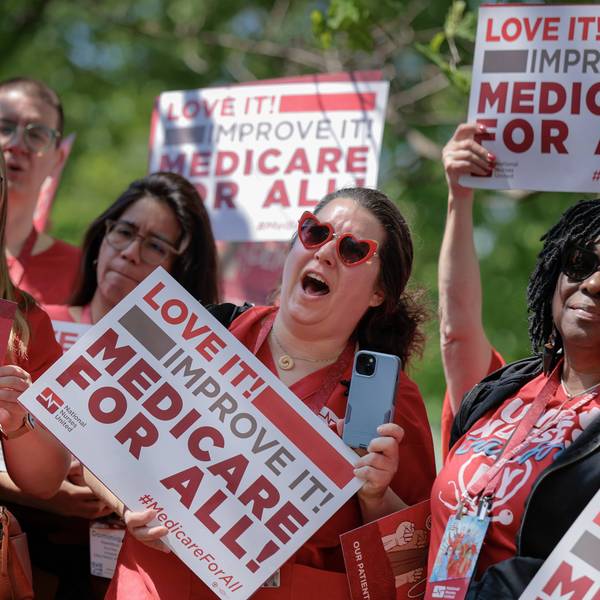
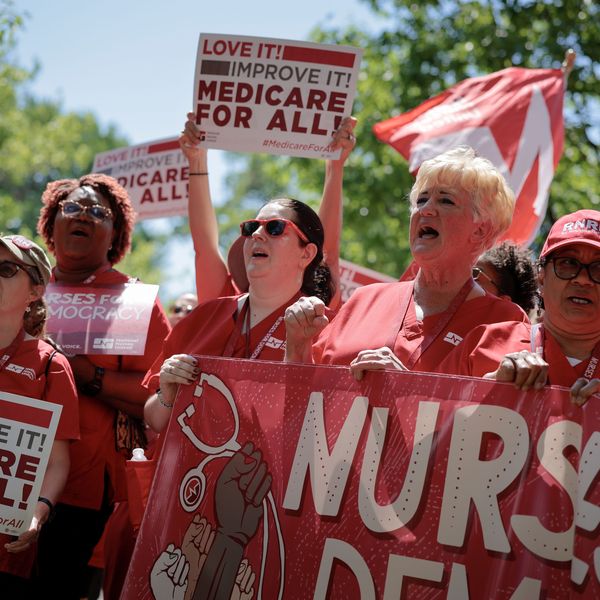
To which Rep. Ilhan Omar (D-Minn.) responded: "If you say you believe healthcare is a right and not a privilege, [then] support Medicare for All."
Democratic Reps. Rashida Tlaib (Mich.), Ayanna Pressley (Mass.), and Pramila Jayapal (Wash.) all shared similar messages.
Despite pressure from Democratic lawmakers in the House and Senate as well as dozens of advocacy groups, Biden declined to propose lowering Medicare's eligibility age from 65 to 60--let alone providing Medicare to every person in the country--in his American Families Plan, the $1.8 trillion social spending and tax reform package he showcased on Wednesday.
In his speech, the president did call on Congress to "lower prescription drug costs" by giving "Medicare the power to save hundreds of billions of dollars by negotiating lower drug prescription prices." He said that the savings could be used to "expand Medicare coverage and benefits without costing taxpayers an additional penny."
And yet, Biden chose not to include any Medicare-related provisions in his American Families Plan.
Ahead of Biden's Wednesday night address to Congress, Sen. Bernie Sanders (I-Vt.) declared in a video that "we've got to deal with healthcare."
Expanding access to and improving Medicare is popular across political party lines, according to polling results (pdf) released last week by Data for Progress.
Although most voters support lowering the Medicare eligibility age to 55, reducing it to zero is even more popular.
Seventy-two percent of Fox News viewers said last year that they favor "changing to a government-run healthcare plan," a reflection of the extent to which Americans are fed up with either being deprived of health insurance or paying exorbitant amounts of money for it under an employment-based, for-profit model.
In his speech, Biden acknowledged that "the pandemic has demonstrated how badly [healthcare] is needed," but critics noted the chasm between that statement and what is currently on offer from the president, who has been adamant in his opposition to Medicare for All.
Public Citizen published a report last month showing that Medicare for All likely would have prevented millions of Covid-19 infections and hundreds of thousands of deaths nationwide. According to the advocacy group, roughly 40% of coronavirus infections and 33% of resultant deaths in the U.S. up to that point were associated with a lack of health insurance.
Before the pandemic, around 87 million Americans were already uninsured or underinsured. In the past year, millions more have been thrown off their employer-provided coverage due to widespread job losses.
Apparently, even a national Covid-19 death toll of nearly 575,000 isn't enough to convince Biden to embrace Medicare for All. The president didn't even include a modest expansion of Medicare beneficiaries and benefits in his American Families Plan, although progressive lawmakers have vowed to fight for its inclusion.
Biden, who pays lip service to universal coverage as he opposes a single-payer health insurance system, remains committed to promoting the Affordable Care Act and has expressed support for a public option, even though health experts have stressed that such an approach would not eliminate burdensome co-pays and deductibles and would still leave millions uninsured.
The Congressional Budget Office has shown that implementing a single-payer system would guarantee high-quality care for every person in the U.S. while reducing overall spending by an estimated $650 billion per year.
Earlier this year, a Lancet panel of policy experts and medical professionals argued that "single-payer, Medicare for All reform is the only way forward" in the wake of the devastation wrought by the coronavirus crisis, which was preceded by "decades of healthcare inequality, privatization, and profiteering."
We are at a crossroads
This country and this world are at a monumental crossroads. In a few short weeks, US voters will have an opportunity to beat back the forces of fascism and confront the billionaires who are rigging the economy, our media system, and our democracy, making it increasingly impossible for ordinary people to get by. We’re not just talking about the election. We’re talking about what must be done once these fascist elements are vanquished from power. We need a bolder set of solutions than what either major party has so far been willing to offer and a working-class movement ready to fight like hell for it. Trump didn't emerge from nowhere. The conditions that fueled MAGA authoritarianism were created by decades of radical neoliberal economic policies and a corrupt political system dominated by corporate interests. They slashed taxes on the super-rich, promising that the benefits would trickle down. They said giveaways to the corporate titans would make life more affordable for the rest of us. It was all bullshit. And when a bitter, betrayed populace searches for someone to blame, right-wing demagogues have little trouble finding scapegoats. People know when they're being lied to, but you won't hear any of this from the corporate media. Only independent journalism—powered and funded by people who believe in building a better world—can deliver truly trustworthy daily news. Our Fall Campaign is underway, and we need your help. To power our newsroom through the rest of the year, we need to raise $125,000 by midnight on October 31. So if you share our vision, please contribute whatever you can to sustain our work. |
During his first speech to a joint session of Congress on Wednesday night, President Joe Biden said that "healthcare should be a right, not a privilege in America."
To which Rep. Ilhan Omar (D-Minn.) responded: "If you say you believe healthcare is a right and not a privilege, [then] support Medicare for All."
Democratic Reps. Rashida Tlaib (Mich.), Ayanna Pressley (Mass.), and Pramila Jayapal (Wash.) all shared similar messages.
Despite pressure from Democratic lawmakers in the House and Senate as well as dozens of advocacy groups, Biden declined to propose lowering Medicare's eligibility age from 65 to 60--let alone providing Medicare to every person in the country--in his American Families Plan, the $1.8 trillion social spending and tax reform package he showcased on Wednesday.
In his speech, the president did call on Congress to "lower prescription drug costs" by giving "Medicare the power to save hundreds of billions of dollars by negotiating lower drug prescription prices." He said that the savings could be used to "expand Medicare coverage and benefits without costing taxpayers an additional penny."
And yet, Biden chose not to include any Medicare-related provisions in his American Families Plan.
Ahead of Biden's Wednesday night address to Congress, Sen. Bernie Sanders (I-Vt.) declared in a video that "we've got to deal with healthcare."
Expanding access to and improving Medicare is popular across political party lines, according to polling results (pdf) released last week by Data for Progress.
Although most voters support lowering the Medicare eligibility age to 55, reducing it to zero is even more popular.
Seventy-two percent of Fox News viewers said last year that they favor "changing to a government-run healthcare plan," a reflection of the extent to which Americans are fed up with either being deprived of health insurance or paying exorbitant amounts of money for it under an employment-based, for-profit model.
In his speech, Biden acknowledged that "the pandemic has demonstrated how badly [healthcare] is needed," but critics noted the chasm between that statement and what is currently on offer from the president, who has been adamant in his opposition to Medicare for All.
Public Citizen published a report last month showing that Medicare for All likely would have prevented millions of Covid-19 infections and hundreds of thousands of deaths nationwide. According to the advocacy group, roughly 40% of coronavirus infections and 33% of resultant deaths in the U.S. up to that point were associated with a lack of health insurance.
Before the pandemic, around 87 million Americans were already uninsured or underinsured. In the past year, millions more have been thrown off their employer-provided coverage due to widespread job losses.
Apparently, even a national Covid-19 death toll of nearly 575,000 isn't enough to convince Biden to embrace Medicare for All. The president didn't even include a modest expansion of Medicare beneficiaries and benefits in his American Families Plan, although progressive lawmakers have vowed to fight for its inclusion.
Biden, who pays lip service to universal coverage as he opposes a single-payer health insurance system, remains committed to promoting the Affordable Care Act and has expressed support for a public option, even though health experts have stressed that such an approach would not eliminate burdensome co-pays and deductibles and would still leave millions uninsured.
The Congressional Budget Office has shown that implementing a single-payer system would guarantee high-quality care for every person in the U.S. while reducing overall spending by an estimated $650 billion per year.
Earlier this year, a Lancet panel of policy experts and medical professionals argued that "single-payer, Medicare for All reform is the only way forward" in the wake of the devastation wrought by the coronavirus crisis, which was preceded by "decades of healthcare inequality, privatization, and profiteering."