

SUBSCRIBE TO OUR FREE NEWSLETTER
Daily news & progressive opinion—funded by the people, not the corporations—delivered straight to your inbox.
5
#000000
#FFFFFF
To donate by check, phone, or other method, see our More Ways to Give page.
Daily news & progressive opinion—funded by the people, not the corporations—delivered straight to your inbox.
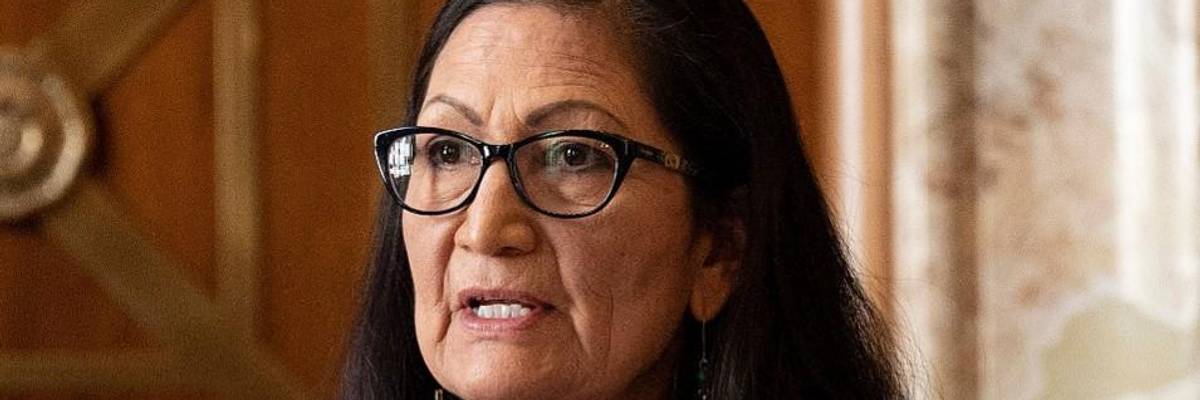
On April 1, 2021 U.S. Interior Secretary announced a new Bureau of Indian Affairs unit dedicated to the investigation of missing and murdered Indigenous people. (Photo: Tom Williams/CQ-Roll Call, Inc. via Getty Images)
Human rights defenders on Friday applauded the announcement by U.S. Interior Secretary Deb Haaland that the Bureau of Indian Affairs will establish a unit tasked with investigating missing and murdered Indigenous people.
"Violence against Indigenous peoples is a crisis that has been underfunded for decades. Far too often, murders and missing persons cases in Indian country go unsolved and unaddressed, leaving families and communities devastated."
--Interior Secretary
Deb Haaland
The Interior Department said in a statement Thursday that "approximately 1,500 American Indian and Alaska Native missing persons have been entered into the National Crime Information Center throughout the U.S., and approximately 2,700 cases of murder and nonnegligent homicide offenses have been reported to the federal government's Uniform Crime Reporting program."
The agency said that the new Missing & Murdered Unit (MMU) "will help put the full weight of the federal government into investigating these cases and marshal law enforcement resources across federal agencies and throughout Indian country."
The MMU will build on the work of Operation Lady Justice, a task force on missing and murdered Indigenous people launched in 2019.
"Investigations remain unsolved often due to a lack of investigative resources available to identify new information from witness testimony, re-examine new or retained material evidence, and review fresh activities of suspects," the Interior Department statement said. "The MMU, in addition to reviewing unsolved cases, will immediately begin working with tribal, BIA, and FBI investigators on active missing and murdered investigations."
Haaland--the first Native American Cabinet secretary in U.S. history--said Thursday that "violence against Indigenous peoples is a crisis that has been underfunded for decades. Far too often, murders and missing persons cases in Indian country go unsolved and unaddressed, leaving families and communities devastated."
"The new MMU unit will provide the resources and leadership to prioritize these cases and coordinate resources to hold people accountable, keep our communities safe, and provide closure for families," Haaland continued. "Whether it's a missing family member or a homicide investigation, these efforts will be all hands on deck."
"We are fully committed to assisting tribal communities with these investigations, and the MMU will leverage every resource available to be a force-multiplier in preventing these cases from becoming cold case investigations," she added.
According to the Coalition to Stop Violence Against Native Women, Indigenous women are murdered at 10 times the national average. Statistics from the U.S. Centers for Disease Control and Prevention show homicide is the third-leading cause of death among American Indian and Alaska Native girls and women ages 10 to 24 and the fifth-leading cause of death for those between the ages of 25 and 34.
A 2016 National Institute of Justice report (pdf) found that 84% of Indigenous women have experienced violence in their lifetimes, 41% had been physically injured by intimate partners, and 67% were concerned for their safety.
Two years later, a survey (pdf) published by the Seattle-based Urban Indian Health Institute reported 5,712 cases of missing and murdered Indigenous girls in 2016, of which only 116 were logged in the U.S. Department of Justice's federal missing persons database.
May 5 is National Day of Awareness for missing and murdered Native women and girls.
Dear Common Dreams reader, It’s been nearly 30 years since I co-founded Common Dreams with my late wife, Lina Newhouser. We had the radical notion that journalism should serve the public good, not corporate profits. It was clear to us from the outset what it would take to build such a project. No paid advertisements. No corporate sponsors. No millionaire publisher telling us what to think or do. Many people said we wouldn't last a year, but we proved those doubters wrong. Together with a tremendous team of journalists and dedicated staff, we built an independent media outlet free from the constraints of profits and corporate control. Our mission has always been simple: To inform. To inspire. To ignite change for the common good. Building Common Dreams was not easy. Our survival was never guaranteed. When you take on the most powerful forces—Wall Street greed, fossil fuel industry destruction, Big Tech lobbyists, and uber-rich oligarchs who have spent billions upon billions rigging the economy and democracy in their favor—the only bulwark you have is supporters who believe in your work. But here’s the urgent message from me today. It's never been this bad out there. And it's never been this hard to keep us going. At the very moment Common Dreams is most needed, the threats we face are intensifying. We need your support now more than ever. We don't accept corporate advertising and never will. We don't have a paywall because we don't think people should be blocked from critical news based on their ability to pay. Everything we do is funded by the donations of readers like you. When everyone does the little they can afford, we are strong. But if that support retreats or dries up, so do we. Will you donate now to make sure Common Dreams not only survives but thrives? —Craig Brown, Co-founder |
Human rights defenders on Friday applauded the announcement by U.S. Interior Secretary Deb Haaland that the Bureau of Indian Affairs will establish a unit tasked with investigating missing and murdered Indigenous people.
"Violence against Indigenous peoples is a crisis that has been underfunded for decades. Far too often, murders and missing persons cases in Indian country go unsolved and unaddressed, leaving families and communities devastated."
--Interior Secretary
Deb Haaland
The Interior Department said in a statement Thursday that "approximately 1,500 American Indian and Alaska Native missing persons have been entered into the National Crime Information Center throughout the U.S., and approximately 2,700 cases of murder and nonnegligent homicide offenses have been reported to the federal government's Uniform Crime Reporting program."
The agency said that the new Missing & Murdered Unit (MMU) "will help put the full weight of the federal government into investigating these cases and marshal law enforcement resources across federal agencies and throughout Indian country."
The MMU will build on the work of Operation Lady Justice, a task force on missing and murdered Indigenous people launched in 2019.
"Investigations remain unsolved often due to a lack of investigative resources available to identify new information from witness testimony, re-examine new or retained material evidence, and review fresh activities of suspects," the Interior Department statement said. "The MMU, in addition to reviewing unsolved cases, will immediately begin working with tribal, BIA, and FBI investigators on active missing and murdered investigations."
Haaland--the first Native American Cabinet secretary in U.S. history--said Thursday that "violence against Indigenous peoples is a crisis that has been underfunded for decades. Far too often, murders and missing persons cases in Indian country go unsolved and unaddressed, leaving families and communities devastated."
"The new MMU unit will provide the resources and leadership to prioritize these cases and coordinate resources to hold people accountable, keep our communities safe, and provide closure for families," Haaland continued. "Whether it's a missing family member or a homicide investigation, these efforts will be all hands on deck."
"We are fully committed to assisting tribal communities with these investigations, and the MMU will leverage every resource available to be a force-multiplier in preventing these cases from becoming cold case investigations," she added.
According to the Coalition to Stop Violence Against Native Women, Indigenous women are murdered at 10 times the national average. Statistics from the U.S. Centers for Disease Control and Prevention show homicide is the third-leading cause of death among American Indian and Alaska Native girls and women ages 10 to 24 and the fifth-leading cause of death for those between the ages of 25 and 34.
A 2016 National Institute of Justice report (pdf) found that 84% of Indigenous women have experienced violence in their lifetimes, 41% had been physically injured by intimate partners, and 67% were concerned for their safety.
Two years later, a survey (pdf) published by the Seattle-based Urban Indian Health Institute reported 5,712 cases of missing and murdered Indigenous girls in 2016, of which only 116 were logged in the U.S. Department of Justice's federal missing persons database.
May 5 is National Day of Awareness for missing and murdered Native women and girls.
Human rights defenders on Friday applauded the announcement by U.S. Interior Secretary Deb Haaland that the Bureau of Indian Affairs will establish a unit tasked with investigating missing and murdered Indigenous people.
"Violence against Indigenous peoples is a crisis that has been underfunded for decades. Far too often, murders and missing persons cases in Indian country go unsolved and unaddressed, leaving families and communities devastated."
--Interior Secretary
Deb Haaland
The Interior Department said in a statement Thursday that "approximately 1,500 American Indian and Alaska Native missing persons have been entered into the National Crime Information Center throughout the U.S., and approximately 2,700 cases of murder and nonnegligent homicide offenses have been reported to the federal government's Uniform Crime Reporting program."
The agency said that the new Missing & Murdered Unit (MMU) "will help put the full weight of the federal government into investigating these cases and marshal law enforcement resources across federal agencies and throughout Indian country."
The MMU will build on the work of Operation Lady Justice, a task force on missing and murdered Indigenous people launched in 2019.
"Investigations remain unsolved often due to a lack of investigative resources available to identify new information from witness testimony, re-examine new or retained material evidence, and review fresh activities of suspects," the Interior Department statement said. "The MMU, in addition to reviewing unsolved cases, will immediately begin working with tribal, BIA, and FBI investigators on active missing and murdered investigations."
Haaland--the first Native American Cabinet secretary in U.S. history--said Thursday that "violence against Indigenous peoples is a crisis that has been underfunded for decades. Far too often, murders and missing persons cases in Indian country go unsolved and unaddressed, leaving families and communities devastated."
"The new MMU unit will provide the resources and leadership to prioritize these cases and coordinate resources to hold people accountable, keep our communities safe, and provide closure for families," Haaland continued. "Whether it's a missing family member or a homicide investigation, these efforts will be all hands on deck."
"We are fully committed to assisting tribal communities with these investigations, and the MMU will leverage every resource available to be a force-multiplier in preventing these cases from becoming cold case investigations," she added.
According to the Coalition to Stop Violence Against Native Women, Indigenous women are murdered at 10 times the national average. Statistics from the U.S. Centers for Disease Control and Prevention show homicide is the third-leading cause of death among American Indian and Alaska Native girls and women ages 10 to 24 and the fifth-leading cause of death for those between the ages of 25 and 34.
A 2016 National Institute of Justice report (pdf) found that 84% of Indigenous women have experienced violence in their lifetimes, 41% had been physically injured by intimate partners, and 67% were concerned for their safety.
Two years later, a survey (pdf) published by the Seattle-based Urban Indian Health Institute reported 5,712 cases of missing and murdered Indigenous girls in 2016, of which only 116 were logged in the U.S. Department of Justice's federal missing persons database.
May 5 is National Day of Awareness for missing and murdered Native women and girls.

