SUBSCRIBE TO OUR FREE NEWSLETTER
Daily news & progressive opinion—funded by the people, not the corporations—delivered straight to your inbox.
5
#000000
#FFFFFF
To donate by check, phone, or other method, see our More Ways to Give page.
Daily news & progressive opinion—funded by the people, not the corporations—delivered straight to your inbox.
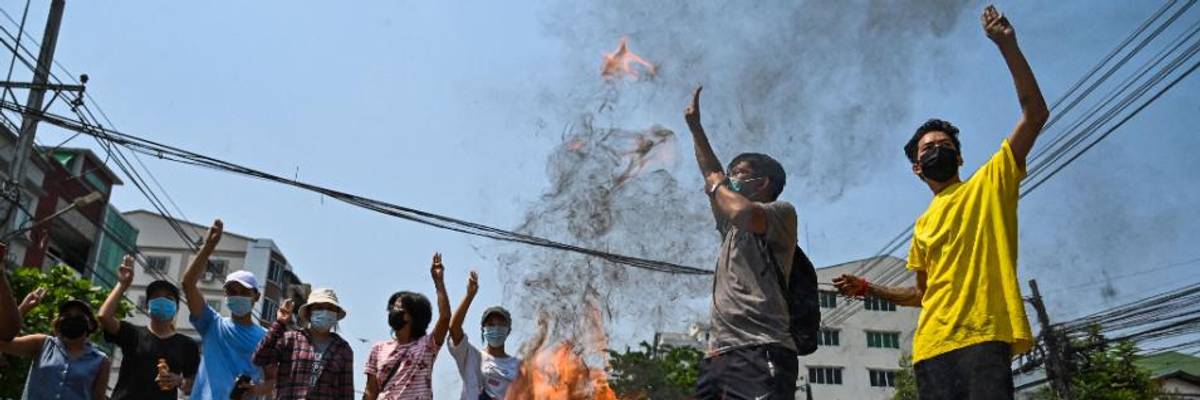
Protesters make the three-finger salute as copies of the 2008 constitution are burnt during a demonstration against the Myanmar's military coup in Yangon's South Okkalapa township on April 1, 2021. (Photo: STR/AFP via Getty Images)
The military junta that seized control of Myanmar in February shut off wireless broadband internet services across the country on Friday in the face of ongoing demonstrations demanding a return to democratic rule and international alarm over the deadly crackdown on anti-coup protesters.
Citing telecom sources and an email to a service provider, Reuters reported on the shutdown order Thursday. The provider Ooredoo posted a statement online saying that the Ministry of Transport and Communications instructed "all wireless broadband data services be temporarily suspended until further notice."
"After weeks of overnight cutoffs of internet access, the military on Friday shut all links apart from those using fiberoptic cable, which was working at drastically reduced speeds," according to the Associated Press. "Access to mobile networks and all wireless--the less costly options used by most people in the developing country--was blocked."
As Reuters reported Friday:
Despite the internet shutdown, users were still able to upload pictures of marches, "flower strikes" and a funeral of a slain protester.
An image shared widely on social media showed a bird's eye view of hundreds of flickering candles on a dark road, spelling out the words "we will never surrender."
Human rights activists have denounced limits on and shutdowns of internet service. In February, Amnesty International's deputy regional director for campaigns, Ming Yu Hah, said that "to shut down the internet amid a volatile coup, a humanitarian crisis, and a health pandemic is a heinous and reckless decision."
Since the coup, the junta has killed 550 people and arrested, charged, or sentenced 2,751, according to the Assistance Association for Political Prisoners (AAPR). Human Rights Watch (HRW) on Friday condemned the forced disappearance of hundreds politicians, election officials, journalists, activists, and protesters.
HRW's statement noted that AAPR said "they could confirm the location of only a small fraction of the more than 2,500 recent detainees they have identified." The U.S.-based group also emphasized that the regime's refusal to confirm detainees' locations or allow access to lawyers or relatives violates international law.
The New York Times reported Thursday that "the regime has arrested at least 56 journalists, outlawed online news outlets known for hard-edge reporting, and crippled communications by cutting off mobile data service. Three photojournalists have been shot and wounded while taking photographs of the anti-coup demonstrations."
"The military junta's widespread use of arbitrary arrests and enforced disappearances appears designed to strike fear in the hearts of anti-coup protesters," declared Brad Adams, HRW's Asia director. "Concerned governments should demand the release of everyone disappeared and impose targeted economic sanctions against junta leaders to finally hold this abusive military to account."
"Enforced disappearances are a heinous crime, not least because of the anguish and suffering caused to family and friends," Adams added. "Myanmar's security forces have continually flouted any respect for human rights, but they should know that they will be held accountable for the disappearances of these individuals and for the safe return of everyone forcibly disappeared."
Despite pressure for international action and warnings from experts about future bloodshed, the United Nations Security Council watered down a British-drafted statement about the current conditions in the Southeast Asian country, which was approved by all 15 members and released this week.
"The members of the Security Council expressed deep concern at the rapidly deteriorating situation, and strongly condemned the use of violence against peaceful protestors and the deaths of hundreds of civilians, including women and children," the statement says in part.
According to the AP:
The original draft was much stronger and would have expressed the Security Council's "readiness to consider further steps," which could include sanctions. It would also have "deplored" the use of violence against peaceful protesters and "condemned in the strongest terms the killing of hundreds of civilians by the security forces."
But at the insistence of China, Myanmar's neighbor and friend, the reference to "further steps" was eliminated and the stronger language, including the words "killing" and "deplore," was softened in the final statement, council diplomats said, speaking on condition of anonymity because discussions were private.
The reference to "further steps" was replaced in the final statement with a sentence saying council members "stressed that they continued to monitor the situation closely and would remain actively seized of the matter."
Diplomats also told the news agency that the Russian government demanded the final statement call "on all sides to refrain from violence" and reiterate "the need to fully respect human rights and to pursue dialogue and reconciliation in accordance with the will and interests of the people of Myanmar."
During a closed session on Wednesday, U.N. special envoy on Myanmar Christine Schraner Burgener reportedly warned that "a bloodbath is imminent" because of the regime's crackdown on demonstrations against the coup and urged members of the Security Council to "consider all available tools to take collective action and do what is right, what the people of Myanmar deserve, and prevent a multi-dimensional catastrophe in the heart of Asia."
The junta has given no indication that it will ease off on the crackdown or return power to elected officials. Local media reported Friday that security forces opened fire and wounded four people at a rally near the city of Mandalay.
The regime continues to detain the nation's democratic leader, Aung San Suu Kyi, and other members of the National League for Democracy. Suu Kyi's attorney revealed Thursday that she has been charged with violating a British colonial-era official secrets law, which can carry a 14-year prison sentence.
Dear Common Dreams reader, It’s been nearly 30 years since I co-founded Common Dreams with my late wife, Lina Newhouser. We had the radical notion that journalism should serve the public good, not corporate profits. It was clear to us from the outset what it would take to build such a project. No paid advertisements. No corporate sponsors. No millionaire publisher telling us what to think or do. Many people said we wouldn't last a year, but we proved those doubters wrong. Together with a tremendous team of journalists and dedicated staff, we built an independent media outlet free from the constraints of profits and corporate control. Our mission has always been simple: To inform. To inspire. To ignite change for the common good. Building Common Dreams was not easy. Our survival was never guaranteed. When you take on the most powerful forces—Wall Street greed, fossil fuel industry destruction, Big Tech lobbyists, and uber-rich oligarchs who have spent billions upon billions rigging the economy and democracy in their favor—the only bulwark you have is supporters who believe in your work. But here’s the urgent message from me today. It's never been this bad out there. And it's never been this hard to keep us going. At the very moment Common Dreams is most needed, the threats we face are intensifying. We need your support now more than ever. We don't accept corporate advertising and never will. We don't have a paywall because we don't think people should be blocked from critical news based on their ability to pay. Everything we do is funded by the donations of readers like you. When everyone does the little they can afford, we are strong. But if that support retreats or dries up, so do we. Will you donate now to make sure Common Dreams not only survives but thrives? —Craig Brown, Co-founder |
The military junta that seized control of Myanmar in February shut off wireless broadband internet services across the country on Friday in the face of ongoing demonstrations demanding a return to democratic rule and international alarm over the deadly crackdown on anti-coup protesters.
Citing telecom sources and an email to a service provider, Reuters reported on the shutdown order Thursday. The provider Ooredoo posted a statement online saying that the Ministry of Transport and Communications instructed "all wireless broadband data services be temporarily suspended until further notice."
"After weeks of overnight cutoffs of internet access, the military on Friday shut all links apart from those using fiberoptic cable, which was working at drastically reduced speeds," according to the Associated Press. "Access to mobile networks and all wireless--the less costly options used by most people in the developing country--was blocked."
As Reuters reported Friday:
Despite the internet shutdown, users were still able to upload pictures of marches, "flower strikes" and a funeral of a slain protester.
An image shared widely on social media showed a bird's eye view of hundreds of flickering candles on a dark road, spelling out the words "we will never surrender."
Human rights activists have denounced limits on and shutdowns of internet service. In February, Amnesty International's deputy regional director for campaigns, Ming Yu Hah, said that "to shut down the internet amid a volatile coup, a humanitarian crisis, and a health pandemic is a heinous and reckless decision."
Since the coup, the junta has killed 550 people and arrested, charged, or sentenced 2,751, according to the Assistance Association for Political Prisoners (AAPR). Human Rights Watch (HRW) on Friday condemned the forced disappearance of hundreds politicians, election officials, journalists, activists, and protesters.
HRW's statement noted that AAPR said "they could confirm the location of only a small fraction of the more than 2,500 recent detainees they have identified." The U.S.-based group also emphasized that the regime's refusal to confirm detainees' locations or allow access to lawyers or relatives violates international law.
The New York Times reported Thursday that "the regime has arrested at least 56 journalists, outlawed online news outlets known for hard-edge reporting, and crippled communications by cutting off mobile data service. Three photojournalists have been shot and wounded while taking photographs of the anti-coup demonstrations."
"The military junta's widespread use of arbitrary arrests and enforced disappearances appears designed to strike fear in the hearts of anti-coup protesters," declared Brad Adams, HRW's Asia director. "Concerned governments should demand the release of everyone disappeared and impose targeted economic sanctions against junta leaders to finally hold this abusive military to account."
"Enforced disappearances are a heinous crime, not least because of the anguish and suffering caused to family and friends," Adams added. "Myanmar's security forces have continually flouted any respect for human rights, but they should know that they will be held accountable for the disappearances of these individuals and for the safe return of everyone forcibly disappeared."
Despite pressure for international action and warnings from experts about future bloodshed, the United Nations Security Council watered down a British-drafted statement about the current conditions in the Southeast Asian country, which was approved by all 15 members and released this week.
"The members of the Security Council expressed deep concern at the rapidly deteriorating situation, and strongly condemned the use of violence against peaceful protestors and the deaths of hundreds of civilians, including women and children," the statement says in part.
According to the AP:
The original draft was much stronger and would have expressed the Security Council's "readiness to consider further steps," which could include sanctions. It would also have "deplored" the use of violence against peaceful protesters and "condemned in the strongest terms the killing of hundreds of civilians by the security forces."
But at the insistence of China, Myanmar's neighbor and friend, the reference to "further steps" was eliminated and the stronger language, including the words "killing" and "deplore," was softened in the final statement, council diplomats said, speaking on condition of anonymity because discussions were private.
The reference to "further steps" was replaced in the final statement with a sentence saying council members "stressed that they continued to monitor the situation closely and would remain actively seized of the matter."
Diplomats also told the news agency that the Russian government demanded the final statement call "on all sides to refrain from violence" and reiterate "the need to fully respect human rights and to pursue dialogue and reconciliation in accordance with the will and interests of the people of Myanmar."
During a closed session on Wednesday, U.N. special envoy on Myanmar Christine Schraner Burgener reportedly warned that "a bloodbath is imminent" because of the regime's crackdown on demonstrations against the coup and urged members of the Security Council to "consider all available tools to take collective action and do what is right, what the people of Myanmar deserve, and prevent a multi-dimensional catastrophe in the heart of Asia."
The junta has given no indication that it will ease off on the crackdown or return power to elected officials. Local media reported Friday that security forces opened fire and wounded four people at a rally near the city of Mandalay.
The regime continues to detain the nation's democratic leader, Aung San Suu Kyi, and other members of the National League for Democracy. Suu Kyi's attorney revealed Thursday that she has been charged with violating a British colonial-era official secrets law, which can carry a 14-year prison sentence.
The military junta that seized control of Myanmar in February shut off wireless broadband internet services across the country on Friday in the face of ongoing demonstrations demanding a return to democratic rule and international alarm over the deadly crackdown on anti-coup protesters.
Citing telecom sources and an email to a service provider, Reuters reported on the shutdown order Thursday. The provider Ooredoo posted a statement online saying that the Ministry of Transport and Communications instructed "all wireless broadband data services be temporarily suspended until further notice."
"After weeks of overnight cutoffs of internet access, the military on Friday shut all links apart from those using fiberoptic cable, which was working at drastically reduced speeds," according to the Associated Press. "Access to mobile networks and all wireless--the less costly options used by most people in the developing country--was blocked."
As Reuters reported Friday:
Despite the internet shutdown, users were still able to upload pictures of marches, "flower strikes" and a funeral of a slain protester.
An image shared widely on social media showed a bird's eye view of hundreds of flickering candles on a dark road, spelling out the words "we will never surrender."
Human rights activists have denounced limits on and shutdowns of internet service. In February, Amnesty International's deputy regional director for campaigns, Ming Yu Hah, said that "to shut down the internet amid a volatile coup, a humanitarian crisis, and a health pandemic is a heinous and reckless decision."
Since the coup, the junta has killed 550 people and arrested, charged, or sentenced 2,751, according to the Assistance Association for Political Prisoners (AAPR). Human Rights Watch (HRW) on Friday condemned the forced disappearance of hundreds politicians, election officials, journalists, activists, and protesters.
HRW's statement noted that AAPR said "they could confirm the location of only a small fraction of the more than 2,500 recent detainees they have identified." The U.S.-based group also emphasized that the regime's refusal to confirm detainees' locations or allow access to lawyers or relatives violates international law.
The New York Times reported Thursday that "the regime has arrested at least 56 journalists, outlawed online news outlets known for hard-edge reporting, and crippled communications by cutting off mobile data service. Three photojournalists have been shot and wounded while taking photographs of the anti-coup demonstrations."
"The military junta's widespread use of arbitrary arrests and enforced disappearances appears designed to strike fear in the hearts of anti-coup protesters," declared Brad Adams, HRW's Asia director. "Concerned governments should demand the release of everyone disappeared and impose targeted economic sanctions against junta leaders to finally hold this abusive military to account."
"Enforced disappearances are a heinous crime, not least because of the anguish and suffering caused to family and friends," Adams added. "Myanmar's security forces have continually flouted any respect for human rights, but they should know that they will be held accountable for the disappearances of these individuals and for the safe return of everyone forcibly disappeared."
Despite pressure for international action and warnings from experts about future bloodshed, the United Nations Security Council watered down a British-drafted statement about the current conditions in the Southeast Asian country, which was approved by all 15 members and released this week.
"The members of the Security Council expressed deep concern at the rapidly deteriorating situation, and strongly condemned the use of violence against peaceful protestors and the deaths of hundreds of civilians, including women and children," the statement says in part.
According to the AP:
The original draft was much stronger and would have expressed the Security Council's "readiness to consider further steps," which could include sanctions. It would also have "deplored" the use of violence against peaceful protesters and "condemned in the strongest terms the killing of hundreds of civilians by the security forces."
But at the insistence of China, Myanmar's neighbor and friend, the reference to "further steps" was eliminated and the stronger language, including the words "killing" and "deplore," was softened in the final statement, council diplomats said, speaking on condition of anonymity because discussions were private.
The reference to "further steps" was replaced in the final statement with a sentence saying council members "stressed that they continued to monitor the situation closely and would remain actively seized of the matter."
Diplomats also told the news agency that the Russian government demanded the final statement call "on all sides to refrain from violence" and reiterate "the need to fully respect human rights and to pursue dialogue and reconciliation in accordance with the will and interests of the people of Myanmar."
During a closed session on Wednesday, U.N. special envoy on Myanmar Christine Schraner Burgener reportedly warned that "a bloodbath is imminent" because of the regime's crackdown on demonstrations against the coup and urged members of the Security Council to "consider all available tools to take collective action and do what is right, what the people of Myanmar deserve, and prevent a multi-dimensional catastrophe in the heart of Asia."
The junta has given no indication that it will ease off on the crackdown or return power to elected officials. Local media reported Friday that security forces opened fire and wounded four people at a rally near the city of Mandalay.
The regime continues to detain the nation's democratic leader, Aung San Suu Kyi, and other members of the National League for Democracy. Suu Kyi's attorney revealed Thursday that she has been charged with violating a British colonial-era official secrets law, which can carry a 14-year prison sentence.