SUBSCRIBE TO OUR FREE NEWSLETTER
Daily news & progressive opinion—funded by the people, not the corporations—delivered straight to your inbox.
5
#000000
#FFFFFF
To donate by check, phone, or other method, see our More Ways to Give page.
Daily news & progressive opinion—funded by the people, not the corporations—delivered straight to your inbox.
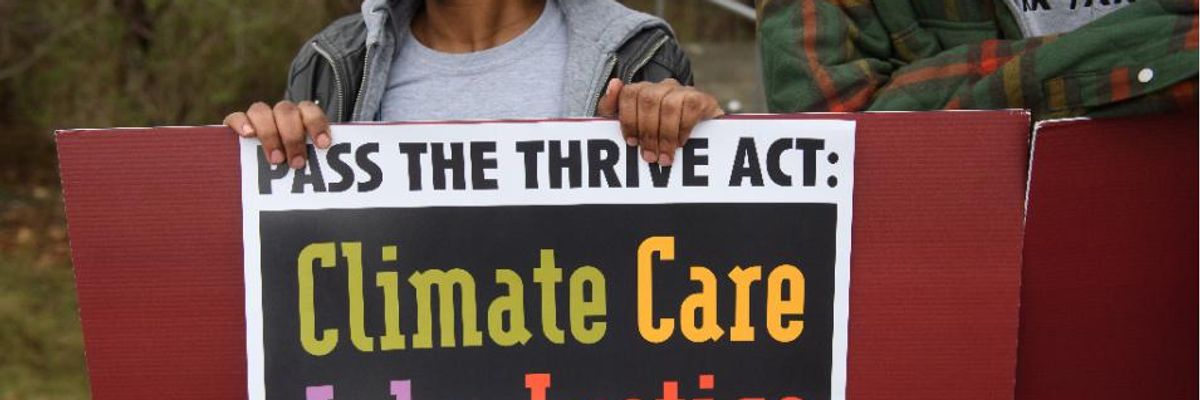
Activists participate in a rally along President Joe Biden's route to deliver a speech on March 31, 2021 in Pittsburgh, Pennsylvania. (Photo: Jeff Swensen/Getty Images for Green New Deal Network)
Members of the Congressional Progressive Caucus made clear Wednesday that while President Joe Biden's roughly $2.3 trillion infrastructure proposal is a welcome start, they believe the final package must be far more ambitious if it is to truly transform America's fossil fuel-dominated energy system and bring the country into line with crucial climate targets.
"Now is not the time to remain beholden to a bankrupt, unpopular ideology that allows the richest people in the world to continue paying next to nothing in taxes, while millions starve in our streets."
--Rep. Ilhan Omar
Rep. Alexandria Ocasio-Cortez (D-N.Y.) said in an appearance on MSNBC late Wednesday that ideally the top-line number would be around $10 trillion in spending on core infrastructure, renewable energy, healthcare improvements, and other key priorities over the next decade, a level of investment the New York Democrat presented as necessary to match the scale of the crises facing the country.
"That may be an eye-popping figure for some people," said Ocasio-Cortez, a leading Green New Deal advocate. "But we need to understand that we are in a devastating economic moment, millions of people in the United States are unemployed, we have a truly crippled healthcare system, and a planetary crisis on our hands--and we're the wealthiest nation in the history of the world. So, we can do $10 trillion."
The chair of the Congressional Progressive Caucus, Rep. Pramila Jayapal (D-Wash.), issued a similar message in a statement released just ahead of Biden's speech in Pittsburgh, where he sketched the broad outlines of his plan and promised "transformational progress in our effort to tackle climate change with American jobs and American ingenuity."
"We believe this package can and should be substantially larger in size and scope," said Jayapal. "During his campaign, President Biden committed to a '$2 trillion accelerated investment' over four years on climate-focused infrastructure alone... Today's proposal, which includes many other priorities such as care jobs, will invest half that amount--roughly $2 trillion over eight years--or 1% of GDP. It makes little sense to narrow his previous ambition on infrastructure or compromise with the physical realities of climate change."
The Washington Democrat went on to voice her caucus' preference for a single, sweeping package encompassing infrastructure spending and health insurance expansions, child care and long-term care, and other measures, rather than two separate pieces of legislation. Biden is expected to unveil the healthcare-focused portion of his package--titled the American Families Plan--some time this month.
"We believe that our country is ready for an even bolder, more comprehensive, and integrated plan that demonstrates the size, scope, and speed required to aggressively slash carbon pollution and avoid climate catastrophe; create millions of good, family-sustaining, union jobs; improve Americans' health and safety; reduce racial and gender disparities; and curb income inequality by making the wealthy and large corporations finally pay their fair share in taxes," said Jayapal.
In his remarks late Wednesday afternoon, Biden stressed the urgency of "bold" action on climate and characterized his proposal as "a once-in-a generation investment in America," but environmentalists and progressive lawmakers said major improvements are needed to align the actual package with the president's lofty rhetoric.
As Common Dreams reported, climate groups are expressing concern that the package in its current form falls well short of what's needed to meet Biden's commitments to slash U.S. carbon emissions by 50% by 2030, end fossil fuel subsidies, transition to 100% clean electricity by 2035, and ensure clean water for all.
"It's not enough," Evan Weber, political director of the youth-led Sunrise Movement, said of the current package. "Set ambitious national targets. Rally the nation. Treat it like it's an emergency. And most importantly: tell the truth about the severity of the crisis... It's the only way to close the gap between the politics of now and what's needed."
Given Democrats' narrow majorities in both the House and Senate, progressive lawmakers have significant leverage over the size and scope of the final package, which will likely be pushed through the filibuster-proof budget reconciliation process amid Republican opposition. Whether the CPC is willing to use its power to force dramatic changes to the legislation remains to be seen.
Rep. Ilhan Omar (D-Minn.), the CPC whip, said in a statement Wednesday that "in addition to the proposals the president laid out, we must use this moment to dramatically lower drug prices, expand Medicare to millions of people, make college more affordable, strengthen the care economy, provide a roadmap to citizenship for our immigrant communities, address the housing crisis, and make much bolder investments in green jobs."
"Now is not the time to remain beholden to a bankrupt, unpopular ideology that allows the richest people in the world to continue paying next to nothing in taxes, while millions starve in our streets," Omar added. "Now is the time to be bold, to tackle the once-in-a-millennium challenge of the climate crisis, and to ensure that we as a country at long last live up to our promise of justice for all."
Dear Common Dreams reader, It’s been nearly 30 years since I co-founded Common Dreams with my late wife, Lina Newhouser. We had the radical notion that journalism should serve the public good, not corporate profits. It was clear to us from the outset what it would take to build such a project. No paid advertisements. No corporate sponsors. No millionaire publisher telling us what to think or do. Many people said we wouldn't last a year, but we proved those doubters wrong. Together with a tremendous team of journalists and dedicated staff, we built an independent media outlet free from the constraints of profits and corporate control. Our mission has always been simple: To inform. To inspire. To ignite change for the common good. Building Common Dreams was not easy. Our survival was never guaranteed. When you take on the most powerful forces—Wall Street greed, fossil fuel industry destruction, Big Tech lobbyists, and uber-rich oligarchs who have spent billions upon billions rigging the economy and democracy in their favor—the only bulwark you have is supporters who believe in your work. But here’s the urgent message from me today. It's never been this bad out there. And it's never been this hard to keep us going. At the very moment Common Dreams is most needed, the threats we face are intensifying. We need your support now more than ever. We don't accept corporate advertising and never will. We don't have a paywall because we don't think people should be blocked from critical news based on their ability to pay. Everything we do is funded by the donations of readers like you. When everyone does the little they can afford, we are strong. But if that support retreats or dries up, so do we. Will you donate now to make sure Common Dreams not only survives but thrives? —Craig Brown, Co-founder |
Members of the Congressional Progressive Caucus made clear Wednesday that while President Joe Biden's roughly $2.3 trillion infrastructure proposal is a welcome start, they believe the final package must be far more ambitious if it is to truly transform America's fossil fuel-dominated energy system and bring the country into line with crucial climate targets.
"Now is not the time to remain beholden to a bankrupt, unpopular ideology that allows the richest people in the world to continue paying next to nothing in taxes, while millions starve in our streets."
--Rep. Ilhan Omar
Rep. Alexandria Ocasio-Cortez (D-N.Y.) said in an appearance on MSNBC late Wednesday that ideally the top-line number would be around $10 trillion in spending on core infrastructure, renewable energy, healthcare improvements, and other key priorities over the next decade, a level of investment the New York Democrat presented as necessary to match the scale of the crises facing the country.
"That may be an eye-popping figure for some people," said Ocasio-Cortez, a leading Green New Deal advocate. "But we need to understand that we are in a devastating economic moment, millions of people in the United States are unemployed, we have a truly crippled healthcare system, and a planetary crisis on our hands--and we're the wealthiest nation in the history of the world. So, we can do $10 trillion."
The chair of the Congressional Progressive Caucus, Rep. Pramila Jayapal (D-Wash.), issued a similar message in a statement released just ahead of Biden's speech in Pittsburgh, where he sketched the broad outlines of his plan and promised "transformational progress in our effort to tackle climate change with American jobs and American ingenuity."
"We believe this package can and should be substantially larger in size and scope," said Jayapal. "During his campaign, President Biden committed to a '$2 trillion accelerated investment' over four years on climate-focused infrastructure alone... Today's proposal, which includes many other priorities such as care jobs, will invest half that amount--roughly $2 trillion over eight years--or 1% of GDP. It makes little sense to narrow his previous ambition on infrastructure or compromise with the physical realities of climate change."
The Washington Democrat went on to voice her caucus' preference for a single, sweeping package encompassing infrastructure spending and health insurance expansions, child care and long-term care, and other measures, rather than two separate pieces of legislation. Biden is expected to unveil the healthcare-focused portion of his package--titled the American Families Plan--some time this month.
"We believe that our country is ready for an even bolder, more comprehensive, and integrated plan that demonstrates the size, scope, and speed required to aggressively slash carbon pollution and avoid climate catastrophe; create millions of good, family-sustaining, union jobs; improve Americans' health and safety; reduce racial and gender disparities; and curb income inequality by making the wealthy and large corporations finally pay their fair share in taxes," said Jayapal.
In his remarks late Wednesday afternoon, Biden stressed the urgency of "bold" action on climate and characterized his proposal as "a once-in-a generation investment in America," but environmentalists and progressive lawmakers said major improvements are needed to align the actual package with the president's lofty rhetoric.
As Common Dreams reported, climate groups are expressing concern that the package in its current form falls well short of what's needed to meet Biden's commitments to slash U.S. carbon emissions by 50% by 2030, end fossil fuel subsidies, transition to 100% clean electricity by 2035, and ensure clean water for all.
"It's not enough," Evan Weber, political director of the youth-led Sunrise Movement, said of the current package. "Set ambitious national targets. Rally the nation. Treat it like it's an emergency. And most importantly: tell the truth about the severity of the crisis... It's the only way to close the gap between the politics of now and what's needed."
Given Democrats' narrow majorities in both the House and Senate, progressive lawmakers have significant leverage over the size and scope of the final package, which will likely be pushed through the filibuster-proof budget reconciliation process amid Republican opposition. Whether the CPC is willing to use its power to force dramatic changes to the legislation remains to be seen.
Rep. Ilhan Omar (D-Minn.), the CPC whip, said in a statement Wednesday that "in addition to the proposals the president laid out, we must use this moment to dramatically lower drug prices, expand Medicare to millions of people, make college more affordable, strengthen the care economy, provide a roadmap to citizenship for our immigrant communities, address the housing crisis, and make much bolder investments in green jobs."
"Now is not the time to remain beholden to a bankrupt, unpopular ideology that allows the richest people in the world to continue paying next to nothing in taxes, while millions starve in our streets," Omar added. "Now is the time to be bold, to tackle the once-in-a-millennium challenge of the climate crisis, and to ensure that we as a country at long last live up to our promise of justice for all."
Members of the Congressional Progressive Caucus made clear Wednesday that while President Joe Biden's roughly $2.3 trillion infrastructure proposal is a welcome start, they believe the final package must be far more ambitious if it is to truly transform America's fossil fuel-dominated energy system and bring the country into line with crucial climate targets.
"Now is not the time to remain beholden to a bankrupt, unpopular ideology that allows the richest people in the world to continue paying next to nothing in taxes, while millions starve in our streets."
--Rep. Ilhan Omar
Rep. Alexandria Ocasio-Cortez (D-N.Y.) said in an appearance on MSNBC late Wednesday that ideally the top-line number would be around $10 trillion in spending on core infrastructure, renewable energy, healthcare improvements, and other key priorities over the next decade, a level of investment the New York Democrat presented as necessary to match the scale of the crises facing the country.
"That may be an eye-popping figure for some people," said Ocasio-Cortez, a leading Green New Deal advocate. "But we need to understand that we are in a devastating economic moment, millions of people in the United States are unemployed, we have a truly crippled healthcare system, and a planetary crisis on our hands--and we're the wealthiest nation in the history of the world. So, we can do $10 trillion."
The chair of the Congressional Progressive Caucus, Rep. Pramila Jayapal (D-Wash.), issued a similar message in a statement released just ahead of Biden's speech in Pittsburgh, where he sketched the broad outlines of his plan and promised "transformational progress in our effort to tackle climate change with American jobs and American ingenuity."
"We believe this package can and should be substantially larger in size and scope," said Jayapal. "During his campaign, President Biden committed to a '$2 trillion accelerated investment' over four years on climate-focused infrastructure alone... Today's proposal, which includes many other priorities such as care jobs, will invest half that amount--roughly $2 trillion over eight years--or 1% of GDP. It makes little sense to narrow his previous ambition on infrastructure or compromise with the physical realities of climate change."
The Washington Democrat went on to voice her caucus' preference for a single, sweeping package encompassing infrastructure spending and health insurance expansions, child care and long-term care, and other measures, rather than two separate pieces of legislation. Biden is expected to unveil the healthcare-focused portion of his package--titled the American Families Plan--some time this month.
"We believe that our country is ready for an even bolder, more comprehensive, and integrated plan that demonstrates the size, scope, and speed required to aggressively slash carbon pollution and avoid climate catastrophe; create millions of good, family-sustaining, union jobs; improve Americans' health and safety; reduce racial and gender disparities; and curb income inequality by making the wealthy and large corporations finally pay their fair share in taxes," said Jayapal.
In his remarks late Wednesday afternoon, Biden stressed the urgency of "bold" action on climate and characterized his proposal as "a once-in-a generation investment in America," but environmentalists and progressive lawmakers said major improvements are needed to align the actual package with the president's lofty rhetoric.
As Common Dreams reported, climate groups are expressing concern that the package in its current form falls well short of what's needed to meet Biden's commitments to slash U.S. carbon emissions by 50% by 2030, end fossil fuel subsidies, transition to 100% clean electricity by 2035, and ensure clean water for all.
"It's not enough," Evan Weber, political director of the youth-led Sunrise Movement, said of the current package. "Set ambitious national targets. Rally the nation. Treat it like it's an emergency. And most importantly: tell the truth about the severity of the crisis... It's the only way to close the gap between the politics of now and what's needed."
Given Democrats' narrow majorities in both the House and Senate, progressive lawmakers have significant leverage over the size and scope of the final package, which will likely be pushed through the filibuster-proof budget reconciliation process amid Republican opposition. Whether the CPC is willing to use its power to force dramatic changes to the legislation remains to be seen.
Rep. Ilhan Omar (D-Minn.), the CPC whip, said in a statement Wednesday that "in addition to the proposals the president laid out, we must use this moment to dramatically lower drug prices, expand Medicare to millions of people, make college more affordable, strengthen the care economy, provide a roadmap to citizenship for our immigrant communities, address the housing crisis, and make much bolder investments in green jobs."
"Now is not the time to remain beholden to a bankrupt, unpopular ideology that allows the richest people in the world to continue paying next to nothing in taxes, while millions starve in our streets," Omar added. "Now is the time to be bold, to tackle the once-in-a-millennium challenge of the climate crisis, and to ensure that we as a country at long last live up to our promise of justice for all."