SUBSCRIBE TO OUR FREE NEWSLETTER
Daily news & progressive opinion—funded by the people, not the corporations—delivered straight to your inbox.
5
#000000
#FFFFFF
To donate by check, phone, or other method, see our More Ways to Give page.
Daily news & progressive opinion—funded by the people, not the corporations—delivered straight to your inbox.
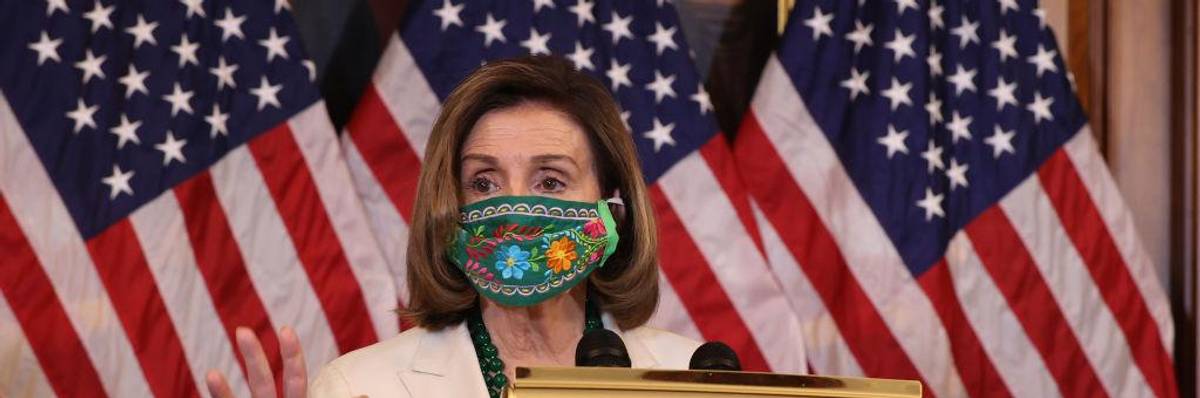
Speaker of the House Nancy Pelosi (D-Calif.) speaks during a news conference about the renewal of the Violence Against Women Act in the Rayburn Room at the U.S. Capitol on March 17, 2021 in Washington, D.C. (Photo: Chip Somodevilla/Getty Images)
On Wednesday--despite opposition from 172 Republicans--the Democrat-controlled U.S. House of Representatives passed legislation to reauthorize the historic Violence Against Women Act.
Despite the well-documented and ongoing abuses suffered by women in the United States, only 29 House Republicans voted for the legislation intended to help eradicate violence against women.
Democratic political volunteer Jake Lobin tweeted Wednesday that "172 Republicans voted against renewing the Violence Against Women Act today because they see no problem with violence against women."
If ultimately signed into law, the legislation--reintroduced by Rep. Sheila Jackson Lee (D-Texas), House Judiciary Committee Chairman Jerry Nadler (D-N.Y.) and Rep. Brian Fitzpatrick (R-Pa.)--would provide grants to state and local governments to improve services for victims of domestic violence, dating violence, sexual assault, and stalking.
Noting President Joe Biden introduced the initial legislation, known as VAWA, Vice President Kamala Harris said "we need to end domestic violence and sexual assault," and urged the Senate to follow the House's lead.
"This is much-needed legislation," Rep. Ilhan Omar (D-Minn.) said in a statement. "One in three women still experience domestic violence, and the coronavirus crisis has forced many women to quarantine in unsafe domestic situations. This bill makes investments on domestic violence prevention, improves access to housing for survivors, and works to better protect Native women and women of color. I am especially proud that it includes three of my amendments to better track the economic consequences of domestic violence."
Lawmakers and advocates celebrated the House's 244-172 vote to pass the VAWA bill:
The original bill passed in 1994 and was reauthorized repeatedly for decades until 2019 when the Republican-controlled Senate refused to reauthorize it on the objection to the gun control provisions included in the bill.
According to the national gun control advocacy group, Everytown for Gun Safety, an average of 53 women are shot and killed every month by an intimate partner and nearly one million women have reported being shot or shot at by intimate partners. According to research, the presence of a gun in a domestic violence situation increases the risk of homicide by 500%.
The updated bill aims to address firearm homicide with a provision to close what is referred to as the "boyfriend loophole" by preventing dating partners convicted of domestic violence or abuse from buying or owning guns. As the current law stands, gun purchase restriction is limited to only spouses or formerly married partners.
Multiple lawmakers pointed out that reintroduction of the bill comes at a time when one in three women experience sexual or intimate partner violence during their lifetime, according to the World Health Organization.
Rep. Lauren Underwood (D-IL.) mentioned that statistic in a tweet saying she "voted to reauthorize the Violence Against Women Act today with that sad truth on my mind."
Referred to as the "shadow pandemic," domestic violence has significantly spiked during Covid-19 lockdowns. The VAWA bill includes an amendment cosponsored by Omar and Rep. Rodney Davis (R-Ill.) that will "require the Department of Health and Human Services to include the impact of the Covid-19 pandemic on survivors of domestic violence as it relates to their ability to maintain economic security."
Rep. Katie Porter (D-Calif.) posted on Twitter to laud the inclusion of her measure to the bill that will now include economic abuse as a form of domestic violence. According to the National Coalition Against Domestic Violence (NCADV), between 21-60% of victims of intimate partner violence lose their jobs due to reasons stemming from the abuse. Victims of intimate partner violence lose a total of 8 million days of paid work each year.
"Each year, millions suffer domestic abuse in silence because they're financially dependent on their partners," Porter tweeted. "I'm proud my measure to integrate economic abuse as a form of domestic violence is included in the Violence Against Women Act, which the House voted to renew today."
Dear Common Dreams reader, It’s been nearly 30 years since I co-founded Common Dreams with my late wife, Lina Newhouser. We had the radical notion that journalism should serve the public good, not corporate profits. It was clear to us from the outset what it would take to build such a project. No paid advertisements. No corporate sponsors. No millionaire publisher telling us what to think or do. Many people said we wouldn't last a year, but we proved those doubters wrong. Together with a tremendous team of journalists and dedicated staff, we built an independent media outlet free from the constraints of profits and corporate control. Our mission has always been simple: To inform. To inspire. To ignite change for the common good. Building Common Dreams was not easy. Our survival was never guaranteed. When you take on the most powerful forces—Wall Street greed, fossil fuel industry destruction, Big Tech lobbyists, and uber-rich oligarchs who have spent billions upon billions rigging the economy and democracy in their favor—the only bulwark you have is supporters who believe in your work. But here’s the urgent message from me today. It's never been this bad out there. And it's never been this hard to keep us going. At the very moment Common Dreams is most needed, the threats we face are intensifying. We need your support now more than ever. We don't accept corporate advertising and never will. We don't have a paywall because we don't think people should be blocked from critical news based on their ability to pay. Everything we do is funded by the donations of readers like you. When everyone does the little they can afford, we are strong. But if that support retreats or dries up, so do we. Will you donate now to make sure Common Dreams not only survives but thrives? —Craig Brown, Co-founder |
On Wednesday--despite opposition from 172 Republicans--the Democrat-controlled U.S. House of Representatives passed legislation to reauthorize the historic Violence Against Women Act.
Despite the well-documented and ongoing abuses suffered by women in the United States, only 29 House Republicans voted for the legislation intended to help eradicate violence against women.
Democratic political volunteer Jake Lobin tweeted Wednesday that "172 Republicans voted against renewing the Violence Against Women Act today because they see no problem with violence against women."
If ultimately signed into law, the legislation--reintroduced by Rep. Sheila Jackson Lee (D-Texas), House Judiciary Committee Chairman Jerry Nadler (D-N.Y.) and Rep. Brian Fitzpatrick (R-Pa.)--would provide grants to state and local governments to improve services for victims of domestic violence, dating violence, sexual assault, and stalking.
Noting President Joe Biden introduced the initial legislation, known as VAWA, Vice President Kamala Harris said "we need to end domestic violence and sexual assault," and urged the Senate to follow the House's lead.
"This is much-needed legislation," Rep. Ilhan Omar (D-Minn.) said in a statement. "One in three women still experience domestic violence, and the coronavirus crisis has forced many women to quarantine in unsafe domestic situations. This bill makes investments on domestic violence prevention, improves access to housing for survivors, and works to better protect Native women and women of color. I am especially proud that it includes three of my amendments to better track the economic consequences of domestic violence."
Lawmakers and advocates celebrated the House's 244-172 vote to pass the VAWA bill:
The original bill passed in 1994 and was reauthorized repeatedly for decades until 2019 when the Republican-controlled Senate refused to reauthorize it on the objection to the gun control provisions included in the bill.
According to the national gun control advocacy group, Everytown for Gun Safety, an average of 53 women are shot and killed every month by an intimate partner and nearly one million women have reported being shot or shot at by intimate partners. According to research, the presence of a gun in a domestic violence situation increases the risk of homicide by 500%.
The updated bill aims to address firearm homicide with a provision to close what is referred to as the "boyfriend loophole" by preventing dating partners convicted of domestic violence or abuse from buying or owning guns. As the current law stands, gun purchase restriction is limited to only spouses or formerly married partners.
Multiple lawmakers pointed out that reintroduction of the bill comes at a time when one in three women experience sexual or intimate partner violence during their lifetime, according to the World Health Organization.
Rep. Lauren Underwood (D-IL.) mentioned that statistic in a tweet saying she "voted to reauthorize the Violence Against Women Act today with that sad truth on my mind."
Referred to as the "shadow pandemic," domestic violence has significantly spiked during Covid-19 lockdowns. The VAWA bill includes an amendment cosponsored by Omar and Rep. Rodney Davis (R-Ill.) that will "require the Department of Health and Human Services to include the impact of the Covid-19 pandemic on survivors of domestic violence as it relates to their ability to maintain economic security."
Rep. Katie Porter (D-Calif.) posted on Twitter to laud the inclusion of her measure to the bill that will now include economic abuse as a form of domestic violence. According to the National Coalition Against Domestic Violence (NCADV), between 21-60% of victims of intimate partner violence lose their jobs due to reasons stemming from the abuse. Victims of intimate partner violence lose a total of 8 million days of paid work each year.
"Each year, millions suffer domestic abuse in silence because they're financially dependent on their partners," Porter tweeted. "I'm proud my measure to integrate economic abuse as a form of domestic violence is included in the Violence Against Women Act, which the House voted to renew today."
On Wednesday--despite opposition from 172 Republicans--the Democrat-controlled U.S. House of Representatives passed legislation to reauthorize the historic Violence Against Women Act.
Despite the well-documented and ongoing abuses suffered by women in the United States, only 29 House Republicans voted for the legislation intended to help eradicate violence against women.
Democratic political volunteer Jake Lobin tweeted Wednesday that "172 Republicans voted against renewing the Violence Against Women Act today because they see no problem with violence against women."
If ultimately signed into law, the legislation--reintroduced by Rep. Sheila Jackson Lee (D-Texas), House Judiciary Committee Chairman Jerry Nadler (D-N.Y.) and Rep. Brian Fitzpatrick (R-Pa.)--would provide grants to state and local governments to improve services for victims of domestic violence, dating violence, sexual assault, and stalking.
Noting President Joe Biden introduced the initial legislation, known as VAWA, Vice President Kamala Harris said "we need to end domestic violence and sexual assault," and urged the Senate to follow the House's lead.
"This is much-needed legislation," Rep. Ilhan Omar (D-Minn.) said in a statement. "One in three women still experience domestic violence, and the coronavirus crisis has forced many women to quarantine in unsafe domestic situations. This bill makes investments on domestic violence prevention, improves access to housing for survivors, and works to better protect Native women and women of color. I am especially proud that it includes three of my amendments to better track the economic consequences of domestic violence."
Lawmakers and advocates celebrated the House's 244-172 vote to pass the VAWA bill:
The original bill passed in 1994 and was reauthorized repeatedly for decades until 2019 when the Republican-controlled Senate refused to reauthorize it on the objection to the gun control provisions included in the bill.
According to the national gun control advocacy group, Everytown for Gun Safety, an average of 53 women are shot and killed every month by an intimate partner and nearly one million women have reported being shot or shot at by intimate partners. According to research, the presence of a gun in a domestic violence situation increases the risk of homicide by 500%.
The updated bill aims to address firearm homicide with a provision to close what is referred to as the "boyfriend loophole" by preventing dating partners convicted of domestic violence or abuse from buying or owning guns. As the current law stands, gun purchase restriction is limited to only spouses or formerly married partners.
Multiple lawmakers pointed out that reintroduction of the bill comes at a time when one in three women experience sexual or intimate partner violence during their lifetime, according to the World Health Organization.
Rep. Lauren Underwood (D-IL.) mentioned that statistic in a tweet saying she "voted to reauthorize the Violence Against Women Act today with that sad truth on my mind."
Referred to as the "shadow pandemic," domestic violence has significantly spiked during Covid-19 lockdowns. The VAWA bill includes an amendment cosponsored by Omar and Rep. Rodney Davis (R-Ill.) that will "require the Department of Health and Human Services to include the impact of the Covid-19 pandemic on survivors of domestic violence as it relates to their ability to maintain economic security."
Rep. Katie Porter (D-Calif.) posted on Twitter to laud the inclusion of her measure to the bill that will now include economic abuse as a form of domestic violence. According to the National Coalition Against Domestic Violence (NCADV), between 21-60% of victims of intimate partner violence lose their jobs due to reasons stemming from the abuse. Victims of intimate partner violence lose a total of 8 million days of paid work each year.
"Each year, millions suffer domestic abuse in silence because they're financially dependent on their partners," Porter tweeted. "I'm proud my measure to integrate economic abuse as a form of domestic violence is included in the Violence Against Women Act, which the House voted to renew today."