

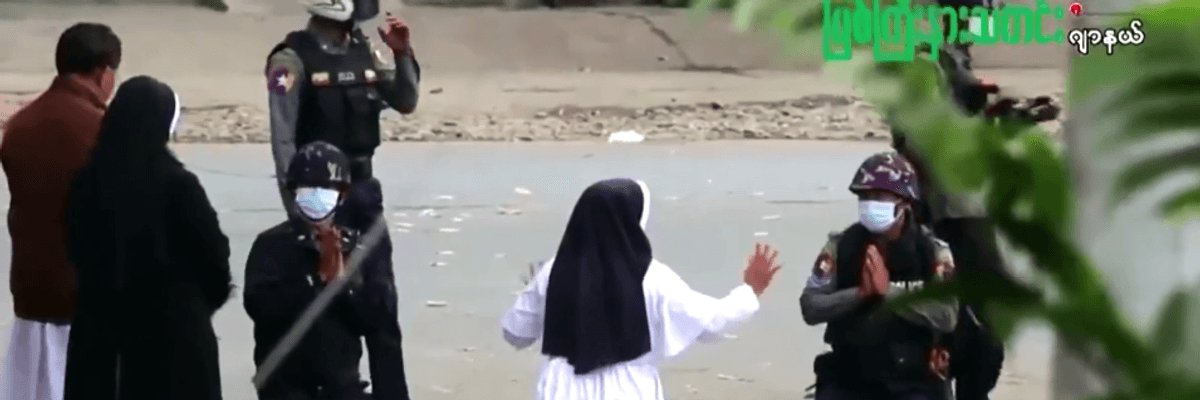
"I knelt down... begging them not to shoot and torture the children, but to shoot me and kill me instead," Sister Ann Rose Nu Tawng said of her attempt to dissuade police officers in Myitkyina, Myanmar from shooting people at a pro-democracy demonstration on March 8, 2021. (Photo: Twitter screengrab via Reuters)
'Kill Me Instead': Despite Nun's Pleas, Military Junta Shoots Pro-Democracy Protesters in Myanmar
"We heard loud gunshots, and saw that a young kid's head had exploded, and there was a river of blood on the street," said Sister Ann Rose Nu Tawng. "We need to value life. It made me feel so sad."
Kneeling before a group of police officers in a northern Myanmar city on Monday, Sister Ann Rose Nu Tawng courageously begged the forces of the country's new military junta to refrain from shooting pro-democracy activists--a plea that was ultimately ignored by the officers who went on to kill at least two people and injure several others as the violent repression of peaceful demonstrations against last month's coup continues.
"I knelt down... begging them not to shoot and torture the children, but to shoot me and kill me instead," Tawng told AFP on Tuesday after a video of the incident went viral.
In a telephone interview with Reuters, the 45-year-old Catholic nun said she told the police officers that "I am not standing up until they give their promise that they will not brutally crack down on protesters."
Reuters reported that Tawng, who runs a clinic in the city of Myitkyina, said senior officers had assured her that "they were just clearing the road." But soon after Tawng and one of the officers touched their foreheads to the ground, the police opened fire on the crowd behind her.
"We heard loud gunshots, and saw that a young kid's head had exploded, and there was a river of blood on the street," Tawng told Reuters.
Despite the brave effort of Tawng, who was surrounded by two fellow sisters and the local bishop as she pleaded with the officers to spare the protesters' lives, a local rescue team confirmed to AFP that the police killed at least two people and injured several others on Monday in Myitkyina, the capital of Myanmar's northernmost state of Kachin.
Tawng told Reuters that she tried to bring some of the victims to the clinic but was blinded by tear gas.
"Our clinic floor became a sea of blood," she told the news outlet. "We need to value life. It made me feel so sad."
Monday was "not Tawang's first encounter with the security forces," AFP reported. Late last month, the nun "made a similar plea for mercy, walking slowly towards police in riot gear, getting on her knees and pleading for them to stop."
"I have thought myself dead already since February 28," she told the news outlet, referring to the day she made the decision to stand up to Myanmar's unelected military regime. "I can't stand and watch without doing anything, seeing what's happening in front of my eyes while all Myanmar is grieving."
In the aftermath of the February 1 military coup that ousted elected leader Daw Aung San Suu Kyi and transferred power to the country's top general, Min Aung Hlaing, at least 54 people have been killed, hundreds more wounded, and over 1,700 arbitrarily detained amid the junta's increasingly violent crackdown on demonstrators who are demanding a return to civilian rule and the release of all imprisoned government officials.
While Suu Kyi, winner of the Nobel Peace Prize in 1991, has in recent years faced intense global criticism for her complicity in the military's genocidal assault on Myanmar's Rohingya Muslim minority, hundreds of thousands of people throughout the Southeast Asian country have taken to the streets to make clear that they oppose her detention and want to be governed by elected officials, not the armed forces.
"Myanmar's military must stop murdering and jailing protestors," the United Nations High Commissioner for Human Rights Michelle Bachelet said in a statement last week.
"It is utterly abhorrent that security forces are firing live ammunition against peaceful protesters across the country," she said. "I am also appalled at the documented attacks against emergency medical staff and ambulances attempting to provide care to those who have been injured."
Calling for the immediate release of all those who are still detained, Bachelet said that "many of the arbitrary arrests and detentions that have been carried out since February 1 may constitute enforced disappearances."
"I urge all those with information and influence--including Myanmar officials who are now joining the civil disobedience movement--to support international efforts to hold military leaders accountable for the serious human rights violations that have been committed both now and in the past," Bachelet continued.
"This is the moment," she added, "to turn the tables towards justice and end the military's stranglehold over democracy in Myanmar."
An Urgent Message From Our Co-Founder
Dear Common Dreams reader, It’s been nearly 30 years since I co-founded Common Dreams with my late wife, Lina Newhouser. We had the radical notion that journalism should serve the public good, not corporate profits. It was clear to us from the outset what it would take to build such a project. No paid advertisements. No corporate sponsors. No millionaire publisher telling us what to think or do. Many people said we wouldn't last a year, but we proved those doubters wrong. Together with a tremendous team of journalists and dedicated staff, we built an independent media outlet free from the constraints of profits and corporate control. Our mission has always been simple: To inform. To inspire. To ignite change for the common good. Building Common Dreams was not easy. Our survival was never guaranteed. When you take on the most powerful forces—Wall Street greed, fossil fuel industry destruction, Big Tech lobbyists, and uber-rich oligarchs who have spent billions upon billions rigging the economy and democracy in their favor—the only bulwark you have is supporters who believe in your work. But here’s the urgent message from me today. It's never been this bad out there. And it's never been this hard to keep us going. At the very moment Common Dreams is most needed, the threats we face are intensifying. We need your support now more than ever. We don't accept corporate advertising and never will. We don't have a paywall because we don't think people should be blocked from critical news based on their ability to pay. Everything we do is funded by the donations of readers like you. When everyone does the little they can afford, we are strong. But if that support retreats or dries up, so do we. Will you donate now to make sure Common Dreams not only survives but thrives? —Craig Brown, Co-founder |
Kneeling before a group of police officers in a northern Myanmar city on Monday, Sister Ann Rose Nu Tawng courageously begged the forces of the country's new military junta to refrain from shooting pro-democracy activists--a plea that was ultimately ignored by the officers who went on to kill at least two people and injure several others as the violent repression of peaceful demonstrations against last month's coup continues.
"I knelt down... begging them not to shoot and torture the children, but to shoot me and kill me instead," Tawng told AFP on Tuesday after a video of the incident went viral.
In a telephone interview with Reuters, the 45-year-old Catholic nun said she told the police officers that "I am not standing up until they give their promise that they will not brutally crack down on protesters."
Reuters reported that Tawng, who runs a clinic in the city of Myitkyina, said senior officers had assured her that "they were just clearing the road." But soon after Tawng and one of the officers touched their foreheads to the ground, the police opened fire on the crowd behind her.
"We heard loud gunshots, and saw that a young kid's head had exploded, and there was a river of blood on the street," Tawng told Reuters.
Despite the brave effort of Tawng, who was surrounded by two fellow sisters and the local bishop as she pleaded with the officers to spare the protesters' lives, a local rescue team confirmed to AFP that the police killed at least two people and injured several others on Monday in Myitkyina, the capital of Myanmar's northernmost state of Kachin.
Tawng told Reuters that she tried to bring some of the victims to the clinic but was blinded by tear gas.
"Our clinic floor became a sea of blood," she told the news outlet. "We need to value life. It made me feel so sad."
Monday was "not Tawang's first encounter with the security forces," AFP reported. Late last month, the nun "made a similar plea for mercy, walking slowly towards police in riot gear, getting on her knees and pleading for them to stop."
"I have thought myself dead already since February 28," she told the news outlet, referring to the day she made the decision to stand up to Myanmar's unelected military regime. "I can't stand and watch without doing anything, seeing what's happening in front of my eyes while all Myanmar is grieving."
In the aftermath of the February 1 military coup that ousted elected leader Daw Aung San Suu Kyi and transferred power to the country's top general, Min Aung Hlaing, at least 54 people have been killed, hundreds more wounded, and over 1,700 arbitrarily detained amid the junta's increasingly violent crackdown on demonstrators who are demanding a return to civilian rule and the release of all imprisoned government officials.
While Suu Kyi, winner of the Nobel Peace Prize in 1991, has in recent years faced intense global criticism for her complicity in the military's genocidal assault on Myanmar's Rohingya Muslim minority, hundreds of thousands of people throughout the Southeast Asian country have taken to the streets to make clear that they oppose her detention and want to be governed by elected officials, not the armed forces.
"Myanmar's military must stop murdering and jailing protestors," the United Nations High Commissioner for Human Rights Michelle Bachelet said in a statement last week.
"It is utterly abhorrent that security forces are firing live ammunition against peaceful protesters across the country," she said. "I am also appalled at the documented attacks against emergency medical staff and ambulances attempting to provide care to those who have been injured."
Calling for the immediate release of all those who are still detained, Bachelet said that "many of the arbitrary arrests and detentions that have been carried out since February 1 may constitute enforced disappearances."
"I urge all those with information and influence--including Myanmar officials who are now joining the civil disobedience movement--to support international efforts to hold military leaders accountable for the serious human rights violations that have been committed both now and in the past," Bachelet continued.
"This is the moment," she added, "to turn the tables towards justice and end the military's stranglehold over democracy in Myanmar."
Kneeling before a group of police officers in a northern Myanmar city on Monday, Sister Ann Rose Nu Tawng courageously begged the forces of the country's new military junta to refrain from shooting pro-democracy activists--a plea that was ultimately ignored by the officers who went on to kill at least two people and injure several others as the violent repression of peaceful demonstrations against last month's coup continues.
"I knelt down... begging them not to shoot and torture the children, but to shoot me and kill me instead," Tawng told AFP on Tuesday after a video of the incident went viral.
In a telephone interview with Reuters, the 45-year-old Catholic nun said she told the police officers that "I am not standing up until they give their promise that they will not brutally crack down on protesters."
Reuters reported that Tawng, who runs a clinic in the city of Myitkyina, said senior officers had assured her that "they were just clearing the road." But soon after Tawng and one of the officers touched their foreheads to the ground, the police opened fire on the crowd behind her.
"We heard loud gunshots, and saw that a young kid's head had exploded, and there was a river of blood on the street," Tawng told Reuters.
Despite the brave effort of Tawng, who was surrounded by two fellow sisters and the local bishop as she pleaded with the officers to spare the protesters' lives, a local rescue team confirmed to AFP that the police killed at least two people and injured several others on Monday in Myitkyina, the capital of Myanmar's northernmost state of Kachin.
Tawng told Reuters that she tried to bring some of the victims to the clinic but was blinded by tear gas.
"Our clinic floor became a sea of blood," she told the news outlet. "We need to value life. It made me feel so sad."
Monday was "not Tawang's first encounter with the security forces," AFP reported. Late last month, the nun "made a similar plea for mercy, walking slowly towards police in riot gear, getting on her knees and pleading for them to stop."
"I have thought myself dead already since February 28," she told the news outlet, referring to the day she made the decision to stand up to Myanmar's unelected military regime. "I can't stand and watch without doing anything, seeing what's happening in front of my eyes while all Myanmar is grieving."
In the aftermath of the February 1 military coup that ousted elected leader Daw Aung San Suu Kyi and transferred power to the country's top general, Min Aung Hlaing, at least 54 people have been killed, hundreds more wounded, and over 1,700 arbitrarily detained amid the junta's increasingly violent crackdown on demonstrators who are demanding a return to civilian rule and the release of all imprisoned government officials.
While Suu Kyi, winner of the Nobel Peace Prize in 1991, has in recent years faced intense global criticism for her complicity in the military's genocidal assault on Myanmar's Rohingya Muslim minority, hundreds of thousands of people throughout the Southeast Asian country have taken to the streets to make clear that they oppose her detention and want to be governed by elected officials, not the armed forces.
"Myanmar's military must stop murdering and jailing protestors," the United Nations High Commissioner for Human Rights Michelle Bachelet said in a statement last week.
"It is utterly abhorrent that security forces are firing live ammunition against peaceful protesters across the country," she said. "I am also appalled at the documented attacks against emergency medical staff and ambulances attempting to provide care to those who have been injured."
Calling for the immediate release of all those who are still detained, Bachelet said that "many of the arbitrary arrests and detentions that have been carried out since February 1 may constitute enforced disappearances."
"I urge all those with information and influence--including Myanmar officials who are now joining the civil disobedience movement--to support international efforts to hold military leaders accountable for the serious human rights violations that have been committed both now and in the past," Bachelet continued.
"This is the moment," she added, "to turn the tables towards justice and end the military's stranglehold over democracy in Myanmar."