SUBSCRIBE TO OUR FREE NEWSLETTER
Daily news & progressive opinion—funded by the people, not the corporations—delivered straight to your inbox.
5
#000000
#FFFFFF
To donate by check, phone, or other method, see our More Ways to Give page.
Daily news & progressive opinion—funded by the people, not the corporations—delivered straight to your inbox.
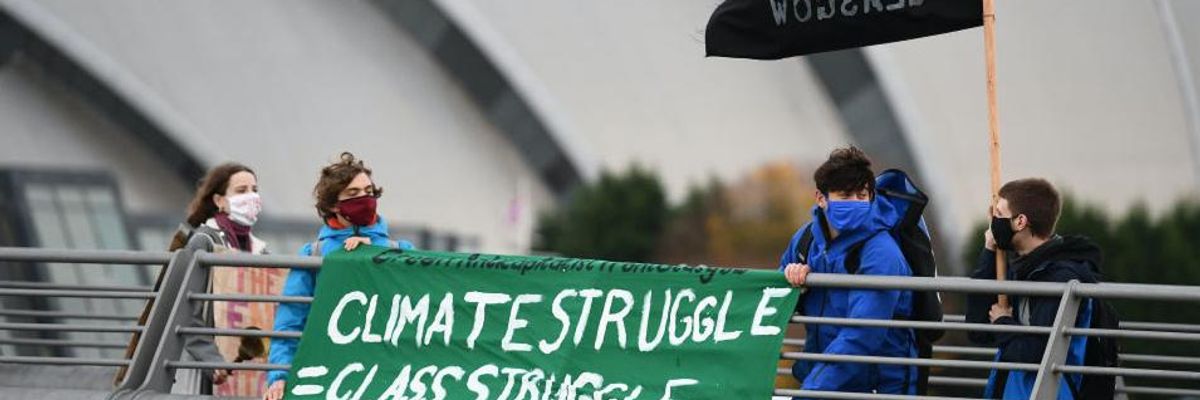
Climate activists demonstrate in Glasglow, Scotland--which will host the COP26 United Nations Climate Conference in November 2021--on November 13, 2020. (Photo: Jeff J. Mitchell/Getty Images)
An international survey conducted by the University of Cambridge and YouGov ahead of this November's COP26 United Nations Climate Change Conference, and published on Monday, found overwhelming support around the world for governments taking more robust action to protect the environment amid the worsening climate crisis.
The pollsters surveyed 14,627 adults in seven countries--Brazil, China, India, Indonesia, Poland, the United Kingdom, and the United States. According to Cambridge University:
Participants were randomly assigned to read either one of four 'treatment' texts about climate change--drafted to reflect current U.N. messaging, public health, social norms, and patriotism--or a neutral text, unrelated to climate and used to test "baseline" support. The participants were then asked if they agreed or disagreed with the statement that "all national governments should do more to protect the environment."
In all of the countries except the U.S., at least 90% of baseline respondents agreed with the statement. In the U.S., the figure was 79%.
"Compared to the baseline, exposure to one of the climate change texts led to a small but significant rise of about one or two percentage points on average," wrote University of Cambridge political psychologist Lee de-Wit. "The figures ranged in the U.K. from 89-93%; as against 96-98% in Brazil, 91-95% in China, 92-97% in India, 99-100% in Indonesia, 91-94% in Poland, and 76-79% in the USA."
In the U.S., the survey found tremendous differences between people who voted for former President Donald Trump in the 2020 election--only 55% of whom said governments should do more to protect the environment--and those who elected President Joe Biden, 95% of whom agreed that governments should make more of an effort to safeguard the environment.
When asked to choose from a list of specific actions governments can take to better protect the environment, the most popular choice among survey respondents was "to protect and preserve" wildlife, marine life, and plants; followed by a policy "to plant more trees to absorb the gases that cause climate change"; thirtythen spending more on developing clean technologies; and finally reducing "the production over 30 years of the gases that cause climate change."
On average, 58% of survey respondents also agreed that businesses should be forced "to pay for the damage they do when their activities contribute to climate change."
De-Wit wrote that "we live in a time of polarization, and environmental issues have long embodied the political divisions in society."
"However, this may be changing," he wrote. "We can see an overwhelming consensus emerging for greater government-led action to protect the environment in major nations."
"As we approach COP26, politicians the world over should take confidence from these findings," added de-Wit. "Voters across party lines want to see more government action. The time is now."
"We face huge challenges protecting the environment, but global public opinion may no longer be chief among them," concluded de-Wit.
The COP26 conference--which was delayed a year due to the coronavirus pandemic--will take place in Glasgow, Scotland November 1-12.
A U.N. report released last week revealed the world is far from meeting the emission-reduction goals of the Paris climate agreement, with scientists warning that accomplishing the accord's target of a maximum global temperature rise of 1.5degC requires cutting planet-heating emissions 45% by 2030 from 2010 levels.
Dear Common Dreams reader, It’s been nearly 30 years since I co-founded Common Dreams with my late wife, Lina Newhouser. We had the radical notion that journalism should serve the public good, not corporate profits. It was clear to us from the outset what it would take to build such a project. No paid advertisements. No corporate sponsors. No millionaire publisher telling us what to think or do. Many people said we wouldn't last a year, but we proved those doubters wrong. Together with a tremendous team of journalists and dedicated staff, we built an independent media outlet free from the constraints of profits and corporate control. Our mission has always been simple: To inform. To inspire. To ignite change for the common good. Building Common Dreams was not easy. Our survival was never guaranteed. When you take on the most powerful forces—Wall Street greed, fossil fuel industry destruction, Big Tech lobbyists, and uber-rich oligarchs who have spent billions upon billions rigging the economy and democracy in their favor—the only bulwark you have is supporters who believe in your work. But here’s the urgent message from me today. It's never been this bad out there. And it's never been this hard to keep us going. At the very moment Common Dreams is most needed, the threats we face are intensifying. We need your support now more than ever. We don't accept corporate advertising and never will. We don't have a paywall because we don't think people should be blocked from critical news based on their ability to pay. Everything we do is funded by the donations of readers like you. When everyone does the little they can afford, we are strong. But if that support retreats or dries up, so do we. Will you donate now to make sure Common Dreams not only survives but thrives? —Craig Brown, Co-founder |
An international survey conducted by the University of Cambridge and YouGov ahead of this November's COP26 United Nations Climate Change Conference, and published on Monday, found overwhelming support around the world for governments taking more robust action to protect the environment amid the worsening climate crisis.
The pollsters surveyed 14,627 adults in seven countries--Brazil, China, India, Indonesia, Poland, the United Kingdom, and the United States. According to Cambridge University:
Participants were randomly assigned to read either one of four 'treatment' texts about climate change--drafted to reflect current U.N. messaging, public health, social norms, and patriotism--or a neutral text, unrelated to climate and used to test "baseline" support. The participants were then asked if they agreed or disagreed with the statement that "all national governments should do more to protect the environment."
In all of the countries except the U.S., at least 90% of baseline respondents agreed with the statement. In the U.S., the figure was 79%.
"Compared to the baseline, exposure to one of the climate change texts led to a small but significant rise of about one or two percentage points on average," wrote University of Cambridge political psychologist Lee de-Wit. "The figures ranged in the U.K. from 89-93%; as against 96-98% in Brazil, 91-95% in China, 92-97% in India, 99-100% in Indonesia, 91-94% in Poland, and 76-79% in the USA."
In the U.S., the survey found tremendous differences between people who voted for former President Donald Trump in the 2020 election--only 55% of whom said governments should do more to protect the environment--and those who elected President Joe Biden, 95% of whom agreed that governments should make more of an effort to safeguard the environment.
When asked to choose from a list of specific actions governments can take to better protect the environment, the most popular choice among survey respondents was "to protect and preserve" wildlife, marine life, and plants; followed by a policy "to plant more trees to absorb the gases that cause climate change"; thirtythen spending more on developing clean technologies; and finally reducing "the production over 30 years of the gases that cause climate change."
On average, 58% of survey respondents also agreed that businesses should be forced "to pay for the damage they do when their activities contribute to climate change."
De-Wit wrote that "we live in a time of polarization, and environmental issues have long embodied the political divisions in society."
"However, this may be changing," he wrote. "We can see an overwhelming consensus emerging for greater government-led action to protect the environment in major nations."
"As we approach COP26, politicians the world over should take confidence from these findings," added de-Wit. "Voters across party lines want to see more government action. The time is now."
"We face huge challenges protecting the environment, but global public opinion may no longer be chief among them," concluded de-Wit.
The COP26 conference--which was delayed a year due to the coronavirus pandemic--will take place in Glasgow, Scotland November 1-12.
A U.N. report released last week revealed the world is far from meeting the emission-reduction goals of the Paris climate agreement, with scientists warning that accomplishing the accord's target of a maximum global temperature rise of 1.5degC requires cutting planet-heating emissions 45% by 2030 from 2010 levels.
An international survey conducted by the University of Cambridge and YouGov ahead of this November's COP26 United Nations Climate Change Conference, and published on Monday, found overwhelming support around the world for governments taking more robust action to protect the environment amid the worsening climate crisis.
The pollsters surveyed 14,627 adults in seven countries--Brazil, China, India, Indonesia, Poland, the United Kingdom, and the United States. According to Cambridge University:
Participants were randomly assigned to read either one of four 'treatment' texts about climate change--drafted to reflect current U.N. messaging, public health, social norms, and patriotism--or a neutral text, unrelated to climate and used to test "baseline" support. The participants were then asked if they agreed or disagreed with the statement that "all national governments should do more to protect the environment."
In all of the countries except the U.S., at least 90% of baseline respondents agreed with the statement. In the U.S., the figure was 79%.
"Compared to the baseline, exposure to one of the climate change texts led to a small but significant rise of about one or two percentage points on average," wrote University of Cambridge political psychologist Lee de-Wit. "The figures ranged in the U.K. from 89-93%; as against 96-98% in Brazil, 91-95% in China, 92-97% in India, 99-100% in Indonesia, 91-94% in Poland, and 76-79% in the USA."
In the U.S., the survey found tremendous differences between people who voted for former President Donald Trump in the 2020 election--only 55% of whom said governments should do more to protect the environment--and those who elected President Joe Biden, 95% of whom agreed that governments should make more of an effort to safeguard the environment.
When asked to choose from a list of specific actions governments can take to better protect the environment, the most popular choice among survey respondents was "to protect and preserve" wildlife, marine life, and plants; followed by a policy "to plant more trees to absorb the gases that cause climate change"; thirtythen spending more on developing clean technologies; and finally reducing "the production over 30 years of the gases that cause climate change."
On average, 58% of survey respondents also agreed that businesses should be forced "to pay for the damage they do when their activities contribute to climate change."
De-Wit wrote that "we live in a time of polarization, and environmental issues have long embodied the political divisions in society."
"However, this may be changing," he wrote. "We can see an overwhelming consensus emerging for greater government-led action to protect the environment in major nations."
"As we approach COP26, politicians the world over should take confidence from these findings," added de-Wit. "Voters across party lines want to see more government action. The time is now."
"We face huge challenges protecting the environment, but global public opinion may no longer be chief among them," concluded de-Wit.
The COP26 conference--which was delayed a year due to the coronavirus pandemic--will take place in Glasgow, Scotland November 1-12.
A U.N. report released last week revealed the world is far from meeting the emission-reduction goals of the Paris climate agreement, with scientists warning that accomplishing the accord's target of a maximum global temperature rise of 1.5degC requires cutting planet-heating emissions 45% by 2030 from 2010 levels.