

SUBSCRIBE TO OUR FREE NEWSLETTER
Daily news & progressive opinion—funded by the people, not the corporations—delivered straight to your inbox.
5
#000000
#FFFFFF
To donate by check, phone, or other method, see our More Ways to Give page.
Daily news & progressive opinion—funded by the people, not the corporations—delivered straight to your inbox.
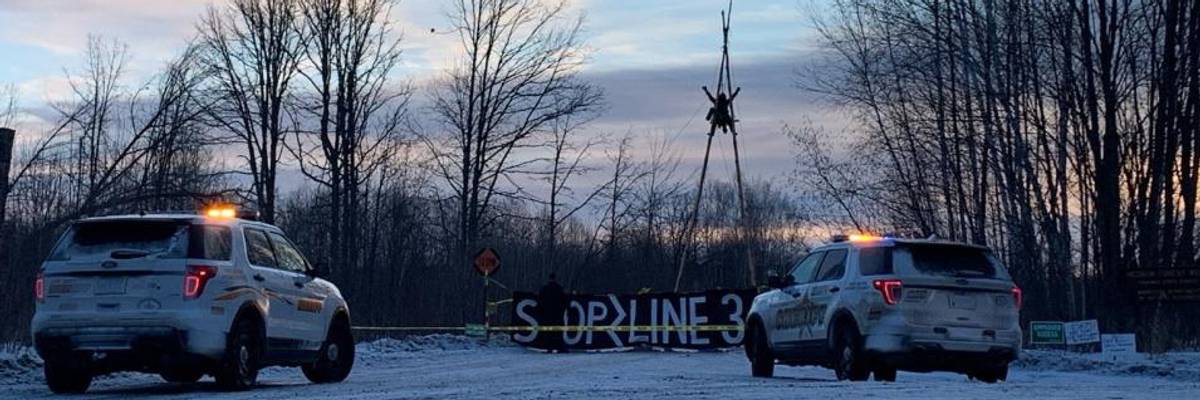
A water protector ascends nearly 40 feet in the air on a bi-pod blocking an entry road to Enbridge Line 3 worksites. (Photo: Giniw Collective)
In the latest act of peaceful resistance to Canadian oil giant Enbridge's Line 3 tar sands project, three water protectors in Savanna State Forest, Minnesota blockaded more than a dozen active worksites on Wednesday morning.
"For generations, multinational corporations have duped us all with their hush money. No more. We are waking up. Our silence will not be bought."
--Big Wind, Northern Arapaho Tribe
Two of the environmental and human rights activists impeded further construction of the fossil fuel pipeline by locking themselves to an overturned vehicle on a road leading to multiple worksites, the Giniw Collective explained in a statement.
Big Wind, a member of the Northern Arapaho Tribe and one of the participants in Wednesday's actions, said that "as a tribal citizen from an 'oil and gas tribe,' I know we are not devoid from the societal norms that prioritiz[e] profit over the planet."
"For generations, multinational corporations have duped us all with their hush money," they added. "No more. We are waking up. Our silence will not be bought."
Danny Leclaire of the Shosone-Bannock Tribe, another participant in Wednesday's actions, said that "Line 3 would ruin the drinking water of millions downstream."
The third protester--a water protector named Rose who ascended nearly 40 feet in the air on a bi-pod blocking an entry road to several worksites--called Line 3 "a disease of greed and destruction."
"I want to live in a world where we are deeply connected to the land and the water," said Rose. "I am taking a risk as an act of love for the forest, the wetlands, the rivers, and the lakes I grew up with. I am proud to stand with those Indigenous to this land who are fighting for all of our futures."
As Common Dreams has reported, climate justice and Indigenous rights advocates are opposed to the expansion of the Line 3 pipeline because it would send 760,000 barrels of crude oil every day from Alberta through North Dakota and Minnesota, to Wisconsin--traversing more than 800 wetland habitats, violating the treaty rights of Anishinaabe peoples, and putting current and future generations at risk of polluted water and a degraded environment.
Since Enbridge began working on the pipeline in late 2020 despite pending lawsuits, opponents have attempted to halt construction through civil disobedience, with arrests being made last December as well as this January and February.
"We have an obligation to future generations to stop this madness."
--Danny Leclaire, Shosone-Bannock Tribe
Minnesota's Democratic Gov. Tim Walz, who said publicly in February of 2019 that projects like this one "don't just need a building permit to go forward, they also need a social permit," has been widely condemned for giving Enbridge the green light to continue working on Line 3 even though it has been described as "a tar sands climate bomb," and activists have pressured Walz to rescind the permit for the pipeline.
While the Minnesota Court of Appeals earlier this month denied a request to halt construction as legal battles continue, Rep. Ilhan Omar (D-Minn.)--who met with Enbridge opponents in late January--has urged President Joe Biden to shut down Line 3 as he did the Keystone XL pipeline, given that both projects spell ecological and social destruction.
"Protect the water, protect the Mississippi," said Leclaire. "We have an obligation to future generations to stop this madness."
Dear Common Dreams reader, It’s been nearly 30 years since I co-founded Common Dreams with my late wife, Lina Newhouser. We had the radical notion that journalism should serve the public good, not corporate profits. It was clear to us from the outset what it would take to build such a project. No paid advertisements. No corporate sponsors. No millionaire publisher telling us what to think or do. Many people said we wouldn't last a year, but we proved those doubters wrong. Together with a tremendous team of journalists and dedicated staff, we built an independent media outlet free from the constraints of profits and corporate control. Our mission has always been simple: To inform. To inspire. To ignite change for the common good. Building Common Dreams was not easy. Our survival was never guaranteed. When you take on the most powerful forces—Wall Street greed, fossil fuel industry destruction, Big Tech lobbyists, and uber-rich oligarchs who have spent billions upon billions rigging the economy and democracy in their favor—the only bulwark you have is supporters who believe in your work. But here’s the urgent message from me today. It's never been this bad out there. And it's never been this hard to keep us going. At the very moment Common Dreams is most needed, the threats we face are intensifying. We need your support now more than ever. We don't accept corporate advertising and never will. We don't have a paywall because we don't think people should be blocked from critical news based on their ability to pay. Everything we do is funded by the donations of readers like you. When everyone does the little they can afford, we are strong. But if that support retreats or dries up, so do we. Will you donate now to make sure Common Dreams not only survives but thrives? —Craig Brown, Co-founder |
In the latest act of peaceful resistance to Canadian oil giant Enbridge's Line 3 tar sands project, three water protectors in Savanna State Forest, Minnesota blockaded more than a dozen active worksites on Wednesday morning.
"For generations, multinational corporations have duped us all with their hush money. No more. We are waking up. Our silence will not be bought."
--Big Wind, Northern Arapaho Tribe
Two of the environmental and human rights activists impeded further construction of the fossil fuel pipeline by locking themselves to an overturned vehicle on a road leading to multiple worksites, the Giniw Collective explained in a statement.
Big Wind, a member of the Northern Arapaho Tribe and one of the participants in Wednesday's actions, said that "as a tribal citizen from an 'oil and gas tribe,' I know we are not devoid from the societal norms that prioritiz[e] profit over the planet."
"For generations, multinational corporations have duped us all with their hush money," they added. "No more. We are waking up. Our silence will not be bought."
Danny Leclaire of the Shosone-Bannock Tribe, another participant in Wednesday's actions, said that "Line 3 would ruin the drinking water of millions downstream."
The third protester--a water protector named Rose who ascended nearly 40 feet in the air on a bi-pod blocking an entry road to several worksites--called Line 3 "a disease of greed and destruction."
"I want to live in a world where we are deeply connected to the land and the water," said Rose. "I am taking a risk as an act of love for the forest, the wetlands, the rivers, and the lakes I grew up with. I am proud to stand with those Indigenous to this land who are fighting for all of our futures."
As Common Dreams has reported, climate justice and Indigenous rights advocates are opposed to the expansion of the Line 3 pipeline because it would send 760,000 barrels of crude oil every day from Alberta through North Dakota and Minnesota, to Wisconsin--traversing more than 800 wetland habitats, violating the treaty rights of Anishinaabe peoples, and putting current and future generations at risk of polluted water and a degraded environment.
Since Enbridge began working on the pipeline in late 2020 despite pending lawsuits, opponents have attempted to halt construction through civil disobedience, with arrests being made last December as well as this January and February.
"We have an obligation to future generations to stop this madness."
--Danny Leclaire, Shosone-Bannock Tribe
Minnesota's Democratic Gov. Tim Walz, who said publicly in February of 2019 that projects like this one "don't just need a building permit to go forward, they also need a social permit," has been widely condemned for giving Enbridge the green light to continue working on Line 3 even though it has been described as "a tar sands climate bomb," and activists have pressured Walz to rescind the permit for the pipeline.
While the Minnesota Court of Appeals earlier this month denied a request to halt construction as legal battles continue, Rep. Ilhan Omar (D-Minn.)--who met with Enbridge opponents in late January--has urged President Joe Biden to shut down Line 3 as he did the Keystone XL pipeline, given that both projects spell ecological and social destruction.
"Protect the water, protect the Mississippi," said Leclaire. "We have an obligation to future generations to stop this madness."
In the latest act of peaceful resistance to Canadian oil giant Enbridge's Line 3 tar sands project, three water protectors in Savanna State Forest, Minnesota blockaded more than a dozen active worksites on Wednesday morning.
"For generations, multinational corporations have duped us all with their hush money. No more. We are waking up. Our silence will not be bought."
--Big Wind, Northern Arapaho Tribe
Two of the environmental and human rights activists impeded further construction of the fossil fuel pipeline by locking themselves to an overturned vehicle on a road leading to multiple worksites, the Giniw Collective explained in a statement.
Big Wind, a member of the Northern Arapaho Tribe and one of the participants in Wednesday's actions, said that "as a tribal citizen from an 'oil and gas tribe,' I know we are not devoid from the societal norms that prioritiz[e] profit over the planet."
"For generations, multinational corporations have duped us all with their hush money," they added. "No more. We are waking up. Our silence will not be bought."
Danny Leclaire of the Shosone-Bannock Tribe, another participant in Wednesday's actions, said that "Line 3 would ruin the drinking water of millions downstream."
The third protester--a water protector named Rose who ascended nearly 40 feet in the air on a bi-pod blocking an entry road to several worksites--called Line 3 "a disease of greed and destruction."
"I want to live in a world where we are deeply connected to the land and the water," said Rose. "I am taking a risk as an act of love for the forest, the wetlands, the rivers, and the lakes I grew up with. I am proud to stand with those Indigenous to this land who are fighting for all of our futures."
As Common Dreams has reported, climate justice and Indigenous rights advocates are opposed to the expansion of the Line 3 pipeline because it would send 760,000 barrels of crude oil every day from Alberta through North Dakota and Minnesota, to Wisconsin--traversing more than 800 wetland habitats, violating the treaty rights of Anishinaabe peoples, and putting current and future generations at risk of polluted water and a degraded environment.
Since Enbridge began working on the pipeline in late 2020 despite pending lawsuits, opponents have attempted to halt construction through civil disobedience, with arrests being made last December as well as this January and February.
"We have an obligation to future generations to stop this madness."
--Danny Leclaire, Shosone-Bannock Tribe
Minnesota's Democratic Gov. Tim Walz, who said publicly in February of 2019 that projects like this one "don't just need a building permit to go forward, they also need a social permit," has been widely condemned for giving Enbridge the green light to continue working on Line 3 even though it has been described as "a tar sands climate bomb," and activists have pressured Walz to rescind the permit for the pipeline.
While the Minnesota Court of Appeals earlier this month denied a request to halt construction as legal battles continue, Rep. Ilhan Omar (D-Minn.)--who met with Enbridge opponents in late January--has urged President Joe Biden to shut down Line 3 as he did the Keystone XL pipeline, given that both projects spell ecological and social destruction.
"Protect the water, protect the Mississippi," said Leclaire. "We have an obligation to future generations to stop this madness."

