SUBSCRIBE TO OUR FREE NEWSLETTER
Daily news & progressive opinion—funded by the people, not the corporations—delivered straight to your inbox.
5
#000000
#FFFFFF
To donate by check, phone, or other method, see our More Ways to Give page.
Daily news & progressive opinion—funded by the people, not the corporations—delivered straight to your inbox.
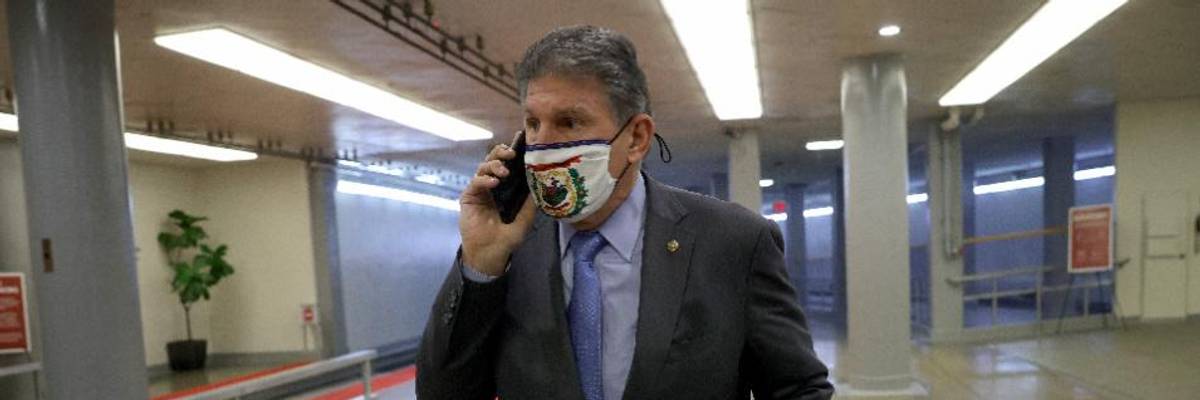
Sen. Joe Manchin (D-W.Va.) walks to the Senate chamber at the U.S. Capitol on February 10, 2021 in Washington, D.C. (Photo: Win McNamee/Getty Images)
Democratic Sen. Joe Manchin of West Virginia on Monday said he will push an amendment to slash the $15 federal minimum wage proposal in the emerging coronavirus relief package to $11 an hour, an idea that progressives immediately rejected as an "unacceptable" attempt to weaken a popular and long-overdue pay raise for tens of millions of workers.
Manchin--whose support Senate Democrats will need to pass a relief bill with a simple majority--told CNN that if the chamber's parliamentarian rules that the proposed Raise the Wage Act of 2021 qualifies under reconciliation and can therefore be included in the final package, he will try to "amend it to $11."
While the West Virginia senator provided little by way of specific details, he said that "we can do $11 in two years and be in a better position than they're going to be with $15 in five years." The minimum wage in West Virginia is currently $8.75 an hour, well below what workers in the state say they need to adequately provide for themselves and their families.
The Raise the Wage Act, reintroduced last month with the support of Democratic congressional leaders and President Joe Biden, would gradually phase in a $15 federal minimum wage over the next four years. Under the proposed phase-in structure (pdf), the $7.25 federal minimum wage would be raised to $9.50 by the end of 2021, $11 by next year, and $15 by 2025.
Rep. Mondaire Jones (D-N.Y.), who made clear earlier this month that he would prefer a much quicker phase in, said late Monday that progressives would not support Manchin's proposal.
"This is unacceptable," Jones tweeted. "The $15 minimum wage is overwhelmingly popular with the American people. One person should not be allowed to hold relief hostage."
Evan Weber, co-founder and political director of the Sunrise Movement, noted that the estimated "living wage for an adult with no children in West Virginia right now is almost $14/hour."
"By 2025 it will be well above $15," Weber added. "$11/hr is not enough for West Virginia or anywhere."
Elizabeth MacDonough, the Senate parliamentarian, is expected to rule as soon as this week on whether the proposed minimum wage increase qualifies under reconciliation, a filibuster-proof process that requires all legislative provisions to have a direct budgetary impact.
Pointing to a recent Congressional Budget Office analysis showing that the proposed pay hike would have a broader impact on federal spending and revenue than two provisions of the 2017 Republican tax cut legislation--which passed through reconciliation--Sen. Bernie Sanders (I-Vt.) said Saturday that he is "confident" the parliamentarian will rule in favor of the Raise the Wage Act.
"I'm very proud of the strong arguments our legal team is making to the parliamentarian that raising the minimum wage to $15 an hour is not 'incidental' to the federal budget and is permissible under reconciliation," said Sanders, the chair of the Senate Budget Committee.
While Vice President Kamala Harris has the authority to overrule the parliamentarian should she rule against the minimum wage increase, the White House has signaled that Harris would not be willing to take such a step.
As Common Dreams reported earlier this month, the Congressional Progressive Caucus (CPC) secured inclusion of the Raise the Wage Act in the House version of the coronavirus relief package, which is currently under construction in congressional committees.
The House doesn't have to contend with the so-called Byrd rule--which empowers individual senators to object to reconciliation provisions they believe to be "extraneous" to the budget process--but both chambers must pass identical legislation for the relief measure to become law.
"A $15 minimum wage must stay in the Covid-19 relief bill," Rep. Pramila Jayapal (D-Wash.), chair of the CPC, tweeted Monday. "I'm going to fight to ensure that it does."
Dear Common Dreams reader, It’s been nearly 30 years since I co-founded Common Dreams with my late wife, Lina Newhouser. We had the radical notion that journalism should serve the public good, not corporate profits. It was clear to us from the outset what it would take to build such a project. No paid advertisements. No corporate sponsors. No millionaire publisher telling us what to think or do. Many people said we wouldn't last a year, but we proved those doubters wrong. Together with a tremendous team of journalists and dedicated staff, we built an independent media outlet free from the constraints of profits and corporate control. Our mission has always been simple: To inform. To inspire. To ignite change for the common good. Building Common Dreams was not easy. Our survival was never guaranteed. When you take on the most powerful forces—Wall Street greed, fossil fuel industry destruction, Big Tech lobbyists, and uber-rich oligarchs who have spent billions upon billions rigging the economy and democracy in their favor—the only bulwark you have is supporters who believe in your work. But here’s the urgent message from me today. It's never been this bad out there. And it's never been this hard to keep us going. At the very moment Common Dreams is most needed, the threats we face are intensifying. We need your support now more than ever. We don't accept corporate advertising and never will. We don't have a paywall because we don't think people should be blocked from critical news based on their ability to pay. Everything we do is funded by the donations of readers like you. When everyone does the little they can afford, we are strong. But if that support retreats or dries up, so do we. Will you donate now to make sure Common Dreams not only survives but thrives? —Craig Brown, Co-founder |
Democratic Sen. Joe Manchin of West Virginia on Monday said he will push an amendment to slash the $15 federal minimum wage proposal in the emerging coronavirus relief package to $11 an hour, an idea that progressives immediately rejected as an "unacceptable" attempt to weaken a popular and long-overdue pay raise for tens of millions of workers.
Manchin--whose support Senate Democrats will need to pass a relief bill with a simple majority--told CNN that if the chamber's parliamentarian rules that the proposed Raise the Wage Act of 2021 qualifies under reconciliation and can therefore be included in the final package, he will try to "amend it to $11."
While the West Virginia senator provided little by way of specific details, he said that "we can do $11 in two years and be in a better position than they're going to be with $15 in five years." The minimum wage in West Virginia is currently $8.75 an hour, well below what workers in the state say they need to adequately provide for themselves and their families.
The Raise the Wage Act, reintroduced last month with the support of Democratic congressional leaders and President Joe Biden, would gradually phase in a $15 federal minimum wage over the next four years. Under the proposed phase-in structure (pdf), the $7.25 federal minimum wage would be raised to $9.50 by the end of 2021, $11 by next year, and $15 by 2025.
Rep. Mondaire Jones (D-N.Y.), who made clear earlier this month that he would prefer a much quicker phase in, said late Monday that progressives would not support Manchin's proposal.
"This is unacceptable," Jones tweeted. "The $15 minimum wage is overwhelmingly popular with the American people. One person should not be allowed to hold relief hostage."
Evan Weber, co-founder and political director of the Sunrise Movement, noted that the estimated "living wage for an adult with no children in West Virginia right now is almost $14/hour."
"By 2025 it will be well above $15," Weber added. "$11/hr is not enough for West Virginia or anywhere."
Elizabeth MacDonough, the Senate parliamentarian, is expected to rule as soon as this week on whether the proposed minimum wage increase qualifies under reconciliation, a filibuster-proof process that requires all legislative provisions to have a direct budgetary impact.
Pointing to a recent Congressional Budget Office analysis showing that the proposed pay hike would have a broader impact on federal spending and revenue than two provisions of the 2017 Republican tax cut legislation--which passed through reconciliation--Sen. Bernie Sanders (I-Vt.) said Saturday that he is "confident" the parliamentarian will rule in favor of the Raise the Wage Act.
"I'm very proud of the strong arguments our legal team is making to the parliamentarian that raising the minimum wage to $15 an hour is not 'incidental' to the federal budget and is permissible under reconciliation," said Sanders, the chair of the Senate Budget Committee.
While Vice President Kamala Harris has the authority to overrule the parliamentarian should she rule against the minimum wage increase, the White House has signaled that Harris would not be willing to take such a step.
As Common Dreams reported earlier this month, the Congressional Progressive Caucus (CPC) secured inclusion of the Raise the Wage Act in the House version of the coronavirus relief package, which is currently under construction in congressional committees.
The House doesn't have to contend with the so-called Byrd rule--which empowers individual senators to object to reconciliation provisions they believe to be "extraneous" to the budget process--but both chambers must pass identical legislation for the relief measure to become law.
"A $15 minimum wage must stay in the Covid-19 relief bill," Rep. Pramila Jayapal (D-Wash.), chair of the CPC, tweeted Monday. "I'm going to fight to ensure that it does."
Democratic Sen. Joe Manchin of West Virginia on Monday said he will push an amendment to slash the $15 federal minimum wage proposal in the emerging coronavirus relief package to $11 an hour, an idea that progressives immediately rejected as an "unacceptable" attempt to weaken a popular and long-overdue pay raise for tens of millions of workers.
Manchin--whose support Senate Democrats will need to pass a relief bill with a simple majority--told CNN that if the chamber's parliamentarian rules that the proposed Raise the Wage Act of 2021 qualifies under reconciliation and can therefore be included in the final package, he will try to "amend it to $11."
While the West Virginia senator provided little by way of specific details, he said that "we can do $11 in two years and be in a better position than they're going to be with $15 in five years." The minimum wage in West Virginia is currently $8.75 an hour, well below what workers in the state say they need to adequately provide for themselves and their families.
The Raise the Wage Act, reintroduced last month with the support of Democratic congressional leaders and President Joe Biden, would gradually phase in a $15 federal minimum wage over the next four years. Under the proposed phase-in structure (pdf), the $7.25 federal minimum wage would be raised to $9.50 by the end of 2021, $11 by next year, and $15 by 2025.
Rep. Mondaire Jones (D-N.Y.), who made clear earlier this month that he would prefer a much quicker phase in, said late Monday that progressives would not support Manchin's proposal.
"This is unacceptable," Jones tweeted. "The $15 minimum wage is overwhelmingly popular with the American people. One person should not be allowed to hold relief hostage."
Evan Weber, co-founder and political director of the Sunrise Movement, noted that the estimated "living wage for an adult with no children in West Virginia right now is almost $14/hour."
"By 2025 it will be well above $15," Weber added. "$11/hr is not enough for West Virginia or anywhere."
Elizabeth MacDonough, the Senate parliamentarian, is expected to rule as soon as this week on whether the proposed minimum wage increase qualifies under reconciliation, a filibuster-proof process that requires all legislative provisions to have a direct budgetary impact.
Pointing to a recent Congressional Budget Office analysis showing that the proposed pay hike would have a broader impact on federal spending and revenue than two provisions of the 2017 Republican tax cut legislation--which passed through reconciliation--Sen. Bernie Sanders (I-Vt.) said Saturday that he is "confident" the parliamentarian will rule in favor of the Raise the Wage Act.
"I'm very proud of the strong arguments our legal team is making to the parliamentarian that raising the minimum wage to $15 an hour is not 'incidental' to the federal budget and is permissible under reconciliation," said Sanders, the chair of the Senate Budget Committee.
While Vice President Kamala Harris has the authority to overrule the parliamentarian should she rule against the minimum wage increase, the White House has signaled that Harris would not be willing to take such a step.
As Common Dreams reported earlier this month, the Congressional Progressive Caucus (CPC) secured inclusion of the Raise the Wage Act in the House version of the coronavirus relief package, which is currently under construction in congressional committees.
The House doesn't have to contend with the so-called Byrd rule--which empowers individual senators to object to reconciliation provisions they believe to be "extraneous" to the budget process--but both chambers must pass identical legislation for the relief measure to become law.
"A $15 minimum wage must stay in the Covid-19 relief bill," Rep. Pramila Jayapal (D-Wash.), chair of the CPC, tweeted Monday. "I'm going to fight to ensure that it does."