SUBSCRIBE TO OUR FREE NEWSLETTER
Daily news & progressive opinion—funded by the people, not the corporations—delivered straight to your inbox.
5
#000000
#FFFFFF
To donate by check, phone, or other method, see our More Ways to Give page.
Daily news & progressive opinion—funded by the people, not the corporations—delivered straight to your inbox.
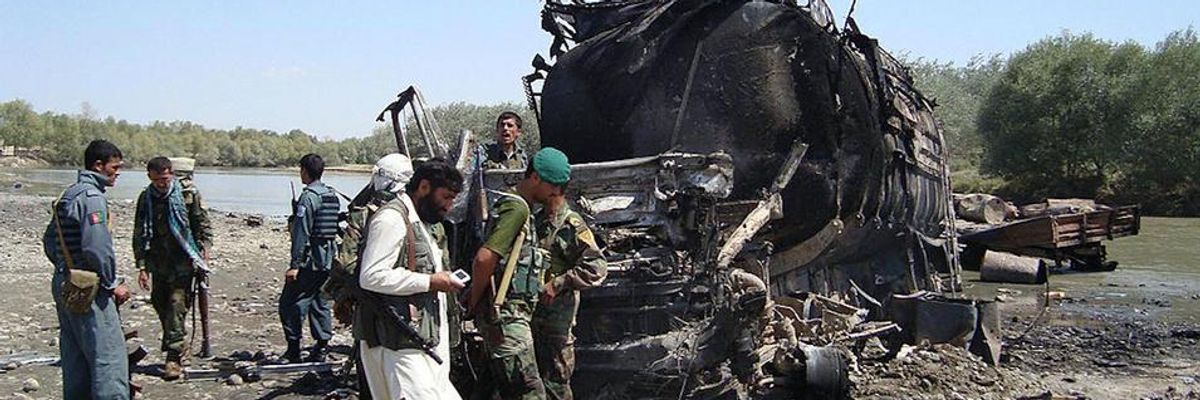
Afghan security forces walk around the blasted remnants of one of the two fuel tankers destroyed in a September 3, 2009 NATO airstrike in Kunduz province that killed as many as 90 civilians. (Photo: STR/AFP via Getty Images)
Afghans and human rights advocates around the world expressed deep disappointment Tuesday after the European Court of Human Rights ruled in favor of Germany in a case brought by victims of a 2009 NATO airstrike that killed as many as 90 civilians.
"They martyred a hundred people, they bombed us unjustly, so how can they come to this unjust decision?"
--Abdul Hanan, plaintiff
The New York Times reports a 17-judge panel of the ECHR ruled unanimously that the German government adequately investigated a September 3, 2009 airstrike in Afghanistan's Kunduz province that targeted two fuel tankers stolen by Taliban fighters. Believing the militants might use the trucks as a mobile bombs, Col. Georg Klein, the German commanding officer of a nearby NATO base, ordered U.S. warplanes to destroy the vehicles.
According to German broadcaster Deutsche Welle, prosecutors said Klein made several calls to an informant to ensure there were no civilians present before the strike. However, scores of Afghan civilians including children flocked to the trucks--which were stuck on a sandbank in the Kunduz River--to siphon off fuel at the Taliban's invitation.
A German military investigation later found that as many as 90 civilians died in the massive explosion caused by the strike. The probe concluded that no charges should be brought against Klein.
Tuesday's ECHR ruling stated that Klein "had not incurred criminal liability mainly because he had been convinced, at the time of ordering the airstrike, that no civilians had been present at the sand bank." Klein was promoted to general in 2012.
The court also found there was "no violation" of Article 2 of the European Convention on Human Rights, that it "had no reason to doubt" Germany's assertion that it thoroughly investigated the airstrike as required under the charter, and that Klein had "not acted with the intent to cause excessive civilian casualties."
The court's findings gave no comfort to plaintiff Abdul Hanan, a farmer whose sons Abdul Bayan and Nesarullah--ages 12 and eight, respectively--were killed in the strike.
"They martyred a hundred people, they bombed us unjustly, so how can they come to this unjust decision?" Hanan told the Times after the ECHR ruling. "Is our blood worth less than the blood of a German?"
"I wanted the court to provide justice, to have mercy on us," Hanan added.
In the aftermath of the mass killing, Germany offered $5,000 payments to families of civilians who died or were seriously injured in the strike. Hanan sought additional damages, as well as an admission by German officials that they failed to protect civilians. The German government argued that it was not legally responsible for the deaths since the airstrike was executed on behalf of the United Nations.
Last December, Germany's constitutional court ruled that the country was not liable for the civilian casualties.
According to the Costs of War Project at Brown University's Watson Institute, more than 43,000 Afghan civilians have been killed during the U.S.-led war in Afghanistan, now in its 20th year. Taliban militants have killed the most noncombatants, but thousands of men, women, and children have also been killed by U.S., allied, and Afghan government bombs and bullets.
This country and this world are at a monumental crossroads. US voters have an opportunity to beat back the forces of fascism and confront the billionaires who are rigging the economy, our media system, and our democracy, making it increasingly impossible for ordinary people to get by. We’re not just talking about the election. We’re talking about what must be done once these fascist elements are vanquished from power. We need a bolder set of solutions than what either major party has so far been willing to offer and a working-class movement ready to fight like hell for it. Trump didn't emerge from nowhere. The conditions that fueled MAGA authoritarianism were created by decades of radical neoliberal economic policies and a corrupt political system dominated by corporate interests. They slashed taxes on the super-rich, promising that the benefits would trickle down. They said giveaways to the corporate titans would make life more affordable for the rest of us. It was all bullshit. And when a bitter, betrayed populace searches for someone to blame, right-wing demagogues have little trouble finding scapegoats. People know when they're being lied to, but you won't hear any of this from the corporate media. Only independent journalism—powered and funded by people who believe in building a better world—can deliver truly trustworthy daily news. If you share our vision, please contribute whatever you can to sustain our work. |
Afghans and human rights advocates around the world expressed deep disappointment Tuesday after the European Court of Human Rights ruled in favor of Germany in a case brought by victims of a 2009 NATO airstrike that killed as many as 90 civilians.
"They martyred a hundred people, they bombed us unjustly, so how can they come to this unjust decision?"
--Abdul Hanan, plaintiff
The New York Times reports a 17-judge panel of the ECHR ruled unanimously that the German government adequately investigated a September 3, 2009 airstrike in Afghanistan's Kunduz province that targeted two fuel tankers stolen by Taliban fighters. Believing the militants might use the trucks as a mobile bombs, Col. Georg Klein, the German commanding officer of a nearby NATO base, ordered U.S. warplanes to destroy the vehicles.
According to German broadcaster Deutsche Welle, prosecutors said Klein made several calls to an informant to ensure there were no civilians present before the strike. However, scores of Afghan civilians including children flocked to the trucks--which were stuck on a sandbank in the Kunduz River--to siphon off fuel at the Taliban's invitation.
A German military investigation later found that as many as 90 civilians died in the massive explosion caused by the strike. The probe concluded that no charges should be brought against Klein.
Tuesday's ECHR ruling stated that Klein "had not incurred criminal liability mainly because he had been convinced, at the time of ordering the airstrike, that no civilians had been present at the sand bank." Klein was promoted to general in 2012.
The court also found there was "no violation" of Article 2 of the European Convention on Human Rights, that it "had no reason to doubt" Germany's assertion that it thoroughly investigated the airstrike as required under the charter, and that Klein had "not acted with the intent to cause excessive civilian casualties."
The court's findings gave no comfort to plaintiff Abdul Hanan, a farmer whose sons Abdul Bayan and Nesarullah--ages 12 and eight, respectively--were killed in the strike.
"They martyred a hundred people, they bombed us unjustly, so how can they come to this unjust decision?" Hanan told the Times after the ECHR ruling. "Is our blood worth less than the blood of a German?"
"I wanted the court to provide justice, to have mercy on us," Hanan added.
In the aftermath of the mass killing, Germany offered $5,000 payments to families of civilians who died or were seriously injured in the strike. Hanan sought additional damages, as well as an admission by German officials that they failed to protect civilians. The German government argued that it was not legally responsible for the deaths since the airstrike was executed on behalf of the United Nations.
Last December, Germany's constitutional court ruled that the country was not liable for the civilian casualties.
According to the Costs of War Project at Brown University's Watson Institute, more than 43,000 Afghan civilians have been killed during the U.S.-led war in Afghanistan, now in its 20th year. Taliban militants have killed the most noncombatants, but thousands of men, women, and children have also been killed by U.S., allied, and Afghan government bombs and bullets.