SUBSCRIBE TO OUR FREE NEWSLETTER
Daily news & progressive opinion—funded by the people, not the corporations—delivered straight to your inbox.
5
#000000
#FFFFFF
To donate by check, phone, or other method, see our More Ways to Give page.
Daily news & progressive opinion—funded by the people, not the corporations—delivered straight to your inbox.
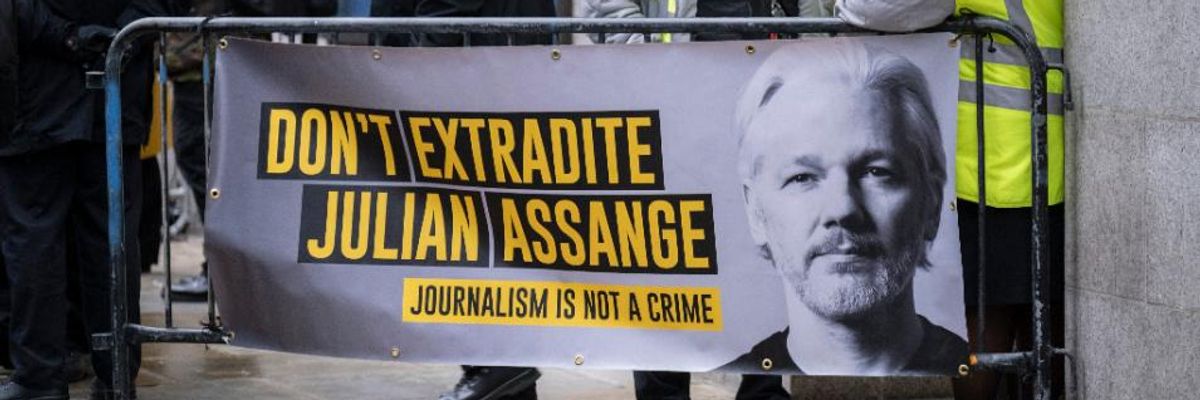
Supporters of WikiLeaks founder and publisher Julian Assange rally after a prolonged legal hearing at the Old Bailey on January 4, 2021, in London. (Photo: Richard Baker/In Pictures via Getty Images)
The Biden Justice Department on Friday formally appealed a British judge's rejection of the U.S. request to extradite Julian Assange, confirming the new administration's intention to run with its predecessor's espionage charges against the WikiLeaks publisher despite warnings that the case endangers press freedoms around the world.
"Yes, we filed an appeal and we are continuing to pursue extradition," Marc Raimondi, a Justice Department spokesperson, told AFP on Friday, the deadline for the U.S. to appeal Judge Vanessa Baraitser's ruling from last month.
As Common Dreams reported at the time, while Baraitser accepted most of the allegations that the Trump Justice Department leveled against Assange in its 2019 indictment--which charges the WikiLeaks founder with 17 counts of violating the Espionage Act--the judge denied the U.S. extradition request on the grounds that America's brutal prison system would pose a threat to Assange's life.
"The Assange case could allow prosecutors to build criminal cases against journalists who obtain government secrets based on their interactions with their sources."
--James Risen, The Intercept
If extradited to the U.S., Assange could face up to 175 years in a maximum-security prison--conditions under which Assange would likely commit suicide, Baraitser warned in her decision.
"Disappointing that the Biden administration should do this given the chilling effect the ongoing pursuit of Julian Assange will have on press freedom," Stefan Simanowitz, Amnesty International's media manager for Europe, tweeted in response to the Biden administration's appeal.
In anticipation of the DOJ's filing, the Courage Foundation--an organization dedicated to defending whistleblowers--said in a statement Thursday that, if confirmed as Biden's attorney general, Merrick Garland should "take a renewed look at the prosecution" of Assange and "drop the case."
"The Assange case represents the gravest threat to press freedom in a generation," the group said. "It's not about Julian Assange as a person. It's about whether the U.S. government will respect the role journalism plays in democratic life (as a check on powerful institutions)."
The Justice Department's appeal came just days after a coalition of press freedom and human rights organizations including the ACLU, Amnesty International, and PEN America published an open letter urging the Biden administration to drop the case against Assange, whose release of classified documents exposed U.S. war crimes in Iraq and Afghanistan.
"Journalists at major news publications regularly speak with sources, ask for clarification or more documentation, and receive and publish documents the government considers secret," the open letter reads. "In our view, such a precedent in this case could effectively criminalize these common journalistic practices. In addition, some of the charges included in the indictment turn entirely on Mr. Assange's decision to publish classified information."
In a column on Thursday, The Intercept's James Risen similarly warned that "if the Assange prosecution is successful, it will set a dangerous legal standard" and "open the door for the government to prosecute journalists for publishing classified information, even if doing so is in the public interest."
"The Assange case could allow prosecutors to build criminal cases against journalists who obtain government secrets based on their interactions with their sources," Risen wrote. "Investigative reporters throughout the country could face criminal liability simply for meeting with sources and encouraging them to provide information."
"That would make it nearly impossible for reporters to aggressively cover the Pentagon, the CIA, or the National Security Agency," Risen added, "and ultimately imperil the American republic."
Dear Common Dreams reader, It’s been nearly 30 years since I co-founded Common Dreams with my late wife, Lina Newhouser. We had the radical notion that journalism should serve the public good, not corporate profits. It was clear to us from the outset what it would take to build such a project. No paid advertisements. No corporate sponsors. No millionaire publisher telling us what to think or do. Many people said we wouldn't last a year, but we proved those doubters wrong. Together with a tremendous team of journalists and dedicated staff, we built an independent media outlet free from the constraints of profits and corporate control. Our mission has always been simple: To inform. To inspire. To ignite change for the common good. Building Common Dreams was not easy. Our survival was never guaranteed. When you take on the most powerful forces—Wall Street greed, fossil fuel industry destruction, Big Tech lobbyists, and uber-rich oligarchs who have spent billions upon billions rigging the economy and democracy in their favor—the only bulwark you have is supporters who believe in your work. But here’s the urgent message from me today. It's never been this bad out there. And it's never been this hard to keep us going. At the very moment Common Dreams is most needed, the threats we face are intensifying. We need your support now more than ever. We don't accept corporate advertising and never will. We don't have a paywall because we don't think people should be blocked from critical news based on their ability to pay. Everything we do is funded by the donations of readers like you. When everyone does the little they can afford, we are strong. But if that support retreats or dries up, so do we. Will you donate now to make sure Common Dreams not only survives but thrives? —Craig Brown, Co-founder |
The Biden Justice Department on Friday formally appealed a British judge's rejection of the U.S. request to extradite Julian Assange, confirming the new administration's intention to run with its predecessor's espionage charges against the WikiLeaks publisher despite warnings that the case endangers press freedoms around the world.
"Yes, we filed an appeal and we are continuing to pursue extradition," Marc Raimondi, a Justice Department spokesperson, told AFP on Friday, the deadline for the U.S. to appeal Judge Vanessa Baraitser's ruling from last month.
As Common Dreams reported at the time, while Baraitser accepted most of the allegations that the Trump Justice Department leveled against Assange in its 2019 indictment--which charges the WikiLeaks founder with 17 counts of violating the Espionage Act--the judge denied the U.S. extradition request on the grounds that America's brutal prison system would pose a threat to Assange's life.
"The Assange case could allow prosecutors to build criminal cases against journalists who obtain government secrets based on their interactions with their sources."
--James Risen, The Intercept
If extradited to the U.S., Assange could face up to 175 years in a maximum-security prison--conditions under which Assange would likely commit suicide, Baraitser warned in her decision.
"Disappointing that the Biden administration should do this given the chilling effect the ongoing pursuit of Julian Assange will have on press freedom," Stefan Simanowitz, Amnesty International's media manager for Europe, tweeted in response to the Biden administration's appeal.
In anticipation of the DOJ's filing, the Courage Foundation--an organization dedicated to defending whistleblowers--said in a statement Thursday that, if confirmed as Biden's attorney general, Merrick Garland should "take a renewed look at the prosecution" of Assange and "drop the case."
"The Assange case represents the gravest threat to press freedom in a generation," the group said. "It's not about Julian Assange as a person. It's about whether the U.S. government will respect the role journalism plays in democratic life (as a check on powerful institutions)."
The Justice Department's appeal came just days after a coalition of press freedom and human rights organizations including the ACLU, Amnesty International, and PEN America published an open letter urging the Biden administration to drop the case against Assange, whose release of classified documents exposed U.S. war crimes in Iraq and Afghanistan.
"Journalists at major news publications regularly speak with sources, ask for clarification or more documentation, and receive and publish documents the government considers secret," the open letter reads. "In our view, such a precedent in this case could effectively criminalize these common journalistic practices. In addition, some of the charges included in the indictment turn entirely on Mr. Assange's decision to publish classified information."
In a column on Thursday, The Intercept's James Risen similarly warned that "if the Assange prosecution is successful, it will set a dangerous legal standard" and "open the door for the government to prosecute journalists for publishing classified information, even if doing so is in the public interest."
"The Assange case could allow prosecutors to build criminal cases against journalists who obtain government secrets based on their interactions with their sources," Risen wrote. "Investigative reporters throughout the country could face criminal liability simply for meeting with sources and encouraging them to provide information."
"That would make it nearly impossible for reporters to aggressively cover the Pentagon, the CIA, or the National Security Agency," Risen added, "and ultimately imperil the American republic."
The Biden Justice Department on Friday formally appealed a British judge's rejection of the U.S. request to extradite Julian Assange, confirming the new administration's intention to run with its predecessor's espionage charges against the WikiLeaks publisher despite warnings that the case endangers press freedoms around the world.
"Yes, we filed an appeal and we are continuing to pursue extradition," Marc Raimondi, a Justice Department spokesperson, told AFP on Friday, the deadline for the U.S. to appeal Judge Vanessa Baraitser's ruling from last month.
As Common Dreams reported at the time, while Baraitser accepted most of the allegations that the Trump Justice Department leveled against Assange in its 2019 indictment--which charges the WikiLeaks founder with 17 counts of violating the Espionage Act--the judge denied the U.S. extradition request on the grounds that America's brutal prison system would pose a threat to Assange's life.
"The Assange case could allow prosecutors to build criminal cases against journalists who obtain government secrets based on their interactions with their sources."
--James Risen, The Intercept
If extradited to the U.S., Assange could face up to 175 years in a maximum-security prison--conditions under which Assange would likely commit suicide, Baraitser warned in her decision.
"Disappointing that the Biden administration should do this given the chilling effect the ongoing pursuit of Julian Assange will have on press freedom," Stefan Simanowitz, Amnesty International's media manager for Europe, tweeted in response to the Biden administration's appeal.
In anticipation of the DOJ's filing, the Courage Foundation--an organization dedicated to defending whistleblowers--said in a statement Thursday that, if confirmed as Biden's attorney general, Merrick Garland should "take a renewed look at the prosecution" of Assange and "drop the case."
"The Assange case represents the gravest threat to press freedom in a generation," the group said. "It's not about Julian Assange as a person. It's about whether the U.S. government will respect the role journalism plays in democratic life (as a check on powerful institutions)."
The Justice Department's appeal came just days after a coalition of press freedom and human rights organizations including the ACLU, Amnesty International, and PEN America published an open letter urging the Biden administration to drop the case against Assange, whose release of classified documents exposed U.S. war crimes in Iraq and Afghanistan.
"Journalists at major news publications regularly speak with sources, ask for clarification or more documentation, and receive and publish documents the government considers secret," the open letter reads. "In our view, such a precedent in this case could effectively criminalize these common journalistic practices. In addition, some of the charges included in the indictment turn entirely on Mr. Assange's decision to publish classified information."
In a column on Thursday, The Intercept's James Risen similarly warned that "if the Assange prosecution is successful, it will set a dangerous legal standard" and "open the door for the government to prosecute journalists for publishing classified information, even if doing so is in the public interest."
"The Assange case could allow prosecutors to build criminal cases against journalists who obtain government secrets based on their interactions with their sources," Risen wrote. "Investigative reporters throughout the country could face criminal liability simply for meeting with sources and encouraging them to provide information."
"That would make it nearly impossible for reporters to aggressively cover the Pentagon, the CIA, or the National Security Agency," Risen added, "and ultimately imperil the American republic."