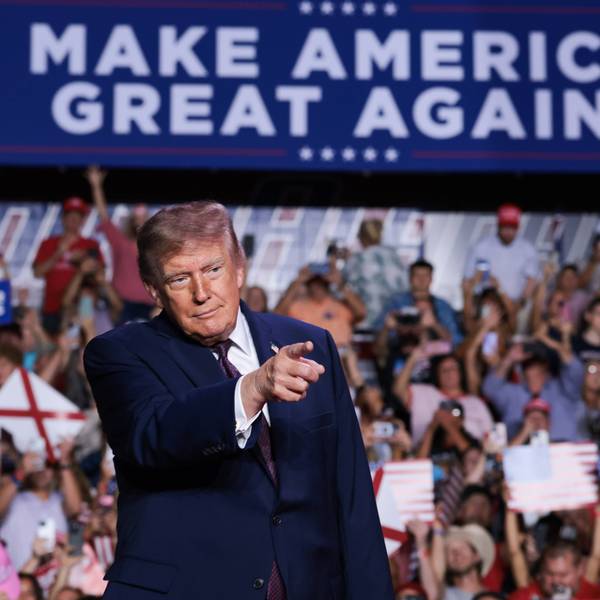

President-elect Joe Biden speaks during a rally outside Center Parc Stadium in Atlanta, Georgia on January 4, 2021. (Photo: Jim Watson/AFP via Getty Images)
After Biden Vowed '$2,000 Checks Will Go Out the Door' Ahead of Georgia Wins, Relief Plan Reportedly Includes Just $1,400
A $1,400 direct payment on top of the recently approved $600 would total $2,000. But as one critic argued, "I don't think that's what Biden promised. And I know it's not what most people heard."
On the eve of the pivotal January 5 Senate runoffs in Georgia, President-elect Joe Biden promised that if Democratic candidates Raphael Warnock and Jon Ossoff emerged victorious, "$2,000 checks will go out the door, restoring hope and decency and honor for so many people who are struggling right now."
Georgia voters ultimately delivered, sending Ossoff and Warnock to the Senate and giving Democrats control of the chamber.
But the coronavirus relief proposal Biden plans to unveil Thursday is reportedly expected to include direct payments of just $1,400, raising the question of whether the president-elect is already backtracking on a promise that helped Democrats retake the Senate.
"Hopefully, Senate Democrats can look through all the nonsense that has been thrown at the proposal in the past few weeks and keep Biden and Schumer's promises to send out these $2,000 checks. America's poorest are depending on them."
--Matt Bruenig, People's Policy Project
"The stimulus package has a price tag above $1.5 trillion and includes a commitment for $1,400 stimulus checks," Reuters reported Thursday, citing an unnamed source familiar with the proposal.
On top of the $600 direct payment that was approved by the coronavirus relief measure signed into law last month, a new $1,400 check would bring the total direct payment that many Americans have received in recent weeks to $2,000.
That is what would have been accomplished by the House-passed CASH Act, legislation that proposed replacing the $600 payments in the most recent relief law with $2,000 checks. The Republican-controlled Senate blocked an effort by Sen. Bernie Sanders (I-Vt.) to force a vote on the bill ahead of the Georgia runoffs. Both Warnock and Ossoff enthusiastically embraced the push for $2,000 direct payments.
But as Biden, Vice President-elect Kamala Harris, and others have continued to call for $2,000 checks in the wake of the Georgia contests without explicitly clarifying that the payments would actually be a $1,400 top-off, analysts have openly wondered what precisely Democrats are proposing.
"So, heretofore, '$2,000 checks' have meant 'increasing the size of the $600 check by $1,400," New York magazine's Eric Levitz tweeted last week, referring to the goal of the CASH Act. "When Dems talk about $2,000 checks now, is that what they mean? Or do they mean bringing the total up to $2,600?"
On Thursday, writer and freelance journalist David Mizner tweeted in response to news of Biden's $1,400 proposal that it "looks like Biden is breaking his promise of $2,000 checks."
As recently as Tuesday, Harris tweeted that "we need $2,000 stimulus checks," pointing to strained food banks across the nation, struggling essential workers, and collapsing small businesses. Two days earlier, Biden declared on Twitter, "$600 is simply not enough when you have to choose between paying rent or putting food on the table."
"We need $2,000 stimulus checks," said the president-elect.
But in other comments following the Georgia races, Biden massaged his direct payment call to indicate that any new round of checks would be aimed at "finishing the job" started by the $600 payments.
"We need more direct relief flowing to families and small businesses, including finishing the job and getting people $2,000 in relief," Biden said in a speech last week announcing the latest members of his economic team. "$600 is simply not enough when you have to choose between paying rent or putting food on the table and keeping the lights on."
Soon-to-be Senate Majority Leader Chuck Schumer (D-N.Y.) sent a similar message in a "Dear Colleague" letter earlier this week, writing, "Democrats wanted to do much more in the last bill and promised to do more, if given the opportunity, to increase direct payments to a total of $2,000--we will get that done."
Vanessa A. Bee, an editor at Current Affairs, tweeted sardonically Thursday that "I for one am sure the American public will be relieved when it realizes that when Biden said $2,000 checks would go out the door if the Dems won Georgia, he meant the difference between whatever the Trump administration happened to issue in January and $2,000."
"If they get mad." Bee continued, "we will simply print out the line buried in the fourth paragraph of the December Politico article and show it to them."
While the $1,400 checks Biden is reportedly set to propose would be the largest round of checks yet, the opening offer falls far short of what progressives in the House and Senate have been demanding for months.
Last April, as Common Dreams reported, members of the Congressional Progressive Caucus (CPC) called for $2,000 monthly payments, a proposal backed by 65% of U.S. voters. A month later, Sens. Sanders, Ed Markey (D-Mass.), and Harris unveiled legislation that would provide most Americans with $2,000 monthly payments for the duration of the Covid-19 crisis.
After the Labor Department announced Thursday that another 1.2 million Americans filed jobless claims last week, CPC Chair Rep. Pramila Jayapal (D-Wash.) warned that widespread economic suffering will continue if "we fail to respond at the scale of this crisis." Jayapal specifically called for $2,000 survival checks, rent cancellation, and other relief measures.
In a Washington Post op-ed on Thursday, Matt Bruenig, the founder of the People's Policy Project, rejected arguments advanced by opponents of the $2,000 direct payments--such as Sen. Joe Manchin (D-W.Va.)--and detailed why direct payments are "better and more well-targeted" to the needy "than every other major tax-credit program that currently exists."
"Hopefully, Senate Democrats can look through all the nonsense that has been thrown at the proposal in the past few weeks and keep Biden and Schumer's promises to send out these $2,000 checks," wrote Bruenig. "America's poorest are depending on them."
More broadly, Slate's Jordan Weissmann argued Wednesday that Biden should not weaken his coronavirus relief proposal with the goal of attracting "bipartisan support," which the president-elect is reportedly aiming to achieve.
"Don't worry about doing to much. Worry about doing too little, and about making sure that voters know that you've come to the rescue," Weissmann advised. "One danger is that the president-elect's desire for bipartisanship will get in the way of his instinct to act; at the moment, Biden reportedly wants to pass the next Covid relief bill with GOP support, rather than using the budget reconciliation process to enact it through a party-line vote."
"Will he pare back parts of his agenda to win cooperation from Mitch McConnell & Co., or burn precious time cajoling Republican senators who might not come along?" asked Weissmann. "Hopefully not."
We are at a crossroads
This country and this world are at a monumental crossroads. In a few short weeks, US voters will have an opportunity to beat back the forces of fascism and confront the billionaires who are rigging the economy, our media system, and our democracy, making it increasingly impossible for ordinary people to get by. We’re not just talking about the election. We’re talking about what must be done once these fascist elements are vanquished from power. We need a bolder set of solutions than what either major party has so far been willing to offer and a working-class movement ready to fight like hell for it. Trump didn't emerge from nowhere. The conditions that fueled MAGA authoritarianism were created by decades of radical neoliberal economic policies and a corrupt political system dominated by corporate interests. They slashed taxes on the super-rich, promising that the benefits would trickle down. They said giveaways to the corporate titans would make life more affordable for the rest of us. It was all bullshit. And when a bitter, betrayed populace searches for someone to blame, right-wing demagogues have little trouble finding scapegoats. People know when they're being lied to, but you won't hear any of this from the corporate media. Only independent journalism—powered and funded by people who believe in building a better world—can deliver truly trustworthy daily news. Our Fall Campaign is underway, and we need your help. To power our newsroom through the rest of the year, we need to raise $125,000 by midnight on October 31. So if you share our vision, please contribute whatever you can to sustain our work. |
On the eve of the pivotal January 5 Senate runoffs in Georgia, President-elect Joe Biden promised that if Democratic candidates Raphael Warnock and Jon Ossoff emerged victorious, "$2,000 checks will go out the door, restoring hope and decency and honor for so many people who are struggling right now."
Georgia voters ultimately delivered, sending Ossoff and Warnock to the Senate and giving Democrats control of the chamber.
But the coronavirus relief proposal Biden plans to unveil Thursday is reportedly expected to include direct payments of just $1,400, raising the question of whether the president-elect is already backtracking on a promise that helped Democrats retake the Senate.
"Hopefully, Senate Democrats can look through all the nonsense that has been thrown at the proposal in the past few weeks and keep Biden and Schumer's promises to send out these $2,000 checks. America's poorest are depending on them."
--Matt Bruenig, People's Policy Project
"The stimulus package has a price tag above $1.5 trillion and includes a commitment for $1,400 stimulus checks," Reuters reported Thursday, citing an unnamed source familiar with the proposal.
On top of the $600 direct payment that was approved by the coronavirus relief measure signed into law last month, a new $1,400 check would bring the total direct payment that many Americans have received in recent weeks to $2,000.
That is what would have been accomplished by the House-passed CASH Act, legislation that proposed replacing the $600 payments in the most recent relief law with $2,000 checks. The Republican-controlled Senate blocked an effort by Sen. Bernie Sanders (I-Vt.) to force a vote on the bill ahead of the Georgia runoffs. Both Warnock and Ossoff enthusiastically embraced the push for $2,000 direct payments.
But as Biden, Vice President-elect Kamala Harris, and others have continued to call for $2,000 checks in the wake of the Georgia contests without explicitly clarifying that the payments would actually be a $1,400 top-off, analysts have openly wondered what precisely Democrats are proposing.
"So, heretofore, '$2,000 checks' have meant 'increasing the size of the $600 check by $1,400," New York magazine's Eric Levitz tweeted last week, referring to the goal of the CASH Act. "When Dems talk about $2,000 checks now, is that what they mean? Or do they mean bringing the total up to $2,600?"
On Thursday, writer and freelance journalist David Mizner tweeted in response to news of Biden's $1,400 proposal that it "looks like Biden is breaking his promise of $2,000 checks."
As recently as Tuesday, Harris tweeted that "we need $2,000 stimulus checks," pointing to strained food banks across the nation, struggling essential workers, and collapsing small businesses. Two days earlier, Biden declared on Twitter, "$600 is simply not enough when you have to choose between paying rent or putting food on the table."
"We need $2,000 stimulus checks," said the president-elect.
But in other comments following the Georgia races, Biden massaged his direct payment call to indicate that any new round of checks would be aimed at "finishing the job" started by the $600 payments.
"We need more direct relief flowing to families and small businesses, including finishing the job and getting people $2,000 in relief," Biden said in a speech last week announcing the latest members of his economic team. "$600 is simply not enough when you have to choose between paying rent or putting food on the table and keeping the lights on."
Soon-to-be Senate Majority Leader Chuck Schumer (D-N.Y.) sent a similar message in a "Dear Colleague" letter earlier this week, writing, "Democrats wanted to do much more in the last bill and promised to do more, if given the opportunity, to increase direct payments to a total of $2,000--we will get that done."
Vanessa A. Bee, an editor at Current Affairs, tweeted sardonically Thursday that "I for one am sure the American public will be relieved when it realizes that when Biden said $2,000 checks would go out the door if the Dems won Georgia, he meant the difference between whatever the Trump administration happened to issue in January and $2,000."
"If they get mad." Bee continued, "we will simply print out the line buried in the fourth paragraph of the December Politico article and show it to them."
While the $1,400 checks Biden is reportedly set to propose would be the largest round of checks yet, the opening offer falls far short of what progressives in the House and Senate have been demanding for months.
Last April, as Common Dreams reported, members of the Congressional Progressive Caucus (CPC) called for $2,000 monthly payments, a proposal backed by 65% of U.S. voters. A month later, Sens. Sanders, Ed Markey (D-Mass.), and Harris unveiled legislation that would provide most Americans with $2,000 monthly payments for the duration of the Covid-19 crisis.
After the Labor Department announced Thursday that another 1.2 million Americans filed jobless claims last week, CPC Chair Rep. Pramila Jayapal (D-Wash.) warned that widespread economic suffering will continue if "we fail to respond at the scale of this crisis." Jayapal specifically called for $2,000 survival checks, rent cancellation, and other relief measures.
In a Washington Post op-ed on Thursday, Matt Bruenig, the founder of the People's Policy Project, rejected arguments advanced by opponents of the $2,000 direct payments--such as Sen. Joe Manchin (D-W.Va.)--and detailed why direct payments are "better and more well-targeted" to the needy "than every other major tax-credit program that currently exists."
"Hopefully, Senate Democrats can look through all the nonsense that has been thrown at the proposal in the past few weeks and keep Biden and Schumer's promises to send out these $2,000 checks," wrote Bruenig. "America's poorest are depending on them."
More broadly, Slate's Jordan Weissmann argued Wednesday that Biden should not weaken his coronavirus relief proposal with the goal of attracting "bipartisan support," which the president-elect is reportedly aiming to achieve.
"Don't worry about doing to much. Worry about doing too little, and about making sure that voters know that you've come to the rescue," Weissmann advised. "One danger is that the president-elect's desire for bipartisanship will get in the way of his instinct to act; at the moment, Biden reportedly wants to pass the next Covid relief bill with GOP support, rather than using the budget reconciliation process to enact it through a party-line vote."
"Will he pare back parts of his agenda to win cooperation from Mitch McConnell & Co., or burn precious time cajoling Republican senators who might not come along?" asked Weissmann. "Hopefully not."