

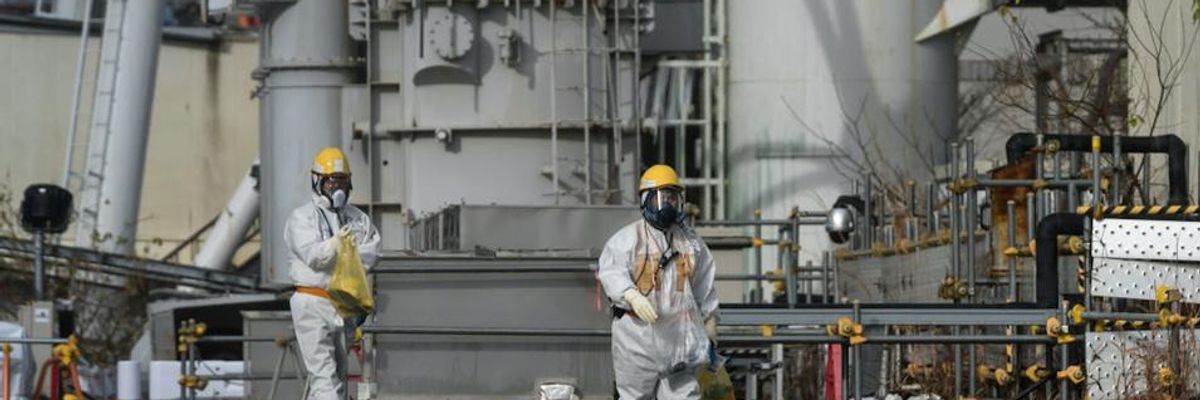
Workers in protective gear walk through the Tokyo Electric Power Co.'s Fukushima Daiichi nuclear power plant on January 29, 2020. (Photo: Tomohiro Ohsumi/Getty Images)
Lethal Levels of Radiation Found in Damaged Fukushima Reactor Will Have 'Huge Impact' on Shutdown, Regulators Warn
The radiation levels reported around shield plugs at two reactors are high enough to kill a worker exposed for even an hour.
In what Japanese regulators on Wednesday called an "extremely serious" development, lethal levels of radiation have been recorded inside the damaged reactor building at the Fukushima No. 1 nuclear power plant, threatening the shutdown and decommissioning of the site of the second-worst peacetime nuclear disaster in history.
"This will have a huge impact on the whole process of decommissioning work."
--Toyoshi Fuketa,
Nuclear Regulation Authority
According to The Asahi Shimbun, Japan's Nuclear Regulation Authority (NRA) reported that massive amounts of radioactive materials have been found around shield plugs of the containment vessels in the No. 2 and No. 3 reactors.
NRA officials estimated radiation levels at 10 sieverts per hour--enough to kill a worker who spends just one hour there.
Decommission of the reactor requires workers to remove the shield plugs, which block radiation from the reactor core during normal plant operation. This discovery has forced officials to reconsider their shutdown plans.
NRA chair Toyoshi Fuketa said that removing the highly irradiated shield plugs made safe retrieval of nuclear fuel debris--an already dangerously daunting task--all the more difficult.
"It appears that nuclear debris lies at an elevated place," Fuketa said at a news conference earlier this month. "This will have a huge impact on the whole process of decommissioning work."
The latest alarming find is the result of an investigation that resumed in September after a five-year pause in which the NRA took new measurements of radiation levels around the shield plugs at the No. 2 and No. 3 reactors.
Tokyo Electric Power Co., the operator of the plant, announced December 24 that nuclear fuel debris removal would be postponed until 2022 or later due to the coronavirus pandemic.
As Common Dreams reported in October, Greenpeace and other environmental and anti-nuclear advocates expressed shock and outrage after the Japanese government announced a plan to release stored water from the ill-fated plant into the Pacific Ocean. Greenpeace subsequently released a report claiming that radioactive carbon-14 released into the ocean "has the potential to damage human DNA."
The Fukushima Daiichi disaster--the result of a 2011 earthquake and tsunami that killed more than 15,000 people in northeastern Japan--was the worst nuclear incident since the 1986 Chernobyl meltdown in the former Soviet Union, and the worst in Japan since the United States waged a nuclear war against the country in 1945 that killed hundreds of thousands of people.
We are at a crossroads
This country and this world are at a monumental crossroads. In a few short weeks, US voters will have an opportunity to beat back the forces of fascism and confront the billionaires who are rigging the economy, our media system, and our democracy, making it increasingly impossible for ordinary people to get by. We’re not just talking about the election. We’re talking about what must be done once these fascist elements are vanquished from power. We need a bolder set of solutions than what either major party has so far been willing to offer and a working-class movement ready to fight like hell for it. Trump didn't emerge from nowhere. The conditions that fueled MAGA authoritarianism were created by decades of radical neoliberal economic policies and a corrupt political system dominated by corporate interests. They slashed taxes on the super-rich, promising that the benefits would trickle down. They said giveaways to the corporate titans would make life more affordable for the rest of us. It was all bullshit. And when a bitter, betrayed populace searches for someone to blame, right-wing demagogues have little trouble finding scapegoats. People know when they're being lied to, but you won't hear any of this from the corporate media. Only independent journalism—powered and funded by people who believe in building a better world—can deliver truly trustworthy daily news. Our Fall Campaign is underway, and we need your help. To power our newsroom through the rest of the year, we need to raise $125,000 by midnight on October 31. So if you share our vision, please contribute whatever you can to sustain our work. |
In what Japanese regulators on Wednesday called an "extremely serious" development, lethal levels of radiation have been recorded inside the damaged reactor building at the Fukushima No. 1 nuclear power plant, threatening the shutdown and decommissioning of the site of the second-worst peacetime nuclear disaster in history.
"This will have a huge impact on the whole process of decommissioning work."
--Toyoshi Fuketa,
Nuclear Regulation Authority
According to The Asahi Shimbun, Japan's Nuclear Regulation Authority (NRA) reported that massive amounts of radioactive materials have been found around shield plugs of the containment vessels in the No. 2 and No. 3 reactors.
NRA officials estimated radiation levels at 10 sieverts per hour--enough to kill a worker who spends just one hour there.
Decommission of the reactor requires workers to remove the shield plugs, which block radiation from the reactor core during normal plant operation. This discovery has forced officials to reconsider their shutdown plans.
NRA chair Toyoshi Fuketa said that removing the highly irradiated shield plugs made safe retrieval of nuclear fuel debris--an already dangerously daunting task--all the more difficult.
"It appears that nuclear debris lies at an elevated place," Fuketa said at a news conference earlier this month. "This will have a huge impact on the whole process of decommissioning work."
The latest alarming find is the result of an investigation that resumed in September after a five-year pause in which the NRA took new measurements of radiation levels around the shield plugs at the No. 2 and No. 3 reactors.
Tokyo Electric Power Co., the operator of the plant, announced December 24 that nuclear fuel debris removal would be postponed until 2022 or later due to the coronavirus pandemic.
As Common Dreams reported in October, Greenpeace and other environmental and anti-nuclear advocates expressed shock and outrage after the Japanese government announced a plan to release stored water from the ill-fated plant into the Pacific Ocean. Greenpeace subsequently released a report claiming that radioactive carbon-14 released into the ocean "has the potential to damage human DNA."
The Fukushima Daiichi disaster--the result of a 2011 earthquake and tsunami that killed more than 15,000 people in northeastern Japan--was the worst nuclear incident since the 1986 Chernobyl meltdown in the former Soviet Union, and the worst in Japan since the United States waged a nuclear war against the country in 1945 that killed hundreds of thousands of people.