
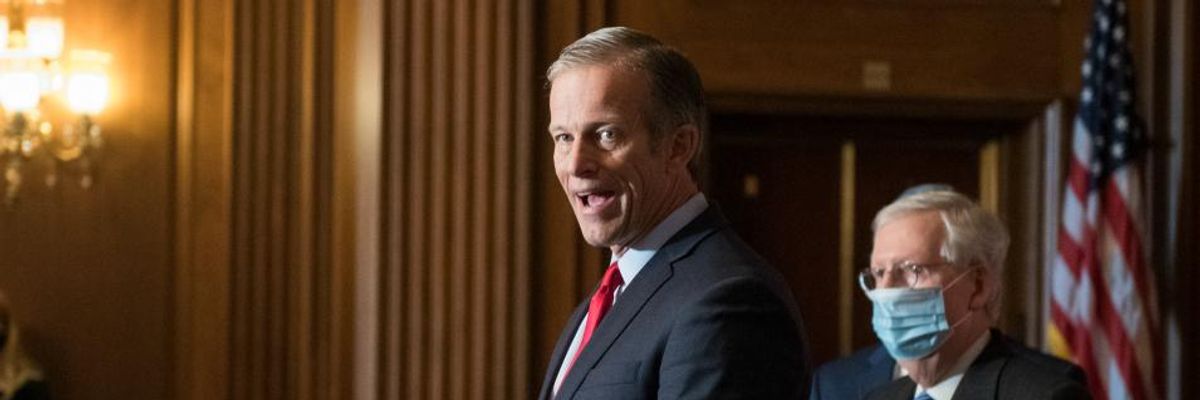
Sen. John Thune (R-S.D.) speaks during a news conference following the weekly meeting with the Senate Republican caucus at the U.S. Capitol on December 15, 2020 in Washington, D.C. (Photo: Rod Lamkey-Pool/Getty Images)
'Gratuitously Cruel': Outrage as GOP Tries to Prevent People on Unemployment From Also Receiving Stimulus Check
"Funny enough, they never take issue with doubling down on corporate bailouts and tax cuts for the wealthy."
Republican negotiators in Congress are reportedly trying to prevent Americans currently receiving federal unemployment insurance from also getting a direct payment under a soon-to-be-finalized relief package, apparently outraged by the notion that millions of people struggling to afford healthcare, food, and rent could obtain aid on top of their inadequate weekly jobless benefits.
"Imagine thinking someone who's trying to pay the rent and buy food with $100, $200, or $300 per week is going to live high on the hog because they get an extra one-time $600."
--Ashley Schapitl, spokesperson for Senate Finance Committee Democrats
As congressional leaders on Wednesday made significant progress toward a deal that would include one-time direct payments of around $600 per person, Senate Majority Whip John Thune (R-S.D.) told reporters that "there could be language in the deal aimed at addressing concerns that people who receive both enhanced unemployment benefits and stimulus checks would be getting a 'double benefit,'" The Hill reported.
The proposed restriction immediately provoked backlash, and Democratic negotiators are reportedly confident they will be able to keep the language out of the final $900 billion package.
"Imagine thinking someone who's trying to pay the rent and buy food with $100, $200, or $300 per week is going to live high on the hog because they get an extra one-time $600," said Ashley Schapitl, a spokesperson for Senate Finance Committee Democrats.
Economist Robert Reich added that, "funny enough, [Republicans] never take issue with doubling down on corporate bailouts and tax cuts for the wealthy," a point echoed by others.
The Republican effort to prevent desperate Americans from receiving a so-called "double benefit" came after the GOP already reportedly succeeded in paring back the duration of unemployment benefits in exchange for the inclusion of direct payments.
Citing unnamed people familiar with the negotiations, the Washington Post reported Wednesday that "congressional leaders have told other lawmakers that they are planning on reducing the length of unemployment benefits by one month from the bipartisan plan," which proposed a four-month extension of emergency unemployment programs set to expire on December 26. (Update: As of Thursday morning, negotiators have rolled back the duration of the unemployment benefit extension even further, to just 10 weeks.)
"This is a cruel last-ditch effort by Senate Republicans to scale back real aid for families."
--Sen. Ron Wyden
"That could mean that the extended benefits would expire at the end of March," the Post noted. "Such a timeline could force the incoming Biden administration to move more quickly in its effort to pass a massive stimulus bill early next year."
The relief agreement is expected to include a $300-per-week federal boost to unemployment benefits--just half of the supplement that congressional Republicans allowed to expire at the end of July.
Sen. Ron Wyden (D-Ore.), the top Democrat on the Senate Finance Committee, was among those who condemned the rollback, saying in a statement, "There's no reason whatsoever to pay for relief checks by cutting the incomes of jobless workers."
"We obviously wouldn't set an arbitrary date to cut off access to the vaccine while Covid is still raging," said Wyden, "so why does Mitch McConnell get to sabotage the economic recovery by cutting support for working people and setting arbitrary expirations?"
As congressional leaders from both parties voiced confidence that they are on the brink of an agreement after months of stagnation, progressives in the House and Senate welcomed the inclusion of direct payments--which they demanded as a necessary component of any deal--but criticized the emerging package as inadequate to address the public health and economic crises ravaging the nation and pushing millions into poverty.
In a speech on the Senate floor Wednesday, Sen. Bernie Sanders (I-Vt.)--who has called for direct payments of $1,200 per adult and $500 per child--said that "there is simply not enough money in the proposal to deal with the unprecedented crises that we now face."
"It is no secret to anybody that right now at this moment in America, we face the worst set of crises that this country has seen in perhaps 100 years," said the Vermont senator. "This bill has a lot in it that is good, but given the enormity of the crises that we face, it simply does not go anywhere [near] far enough... We're gonna fight for more."
We are at a crossroads
This country and this world are at a monumental crossroads. In a few short weeks, US voters will have an opportunity to beat back the forces of fascism and confront the billionaires who are rigging the economy, our media system, and our democracy, making it increasingly impossible for ordinary people to get by. We’re not just talking about the election. We’re talking about what must be done once these fascist elements are vanquished from power. We need a bolder set of solutions than what either major party has so far been willing to offer and a working-class movement ready to fight like hell for it. Trump didn't emerge from nowhere. The conditions that fueled MAGA authoritarianism were created by decades of radical neoliberal economic policies and a corrupt political system dominated by corporate interests. They slashed taxes on the super-rich, promising that the benefits would trickle down. They said giveaways to the corporate titans would make life more affordable for the rest of us. It was all bullshit. And when a bitter, betrayed populace searches for someone to blame, right-wing demagogues have little trouble finding scapegoats. People know when they're being lied to, but you won't hear any of this from the corporate media. Only independent journalism—powered and funded by people who believe in building a better world—can deliver truly trustworthy daily news. Our Fall Campaign is underway, and we need your help. To power our newsroom through the rest of the year, we need to raise $125,000 by midnight on October 31. So if you share our vision, please contribute whatever you can to sustain our work. |
Republican negotiators in Congress are reportedly trying to prevent Americans currently receiving federal unemployment insurance from also getting a direct payment under a soon-to-be-finalized relief package, apparently outraged by the notion that millions of people struggling to afford healthcare, food, and rent could obtain aid on top of their inadequate weekly jobless benefits.
"Imagine thinking someone who's trying to pay the rent and buy food with $100, $200, or $300 per week is going to live high on the hog because they get an extra one-time $600."
--Ashley Schapitl, spokesperson for Senate Finance Committee Democrats
As congressional leaders on Wednesday made significant progress toward a deal that would include one-time direct payments of around $600 per person, Senate Majority Whip John Thune (R-S.D.) told reporters that "there could be language in the deal aimed at addressing concerns that people who receive both enhanced unemployment benefits and stimulus checks would be getting a 'double benefit,'" The Hill reported.
The proposed restriction immediately provoked backlash, and Democratic negotiators are reportedly confident they will be able to keep the language out of the final $900 billion package.
"Imagine thinking someone who's trying to pay the rent and buy food with $100, $200, or $300 per week is going to live high on the hog because they get an extra one-time $600," said Ashley Schapitl, a spokesperson for Senate Finance Committee Democrats.
Economist Robert Reich added that, "funny enough, [Republicans] never take issue with doubling down on corporate bailouts and tax cuts for the wealthy," a point echoed by others.
The Republican effort to prevent desperate Americans from receiving a so-called "double benefit" came after the GOP already reportedly succeeded in paring back the duration of unemployment benefits in exchange for the inclusion of direct payments.
Citing unnamed people familiar with the negotiations, the Washington Post reported Wednesday that "congressional leaders have told other lawmakers that they are planning on reducing the length of unemployment benefits by one month from the bipartisan plan," which proposed a four-month extension of emergency unemployment programs set to expire on December 26. (Update: As of Thursday morning, negotiators have rolled back the duration of the unemployment benefit extension even further, to just 10 weeks.)
"This is a cruel last-ditch effort by Senate Republicans to scale back real aid for families."
--Sen. Ron Wyden
"That could mean that the extended benefits would expire at the end of March," the Post noted. "Such a timeline could force the incoming Biden administration to move more quickly in its effort to pass a massive stimulus bill early next year."
The relief agreement is expected to include a $300-per-week federal boost to unemployment benefits--just half of the supplement that congressional Republicans allowed to expire at the end of July.
Sen. Ron Wyden (D-Ore.), the top Democrat on the Senate Finance Committee, was among those who condemned the rollback, saying in a statement, "There's no reason whatsoever to pay for relief checks by cutting the incomes of jobless workers."
"We obviously wouldn't set an arbitrary date to cut off access to the vaccine while Covid is still raging," said Wyden, "so why does Mitch McConnell get to sabotage the economic recovery by cutting support for working people and setting arbitrary expirations?"
As congressional leaders from both parties voiced confidence that they are on the brink of an agreement after months of stagnation, progressives in the House and Senate welcomed the inclusion of direct payments--which they demanded as a necessary component of any deal--but criticized the emerging package as inadequate to address the public health and economic crises ravaging the nation and pushing millions into poverty.
In a speech on the Senate floor Wednesday, Sen. Bernie Sanders (I-Vt.)--who has called for direct payments of $1,200 per adult and $500 per child--said that "there is simply not enough money in the proposal to deal with the unprecedented crises that we now face."
"It is no secret to anybody that right now at this moment in America, we face the worst set of crises that this country has seen in perhaps 100 years," said the Vermont senator. "This bill has a lot in it that is good, but given the enormity of the crises that we face, it simply does not go anywhere [near] far enough... We're gonna fight for more."
Republican negotiators in Congress are reportedly trying to prevent Americans currently receiving federal unemployment insurance from also getting a direct payment under a soon-to-be-finalized relief package, apparently outraged by the notion that millions of people struggling to afford healthcare, food, and rent could obtain aid on top of their inadequate weekly jobless benefits.
"Imagine thinking someone who's trying to pay the rent and buy food with $100, $200, or $300 per week is going to live high on the hog because they get an extra one-time $600."
--Ashley Schapitl, spokesperson for Senate Finance Committee Democrats
As congressional leaders on Wednesday made significant progress toward a deal that would include one-time direct payments of around $600 per person, Senate Majority Whip John Thune (R-S.D.) told reporters that "there could be language in the deal aimed at addressing concerns that people who receive both enhanced unemployment benefits and stimulus checks would be getting a 'double benefit,'" The Hill reported.
The proposed restriction immediately provoked backlash, and Democratic negotiators are reportedly confident they will be able to keep the language out of the final $900 billion package.
"Imagine thinking someone who's trying to pay the rent and buy food with $100, $200, or $300 per week is going to live high on the hog because they get an extra one-time $600," said Ashley Schapitl, a spokesperson for Senate Finance Committee Democrats.
Economist Robert Reich added that, "funny enough, [Republicans] never take issue with doubling down on corporate bailouts and tax cuts for the wealthy," a point echoed by others.
The Republican effort to prevent desperate Americans from receiving a so-called "double benefit" came after the GOP already reportedly succeeded in paring back the duration of unemployment benefits in exchange for the inclusion of direct payments.
Citing unnamed people familiar with the negotiations, the Washington Post reported Wednesday that "congressional leaders have told other lawmakers that they are planning on reducing the length of unemployment benefits by one month from the bipartisan plan," which proposed a four-month extension of emergency unemployment programs set to expire on December 26. (Update: As of Thursday morning, negotiators have rolled back the duration of the unemployment benefit extension even further, to just 10 weeks.)
"This is a cruel last-ditch effort by Senate Republicans to scale back real aid for families."
--Sen. Ron Wyden
"That could mean that the extended benefits would expire at the end of March," the Post noted. "Such a timeline could force the incoming Biden administration to move more quickly in its effort to pass a massive stimulus bill early next year."
The relief agreement is expected to include a $300-per-week federal boost to unemployment benefits--just half of the supplement that congressional Republicans allowed to expire at the end of July.
Sen. Ron Wyden (D-Ore.), the top Democrat on the Senate Finance Committee, was among those who condemned the rollback, saying in a statement, "There's no reason whatsoever to pay for relief checks by cutting the incomes of jobless workers."
"We obviously wouldn't set an arbitrary date to cut off access to the vaccine while Covid is still raging," said Wyden, "so why does Mitch McConnell get to sabotage the economic recovery by cutting support for working people and setting arbitrary expirations?"
As congressional leaders from both parties voiced confidence that they are on the brink of an agreement after months of stagnation, progressives in the House and Senate welcomed the inclusion of direct payments--which they demanded as a necessary component of any deal--but criticized the emerging package as inadequate to address the public health and economic crises ravaging the nation and pushing millions into poverty.
In a speech on the Senate floor Wednesday, Sen. Bernie Sanders (I-Vt.)--who has called for direct payments of $1,200 per adult and $500 per child--said that "there is simply not enough money in the proposal to deal with the unprecedented crises that we now face."
"It is no secret to anybody that right now at this moment in America, we face the worst set of crises that this country has seen in perhaps 100 years," said the Vermont senator. "This bill has a lot in it that is good, but given the enormity of the crises that we face, it simply does not go anywhere [near] far enough... We're gonna fight for more."