SUBSCRIBE TO OUR FREE NEWSLETTER
Daily news & progressive opinion—funded by the people, not the corporations—delivered straight to your inbox.
5
#000000
#FFFFFF
To donate by check, phone, or other method, see our More Ways to Give page.
Daily news & progressive opinion—funded by the people, not the corporations—delivered straight to your inbox.
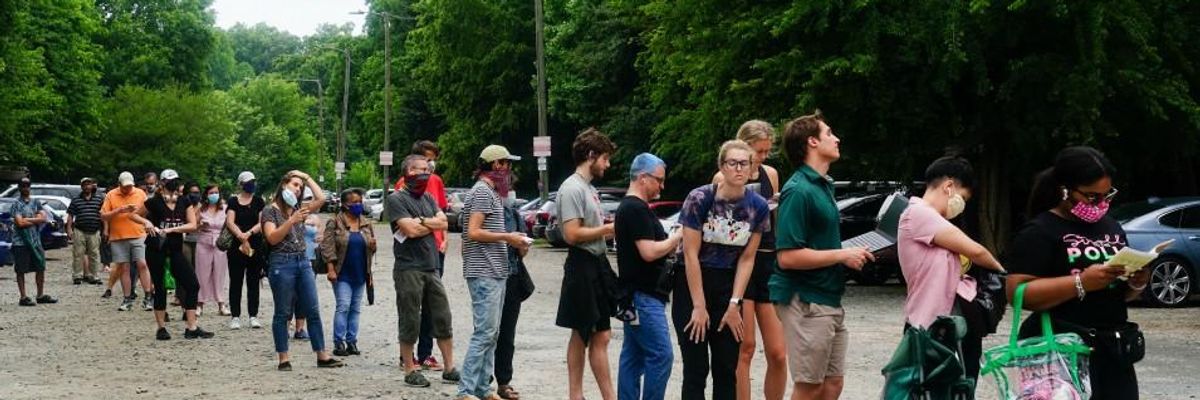
People wait in line to vote in Georgia's Primary Election on June 9, 2020 in Atlanta. (Photo: Elijah Nouvelage/Getty Images)
Officials in Georgia's third most populous county came under fire from civil rights advocates Monday after announcing they would slash the number of early voting sites for the state's two critical U.S. Senate runoff elections by more than half.
"While these closures are likely to adversely affect many Cobb County voters, we are especially concerned that these closures will be harmful to Cobb County's Black and Latinx voters because many of the locations are in Black and Latinx communities."
--Civil rights groups
Half a dozen groups including the Georgia NAACP, the ACLU of Georgia, and the Southern Poverty Law Center sent a letter (pdf) to the Cobb County Board of Commissioners and Board of Elections and Registration urging them not to cut back on early voting sites. The officials plan on closing six of the county's 11 advance polling locations, claiming they do not have the resources to keep all of them open.
"While these closures are likely to adversely affect many Cobb County voters, we are especially concerned that these closures will be harmful to Cobb County's Black and Latinx voters because many of the locations are in Black and Latinx communities," the letter states.
According to (pdf) the Center for New Data, of the 10 Georgia polling locations with the highest estimated portion of voters spending longer than 30 minutes on-site, five are slated for closure.
Some 760,000 people live in the county, which lies just northwest of Atlanta. Its population is nearly 29% Black and over 13% Latinx and, although long a Republican stronghold, has become more liberal in recent years.
While Republican nominee Mitt Romney trounced former President Barack Obama by over 12 percentage points in the 2012 presidential election, Democratic nominee Hillary Clinton edged out President Donald Trump by two points in 2016 and President-elect Joe Biden easily defeated Trump by 14 points in 2020, largely on the strength of the very Black and Latinx voters who rights advocates warn would likely be adversely affected by the closure of polling sites during the coronavirus pandemic.
Covid-19, "which is ravaging the nation, has had extremely harsh effects in Black and Latinx communities and makes in-person voting on Election Day an untenable option for many voters," the groups' letter asserts.
"Moreover, due to widespread concerns with the reliability of the United States Postal Service, many voters are not comfortable requesting or casting absentee ballots by mail," the letter states. "As demonstrated by the record turnout during the advance voting period for the 2020 general election, advance voting is the only acceptable option for safe and secure voting for many voters."
Under Georgia law, if a Senate candidate does not receive at least 50% of the vote in a general election, the two top-finishing candidates must face each other in a runoff. On January 5, there will be two such elections, with Democratic challenger Jon Ossoff facing Sen. David Perdue in one and Rev. Raphael Warnock taking on Sen. Kelly Loeffler in the other.
On November 3, Perdue won 49.7% to Ossoff's 47.9%, while Warnock led Loeffler by a wider margin of 32.9% to 29.5%, with the GOP vote being split between Loeffler and Doug Collins, who received 20.0% of the vote.
If both Ossoff and Warnock emerge victorious, Democrats will gain control of the Senate, as incoming Vice President Kamala Harris will cast the tie-breaking vote. If either GOP incumbent wins, Republicans will remain in control of the Senate, posing what is likely to be a constant thorn in the side of President Joe Biden and his agenda.
Early voting for the Georgia Senate runoffs begins December 14.
Dear Common Dreams reader, It’s been nearly 30 years since I co-founded Common Dreams with my late wife, Lina Newhouser. We had the radical notion that journalism should serve the public good, not corporate profits. It was clear to us from the outset what it would take to build such a project. No paid advertisements. No corporate sponsors. No millionaire publisher telling us what to think or do. Many people said we wouldn't last a year, but we proved those doubters wrong. Together with a tremendous team of journalists and dedicated staff, we built an independent media outlet free from the constraints of profits and corporate control. Our mission has always been simple: To inform. To inspire. To ignite change for the common good. Building Common Dreams was not easy. Our survival was never guaranteed. When you take on the most powerful forces—Wall Street greed, fossil fuel industry destruction, Big Tech lobbyists, and uber-rich oligarchs who have spent billions upon billions rigging the economy and democracy in their favor—the only bulwark you have is supporters who believe in your work. But here’s the urgent message from me today. It's never been this bad out there. And it's never been this hard to keep us going. At the very moment Common Dreams is most needed, the threats we face are intensifying. We need your support now more than ever. We don't accept corporate advertising and never will. We don't have a paywall because we don't think people should be blocked from critical news based on their ability to pay. Everything we do is funded by the donations of readers like you. When everyone does the little they can afford, we are strong. But if that support retreats or dries up, so do we. Will you donate now to make sure Common Dreams not only survives but thrives? —Craig Brown, Co-founder |
Officials in Georgia's third most populous county came under fire from civil rights advocates Monday after announcing they would slash the number of early voting sites for the state's two critical U.S. Senate runoff elections by more than half.
"While these closures are likely to adversely affect many Cobb County voters, we are especially concerned that these closures will be harmful to Cobb County's Black and Latinx voters because many of the locations are in Black and Latinx communities."
--Civil rights groups
Half a dozen groups including the Georgia NAACP, the ACLU of Georgia, and the Southern Poverty Law Center sent a letter (pdf) to the Cobb County Board of Commissioners and Board of Elections and Registration urging them not to cut back on early voting sites. The officials plan on closing six of the county's 11 advance polling locations, claiming they do not have the resources to keep all of them open.
"While these closures are likely to adversely affect many Cobb County voters, we are especially concerned that these closures will be harmful to Cobb County's Black and Latinx voters because many of the locations are in Black and Latinx communities," the letter states.
According to (pdf) the Center for New Data, of the 10 Georgia polling locations with the highest estimated portion of voters spending longer than 30 minutes on-site, five are slated for closure.
Some 760,000 people live in the county, which lies just northwest of Atlanta. Its population is nearly 29% Black and over 13% Latinx and, although long a Republican stronghold, has become more liberal in recent years.
While Republican nominee Mitt Romney trounced former President Barack Obama by over 12 percentage points in the 2012 presidential election, Democratic nominee Hillary Clinton edged out President Donald Trump by two points in 2016 and President-elect Joe Biden easily defeated Trump by 14 points in 2020, largely on the strength of the very Black and Latinx voters who rights advocates warn would likely be adversely affected by the closure of polling sites during the coronavirus pandemic.
Covid-19, "which is ravaging the nation, has had extremely harsh effects in Black and Latinx communities and makes in-person voting on Election Day an untenable option for many voters," the groups' letter asserts.
"Moreover, due to widespread concerns with the reliability of the United States Postal Service, many voters are not comfortable requesting or casting absentee ballots by mail," the letter states. "As demonstrated by the record turnout during the advance voting period for the 2020 general election, advance voting is the only acceptable option for safe and secure voting for many voters."
Under Georgia law, if a Senate candidate does not receive at least 50% of the vote in a general election, the two top-finishing candidates must face each other in a runoff. On January 5, there will be two such elections, with Democratic challenger Jon Ossoff facing Sen. David Perdue in one and Rev. Raphael Warnock taking on Sen. Kelly Loeffler in the other.
On November 3, Perdue won 49.7% to Ossoff's 47.9%, while Warnock led Loeffler by a wider margin of 32.9% to 29.5%, with the GOP vote being split between Loeffler and Doug Collins, who received 20.0% of the vote.
If both Ossoff and Warnock emerge victorious, Democrats will gain control of the Senate, as incoming Vice President Kamala Harris will cast the tie-breaking vote. If either GOP incumbent wins, Republicans will remain in control of the Senate, posing what is likely to be a constant thorn in the side of President Joe Biden and his agenda.
Early voting for the Georgia Senate runoffs begins December 14.
Officials in Georgia's third most populous county came under fire from civil rights advocates Monday after announcing they would slash the number of early voting sites for the state's two critical U.S. Senate runoff elections by more than half.
"While these closures are likely to adversely affect many Cobb County voters, we are especially concerned that these closures will be harmful to Cobb County's Black and Latinx voters because many of the locations are in Black and Latinx communities."
--Civil rights groups
Half a dozen groups including the Georgia NAACP, the ACLU of Georgia, and the Southern Poverty Law Center sent a letter (pdf) to the Cobb County Board of Commissioners and Board of Elections and Registration urging them not to cut back on early voting sites. The officials plan on closing six of the county's 11 advance polling locations, claiming they do not have the resources to keep all of them open.
"While these closures are likely to adversely affect many Cobb County voters, we are especially concerned that these closures will be harmful to Cobb County's Black and Latinx voters because many of the locations are in Black and Latinx communities," the letter states.
According to (pdf) the Center for New Data, of the 10 Georgia polling locations with the highest estimated portion of voters spending longer than 30 minutes on-site, five are slated for closure.
Some 760,000 people live in the county, which lies just northwest of Atlanta. Its population is nearly 29% Black and over 13% Latinx and, although long a Republican stronghold, has become more liberal in recent years.
While Republican nominee Mitt Romney trounced former President Barack Obama by over 12 percentage points in the 2012 presidential election, Democratic nominee Hillary Clinton edged out President Donald Trump by two points in 2016 and President-elect Joe Biden easily defeated Trump by 14 points in 2020, largely on the strength of the very Black and Latinx voters who rights advocates warn would likely be adversely affected by the closure of polling sites during the coronavirus pandemic.
Covid-19, "which is ravaging the nation, has had extremely harsh effects in Black and Latinx communities and makes in-person voting on Election Day an untenable option for many voters," the groups' letter asserts.
"Moreover, due to widespread concerns with the reliability of the United States Postal Service, many voters are not comfortable requesting or casting absentee ballots by mail," the letter states. "As demonstrated by the record turnout during the advance voting period for the 2020 general election, advance voting is the only acceptable option for safe and secure voting for many voters."
Under Georgia law, if a Senate candidate does not receive at least 50% of the vote in a general election, the two top-finishing candidates must face each other in a runoff. On January 5, there will be two such elections, with Democratic challenger Jon Ossoff facing Sen. David Perdue in one and Rev. Raphael Warnock taking on Sen. Kelly Loeffler in the other.
On November 3, Perdue won 49.7% to Ossoff's 47.9%, while Warnock led Loeffler by a wider margin of 32.9% to 29.5%, with the GOP vote being split between Loeffler and Doug Collins, who received 20.0% of the vote.
If both Ossoff and Warnock emerge victorious, Democrats will gain control of the Senate, as incoming Vice President Kamala Harris will cast the tie-breaking vote. If either GOP incumbent wins, Republicans will remain in control of the Senate, posing what is likely to be a constant thorn in the side of President Joe Biden and his agenda.
Early voting for the Georgia Senate runoffs begins December 14.