SUBSCRIBE TO OUR FREE NEWSLETTER
Daily news & progressive opinion—funded by the people, not the corporations—delivered straight to your inbox.
5
#000000
#FFFFFF
To donate by check, phone, or other method, see our More Ways to Give page.
Daily news & progressive opinion—funded by the people, not the corporations—delivered straight to your inbox.
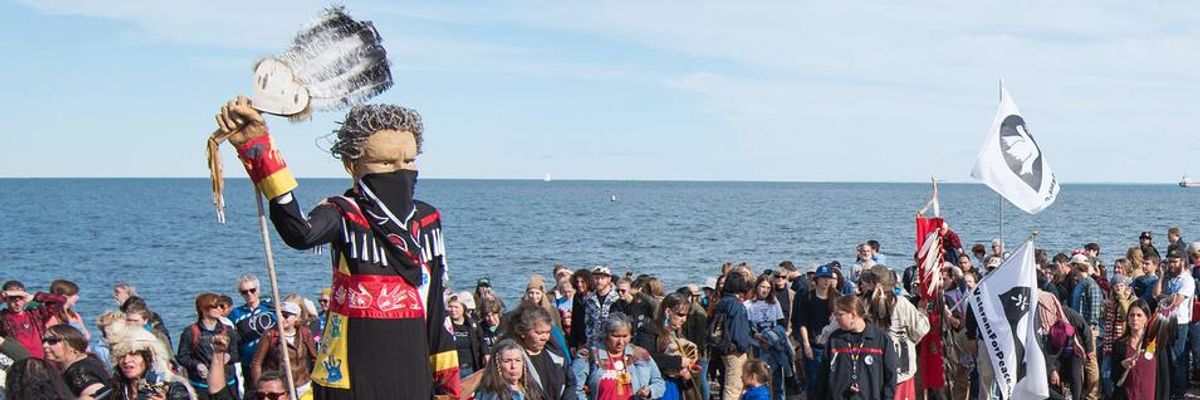
Hundreds of Indigenous and allied people gathered on the shore of Gichi-gami (Lake Superior) on September 27, 2019 to protest the Enbridge Line 3 tar sands pipeline. (Photo: Fibonacci Blue/Flickr/cc)
Indigenous-led water protectors on Friday engaged in multiple direct actions against Enbridge's highly controversial Line 3 tar sands pipeline in Minnesota, on the same day that state regulators denied a request from two tribes to stop the Canadian company from proceeding with the project.
"Clean water and unpolluted land capable of providing sustenance is essential to our survival... [and] Line 3 poses an existential threat to our well-being."
--Minnesota Chippewa Tribe
Water protectors blocked pipeline traffic and climbed and occupied trees as part of Friday's actions. Urging other Indigenous peoples and allies to "take a stand," the Anishinaabe activists at one of the protests told other Native Americans that "your ancestors are here too."
"Take a moment to speak to her, our Mother Earth is crying out for the warriors to rise again," they said. "Strong hearts to the front!"
In a statement, Line 3 Media Collective said that the pipeline "violates the treaty rights of Anishinaabe peoples by endangering critical natural resources in the 1854, 1855, and 1867 treaty areas, where the Ojibwe have the right to hunt, fish, gather medicinal plants, harvest wild rice, and preserve sacred sites."
"The state of Minnesota does not have the consent of many tribes that will be impacted by construction and spills," the group added. "Last week, the Red Lake Band of Chippewa and the White Earth Band petitioned the Minnesota Public Utilities Commission to pause its approval of Line 3 construction while challenges to the permits are considered by the Minnesota Court of Appeals."
On Friday, the MPUC voted 4-1 to reject the tribes' request. According to the Washington Post, the commissioners said that further delays would hurt workers who had traveled to northern Minnesota. They also cited Democratic Gov. Tim Walz's designation of the project as "critical" during the coronavirus pandemic.
On Thursday, the Minnesota Chippewa Tribe (MCT) appealed directly to Walz:
Indian people have lived along the lakes, rivers, and streams of northern Minnesota since time immemorial. The people of the MCT have flourished in the area for centuries due to the careful conservation of our resources. Clean water and unpolluted land capable of providing sustenance is essential to our survival... [and] Line 3 poses an existential threat to our well-being.
The vote and the water protectors' latest act of resistance come just two days after construction began on the $2.9 billion, 1,100-mile extension.
According to Indigenous-led environmental group Honor the Earth, the pipeline will have the daily capacity to transport 760,000 barrels of tar sands oil--known as the world's dirtiest fuel--from Alberta, Canada to a port in Superior, Wisconsin. Stop Line 3 says the pipeline will run "through untouched wetlands and the treaty territory of Anishinaabe peoples."
"We have the right to practice our treaty rights," stressed Gitchigumi Scout member Taysha Martineau, one of the Indigenous leaders at the Friday action. "We ask you to bear witness and protect our right to do so."
This country and this world are at a monumental crossroads. US voters have an opportunity to beat back the forces of fascism and confront the billionaires who are rigging the economy, our media system, and our democracy, making it increasingly impossible for ordinary people to get by. We’re not just talking about the election. We’re talking about what must be done once these fascist elements are vanquished from power. We need a bolder set of solutions than what either major party has so far been willing to offer and a working-class movement ready to fight like hell for it. Trump didn't emerge from nowhere. The conditions that fueled MAGA authoritarianism were created by decades of radical neoliberal economic policies and a corrupt political system dominated by corporate interests. They slashed taxes on the super-rich, promising that the benefits would trickle down. They said giveaways to the corporate titans would make life more affordable for the rest of us. It was all bullshit. And when a bitter, betrayed populace searches for someone to blame, right-wing demagogues have little trouble finding scapegoats. People know when they're being lied to, but you won't hear any of this from the corporate media. Only independent journalism—powered and funded by people who believe in building a better world—can deliver truly trustworthy daily news. If you share our vision, please contribute whatever you can to sustain our work. |
Indigenous-led water protectors on Friday engaged in multiple direct actions against Enbridge's highly controversial Line 3 tar sands pipeline in Minnesota, on the same day that state regulators denied a request from two tribes to stop the Canadian company from proceeding with the project.
"Clean water and unpolluted land capable of providing sustenance is essential to our survival... [and] Line 3 poses an existential threat to our well-being."
--Minnesota Chippewa Tribe
Water protectors blocked pipeline traffic and climbed and occupied trees as part of Friday's actions. Urging other Indigenous peoples and allies to "take a stand," the Anishinaabe activists at one of the protests told other Native Americans that "your ancestors are here too."
"Take a moment to speak to her, our Mother Earth is crying out for the warriors to rise again," they said. "Strong hearts to the front!"
In a statement, Line 3 Media Collective said that the pipeline "violates the treaty rights of Anishinaabe peoples by endangering critical natural resources in the 1854, 1855, and 1867 treaty areas, where the Ojibwe have the right to hunt, fish, gather medicinal plants, harvest wild rice, and preserve sacred sites."
"The state of Minnesota does not have the consent of many tribes that will be impacted by construction and spills," the group added. "Last week, the Red Lake Band of Chippewa and the White Earth Band petitioned the Minnesota Public Utilities Commission to pause its approval of Line 3 construction while challenges to the permits are considered by the Minnesota Court of Appeals."
On Friday, the MPUC voted 4-1 to reject the tribes' request. According to the Washington Post, the commissioners said that further delays would hurt workers who had traveled to northern Minnesota. They also cited Democratic Gov. Tim Walz's designation of the project as "critical" during the coronavirus pandemic.
On Thursday, the Minnesota Chippewa Tribe (MCT) appealed directly to Walz:
Indian people have lived along the lakes, rivers, and streams of northern Minnesota since time immemorial. The people of the MCT have flourished in the area for centuries due to the careful conservation of our resources. Clean water and unpolluted land capable of providing sustenance is essential to our survival... [and] Line 3 poses an existential threat to our well-being.
The vote and the water protectors' latest act of resistance come just two days after construction began on the $2.9 billion, 1,100-mile extension.
According to Indigenous-led environmental group Honor the Earth, the pipeline will have the daily capacity to transport 760,000 barrels of tar sands oil--known as the world's dirtiest fuel--from Alberta, Canada to a port in Superior, Wisconsin. Stop Line 3 says the pipeline will run "through untouched wetlands and the treaty territory of Anishinaabe peoples."
"We have the right to practice our treaty rights," stressed Gitchigumi Scout member Taysha Martineau, one of the Indigenous leaders at the Friday action. "We ask you to bear witness and protect our right to do so."