SUBSCRIBE TO OUR FREE NEWSLETTER
Daily news & progressive opinion—funded by the people, not the corporations—delivered straight to your inbox.
5
#000000
#FFFFFF
To donate by check, phone, or other method, see our More Ways to Give page.
Daily news & progressive opinion—funded by the people, not the corporations—delivered straight to your inbox.
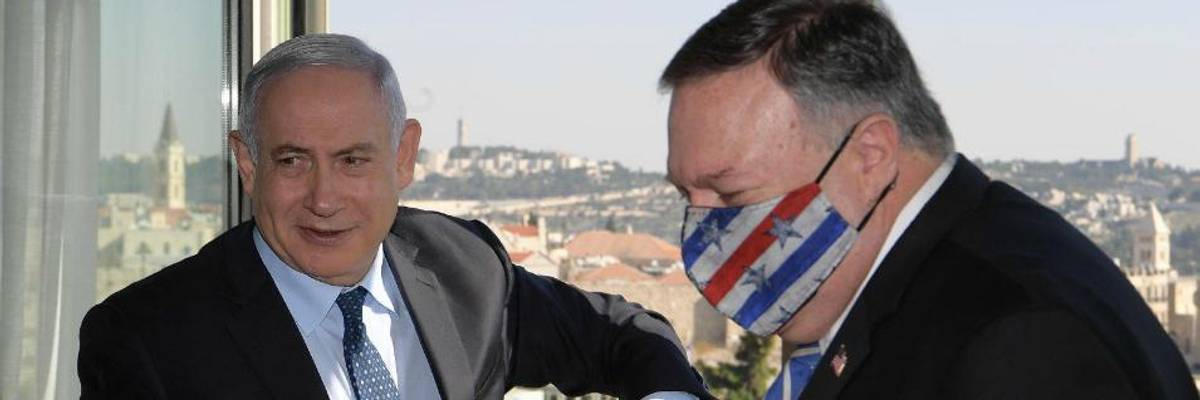
U.S. Secretary of State Mike Pompeo and Israeli Prime Minister Benjamin Netanyahu meet at the Prime Ministry Office in West Jerusalem on November 19, 2020. (Photo: Israeli Prime Ministry/Handout/Anadolu Agency via Getty Images)
The alarming possibility of a military attack on Iran--a nation that has long been in the sights of war hawks in the United States, Saudi Arabia, and Israel--was immediately invoked by foreign policy analysts Monday following reports that Israeli Prime Minister Benjamin Netanyahu met in secret late Sunday with Saudi Crown Prince Mohammed bin Salman and U.S. Secretary of State Mike Pompeo.
First divulged by unnamed Israeli officials and publicly denied Monday morning by the Saudi foreign minister, the reported covert meeting in Neom, Saudi Arabia comes on the heels of news last week that U.S. President Donald Trump asked his senior advisers for options to bomb Iran's primary nuclear energy site, prompting Iran to vow a "crushing response" to any attack.
"So Netanyahu secretly visited Saudi Arabia yesterday... Are Bibi and the Saudis preparing an attack against Iran?"
--Trita Parsi, Quincy Institute for Responsible Statecraft
Trump's request for military strike options came days after he lost the presidential election to Joe Biden, who has pledged to act quickly to reenter the Iran nuclear agreement that Trump violated in May of 2018. Contrary to baseless and ongoing allegations by the U.S. and Israel, Iran says it is not developing and has no plans to develop nuclear weapons--a claim U.N. inspectors have repeatedly verified in recent years.
The context of the Trump administration's aggressive posturing and militaristic threats against Iran fueled critics' concerns following word of the secret meeting between MbS, Netanyahu, and Pompeo, which was also reportedly attended by Yossi Cohen, director of the Israeli spy agency Mossad.
"It is extremely alarming that the warmongers most reliant on Trump's blank checks are secretly meeting in the middle of the night as the clock nearly runs out on the Trump administration," tweeted foreign policy analyst Omar Baddar. "Do they have Iran in the crosshairs?"
Trita Parsi, executive vice president of the Quincy Institute for Responsible Statecraft, echoed Baddar's fears and raised the additional concern that the "actual target" of the meeting was "the incoming Biden team, with the aim of deterring the U.S. from seeking diplomacy with Tehran."
Despite the public denial by Saudi Foreign Minister Prince Faisal bin Farhan--who tweeted early Monday that "the only officials present" at the meeting "were American and Saudi"--unnamed Saudi officials told the Wall Street Journal that Netanyahu attended the meeting with Pompeo and MbS.
Among the topics discussed at the hours-long meeting, according to the Journal, were Iran and normalization of relations between Israel and Saudi Arabia.
Both Netanyahu and Pompeo refused to comment on the meeting, but neither denied that it took place.
Joe Cirincione, a distinguished fellow at the Quincy Institute, warned in an op-ed last week that while unlikely, an attack on Iran by either the U.S. or Israel is a possibility worth taking seriously and guarding against.
"A member of Netanyahu's cabinet, Settlements Minister Tzahi Hanegbi, flatly predicted in early November that Israel will attack Iran if Joe Biden is elected president," Cirincione pointed out. "Ominously, the U.S. Central Command announced... that it moved a detachment of F-16 fighter-bombers from Germany to the UAE, across the Gulf from Iran."
Returning the U.S. to compliance with the Iran nuclear agreement, argued Cirincione, "would allow the United States to establish a more robust relationship with Iran with regular contacts--as was the case during the Obama administration--that would reduce the risks of conflicts that could escalate, intended or unintended, into a war that would make the wars in Iraq and Afghanistan look trivial in comparison."
Dear Common Dreams reader, It’s been nearly 30 years since I co-founded Common Dreams with my late wife, Lina Newhouser. We had the radical notion that journalism should serve the public good, not corporate profits. It was clear to us from the outset what it would take to build such a project. No paid advertisements. No corporate sponsors. No millionaire publisher telling us what to think or do. Many people said we wouldn't last a year, but we proved those doubters wrong. Together with a tremendous team of journalists and dedicated staff, we built an independent media outlet free from the constraints of profits and corporate control. Our mission has always been simple: To inform. To inspire. To ignite change for the common good. Building Common Dreams was not easy. Our survival was never guaranteed. When you take on the most powerful forces—Wall Street greed, fossil fuel industry destruction, Big Tech lobbyists, and uber-rich oligarchs who have spent billions upon billions rigging the economy and democracy in their favor—the only bulwark you have is supporters who believe in your work. But here’s the urgent message from me today. It's never been this bad out there. And it's never been this hard to keep us going. At the very moment Common Dreams is most needed, the threats we face are intensifying. We need your support now more than ever. We don't accept corporate advertising and never will. We don't have a paywall because we don't think people should be blocked from critical news based on their ability to pay. Everything we do is funded by the donations of readers like you. When everyone does the little they can afford, we are strong. But if that support retreats or dries up, so do we. Will you donate now to make sure Common Dreams not only survives but thrives? —Craig Brown, Co-founder |
The alarming possibility of a military attack on Iran--a nation that has long been in the sights of war hawks in the United States, Saudi Arabia, and Israel--was immediately invoked by foreign policy analysts Monday following reports that Israeli Prime Minister Benjamin Netanyahu met in secret late Sunday with Saudi Crown Prince Mohammed bin Salman and U.S. Secretary of State Mike Pompeo.
First divulged by unnamed Israeli officials and publicly denied Monday morning by the Saudi foreign minister, the reported covert meeting in Neom, Saudi Arabia comes on the heels of news last week that U.S. President Donald Trump asked his senior advisers for options to bomb Iran's primary nuclear energy site, prompting Iran to vow a "crushing response" to any attack.
"So Netanyahu secretly visited Saudi Arabia yesterday... Are Bibi and the Saudis preparing an attack against Iran?"
--Trita Parsi, Quincy Institute for Responsible Statecraft
Trump's request for military strike options came days after he lost the presidential election to Joe Biden, who has pledged to act quickly to reenter the Iran nuclear agreement that Trump violated in May of 2018. Contrary to baseless and ongoing allegations by the U.S. and Israel, Iran says it is not developing and has no plans to develop nuclear weapons--a claim U.N. inspectors have repeatedly verified in recent years.
The context of the Trump administration's aggressive posturing and militaristic threats against Iran fueled critics' concerns following word of the secret meeting between MbS, Netanyahu, and Pompeo, which was also reportedly attended by Yossi Cohen, director of the Israeli spy agency Mossad.
"It is extremely alarming that the warmongers most reliant on Trump's blank checks are secretly meeting in the middle of the night as the clock nearly runs out on the Trump administration," tweeted foreign policy analyst Omar Baddar. "Do they have Iran in the crosshairs?"
Trita Parsi, executive vice president of the Quincy Institute for Responsible Statecraft, echoed Baddar's fears and raised the additional concern that the "actual target" of the meeting was "the incoming Biden team, with the aim of deterring the U.S. from seeking diplomacy with Tehran."
Despite the public denial by Saudi Foreign Minister Prince Faisal bin Farhan--who tweeted early Monday that "the only officials present" at the meeting "were American and Saudi"--unnamed Saudi officials told the Wall Street Journal that Netanyahu attended the meeting with Pompeo and MbS.
Among the topics discussed at the hours-long meeting, according to the Journal, were Iran and normalization of relations between Israel and Saudi Arabia.
Both Netanyahu and Pompeo refused to comment on the meeting, but neither denied that it took place.
Joe Cirincione, a distinguished fellow at the Quincy Institute, warned in an op-ed last week that while unlikely, an attack on Iran by either the U.S. or Israel is a possibility worth taking seriously and guarding against.
"A member of Netanyahu's cabinet, Settlements Minister Tzahi Hanegbi, flatly predicted in early November that Israel will attack Iran if Joe Biden is elected president," Cirincione pointed out. "Ominously, the U.S. Central Command announced... that it moved a detachment of F-16 fighter-bombers from Germany to the UAE, across the Gulf from Iran."
Returning the U.S. to compliance with the Iran nuclear agreement, argued Cirincione, "would allow the United States to establish a more robust relationship with Iran with regular contacts--as was the case during the Obama administration--that would reduce the risks of conflicts that could escalate, intended or unintended, into a war that would make the wars in Iraq and Afghanistan look trivial in comparison."
The alarming possibility of a military attack on Iran--a nation that has long been in the sights of war hawks in the United States, Saudi Arabia, and Israel--was immediately invoked by foreign policy analysts Monday following reports that Israeli Prime Minister Benjamin Netanyahu met in secret late Sunday with Saudi Crown Prince Mohammed bin Salman and U.S. Secretary of State Mike Pompeo.
First divulged by unnamed Israeli officials and publicly denied Monday morning by the Saudi foreign minister, the reported covert meeting in Neom, Saudi Arabia comes on the heels of news last week that U.S. President Donald Trump asked his senior advisers for options to bomb Iran's primary nuclear energy site, prompting Iran to vow a "crushing response" to any attack.
"So Netanyahu secretly visited Saudi Arabia yesterday... Are Bibi and the Saudis preparing an attack against Iran?"
--Trita Parsi, Quincy Institute for Responsible Statecraft
Trump's request for military strike options came days after he lost the presidential election to Joe Biden, who has pledged to act quickly to reenter the Iran nuclear agreement that Trump violated in May of 2018. Contrary to baseless and ongoing allegations by the U.S. and Israel, Iran says it is not developing and has no plans to develop nuclear weapons--a claim U.N. inspectors have repeatedly verified in recent years.
The context of the Trump administration's aggressive posturing and militaristic threats against Iran fueled critics' concerns following word of the secret meeting between MbS, Netanyahu, and Pompeo, which was also reportedly attended by Yossi Cohen, director of the Israeli spy agency Mossad.
"It is extremely alarming that the warmongers most reliant on Trump's blank checks are secretly meeting in the middle of the night as the clock nearly runs out on the Trump administration," tweeted foreign policy analyst Omar Baddar. "Do they have Iran in the crosshairs?"
Trita Parsi, executive vice president of the Quincy Institute for Responsible Statecraft, echoed Baddar's fears and raised the additional concern that the "actual target" of the meeting was "the incoming Biden team, with the aim of deterring the U.S. from seeking diplomacy with Tehran."
Despite the public denial by Saudi Foreign Minister Prince Faisal bin Farhan--who tweeted early Monday that "the only officials present" at the meeting "were American and Saudi"--unnamed Saudi officials told the Wall Street Journal that Netanyahu attended the meeting with Pompeo and MbS.
Among the topics discussed at the hours-long meeting, according to the Journal, were Iran and normalization of relations between Israel and Saudi Arabia.
Both Netanyahu and Pompeo refused to comment on the meeting, but neither denied that it took place.
Joe Cirincione, a distinguished fellow at the Quincy Institute, warned in an op-ed last week that while unlikely, an attack on Iran by either the U.S. or Israel is a possibility worth taking seriously and guarding against.
"A member of Netanyahu's cabinet, Settlements Minister Tzahi Hanegbi, flatly predicted in early November that Israel will attack Iran if Joe Biden is elected president," Cirincione pointed out. "Ominously, the U.S. Central Command announced... that it moved a detachment of F-16 fighter-bombers from Germany to the UAE, across the Gulf from Iran."
Returning the U.S. to compliance with the Iran nuclear agreement, argued Cirincione, "would allow the United States to establish a more robust relationship with Iran with regular contacts--as was the case during the Obama administration--that would reduce the risks of conflicts that could escalate, intended or unintended, into a war that would make the wars in Iraq and Afghanistan look trivial in comparison."