SUBSCRIBE TO OUR FREE NEWSLETTER
Daily news & progressive opinion—funded by the people, not the corporations—delivered straight to your inbox.
5
#000000
#FFFFFF
To donate by check, phone, or other method, see our More Ways to Give page.
Daily news & progressive opinion—funded by the people, not the corporations—delivered straight to your inbox.
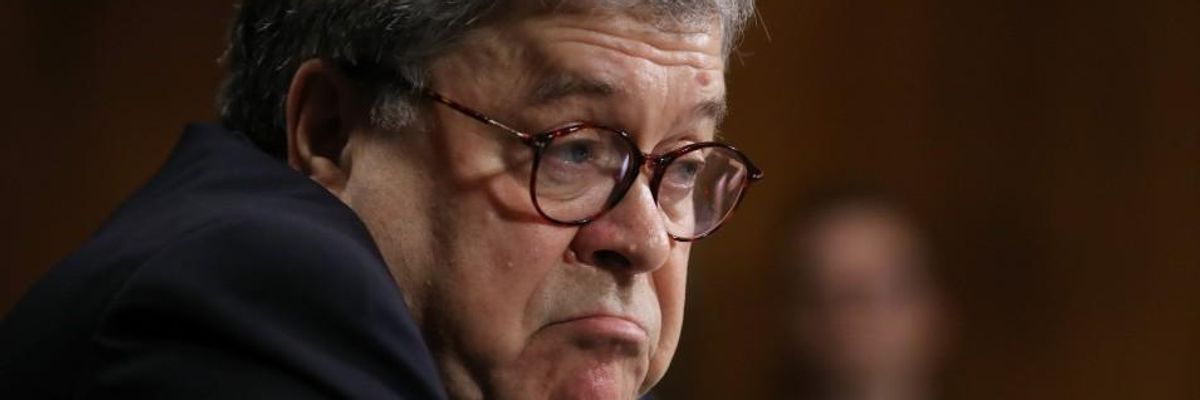
U.S. Attorney General William Barr testified before the Senate Judiciary Committee on May 1, 2019 about the Justice Department's investigation of Russian interference with the 2016 presidential election. (Photo: Win McNamee/Getty Images)
U.S. Attorney General William Barr came under fire overnight after issuing a memo to federal prosecutors that critics warn aims to bolster President Donald Trump's continued baseless claims that rampant voter fraud--which doesn't factually exist--cost him reelection.
"To do so when there is no such evidence--and when the president's clear strategy is to delegitimize the results of a proper election--is one of the more problematic acts of any attorney general in my lifetime."
--Stephen I. Vladeck, University of Texas School of Law
According to the Huffington Post:
Barr's memo, sent to U.S. attorneys across the country, authorizes an exception to Justice Department guidelines, telling top federal prosecutors they could "pursue substantial allegations of voting and vote tabulation irregularities prior to the certification of elections in your jurisdictions in certain cases." Barr wrote that he'd already done so in specific instances.
"Such inquiries and reviews may be conducted if there are clear and apparently-credible allegations of irregularities that, if true, could potentially impact the outcome of a federal election in an individual State," Barr wrote. "Any investigation of claims of irregularities that, if true, would clearly not impact the outcome of a federal election in an individual State should normally be deferred until after the election certification process is completed."
The reversal of longstanding DOJ policy--especially under circumstances when no allegations of significant fraud have been substantiated and as Trump continues his refusal to concede or acknowledge the vote tabulations which show he lost the electoral college and popular vote tallies by significant margins--was seen by legal experts as a brazen effort by Barr to legitimatize the president's baseless and dangerous narrative about the integrity of the election.
Vanita Gupta, president and CEO of The Leadership Conference on Civil and Human Rights, tweeted:
Sen. Elizabeth Warren (D-Mass.) was unsparing in her rebuke:
In response to the memo (pdf), Kristen Clarke, president and executive director of the Lawyers' Committee for Civil Rights Under Law, denounced the directive as a partisan effort to give comfort to the president's baseless claims while doing serious damage to the reputation of the DOJ as a non-political arm of the government.
"We condemn Attorney General's Barr post-election attempt to weaponize the Justice Department to breathe life into President Trump's baseless and unsubstantiated claims of vote fraud," Clarke said in a statement late Monday night. "Barr's attempt to interject and activate federal prosecutors is clearly part of a coordinated attempt to sow chaos and discord, and undermine confidence in the electoral outcome."
"Americans," she continued, "will see this move for what it is--a naked political ploy and it will not succeed. This move is especially astounding given the Justice Department's deafening silence regarding countless documented instances of voter suppression and voting discrimination this season."
Speaking with the New York Times, Stephen I. Vladeck, a University of Texas School of Law professor, said the memo is deeply troubling. "It would be problematic enough if Barr were reversing longstanding Justice Department guidance because of significant, substantiated claims of misconduct--that could presumably be handled at the local and state level," Vladeck said. "But to do so when there is no such evidence--and when the president's clear strategy is to delegitimize the results of a proper election--is one of the more problematic acts of any attorney general in my lifetime."
Following Barr's issuance of the memo, the Times' DOJ correspondent Katie Benner reported that Richard Pilger, the DOJ official who heads the voter fraud division, resigned his position in objection to the orders it contained:
Pilger will remain in the DOJ, but stepped aside from his job as head of the Election Crimes Branch.
According to the Washington Post, "people said Barr had first broached a similar idea some weeks ago and that political leadership in the Justice Department's Criminal Division, of which the Election Crimes Branch is a part, pushed back. Those officials were blindsided when Barr's memo was released on Monday, the people said."
Dear Common Dreams reader, It’s been nearly 30 years since I co-founded Common Dreams with my late wife, Lina Newhouser. We had the radical notion that journalism should serve the public good, not corporate profits. It was clear to us from the outset what it would take to build such a project. No paid advertisements. No corporate sponsors. No millionaire publisher telling us what to think or do. Many people said we wouldn't last a year, but we proved those doubters wrong. Together with a tremendous team of journalists and dedicated staff, we built an independent media outlet free from the constraints of profits and corporate control. Our mission has always been simple: To inform. To inspire. To ignite change for the common good. Building Common Dreams was not easy. Our survival was never guaranteed. When you take on the most powerful forces—Wall Street greed, fossil fuel industry destruction, Big Tech lobbyists, and uber-rich oligarchs who have spent billions upon billions rigging the economy and democracy in their favor—the only bulwark you have is supporters who believe in your work. But here’s the urgent message from me today. It's never been this bad out there. And it's never been this hard to keep us going. At the very moment Common Dreams is most needed, the threats we face are intensifying. We need your support now more than ever. We don't accept corporate advertising and never will. We don't have a paywall because we don't think people should be blocked from critical news based on their ability to pay. Everything we do is funded by the donations of readers like you. When everyone does the little they can afford, we are strong. But if that support retreats or dries up, so do we. Will you donate now to make sure Common Dreams not only survives but thrives? —Craig Brown, Co-founder |
U.S. Attorney General William Barr came under fire overnight after issuing a memo to federal prosecutors that critics warn aims to bolster President Donald Trump's continued baseless claims that rampant voter fraud--which doesn't factually exist--cost him reelection.
"To do so when there is no such evidence--and when the president's clear strategy is to delegitimize the results of a proper election--is one of the more problematic acts of any attorney general in my lifetime."
--Stephen I. Vladeck, University of Texas School of Law
According to the Huffington Post:
Barr's memo, sent to U.S. attorneys across the country, authorizes an exception to Justice Department guidelines, telling top federal prosecutors they could "pursue substantial allegations of voting and vote tabulation irregularities prior to the certification of elections in your jurisdictions in certain cases." Barr wrote that he'd already done so in specific instances.
"Such inquiries and reviews may be conducted if there are clear and apparently-credible allegations of irregularities that, if true, could potentially impact the outcome of a federal election in an individual State," Barr wrote. "Any investigation of claims of irregularities that, if true, would clearly not impact the outcome of a federal election in an individual State should normally be deferred until after the election certification process is completed."
The reversal of longstanding DOJ policy--especially under circumstances when no allegations of significant fraud have been substantiated and as Trump continues his refusal to concede or acknowledge the vote tabulations which show he lost the electoral college and popular vote tallies by significant margins--was seen by legal experts as a brazen effort by Barr to legitimatize the president's baseless and dangerous narrative about the integrity of the election.
Vanita Gupta, president and CEO of The Leadership Conference on Civil and Human Rights, tweeted:
Sen. Elizabeth Warren (D-Mass.) was unsparing in her rebuke:
In response to the memo (pdf), Kristen Clarke, president and executive director of the Lawyers' Committee for Civil Rights Under Law, denounced the directive as a partisan effort to give comfort to the president's baseless claims while doing serious damage to the reputation of the DOJ as a non-political arm of the government.
"We condemn Attorney General's Barr post-election attempt to weaponize the Justice Department to breathe life into President Trump's baseless and unsubstantiated claims of vote fraud," Clarke said in a statement late Monday night. "Barr's attempt to interject and activate federal prosecutors is clearly part of a coordinated attempt to sow chaos and discord, and undermine confidence in the electoral outcome."
"Americans," she continued, "will see this move for what it is--a naked political ploy and it will not succeed. This move is especially astounding given the Justice Department's deafening silence regarding countless documented instances of voter suppression and voting discrimination this season."
Speaking with the New York Times, Stephen I. Vladeck, a University of Texas School of Law professor, said the memo is deeply troubling. "It would be problematic enough if Barr were reversing longstanding Justice Department guidance because of significant, substantiated claims of misconduct--that could presumably be handled at the local and state level," Vladeck said. "But to do so when there is no such evidence--and when the president's clear strategy is to delegitimize the results of a proper election--is one of the more problematic acts of any attorney general in my lifetime."
Following Barr's issuance of the memo, the Times' DOJ correspondent Katie Benner reported that Richard Pilger, the DOJ official who heads the voter fraud division, resigned his position in objection to the orders it contained:
Pilger will remain in the DOJ, but stepped aside from his job as head of the Election Crimes Branch.
According to the Washington Post, "people said Barr had first broached a similar idea some weeks ago and that political leadership in the Justice Department's Criminal Division, of which the Election Crimes Branch is a part, pushed back. Those officials were blindsided when Barr's memo was released on Monday, the people said."
U.S. Attorney General William Barr came under fire overnight after issuing a memo to federal prosecutors that critics warn aims to bolster President Donald Trump's continued baseless claims that rampant voter fraud--which doesn't factually exist--cost him reelection.
"To do so when there is no such evidence--and when the president's clear strategy is to delegitimize the results of a proper election--is one of the more problematic acts of any attorney general in my lifetime."
--Stephen I. Vladeck, University of Texas School of Law
According to the Huffington Post:
Barr's memo, sent to U.S. attorneys across the country, authorizes an exception to Justice Department guidelines, telling top federal prosecutors they could "pursue substantial allegations of voting and vote tabulation irregularities prior to the certification of elections in your jurisdictions in certain cases." Barr wrote that he'd already done so in specific instances.
"Such inquiries and reviews may be conducted if there are clear and apparently-credible allegations of irregularities that, if true, could potentially impact the outcome of a federal election in an individual State," Barr wrote. "Any investigation of claims of irregularities that, if true, would clearly not impact the outcome of a federal election in an individual State should normally be deferred until after the election certification process is completed."
The reversal of longstanding DOJ policy--especially under circumstances when no allegations of significant fraud have been substantiated and as Trump continues his refusal to concede or acknowledge the vote tabulations which show he lost the electoral college and popular vote tallies by significant margins--was seen by legal experts as a brazen effort by Barr to legitimatize the president's baseless and dangerous narrative about the integrity of the election.
Vanita Gupta, president and CEO of The Leadership Conference on Civil and Human Rights, tweeted:
Sen. Elizabeth Warren (D-Mass.) was unsparing in her rebuke:
In response to the memo (pdf), Kristen Clarke, president and executive director of the Lawyers' Committee for Civil Rights Under Law, denounced the directive as a partisan effort to give comfort to the president's baseless claims while doing serious damage to the reputation of the DOJ as a non-political arm of the government.
"We condemn Attorney General's Barr post-election attempt to weaponize the Justice Department to breathe life into President Trump's baseless and unsubstantiated claims of vote fraud," Clarke said in a statement late Monday night. "Barr's attempt to interject and activate federal prosecutors is clearly part of a coordinated attempt to sow chaos and discord, and undermine confidence in the electoral outcome."
"Americans," she continued, "will see this move for what it is--a naked political ploy and it will not succeed. This move is especially astounding given the Justice Department's deafening silence regarding countless documented instances of voter suppression and voting discrimination this season."
Speaking with the New York Times, Stephen I. Vladeck, a University of Texas School of Law professor, said the memo is deeply troubling. "It would be problematic enough if Barr were reversing longstanding Justice Department guidance because of significant, substantiated claims of misconduct--that could presumably be handled at the local and state level," Vladeck said. "But to do so when there is no such evidence--and when the president's clear strategy is to delegitimize the results of a proper election--is one of the more problematic acts of any attorney general in my lifetime."
Following Barr's issuance of the memo, the Times' DOJ correspondent Katie Benner reported that Richard Pilger, the DOJ official who heads the voter fraud division, resigned his position in objection to the orders it contained:
Pilger will remain in the DOJ, but stepped aside from his job as head of the Election Crimes Branch.
According to the Washington Post, "people said Barr had first broached a similar idea some weeks ago and that political leadership in the Justice Department's Criminal Division, of which the Election Crimes Branch is a part, pushed back. Those officials were blindsided when Barr's memo was released on Monday, the people said."