
Postmaster General Louis DeJoy arrives to testifiy during a House Oversight and Reform Committee hearing on slowdowns at the U.S. Postal Service ahead of the November elections on Capitol Hill in Washington, D.C. on August 24, 2020. (Photo: Tom Williams/Pool/AFP via Getty Images)
Applause for All Who 'Never Gave Up This Fight': US Postal Service Agrees to Reverse Changes That Slowed Mail Nationwide
"We are ensuring mail services will be immediately restored," said Montana's Democratic Gov. Steve Bullock.
The U.S. Postal Service agreed Wednesday to reverse dramatic changes to mail operations imposed in recent months by Postmaster General Louis DeJoy, settling a lawsuit filed by Montana's Democratic Gov. Steve Bullock seeking to ensure that mail services throughout the country--including the timely delivery of ballots and medicines--would be fully functional amid a pandemic that has increased the demand for mail-in voting.
The lawsuit filed against DeJoy and the USPS on September 9 "argued changes implemented in June harmed access to mail services in Montana, resulting in delayed delivery of medical prescriptions, payments, and job applications, and impeding the ability of Montana residents to vote by mail," the Associated Press reported Thursday.
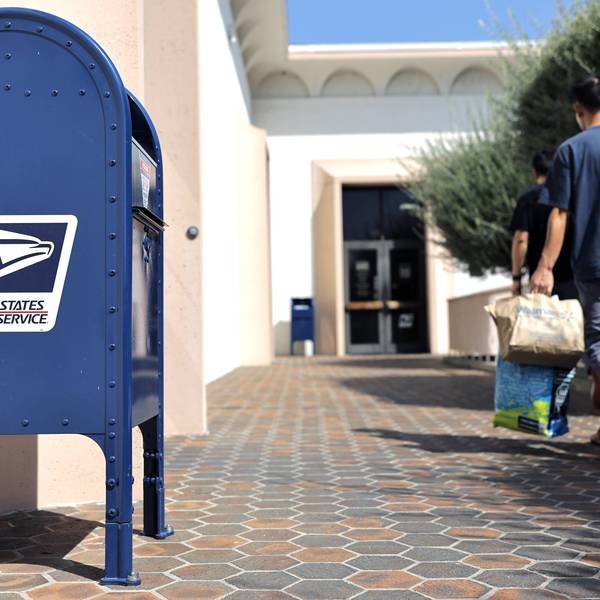
USPS agreed to reverse all changes, which entailed various forms of sabotage including reduced hours and restricted overtime, closure of processing facilities, and removal of sorting machines as well as collection boxes, as Common Dreams has reported.
According to AP, the agreement also requires USPS to prioritize election mail in the crucial coming weeks, and the restoration of services applies nationwide.
Wednesday's agreement comes after two federal judges in September temporarily halted DeJoy's policy changes, largely granting a request made by 14 states for a court order blocking the postmaster general's actions.
As Common Dreams reported last month, Judge Stanley Bastian of the U.S. District Court for the Eastern District of Washington described DeJoy's efforts as a "politically motivated attack" on the USPS that was part of "an intentional effort" by the Trump administration to "disrupt and challenge the legitimacy of upcoming local, state, and federal elections."
Since "72% of the decommissioned high-speed mail sorting machines... were located in counties where Hillary Clinton received the most votes in 2016," Bastian argued that the White House was engaging in targeted "voter disenfranchisement."
We are at a crossroads
This country and this world are at a monumental crossroads. In a few short weeks, US voters will have an opportunity to beat back the forces of fascism and confront the billionaires who are rigging the economy, our media system, and our democracy, making it increasingly impossible for ordinary people to get by. We’re not just talking about the election. We’re talking about what must be done once these fascist elements are vanquished from power. We need a bolder set of solutions than what either major party has so far been willing to offer and a working-class movement ready to fight like hell for it. Trump didn't emerge from nowhere. The conditions that fueled MAGA authoritarianism were created by decades of radical neoliberal economic policies and a corrupt political system dominated by corporate interests. They slashed taxes on the super-rich, promising that the benefits would trickle down. They said giveaways to the corporate titans would make life more affordable for the rest of us. It was all bullshit. And when a bitter, betrayed populace searches for someone to blame, right-wing demagogues have little trouble finding scapegoats. People know when they're being lied to, but you won't hear any of this from the corporate media. Only independent journalism—powered and funded by people who believe in building a better world—can deliver truly trustworthy daily news. Our Fall Campaign is underway, and we need your help. To power our newsroom through the rest of the year, we need to raise $125,000 by midnight on October 31. So if you share our vision, please contribute whatever you can to sustain our work. |
The U.S. Postal Service agreed Wednesday to reverse dramatic changes to mail operations imposed in recent months by Postmaster General Louis DeJoy, settling a lawsuit filed by Montana's Democratic Gov. Steve Bullock seeking to ensure that mail services throughout the country--including the timely delivery of ballots and medicines--would be fully functional amid a pandemic that has increased the demand for mail-in voting.
The lawsuit filed against DeJoy and the USPS on September 9 "argued changes implemented in June harmed access to mail services in Montana, resulting in delayed delivery of medical prescriptions, payments, and job applications, and impeding the ability of Montana residents to vote by mail," the Associated Press reported Thursday.
USPS agreed to reverse all changes, which entailed various forms of sabotage including reduced hours and restricted overtime, closure of processing facilities, and removal of sorting machines as well as collection boxes, as Common Dreams has reported.
According to AP, the agreement also requires USPS to prioritize election mail in the crucial coming weeks, and the restoration of services applies nationwide.
Wednesday's agreement comes after two federal judges in September temporarily halted DeJoy's policy changes, largely granting a request made by 14 states for a court order blocking the postmaster general's actions.
As Common Dreams reported last month, Judge Stanley Bastian of the U.S. District Court for the Eastern District of Washington described DeJoy's efforts as a "politically motivated attack" on the USPS that was part of "an intentional effort" by the Trump administration to "disrupt and challenge the legitimacy of upcoming local, state, and federal elections."
Since "72% of the decommissioned high-speed mail sorting machines... were located in counties where Hillary Clinton received the most votes in 2016," Bastian argued that the White House was engaging in targeted "voter disenfranchisement."
The U.S. Postal Service agreed Wednesday to reverse dramatic changes to mail operations imposed in recent months by Postmaster General Louis DeJoy, settling a lawsuit filed by Montana's Democratic Gov. Steve Bullock seeking to ensure that mail services throughout the country--including the timely delivery of ballots and medicines--would be fully functional amid a pandemic that has increased the demand for mail-in voting.
The lawsuit filed against DeJoy and the USPS on September 9 "argued changes implemented in June harmed access to mail services in Montana, resulting in delayed delivery of medical prescriptions, payments, and job applications, and impeding the ability of Montana residents to vote by mail," the Associated Press reported Thursday.
USPS agreed to reverse all changes, which entailed various forms of sabotage including reduced hours and restricted overtime, closure of processing facilities, and removal of sorting machines as well as collection boxes, as Common Dreams has reported.
According to AP, the agreement also requires USPS to prioritize election mail in the crucial coming weeks, and the restoration of services applies nationwide.
Wednesday's agreement comes after two federal judges in September temporarily halted DeJoy's policy changes, largely granting a request made by 14 states for a court order blocking the postmaster general's actions.
As Common Dreams reported last month, Judge Stanley Bastian of the U.S. District Court for the Eastern District of Washington described DeJoy's efforts as a "politically motivated attack" on the USPS that was part of "an intentional effort" by the Trump administration to "disrupt and challenge the legitimacy of upcoming local, state, and federal elections."
Since "72% of the decommissioned high-speed mail sorting machines... were located in counties where Hillary Clinton received the most votes in 2016," Bastian argued that the White House was engaging in targeted "voter disenfranchisement."