

SUBSCRIBE TO OUR FREE NEWSLETTER
Daily news & progressive opinion—funded by the people, not the corporations—delivered straight to your inbox.
5
#000000
#FFFFFF
To donate by check, phone, or other method, see our More Ways to Give page.
Daily news & progressive opinion—funded by the people, not the corporations—delivered straight to your inbox.
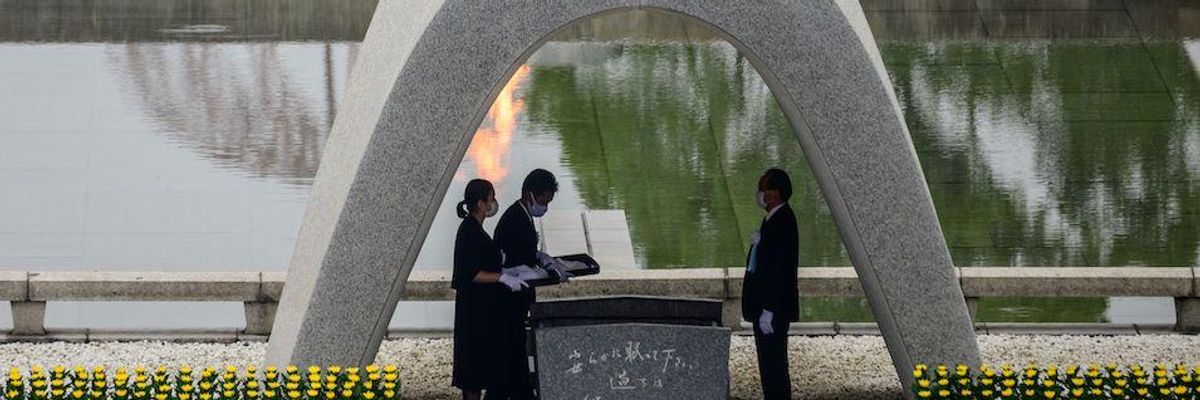
Hiroshima mayor Kazumi Matsui and representatives of bereaved families take part in a ceremony at the Memorial Cenotaph during the 75th anniversary memorial service for atomic bomb victims at the Peace Memorial Park in Hiroshima on August 6, 2020.
The mayor of Hiroshima on Thursday warned of the ongoing dangers of nationalism and militarism on the 75th anniversary of the nuclear bombing of the Japanese city by the United States on August 6, 1945.
"We must never allow this painful past to repeat itself," said Kazumi Matsui. "Civil society must reject self-centered nationalism and unite against all threats."
Matsui tied the current moment and ongoing Covid-19 outbreak to the struggles of the world during the 1918 Spanish flu pandemic, which killed 50 million people worldwide.
"When the 1918 flu pandemic attacked a century ago, it took tens of millions of lives and terrorized the world because nations fighting World War I were unable to meet the threat together," said Matsui. "A subsequent upsurge in nationalism led to World War II and the atomic bombings."
As the Washington Post reported, the anniversary events were more modest than in recent years due to the coronavirus:
Crowds usually reaching in the tens of thousands were kept away. Just 880 seats, spaced six feet apart, were placed on the lawn of the park, reserved for dignitaries, children, survivors of the bomb attack, and families of those killed.
Flowers were laid at a cenotaph dedicated to the victims, a bell tolled as the audience bowed their heads in prayer, and children sang a song for peace.
"As the only country to have experienced nuclear devastation in the world, this is our unchanging mission to step by step and steadily advance the efforts by the international community for a world free from nuclear weapons," Japanese Prime Minister Shinzo Abe said in a statement at the ceremony.
As Common Dreams reported, U.S. President Donald Trump has withdrawn the country from a number of nuclear arms treaties in his first term, including the Intermediate-Range Nuclear Forces Treaty in 2019. The president also pulled out of the Open Skies Treaty, which is credited with helping the U.S. and Russia avoid war for three decades.
The bilateral Strategic Arms Reduction Treaty between the U.S. and Russia, also known as New START, expires in February, but experts warn it is unlikely to be renewed should Trump be reelected.
"The web of arms control, transparency, and confidence-building instruments established during the Cold War and its aftermath is fraying," said U.N. Secretary General Antonio Guterres in a video message for the anniversary. "Division, distrust, and a lack of dialogue threaten to return the world to unrestrained strategic nuclear competition."
A petition called the "Hibakusha Appeal"--named for survivors of the attacks--is calling for an end to the development of new nuclear weapons as well as the destruction of existing stockpiles.
In an email to supporters Thursday, the Union of Concerned Scientists urged Americans to sign the petition and make sure the country works to "step back from the brink of nuclear annihilation, using diplomacy and science to end nuclear arms racing."
"Nuclear weapons have already done unspeakable harm," said the group. "As we mark these anniversaries, let's also look forward and work to ensure they never harm anybody else again."
Dear Common Dreams reader, It’s been nearly 30 years since I co-founded Common Dreams with my late wife, Lina Newhouser. We had the radical notion that journalism should serve the public good, not corporate profits. It was clear to us from the outset what it would take to build such a project. No paid advertisements. No corporate sponsors. No millionaire publisher telling us what to think or do. Many people said we wouldn't last a year, but we proved those doubters wrong. Together with a tremendous team of journalists and dedicated staff, we built an independent media outlet free from the constraints of profits and corporate control. Our mission has always been simple: To inform. To inspire. To ignite change for the common good. Building Common Dreams was not easy. Our survival was never guaranteed. When you take on the most powerful forces—Wall Street greed, fossil fuel industry destruction, Big Tech lobbyists, and uber-rich oligarchs who have spent billions upon billions rigging the economy and democracy in their favor—the only bulwark you have is supporters who believe in your work. But here’s the urgent message from me today. It's never been this bad out there. And it's never been this hard to keep us going. At the very moment Common Dreams is most needed, the threats we face are intensifying. We need your support now more than ever. We don't accept corporate advertising and never will. We don't have a paywall because we don't think people should be blocked from critical news based on their ability to pay. Everything we do is funded by the donations of readers like you. When everyone does the little they can afford, we are strong. But if that support retreats or dries up, so do we. Will you donate now to make sure Common Dreams not only survives but thrives? —Craig Brown, Co-founder |
The mayor of Hiroshima on Thursday warned of the ongoing dangers of nationalism and militarism on the 75th anniversary of the nuclear bombing of the Japanese city by the United States on August 6, 1945.
"We must never allow this painful past to repeat itself," said Kazumi Matsui. "Civil society must reject self-centered nationalism and unite against all threats."
Matsui tied the current moment and ongoing Covid-19 outbreak to the struggles of the world during the 1918 Spanish flu pandemic, which killed 50 million people worldwide.
"When the 1918 flu pandemic attacked a century ago, it took tens of millions of lives and terrorized the world because nations fighting World War I were unable to meet the threat together," said Matsui. "A subsequent upsurge in nationalism led to World War II and the atomic bombings."
As the Washington Post reported, the anniversary events were more modest than in recent years due to the coronavirus:
Crowds usually reaching in the tens of thousands were kept away. Just 880 seats, spaced six feet apart, were placed on the lawn of the park, reserved for dignitaries, children, survivors of the bomb attack, and families of those killed.
Flowers were laid at a cenotaph dedicated to the victims, a bell tolled as the audience bowed their heads in prayer, and children sang a song for peace.
"As the only country to have experienced nuclear devastation in the world, this is our unchanging mission to step by step and steadily advance the efforts by the international community for a world free from nuclear weapons," Japanese Prime Minister Shinzo Abe said in a statement at the ceremony.
As Common Dreams reported, U.S. President Donald Trump has withdrawn the country from a number of nuclear arms treaties in his first term, including the Intermediate-Range Nuclear Forces Treaty in 2019. The president also pulled out of the Open Skies Treaty, which is credited with helping the U.S. and Russia avoid war for three decades.
The bilateral Strategic Arms Reduction Treaty between the U.S. and Russia, also known as New START, expires in February, but experts warn it is unlikely to be renewed should Trump be reelected.
"The web of arms control, transparency, and confidence-building instruments established during the Cold War and its aftermath is fraying," said U.N. Secretary General Antonio Guterres in a video message for the anniversary. "Division, distrust, and a lack of dialogue threaten to return the world to unrestrained strategic nuclear competition."
A petition called the "Hibakusha Appeal"--named for survivors of the attacks--is calling for an end to the development of new nuclear weapons as well as the destruction of existing stockpiles.
In an email to supporters Thursday, the Union of Concerned Scientists urged Americans to sign the petition and make sure the country works to "step back from the brink of nuclear annihilation, using diplomacy and science to end nuclear arms racing."
"Nuclear weapons have already done unspeakable harm," said the group. "As we mark these anniversaries, let's also look forward and work to ensure they never harm anybody else again."
The mayor of Hiroshima on Thursday warned of the ongoing dangers of nationalism and militarism on the 75th anniversary of the nuclear bombing of the Japanese city by the United States on August 6, 1945.
"We must never allow this painful past to repeat itself," said Kazumi Matsui. "Civil society must reject self-centered nationalism and unite against all threats."
Matsui tied the current moment and ongoing Covid-19 outbreak to the struggles of the world during the 1918 Spanish flu pandemic, which killed 50 million people worldwide.
"When the 1918 flu pandemic attacked a century ago, it took tens of millions of lives and terrorized the world because nations fighting World War I were unable to meet the threat together," said Matsui. "A subsequent upsurge in nationalism led to World War II and the atomic bombings."
As the Washington Post reported, the anniversary events were more modest than in recent years due to the coronavirus:
Crowds usually reaching in the tens of thousands were kept away. Just 880 seats, spaced six feet apart, were placed on the lawn of the park, reserved for dignitaries, children, survivors of the bomb attack, and families of those killed.
Flowers were laid at a cenotaph dedicated to the victims, a bell tolled as the audience bowed their heads in prayer, and children sang a song for peace.
"As the only country to have experienced nuclear devastation in the world, this is our unchanging mission to step by step and steadily advance the efforts by the international community for a world free from nuclear weapons," Japanese Prime Minister Shinzo Abe said in a statement at the ceremony.
As Common Dreams reported, U.S. President Donald Trump has withdrawn the country from a number of nuclear arms treaties in his first term, including the Intermediate-Range Nuclear Forces Treaty in 2019. The president also pulled out of the Open Skies Treaty, which is credited with helping the U.S. and Russia avoid war for three decades.
The bilateral Strategic Arms Reduction Treaty between the U.S. and Russia, also known as New START, expires in February, but experts warn it is unlikely to be renewed should Trump be reelected.
"The web of arms control, transparency, and confidence-building instruments established during the Cold War and its aftermath is fraying," said U.N. Secretary General Antonio Guterres in a video message for the anniversary. "Division, distrust, and a lack of dialogue threaten to return the world to unrestrained strategic nuclear competition."
A petition called the "Hibakusha Appeal"--named for survivors of the attacks--is calling for an end to the development of new nuclear weapons as well as the destruction of existing stockpiles.
In an email to supporters Thursday, the Union of Concerned Scientists urged Americans to sign the petition and make sure the country works to "step back from the brink of nuclear annihilation, using diplomacy and science to end nuclear arms racing."
"Nuclear weapons have already done unspeakable harm," said the group. "As we mark these anniversaries, let's also look forward and work to ensure they never harm anybody else again."

