SUBSCRIBE TO OUR FREE NEWSLETTER
Daily news & progressive opinion—funded by the people, not the corporations—delivered straight to your inbox.
5
#000000
#FFFFFF
To donate by check, phone, or other method, see our More Ways to Give page.


Daily news & progressive opinion—funded by the people, not the corporations—delivered straight to your inbox.

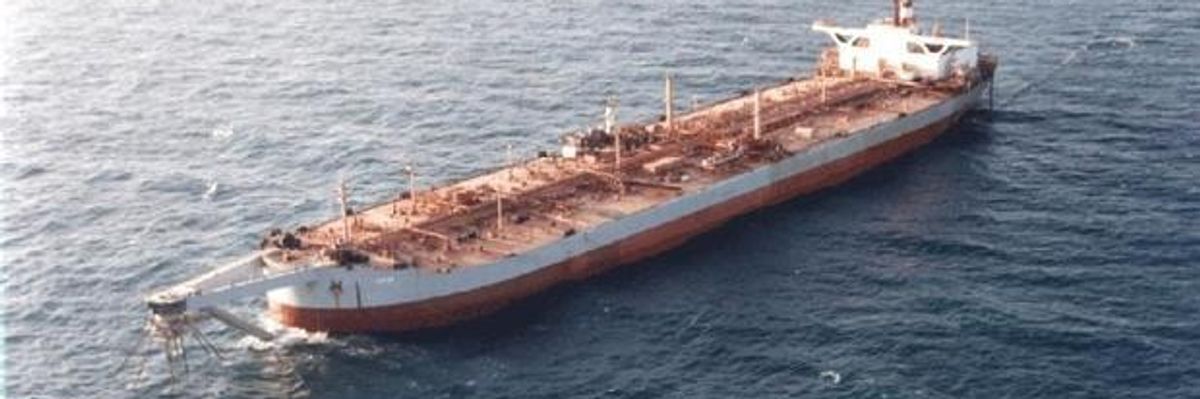
A file photo shows the FSO Safer supertanker permanently anchored off Yemen's Red Sea coast, west of Hodeida. (Handout)
A United Nations official raised alarm Wednesday about the potential threat of a major oil spill off the coast of Yemen, warning that an aging supertanker off the country's coast could dump four times more oil into the Red Sea than the Exxon Valdez oil disaster of 1989.
The remarks from U.N. Environment Programme (UNEP) executive director Inger Andersen to the U.N. Security Council paint a frightening picture of the environmental and humanitarian consequences posed by the oil in the FSO Safer.
Should a spill occur, it would "directly affect millions of people in a country that is already enduring the world's largest humanitarian emergency," said Andersen.
The 45-year-old vessel, under control of Houthi rebels since 2015, holds more than 1 million barrels of crude oil and has been described as a "massive floating time bomb" that "is corroding away rapidly as we speak."
The Associated Press reported last month that "seawater has entered the engine compartment of the tanker, which hasn't been maintained for over five years," and the Houthis have so far blocked U.N. inspectors access to the ship.
"Rust has covered parts of the tanker and the inert gas that prevents the tanks from gathering inflammable gases, has leaked out," AP reported. "Experts say maintenance is no longer possible because the damage to the ship is irreversible."
Andersen, in her comments to the Security Council, pointed to "increasingly likely" scenarios of either a spill or explosion on the tanker, either of which would unleash "a serious, long-lasting environmental impact." Andersen further noted that the Red Sea is "one of the most important repositories of biodiversity on the planet" and said an oil disaster from the FSO Safer has the potential to impact 28 million people who rely on the sea and its coastal area for their livelihoods.
"If the SAFER leaks, potentially spilling four times more oil into the Red Sea than the Exxon Valdez oil spill," Andersen said, "ecosystems and fisheries would be damaged for an extended period into the future."
The UNEP chief pointed to a recent study analyzing potential threats of a spill. Among the worst case scenarios--which would happen if the spill took place between July and September--include that all of Yemen's fisheries would be affected, there would be a months-long closure of the crucial port causing a 200% spike in fuel prices in Yemen for several months and a doubling in food prices, and over 8,000 water wells would be at risk of contamination.
Even if a spill was immediately followed by actions to recover the oil and clean up the shoreline, "it would nonetheless take years for the ecosystems and the economies to recover," said Anderson. But immediate spill response could be marred by the fact that Yemen and its neighboring countries lack capacity for such action. The ongoing conflict in Yemen would be an additional obstacle to immediate remediation efforts, she said.
Efforts to prevent an oil spill or explosion are therefore paramount, said Andersen, pointing to the need to offload the oil and move the tanker. But, she stressed, plans to address a spill must still be in place.
"If the SAFER leaks, potentially spilling four times more oil into the Red Sea than the Exxon Valdez oil spill," Andersen said, "ecosystems and fisheries would be damaged for an extended period into the future."
Efforts to stave off the looming disaster can't wait any longer, she said.
"Time is running out for us to act in a coordinated manner to prevent a looming environmental, economic, and humanitarian catastrophe," Andersen said, calling for a U.N. team to have access to the vessel to assess the situation.
U.N. humanitarian affairs chief Mark Lowcock also addressed the impending diaster at the Security Council and urged Houthis to seize the "important opportunity here to take steps that will spare millions of their fellow citizens from yet another tragedy."

Dear Common Dreams reader, It’s been nearly 30 years since I co-founded Common Dreams with my late wife, Lina Newhouser. We had the radical notion that journalism should serve the public good, not corporate profits. It was clear to us from the outset what it would take to build such a project. No paid advertisements. No corporate sponsors. No millionaire publisher telling us what to think or do. Many people said we wouldn't last a year, but we proved those doubters wrong. Together with a tremendous team of journalists and dedicated staff, we built an independent media outlet free from the constraints of profits and corporate control. Our mission has always been simple: To inform. To inspire. To ignite change for the common good. Building Common Dreams was not easy. Our survival was never guaranteed. When you take on the most powerful forces—Wall Street greed, fossil fuel industry destruction, Big Tech lobbyists, and uber-rich oligarchs who have spent billions upon billions rigging the economy and democracy in their favor—the only bulwark you have is supporters who believe in your work. But here’s the urgent message from me today. It's never been this bad out there. And it's never been this hard to keep us going. At the very moment Common Dreams is most needed, the threats we face are intensifying. We need your support now more than ever. We don't accept corporate advertising and never will. We don't have a paywall because we don't think people should be blocked from critical news based on their ability to pay. Everything we do is funded by the donations of readers like you. When everyone does the little they can afford, we are strong. But if that support retreats or dries up, so do we. Will you donate now to make sure Common Dreams not only survives but thrives? —Craig Brown, Co-founder |
A United Nations official raised alarm Wednesday about the potential threat of a major oil spill off the coast of Yemen, warning that an aging supertanker off the country's coast could dump four times more oil into the Red Sea than the Exxon Valdez oil disaster of 1989.
The remarks from U.N. Environment Programme (UNEP) executive director Inger Andersen to the U.N. Security Council paint a frightening picture of the environmental and humanitarian consequences posed by the oil in the FSO Safer.
Should a spill occur, it would "directly affect millions of people in a country that is already enduring the world's largest humanitarian emergency," said Andersen.
The 45-year-old vessel, under control of Houthi rebels since 2015, holds more than 1 million barrels of crude oil and has been described as a "massive floating time bomb" that "is corroding away rapidly as we speak."
The Associated Press reported last month that "seawater has entered the engine compartment of the tanker, which hasn't been maintained for over five years," and the Houthis have so far blocked U.N. inspectors access to the ship.
"Rust has covered parts of the tanker and the inert gas that prevents the tanks from gathering inflammable gases, has leaked out," AP reported. "Experts say maintenance is no longer possible because the damage to the ship is irreversible."
Andersen, in her comments to the Security Council, pointed to "increasingly likely" scenarios of either a spill or explosion on the tanker, either of which would unleash "a serious, long-lasting environmental impact." Andersen further noted that the Red Sea is "one of the most important repositories of biodiversity on the planet" and said an oil disaster from the FSO Safer has the potential to impact 28 million people who rely on the sea and its coastal area for their livelihoods.
"If the SAFER leaks, potentially spilling four times more oil into the Red Sea than the Exxon Valdez oil spill," Andersen said, "ecosystems and fisheries would be damaged for an extended period into the future."
The UNEP chief pointed to a recent study analyzing potential threats of a spill. Among the worst case scenarios--which would happen if the spill took place between July and September--include that all of Yemen's fisheries would be affected, there would be a months-long closure of the crucial port causing a 200% spike in fuel prices in Yemen for several months and a doubling in food prices, and over 8,000 water wells would be at risk of contamination.
Even if a spill was immediately followed by actions to recover the oil and clean up the shoreline, "it would nonetheless take years for the ecosystems and the economies to recover," said Anderson. But immediate spill response could be marred by the fact that Yemen and its neighboring countries lack capacity for such action. The ongoing conflict in Yemen would be an additional obstacle to immediate remediation efforts, she said.
Efforts to prevent an oil spill or explosion are therefore paramount, said Andersen, pointing to the need to offload the oil and move the tanker. But, she stressed, plans to address a spill must still be in place.
"If the SAFER leaks, potentially spilling four times more oil into the Red Sea than the Exxon Valdez oil spill," Andersen said, "ecosystems and fisheries would be damaged for an extended period into the future."
Efforts to stave off the looming disaster can't wait any longer, she said.
"Time is running out for us to act in a coordinated manner to prevent a looming environmental, economic, and humanitarian catastrophe," Andersen said, calling for a U.N. team to have access to the vessel to assess the situation.
U.N. humanitarian affairs chief Mark Lowcock also addressed the impending diaster at the Security Council and urged Houthis to seize the "important opportunity here to take steps that will spare millions of their fellow citizens from yet another tragedy."

A United Nations official raised alarm Wednesday about the potential threat of a major oil spill off the coast of Yemen, warning that an aging supertanker off the country's coast could dump four times more oil into the Red Sea than the Exxon Valdez oil disaster of 1989.
The remarks from U.N. Environment Programme (UNEP) executive director Inger Andersen to the U.N. Security Council paint a frightening picture of the environmental and humanitarian consequences posed by the oil in the FSO Safer.
Should a spill occur, it would "directly affect millions of people in a country that is already enduring the world's largest humanitarian emergency," said Andersen.
The 45-year-old vessel, under control of Houthi rebels since 2015, holds more than 1 million barrels of crude oil and has been described as a "massive floating time bomb" that "is corroding away rapidly as we speak."
The Associated Press reported last month that "seawater has entered the engine compartment of the tanker, which hasn't been maintained for over five years," and the Houthis have so far blocked U.N. inspectors access to the ship.
"Rust has covered parts of the tanker and the inert gas that prevents the tanks from gathering inflammable gases, has leaked out," AP reported. "Experts say maintenance is no longer possible because the damage to the ship is irreversible."
Andersen, in her comments to the Security Council, pointed to "increasingly likely" scenarios of either a spill or explosion on the tanker, either of which would unleash "a serious, long-lasting environmental impact." Andersen further noted that the Red Sea is "one of the most important repositories of biodiversity on the planet" and said an oil disaster from the FSO Safer has the potential to impact 28 million people who rely on the sea and its coastal area for their livelihoods.
"If the SAFER leaks, potentially spilling four times more oil into the Red Sea than the Exxon Valdez oil spill," Andersen said, "ecosystems and fisheries would be damaged for an extended period into the future."
The UNEP chief pointed to a recent study analyzing potential threats of a spill. Among the worst case scenarios--which would happen if the spill took place between July and September--include that all of Yemen's fisheries would be affected, there would be a months-long closure of the crucial port causing a 200% spike in fuel prices in Yemen for several months and a doubling in food prices, and over 8,000 water wells would be at risk of contamination.
Even if a spill was immediately followed by actions to recover the oil and clean up the shoreline, "it would nonetheless take years for the ecosystems and the economies to recover," said Anderson. But immediate spill response could be marred by the fact that Yemen and its neighboring countries lack capacity for such action. The ongoing conflict in Yemen would be an additional obstacle to immediate remediation efforts, she said.
Efforts to prevent an oil spill or explosion are therefore paramount, said Andersen, pointing to the need to offload the oil and move the tanker. But, she stressed, plans to address a spill must still be in place.
"If the SAFER leaks, potentially spilling four times more oil into the Red Sea than the Exxon Valdez oil spill," Andersen said, "ecosystems and fisheries would be damaged for an extended period into the future."
Efforts to stave off the looming disaster can't wait any longer, she said.
"Time is running out for us to act in a coordinated manner to prevent a looming environmental, economic, and humanitarian catastrophe," Andersen said, calling for a U.N. team to have access to the vessel to assess the situation.
U.N. humanitarian affairs chief Mark Lowcock also addressed the impending diaster at the Security Council and urged Houthis to seize the "important opportunity here to take steps that will spare millions of their fellow citizens from yet another tragedy."