

SUBSCRIBE TO OUR FREE NEWSLETTER
Daily news & progressive opinion—funded by the people, not the corporations—delivered straight to your inbox.
5
#000000
#FFFFFF
To donate by check, phone, or other method, see our More Ways to Give page.
Daily news & progressive opinion—funded by the people, not the corporations—delivered straight to your inbox.
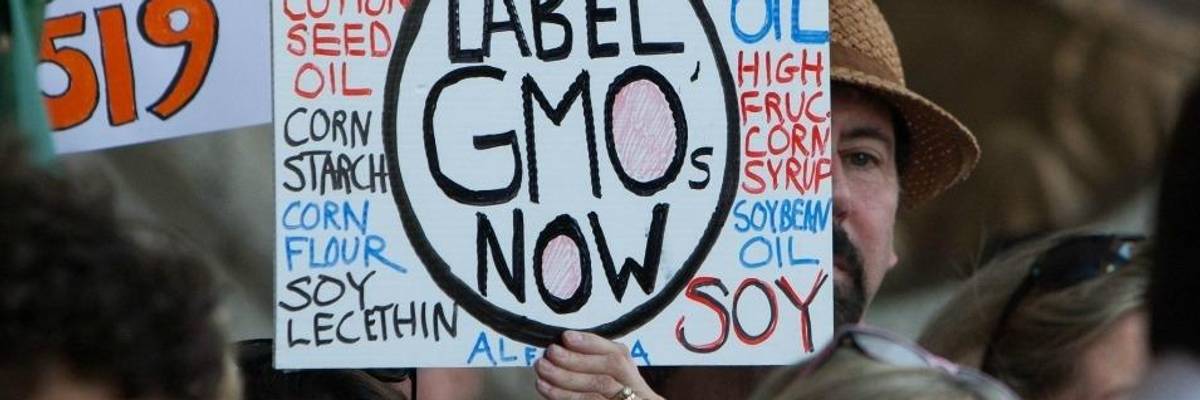
A rally in support of GMO labeling in Connecticut. (Photo: CT Senate Democrats)
Food safety advocacy groups objected to the Trump administration's latest assault on the country's agricultural regulatory framework as the Department of Agriculture announced Thursday it would leave oversight on GMOs to the companies producing the organisms.
"There is a need for adequate safeguards and effective regulatory oversight to ensure that there aren't unintended consequences to biodiversity from these new technologies," Aviva Glaser, director of agriculture policy at the National Wildlife Federation, said in a statement responding the rule, "but unfortunately, USDA's rule falls short of achieving this."
The new "SECURE rule" (pdf) would allow companies involved in gene editing (GE) to avoid government oversight if the companies themselves determine the editing involves modifications that could be achieved through traditional breeding. Critics charge that the new rule leaves that determination up to the companies themselves, removing two regulatory checks in one swoop.
"While some genetically engineered products are safe and beneficial, the federal government needs a regulatory system that tracks product development and ensures safety before products are marketed," said Center for Science in the Public Interest (CSPI) biotechnology project director Gregory Jaffe. "We support science- and risk-based federal oversight of genetically engineered plants to ensure they are safe to humans and the environment before they are released for cultivation or restoration, but today's final regulation does not achieve that result."
According to the CSPI, the rule change flies in the face of the desires of a broad coalition of interested groups:
Despite a unified position from environmental groups, consumer organizations, biotech crop developers, and food industry stakeholders imploring USDA to eliminate a provision allowing crop developers to self-determine whether their products are regulated, the Trump administration refused to require developers to even notify the agency of products they believe are exempt under the new regulations.
Center for Food Safety senior attorney Sylvia Wu said in a statement Friday that the USDA was trying to use a needed update to an outdated set of rules to push through yet another industry-friendly policy that could have ramifications for the country's food supply.
"While revisions to USDA's regulations--first drafted in 1987--are necessary in order to ensure that the regulatory scheme adequately addresses the harms associated with current GE technology, the new regulations finalized by USDA, paradoxically named the SECURE rule, are anything but secure," said Wu.
"Instead of fixing long-standing deficiencies and strengthening the regulatory system to guarantee proper oversight of new GE technologies and their associated risks, the revised regulations dramatically scale back USDA's regulatory authority, leaving most GMOs unregulated," Wu added.
Bottom line, said Consumer Federation of America director of food policy Thomas Gremillion, "consumers have a right to know how gene editing is being used to produce the foods they buy in the market."
"This rule will undermine public confidence in the food supply," Germillion said, "and ultimately set back beneficial uses of this technology."
Dear Common Dreams reader, It’s been nearly 30 years since I co-founded Common Dreams with my late wife, Lina Newhouser. We had the radical notion that journalism should serve the public good, not corporate profits. It was clear to us from the outset what it would take to build such a project. No paid advertisements. No corporate sponsors. No millionaire publisher telling us what to think or do. Many people said we wouldn't last a year, but we proved those doubters wrong. Together with a tremendous team of journalists and dedicated staff, we built an independent media outlet free from the constraints of profits and corporate control. Our mission has always been simple: To inform. To inspire. To ignite change for the common good. Building Common Dreams was not easy. Our survival was never guaranteed. When you take on the most powerful forces—Wall Street greed, fossil fuel industry destruction, Big Tech lobbyists, and uber-rich oligarchs who have spent billions upon billions rigging the economy and democracy in their favor—the only bulwark you have is supporters who believe in your work. But here’s the urgent message from me today. It's never been this bad out there. And it's never been this hard to keep us going. At the very moment Common Dreams is most needed, the threats we face are intensifying. We need your support now more than ever. We don't accept corporate advertising and never will. We don't have a paywall because we don't think people should be blocked from critical news based on their ability to pay. Everything we do is funded by the donations of readers like you. When everyone does the little they can afford, we are strong. But if that support retreats or dries up, so do we. Will you donate now to make sure Common Dreams not only survives but thrives? —Craig Brown, Co-founder |
Food safety advocacy groups objected to the Trump administration's latest assault on the country's agricultural regulatory framework as the Department of Agriculture announced Thursday it would leave oversight on GMOs to the companies producing the organisms.
"There is a need for adequate safeguards and effective regulatory oversight to ensure that there aren't unintended consequences to biodiversity from these new technologies," Aviva Glaser, director of agriculture policy at the National Wildlife Federation, said in a statement responding the rule, "but unfortunately, USDA's rule falls short of achieving this."
The new "SECURE rule" (pdf) would allow companies involved in gene editing (GE) to avoid government oversight if the companies themselves determine the editing involves modifications that could be achieved through traditional breeding. Critics charge that the new rule leaves that determination up to the companies themselves, removing two regulatory checks in one swoop.
"While some genetically engineered products are safe and beneficial, the federal government needs a regulatory system that tracks product development and ensures safety before products are marketed," said Center for Science in the Public Interest (CSPI) biotechnology project director Gregory Jaffe. "We support science- and risk-based federal oversight of genetically engineered plants to ensure they are safe to humans and the environment before they are released for cultivation or restoration, but today's final regulation does not achieve that result."
According to the CSPI, the rule change flies in the face of the desires of a broad coalition of interested groups:
Despite a unified position from environmental groups, consumer organizations, biotech crop developers, and food industry stakeholders imploring USDA to eliminate a provision allowing crop developers to self-determine whether their products are regulated, the Trump administration refused to require developers to even notify the agency of products they believe are exempt under the new regulations.
Center for Food Safety senior attorney Sylvia Wu said in a statement Friday that the USDA was trying to use a needed update to an outdated set of rules to push through yet another industry-friendly policy that could have ramifications for the country's food supply.
"While revisions to USDA's regulations--first drafted in 1987--are necessary in order to ensure that the regulatory scheme adequately addresses the harms associated with current GE technology, the new regulations finalized by USDA, paradoxically named the SECURE rule, are anything but secure," said Wu.
"Instead of fixing long-standing deficiencies and strengthening the regulatory system to guarantee proper oversight of new GE technologies and their associated risks, the revised regulations dramatically scale back USDA's regulatory authority, leaving most GMOs unregulated," Wu added.
Bottom line, said Consumer Federation of America director of food policy Thomas Gremillion, "consumers have a right to know how gene editing is being used to produce the foods they buy in the market."
"This rule will undermine public confidence in the food supply," Germillion said, "and ultimately set back beneficial uses of this technology."
Food safety advocacy groups objected to the Trump administration's latest assault on the country's agricultural regulatory framework as the Department of Agriculture announced Thursday it would leave oversight on GMOs to the companies producing the organisms.
"There is a need for adequate safeguards and effective regulatory oversight to ensure that there aren't unintended consequences to biodiversity from these new technologies," Aviva Glaser, director of agriculture policy at the National Wildlife Federation, said in a statement responding the rule, "but unfortunately, USDA's rule falls short of achieving this."
The new "SECURE rule" (pdf) would allow companies involved in gene editing (GE) to avoid government oversight if the companies themselves determine the editing involves modifications that could be achieved through traditional breeding. Critics charge that the new rule leaves that determination up to the companies themselves, removing two regulatory checks in one swoop.
"While some genetically engineered products are safe and beneficial, the federal government needs a regulatory system that tracks product development and ensures safety before products are marketed," said Center for Science in the Public Interest (CSPI) biotechnology project director Gregory Jaffe. "We support science- and risk-based federal oversight of genetically engineered plants to ensure they are safe to humans and the environment before they are released for cultivation or restoration, but today's final regulation does not achieve that result."
According to the CSPI, the rule change flies in the face of the desires of a broad coalition of interested groups:
Despite a unified position from environmental groups, consumer organizations, biotech crop developers, and food industry stakeholders imploring USDA to eliminate a provision allowing crop developers to self-determine whether their products are regulated, the Trump administration refused to require developers to even notify the agency of products they believe are exempt under the new regulations.
Center for Food Safety senior attorney Sylvia Wu said in a statement Friday that the USDA was trying to use a needed update to an outdated set of rules to push through yet another industry-friendly policy that could have ramifications for the country's food supply.
"While revisions to USDA's regulations--first drafted in 1987--are necessary in order to ensure that the regulatory scheme adequately addresses the harms associated with current GE technology, the new regulations finalized by USDA, paradoxically named the SECURE rule, are anything but secure," said Wu.
"Instead of fixing long-standing deficiencies and strengthening the regulatory system to guarantee proper oversight of new GE technologies and their associated risks, the revised regulations dramatically scale back USDA's regulatory authority, leaving most GMOs unregulated," Wu added.
Bottom line, said Consumer Federation of America director of food policy Thomas Gremillion, "consumers have a right to know how gene editing is being used to produce the foods they buy in the market."
"This rule will undermine public confidence in the food supply," Germillion said, "and ultimately set back beneficial uses of this technology."

