SUBSCRIBE TO OUR FREE NEWSLETTER
Daily news & progressive opinion—funded by the people, not the corporations—delivered straight to your inbox.
5
#000000
#FFFFFF
To donate by check, phone, or other method, see our More Ways to Give page.
Daily news & progressive opinion—funded by the people, not the corporations—delivered straight to your inbox.
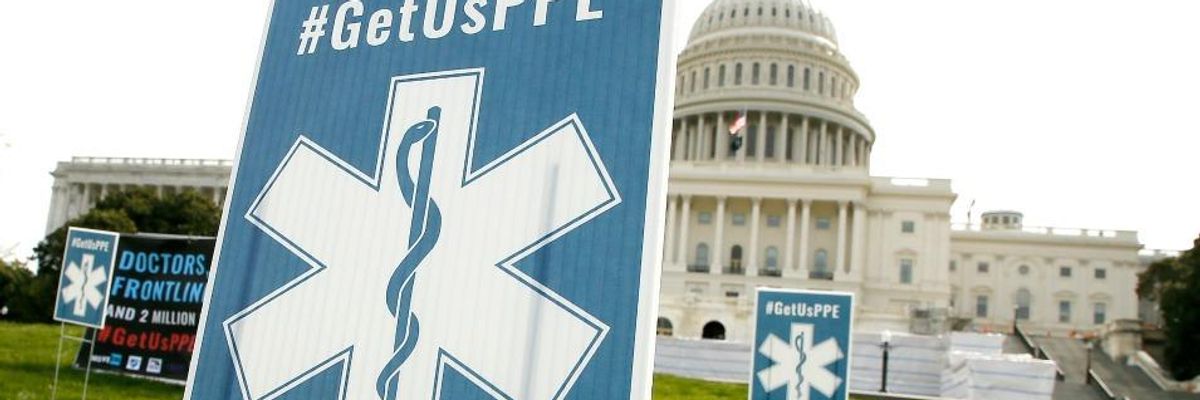
1,000 pop-up signs were arranged on the lawn of the U.S. Capitol Building showing the faces of nurses and frontline healthcare workers pleading for adequate personal protective equipment (PPE) on April 17, 2020 in Washington, DC. (Photo: Paul Morigi/Getty Images for MoveOn)
Progressives on Saturday denounced an "infuriating" report which detailed the Department of Health and Human Services' refusal to take an American company up on its offer to supply millions of N95 respirators to the government early on in the coronavirus pandemic.
The Washington Post reported that federal scientist Rick Bright, who filed a whistleblower complaint last week over his demotion following his criticism of the Trump administration's response to the pandemic, detailed communications with Prestige Ameritech in January in which HHS ignored the medical supply company's offer to produce masks.
The head of the Ft. Worth-based company, Michael Bowen, wrote to HHS on January 23, two days after the U.S. confirmed its first case of Covid-19.
Bowen offered to use four dormant production lines to produce as many as seven million N95 masks per month, but was told by Laura Wolf, director of the Division of Critical Infrastructure Protection at HHS, "I don't believe we as a government are anywhere near answering those questions for you yet."
"We are the last major domestic mask company," replied Bowen, who at the time was fulfilling orders for masks from all over the world. "My phones are ringing now, so I don't 'need' government business. I'm just letting you know that I can help you preserve our infrastructure if things ever get really bad."
In Bright's whistleblower complaint, he described how he tried to direct Assistant Secretary for Preparedness and Response Robert Kadlec's attention to Bowen's offer in late January. Bowen wrote to Bright following his communications with Wolf that "U.S. mask supply is at imminent risk," and adding a blunt warning: "Rick, I think we're in deep shit."
Bright demanded to know from Kadlec why Bowen's offer had fallen "on deaf ears."
"We have been watching and receiving warnings on this for over a week," the scientist wrote.
The agency's refusal to take Bowen up on his offer early on helped lead to a crisis weeks later, as healthcare workers across the country reported severe shortages of N95 masks as well as other personal protective equipment needed to stop the spread of Covid-19 in healthcare settings. As the Trump administration denied several times that it was responsible for making sure states had the supplies they needed, states were forced in bidding wars with one another over equipment orders that they placed directly with manufacturers.
The details Bright offered in his whistleblower complaint painted a picture of "criminal negligence," wrote New York Times editorial board member Brent Staples.
Others on social media expressed shock at the Post's report.
"I don't even have words to describe how poorly Donald Trump has handled this crisis," wrote Rep. Mark Pocan (D-Wisc.) in response to the story.
In addition to pressing HHS officials on Bowen's offer, Bright was critical of President Donald Trump's promotion of hydroxychloroquine as a treatment for Covid-19. The scientist had also clashed with Kadlec earlier in Trump's term, when Kadlec urged Bright to transfer $40 million from Bright's department at HHS to the Strategic National Stockpile in 2018 to purchase a drug made by manufacturer Alvogen, the client of a lobbyist who had connections to the Trump administration.
On Friday, a federal probe found that there were "reasonable grounds to believe" that the Trump administration unlawfully retaliated against Bright by demoting him.
This country and this world are at a monumental crossroads. US voters have an opportunity to beat back the forces of fascism and confront the billionaires who are rigging the economy, our media system, and our democracy, making it increasingly impossible for ordinary people to get by. We’re not just talking about the election. We’re talking about what must be done once these fascist elements are vanquished from power. We need a bolder set of solutions than what either major party has so far been willing to offer and a working-class movement ready to fight like hell for it. Trump didn't emerge from nowhere. The conditions that fueled MAGA authoritarianism were created by decades of radical neoliberal economic policies and a corrupt political system dominated by corporate interests. They slashed taxes on the super-rich, promising that the benefits would trickle down. They said giveaways to the corporate titans would make life more affordable for the rest of us. It was all bullshit. And when a bitter, betrayed populace searches for someone to blame, right-wing demagogues have little trouble finding scapegoats. People know when they're being lied to, but you won't hear any of this from the corporate media. Only independent journalism—powered and funded by people who believe in building a better world—can deliver truly trustworthy daily news. If you share our vision, please contribute whatever you can to sustain our work. |
Progressives on Saturday denounced an "infuriating" report which detailed the Department of Health and Human Services' refusal to take an American company up on its offer to supply millions of N95 respirators to the government early on in the coronavirus pandemic.
The Washington Post reported that federal scientist Rick Bright, who filed a whistleblower complaint last week over his demotion following his criticism of the Trump administration's response to the pandemic, detailed communications with Prestige Ameritech in January in which HHS ignored the medical supply company's offer to produce masks.
The head of the Ft. Worth-based company, Michael Bowen, wrote to HHS on January 23, two days after the U.S. confirmed its first case of Covid-19.
Bowen offered to use four dormant production lines to produce as many as seven million N95 masks per month, but was told by Laura Wolf, director of the Division of Critical Infrastructure Protection at HHS, "I don't believe we as a government are anywhere near answering those questions for you yet."
"We are the last major domestic mask company," replied Bowen, who at the time was fulfilling orders for masks from all over the world. "My phones are ringing now, so I don't 'need' government business. I'm just letting you know that I can help you preserve our infrastructure if things ever get really bad."
In Bright's whistleblower complaint, he described how he tried to direct Assistant Secretary for Preparedness and Response Robert Kadlec's attention to Bowen's offer in late January. Bowen wrote to Bright following his communications with Wolf that "U.S. mask supply is at imminent risk," and adding a blunt warning: "Rick, I think we're in deep shit."
Bright demanded to know from Kadlec why Bowen's offer had fallen "on deaf ears."
"We have been watching and receiving warnings on this for over a week," the scientist wrote.
The agency's refusal to take Bowen up on his offer early on helped lead to a crisis weeks later, as healthcare workers across the country reported severe shortages of N95 masks as well as other personal protective equipment needed to stop the spread of Covid-19 in healthcare settings. As the Trump administration denied several times that it was responsible for making sure states had the supplies they needed, states were forced in bidding wars with one another over equipment orders that they placed directly with manufacturers.
The details Bright offered in his whistleblower complaint painted a picture of "criminal negligence," wrote New York Times editorial board member Brent Staples.
Others on social media expressed shock at the Post's report.
"I don't even have words to describe how poorly Donald Trump has handled this crisis," wrote Rep. Mark Pocan (D-Wisc.) in response to the story.
In addition to pressing HHS officials on Bowen's offer, Bright was critical of President Donald Trump's promotion of hydroxychloroquine as a treatment for Covid-19. The scientist had also clashed with Kadlec earlier in Trump's term, when Kadlec urged Bright to transfer $40 million from Bright's department at HHS to the Strategic National Stockpile in 2018 to purchase a drug made by manufacturer Alvogen, the client of a lobbyist who had connections to the Trump administration.
On Friday, a federal probe found that there were "reasonable grounds to believe" that the Trump administration unlawfully retaliated against Bright by demoting him.