SUBSCRIBE TO OUR FREE NEWSLETTER
Daily news & progressive opinion—funded by the people, not the corporations—delivered straight to your inbox.
5
#000000
#FFFFFF
To donate by check, phone, or other method, see our More Ways to Give page.
Daily news & progressive opinion—funded by the people, not the corporations—delivered straight to your inbox.
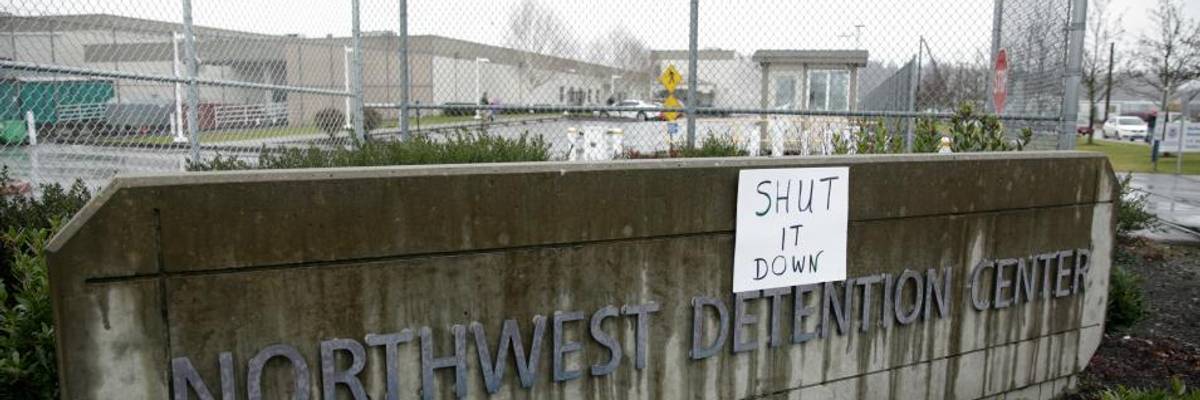
A sign that reads "shut it down" is pictured at the Northwest Detention Center as during a protest at the Tacoma, Washington facility on Feb. 26, 2017. (Photo: Jason Redmond/AFP via Getty Images)
A United Nations human rights expert on Monday urged the U.S. government to stop detaining migrants who are being "held for processing" of their immigration claims in "overcrowded and unsanitary administrative centers," citing concerns about the ongoing coronavirus pandemic.
"It is very difficult to keep the necessary physical distance in overcrowded detention facilities," Felipe Gonzalez Morales, the U.N. special rapporteur on the human rights of migrants, said in statement. "Significantly reducing the number of detained migrants by releasing them into alternative settings can easily solve this."
"None of those migrants are detained for criminal offenses, but are simply awaiting decisions on their immigration claims," he added. "The authorities should assess the capacity of readily available alternatives measures in the country and elaborate a set of criteria to identify those in administrative detention that could be immediately released to alternative placements."
Alternatives to detention facilities--poor conditions of which were often decried by detainees and immigration rights advocates long before the coronavirus outbreak--include providing community-based accommodations and care to migrants.
Alluding to the U.S. government's long track record--particularly under President Donald Trump--of ignoring the human rights of migrants, Gonzalez Morales said that "alternatives to widespread immigration detention in the U.S. would also ensure that migrants are not arbitrarily detained."
The Monday statement from the Office of the High Commissioner for Human Rights noted that U.N. human rights experts have "received repeated reports of unsanitary conditions and lack of proper healthcare" at the Tacoma Northwest Processing Center in Washington state.
One local newspaper editorial warned earlier this month that U.S. Immigration and Customs Enforcement (ICE) facility--run by the private, for-profit company the GEO Group--could be "a ticking time bomb, a potential for a 'coronavirus catastrophe.'"
Gonzalez Morales said that rights experts were told "there is a lack of protective measures for detainees, that it is impossible to keep the recommended physical distance, and that new arrivals are not being put into isolation for medical observations," which "raises grave concerns that the coronavirus could spread in the center."
The special rapporteur has joined with five other U.N. experts in pressuring the U.S. government and the GEO Group to boost efforts to prevent the spread of the virus at the center, including by ensuring that all detainees have access to adequate healthcare and water and sanitation facilities.
Among the group was Nils Melzer, U.N. special rapporteur on torture and other cruel, inhuman, or degrading treatment or punishment, who highlighted Gonzalez Morales' comments on Twitter Monday:
The new pressure from Gonzalez Morales and his colleagues add to the mounting criticism of the Trump administration's immigration policies as well as the failures of federal, state, and local governments to protect people--especially those at high risk of dying from a COVID-19 infection--in all types of detention facilities, including jails and prisons.
An early April report from Amnesty International declared that "detaining anyone solely for migration-related reasons during a global pandemic is cruel, reckless, and deadly."
The Trump administration has also come under fire for exploiting the pandemic to push through controversial immigration policies that the president and top officials have sought from the beginning.
As Vox reported Monday:
Amid the pandemic, the Trump administration has closed the U.S.-Mexico border, implemented an expulsion order to swiftly turn away migrants at the border, and postponed all immigration court hearings for migrants who are waiting in Mexico for a decision on their asylum applications in the U.S. Those measures, coupled with the restrictions on asylum-seekers that were already in place, have brought the asylum system to a virtual standstill.
"We're worried about the rapid, systematic expulsions of persons including asylum-seekers from the U.S.," Sibylla Brodzinsky, a spokesperson for the U.N. high commissioner for refugees (UNCHR), told Vox. "Obviously, a pandemic of this nature warrants extraordinary measures at borders, but the expulsion of asylum-seekers, which basically results in refoulement, shouldn't be among those measures."
Dear Common Dreams reader, It’s been nearly 30 years since I co-founded Common Dreams with my late wife, Lina Newhouser. We had the radical notion that journalism should serve the public good, not corporate profits. It was clear to us from the outset what it would take to build such a project. No paid advertisements. No corporate sponsors. No millionaire publisher telling us what to think or do. Many people said we wouldn't last a year, but we proved those doubters wrong. Together with a tremendous team of journalists and dedicated staff, we built an independent media outlet free from the constraints of profits and corporate control. Our mission has always been simple: To inform. To inspire. To ignite change for the common good. Building Common Dreams was not easy. Our survival was never guaranteed. When you take on the most powerful forces—Wall Street greed, fossil fuel industry destruction, Big Tech lobbyists, and uber-rich oligarchs who have spent billions upon billions rigging the economy and democracy in their favor—the only bulwark you have is supporters who believe in your work. But here’s the urgent message from me today. It's never been this bad out there. And it's never been this hard to keep us going. At the very moment Common Dreams is most needed, the threats we face are intensifying. We need your support now more than ever. We don't accept corporate advertising and never will. We don't have a paywall because we don't think people should be blocked from critical news based on their ability to pay. Everything we do is funded by the donations of readers like you. When everyone does the little they can afford, we are strong. But if that support retreats or dries up, so do we. Will you donate now to make sure Common Dreams not only survives but thrives? —Craig Brown, Co-founder |
A United Nations human rights expert on Monday urged the U.S. government to stop detaining migrants who are being "held for processing" of their immigration claims in "overcrowded and unsanitary administrative centers," citing concerns about the ongoing coronavirus pandemic.
"It is very difficult to keep the necessary physical distance in overcrowded detention facilities," Felipe Gonzalez Morales, the U.N. special rapporteur on the human rights of migrants, said in statement. "Significantly reducing the number of detained migrants by releasing them into alternative settings can easily solve this."
"None of those migrants are detained for criminal offenses, but are simply awaiting decisions on their immigration claims," he added. "The authorities should assess the capacity of readily available alternatives measures in the country and elaborate a set of criteria to identify those in administrative detention that could be immediately released to alternative placements."
Alternatives to detention facilities--poor conditions of which were often decried by detainees and immigration rights advocates long before the coronavirus outbreak--include providing community-based accommodations and care to migrants.
Alluding to the U.S. government's long track record--particularly under President Donald Trump--of ignoring the human rights of migrants, Gonzalez Morales said that "alternatives to widespread immigration detention in the U.S. would also ensure that migrants are not arbitrarily detained."
The Monday statement from the Office of the High Commissioner for Human Rights noted that U.N. human rights experts have "received repeated reports of unsanitary conditions and lack of proper healthcare" at the Tacoma Northwest Processing Center in Washington state.
One local newspaper editorial warned earlier this month that U.S. Immigration and Customs Enforcement (ICE) facility--run by the private, for-profit company the GEO Group--could be "a ticking time bomb, a potential for a 'coronavirus catastrophe.'"
Gonzalez Morales said that rights experts were told "there is a lack of protective measures for detainees, that it is impossible to keep the recommended physical distance, and that new arrivals are not being put into isolation for medical observations," which "raises grave concerns that the coronavirus could spread in the center."
The special rapporteur has joined with five other U.N. experts in pressuring the U.S. government and the GEO Group to boost efforts to prevent the spread of the virus at the center, including by ensuring that all detainees have access to adequate healthcare and water and sanitation facilities.
Among the group was Nils Melzer, U.N. special rapporteur on torture and other cruel, inhuman, or degrading treatment or punishment, who highlighted Gonzalez Morales' comments on Twitter Monday:
The new pressure from Gonzalez Morales and his colleagues add to the mounting criticism of the Trump administration's immigration policies as well as the failures of federal, state, and local governments to protect people--especially those at high risk of dying from a COVID-19 infection--in all types of detention facilities, including jails and prisons.
An early April report from Amnesty International declared that "detaining anyone solely for migration-related reasons during a global pandemic is cruel, reckless, and deadly."
The Trump administration has also come under fire for exploiting the pandemic to push through controversial immigration policies that the president and top officials have sought from the beginning.
As Vox reported Monday:
Amid the pandemic, the Trump administration has closed the U.S.-Mexico border, implemented an expulsion order to swiftly turn away migrants at the border, and postponed all immigration court hearings for migrants who are waiting in Mexico for a decision on their asylum applications in the U.S. Those measures, coupled with the restrictions on asylum-seekers that were already in place, have brought the asylum system to a virtual standstill.
"We're worried about the rapid, systematic expulsions of persons including asylum-seekers from the U.S.," Sibylla Brodzinsky, a spokesperson for the U.N. high commissioner for refugees (UNCHR), told Vox. "Obviously, a pandemic of this nature warrants extraordinary measures at borders, but the expulsion of asylum-seekers, which basically results in refoulement, shouldn't be among those measures."
A United Nations human rights expert on Monday urged the U.S. government to stop detaining migrants who are being "held for processing" of their immigration claims in "overcrowded and unsanitary administrative centers," citing concerns about the ongoing coronavirus pandemic.
"It is very difficult to keep the necessary physical distance in overcrowded detention facilities," Felipe Gonzalez Morales, the U.N. special rapporteur on the human rights of migrants, said in statement. "Significantly reducing the number of detained migrants by releasing them into alternative settings can easily solve this."
"None of those migrants are detained for criminal offenses, but are simply awaiting decisions on their immigration claims," he added. "The authorities should assess the capacity of readily available alternatives measures in the country and elaborate a set of criteria to identify those in administrative detention that could be immediately released to alternative placements."
Alternatives to detention facilities--poor conditions of which were often decried by detainees and immigration rights advocates long before the coronavirus outbreak--include providing community-based accommodations and care to migrants.
Alluding to the U.S. government's long track record--particularly under President Donald Trump--of ignoring the human rights of migrants, Gonzalez Morales said that "alternatives to widespread immigration detention in the U.S. would also ensure that migrants are not arbitrarily detained."
The Monday statement from the Office of the High Commissioner for Human Rights noted that U.N. human rights experts have "received repeated reports of unsanitary conditions and lack of proper healthcare" at the Tacoma Northwest Processing Center in Washington state.
One local newspaper editorial warned earlier this month that U.S. Immigration and Customs Enforcement (ICE) facility--run by the private, for-profit company the GEO Group--could be "a ticking time bomb, a potential for a 'coronavirus catastrophe.'"
Gonzalez Morales said that rights experts were told "there is a lack of protective measures for detainees, that it is impossible to keep the recommended physical distance, and that new arrivals are not being put into isolation for medical observations," which "raises grave concerns that the coronavirus could spread in the center."
The special rapporteur has joined with five other U.N. experts in pressuring the U.S. government and the GEO Group to boost efforts to prevent the spread of the virus at the center, including by ensuring that all detainees have access to adequate healthcare and water and sanitation facilities.
Among the group was Nils Melzer, U.N. special rapporteur on torture and other cruel, inhuman, or degrading treatment or punishment, who highlighted Gonzalez Morales' comments on Twitter Monday:
The new pressure from Gonzalez Morales and his colleagues add to the mounting criticism of the Trump administration's immigration policies as well as the failures of federal, state, and local governments to protect people--especially those at high risk of dying from a COVID-19 infection--in all types of detention facilities, including jails and prisons.
An early April report from Amnesty International declared that "detaining anyone solely for migration-related reasons during a global pandemic is cruel, reckless, and deadly."
The Trump administration has also come under fire for exploiting the pandemic to push through controversial immigration policies that the president and top officials have sought from the beginning.
As Vox reported Monday:
Amid the pandemic, the Trump administration has closed the U.S.-Mexico border, implemented an expulsion order to swiftly turn away migrants at the border, and postponed all immigration court hearings for migrants who are waiting in Mexico for a decision on their asylum applications in the U.S. Those measures, coupled with the restrictions on asylum-seekers that were already in place, have brought the asylum system to a virtual standstill.
"We're worried about the rapid, systematic expulsions of persons including asylum-seekers from the U.S.," Sibylla Brodzinsky, a spokesperson for the U.N. high commissioner for refugees (UNCHR), told Vox. "Obviously, a pandemic of this nature warrants extraordinary measures at borders, but the expulsion of asylum-seekers, which basically results in refoulement, shouldn't be among those measures."