SUBSCRIBE TO OUR FREE NEWSLETTER
Daily news & progressive opinion—funded by the people, not the corporations—delivered straight to your inbox.
5
#000000
#FFFFFF
To donate by check, phone, or other method, see our More Ways to Give page.
Daily news & progressive opinion—funded by the people, not the corporations—delivered straight to your inbox.

A USPS postal worker wears mask while making deliveries in Beacon Hill in Boston during the COVID-19 pandemic on April 8, 2020. (Photo: David L. Ryan/The Boston Globe via Getty Images)
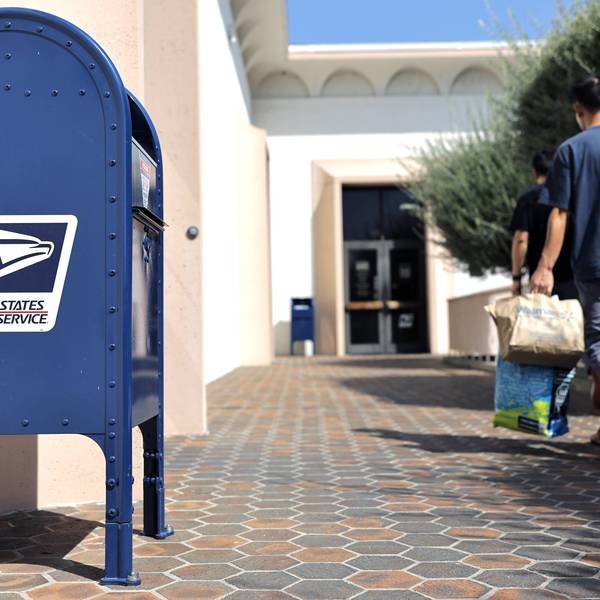
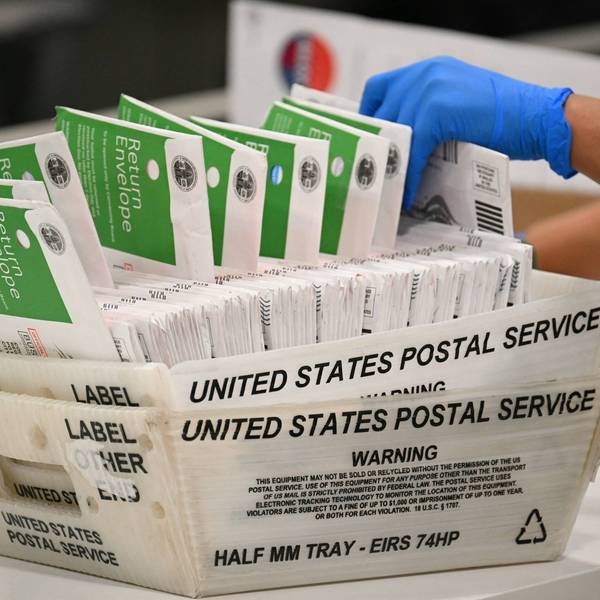
The U.S. Postal Service warned Congress this week that it will completely "run out of cash" in the next several months without immediate action from the White House and Congress, but--with as many as 630,000 jobs at risk--President Donald Trump and Republican lawmakers have refused to commit to rescuing the prized government institution as it falters amid the coronavirus pandemic.
Postmaster General Megan Brennan told the House Oversight and Reform Committee in a briefing on Thursday that the USPS will need access to a total of $75 billion in cash, grants, and loans in order to avert financial ruin by the fall.
"Our Postal Service is on the verge of collapse. I'm calling on Congress to act swiftly to shore up USPS so that everyone can continue to receive essential medicines and supplies, and as many Americans as possible can vote from home."
--Sen. Elizabeth Warren"We are at a critical juncture in the life of the Postal Service. At a time when America needs the Postal Service more than ever, the reason we are so needed is having a devastating effect on our business," said Brennan, referring to the coronavirus outbreak, which has led to a sharp decline in mail volume.
As Government Executive reported, "House Democrats pushed for a $25 billion cash infusion for the Postal Service as part of the last stimulus package, but Senate negotiators ultimately opted to include only a $10 billion line of credit. Postal management has said that amount would be insufficient for preventing fiscal calamity this year."
President Donald Trump has thus far rejected the Postal Service's requests. During a press briefing earlier this week, Trump urged USPS to simply "raise the prices by, actually a lot."
Rep. Gerry Connolly (D-Va.), one of the most vocal critics of the Trump administration's refusal to assist USPS, said in a statement Thursday that "we cannot allow the Postal Service to collapse."
"To do so would deepen our nation's economic crisis and eliminate an important lifeline for individuals who rely on the Postal Service's 1 billion deliveries of lifesaving prescription deliveries and eviscerate the very infrastructure we need to administer the upcoming elections," said Connolly.
In a tweet Thursday, Connolly accused Trump of personally intervening to block the approval of any emergency funding for the Postal Service.
According to new reporting from the Washington Post on Saturday, Connolly's accusation was correct. "Trump threatened to veto the $2.2 trillion Coronavirus Aid, Relief, and Economic Security, or CARES, Act if the legislation contained any money directed to bail out the postal agency, according to a senior Trump administration official and congressional official," the Post reported.
The New York Times reported Thursday that a bailout for the Postal Service "has already emerged as a political sticking point" in talks over another large coronavirus stimulus package, "with Democrats pressing to deliver one and President Trump, a persistent critic of the agency, opposed."
"Some lawmakers, postal union representatives, and others who rely on the service now fear that the Trump administration is trying to use the current crisis to achieve conservatives' longstanding goal of nudging the mail service toward privatization," the Times noted, "either by setting highly prescriptive loan terms or by essentially forcing it into bankruptcy. That would aid commercial competitors like FedEx and UPS."
Progressives argue that a major culprit behind the Postal Service's financial woes is a 2006 law that requires USPS to prefund its retirees' health benefits through the year 2056. As Sarah Anderson and Brian Wakamo of the Institute for Policy Studies wrote last year, "this extraordinary mandate, which applies to no other federal agency or private corporation, created a financial 'crisis' that has been used to justify harmful service cuts and even calls for postal privatization."
In a tweet Friday, Sen. Elizabeth Warren (D-Mass.) urged Congress to take immediate action to provide relief to USPS as the Trump White House refuses to budge.
"Our Postal Service is on the verge of collapse," said Warren. "I'm calling on Congress to act swiftly to shore up USPS so that everyone can continue to receive essential medicines and supplies, and as many Americans as possible can vote from home."
Dear Common Dreams reader, It’s been nearly 30 years since I co-founded Common Dreams with my late wife, Lina Newhouser. We had the radical notion that journalism should serve the public good, not corporate profits. It was clear to us from the outset what it would take to build such a project. No paid advertisements. No corporate sponsors. No millionaire publisher telling us what to think or do. Many people said we wouldn't last a year, but we proved those doubters wrong. Together with a tremendous team of journalists and dedicated staff, we built an independent media outlet free from the constraints of profits and corporate control. Our mission has always been simple: To inform. To inspire. To ignite change for the common good. Building Common Dreams was not easy. Our survival was never guaranteed. When you take on the most powerful forces—Wall Street greed, fossil fuel industry destruction, Big Tech lobbyists, and uber-rich oligarchs who have spent billions upon billions rigging the economy and democracy in their favor—the only bulwark you have is supporters who believe in your work. But here’s the urgent message from me today. It's never been this bad out there. And it's never been this hard to keep us going. At the very moment Common Dreams is most needed, the threats we face are intensifying. We need your support now more than ever. We don't accept corporate advertising and never will. We don't have a paywall because we don't think people should be blocked from critical news based on their ability to pay. Everything we do is funded by the donations of readers like you. When everyone does the little they can afford, we are strong. But if that support retreats or dries up, so do we. Will you donate now to make sure Common Dreams not only survives but thrives? —Craig Brown, Co-founder |
The U.S. Postal Service warned Congress this week that it will completely "run out of cash" in the next several months without immediate action from the White House and Congress, but--with as many as 630,000 jobs at risk--President Donald Trump and Republican lawmakers have refused to commit to rescuing the prized government institution as it falters amid the coronavirus pandemic.
Postmaster General Megan Brennan told the House Oversight and Reform Committee in a briefing on Thursday that the USPS will need access to a total of $75 billion in cash, grants, and loans in order to avert financial ruin by the fall.
"Our Postal Service is on the verge of collapse. I'm calling on Congress to act swiftly to shore up USPS so that everyone can continue to receive essential medicines and supplies, and as many Americans as possible can vote from home."
--Sen. Elizabeth Warren"We are at a critical juncture in the life of the Postal Service. At a time when America needs the Postal Service more than ever, the reason we are so needed is having a devastating effect on our business," said Brennan, referring to the coronavirus outbreak, which has led to a sharp decline in mail volume.
As Government Executive reported, "House Democrats pushed for a $25 billion cash infusion for the Postal Service as part of the last stimulus package, but Senate negotiators ultimately opted to include only a $10 billion line of credit. Postal management has said that amount would be insufficient for preventing fiscal calamity this year."
President Donald Trump has thus far rejected the Postal Service's requests. During a press briefing earlier this week, Trump urged USPS to simply "raise the prices by, actually a lot."
Rep. Gerry Connolly (D-Va.), one of the most vocal critics of the Trump administration's refusal to assist USPS, said in a statement Thursday that "we cannot allow the Postal Service to collapse."
"To do so would deepen our nation's economic crisis and eliminate an important lifeline for individuals who rely on the Postal Service's 1 billion deliveries of lifesaving prescription deliveries and eviscerate the very infrastructure we need to administer the upcoming elections," said Connolly.
In a tweet Thursday, Connolly accused Trump of personally intervening to block the approval of any emergency funding for the Postal Service.
According to new reporting from the Washington Post on Saturday, Connolly's accusation was correct. "Trump threatened to veto the $2.2 trillion Coronavirus Aid, Relief, and Economic Security, or CARES, Act if the legislation contained any money directed to bail out the postal agency, according to a senior Trump administration official and congressional official," the Post reported.
The New York Times reported Thursday that a bailout for the Postal Service "has already emerged as a political sticking point" in talks over another large coronavirus stimulus package, "with Democrats pressing to deliver one and President Trump, a persistent critic of the agency, opposed."
"Some lawmakers, postal union representatives, and others who rely on the service now fear that the Trump administration is trying to use the current crisis to achieve conservatives' longstanding goal of nudging the mail service toward privatization," the Times noted, "either by setting highly prescriptive loan terms or by essentially forcing it into bankruptcy. That would aid commercial competitors like FedEx and UPS."
Progressives argue that a major culprit behind the Postal Service's financial woes is a 2006 law that requires USPS to prefund its retirees' health benefits through the year 2056. As Sarah Anderson and Brian Wakamo of the Institute for Policy Studies wrote last year, "this extraordinary mandate, which applies to no other federal agency or private corporation, created a financial 'crisis' that has been used to justify harmful service cuts and even calls for postal privatization."
In a tweet Friday, Sen. Elizabeth Warren (D-Mass.) urged Congress to take immediate action to provide relief to USPS as the Trump White House refuses to budge.
"Our Postal Service is on the verge of collapse," said Warren. "I'm calling on Congress to act swiftly to shore up USPS so that everyone can continue to receive essential medicines and supplies, and as many Americans as possible can vote from home."
The U.S. Postal Service warned Congress this week that it will completely "run out of cash" in the next several months without immediate action from the White House and Congress, but--with as many as 630,000 jobs at risk--President Donald Trump and Republican lawmakers have refused to commit to rescuing the prized government institution as it falters amid the coronavirus pandemic.
Postmaster General Megan Brennan told the House Oversight and Reform Committee in a briefing on Thursday that the USPS will need access to a total of $75 billion in cash, grants, and loans in order to avert financial ruin by the fall.
"Our Postal Service is on the verge of collapse. I'm calling on Congress to act swiftly to shore up USPS so that everyone can continue to receive essential medicines and supplies, and as many Americans as possible can vote from home."
--Sen. Elizabeth Warren"We are at a critical juncture in the life of the Postal Service. At a time when America needs the Postal Service more than ever, the reason we are so needed is having a devastating effect on our business," said Brennan, referring to the coronavirus outbreak, which has led to a sharp decline in mail volume.
As Government Executive reported, "House Democrats pushed for a $25 billion cash infusion for the Postal Service as part of the last stimulus package, but Senate negotiators ultimately opted to include only a $10 billion line of credit. Postal management has said that amount would be insufficient for preventing fiscal calamity this year."
President Donald Trump has thus far rejected the Postal Service's requests. During a press briefing earlier this week, Trump urged USPS to simply "raise the prices by, actually a lot."
Rep. Gerry Connolly (D-Va.), one of the most vocal critics of the Trump administration's refusal to assist USPS, said in a statement Thursday that "we cannot allow the Postal Service to collapse."
"To do so would deepen our nation's economic crisis and eliminate an important lifeline for individuals who rely on the Postal Service's 1 billion deliveries of lifesaving prescription deliveries and eviscerate the very infrastructure we need to administer the upcoming elections," said Connolly.
In a tweet Thursday, Connolly accused Trump of personally intervening to block the approval of any emergency funding for the Postal Service.
According to new reporting from the Washington Post on Saturday, Connolly's accusation was correct. "Trump threatened to veto the $2.2 trillion Coronavirus Aid, Relief, and Economic Security, or CARES, Act if the legislation contained any money directed to bail out the postal agency, according to a senior Trump administration official and congressional official," the Post reported.
The New York Times reported Thursday that a bailout for the Postal Service "has already emerged as a political sticking point" in talks over another large coronavirus stimulus package, "with Democrats pressing to deliver one and President Trump, a persistent critic of the agency, opposed."
"Some lawmakers, postal union representatives, and others who rely on the service now fear that the Trump administration is trying to use the current crisis to achieve conservatives' longstanding goal of nudging the mail service toward privatization," the Times noted, "either by setting highly prescriptive loan terms or by essentially forcing it into bankruptcy. That would aid commercial competitors like FedEx and UPS."
Progressives argue that a major culprit behind the Postal Service's financial woes is a 2006 law that requires USPS to prefund its retirees' health benefits through the year 2056. As Sarah Anderson and Brian Wakamo of the Institute for Policy Studies wrote last year, "this extraordinary mandate, which applies to no other federal agency or private corporation, created a financial 'crisis' that has been used to justify harmful service cuts and even calls for postal privatization."
In a tweet Friday, Sen. Elizabeth Warren (D-Mass.) urged Congress to take immediate action to provide relief to USPS as the Trump White House refuses to budge.
"Our Postal Service is on the verge of collapse," said Warren. "I'm calling on Congress to act swiftly to shore up USPS so that everyone can continue to receive essential medicines and supplies, and as many Americans as possible can vote from home."