SUBSCRIBE TO OUR FREE NEWSLETTER
Daily news & progressive opinion—funded by the people, not the corporations—delivered straight to your inbox.
5
#000000
#FFFFFF
To donate by check, phone, or other method, see our More Ways to Give page.
Daily news & progressive opinion—funded by the people, not the corporations—delivered straight to your inbox.
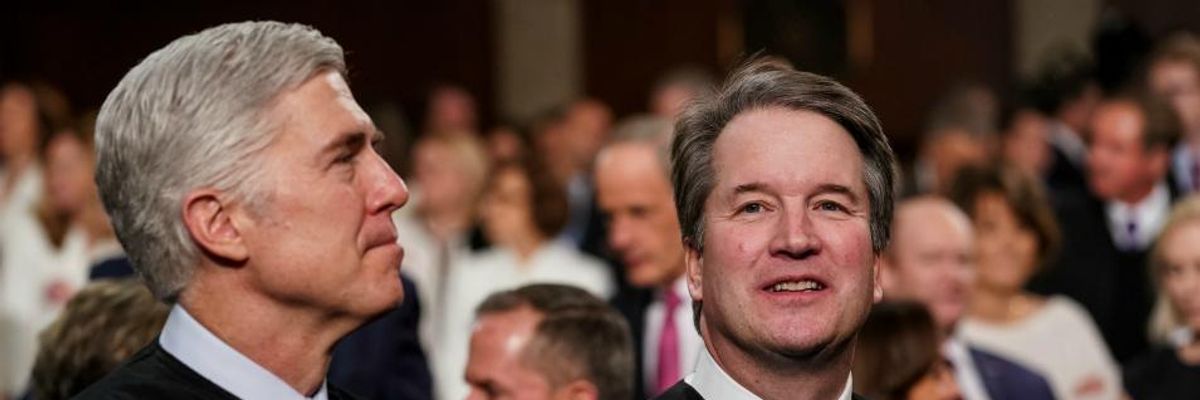
Supreme Court Justices Neil Gorsuch and Brett Kavanaugh attend the State of the Union address in the chamber of the U.S. House of Representatives at the U.S. Capitol Building on February 5, 2019 in Washington, D.C. (Photo: Doug Mills-Pool/Getty Images)
The U.S. Supreme Court's conservative majority Monday night was accused of green-lighting "one of the most brazen acts of voter suppression in modern times" after the body overturned a lower court ruling that extended the absentee voting deadline in Wisconsin by six days in an effort to allow people to more safely exercise the franchise amid the coronavirus pandemic.
"An election that forces voters to choose between protecting their health and casting a ballot is not a free and fair election. Nor should its results be treated as indisputably legitimate. This is a tragic day for democracy."
--Mark Joseph Stern, Slate
In a 5-4 decision (pdf) along ideological lines, the high court ruled that Wisconsin voters must hand-deliver their absentee ballots by the end of the day Tuesday or have them postmarked April 7 if their ballot is to be counted. The decision rewards Wisconsin Republicans and GOP groups that led the legal challenge against the extension of absentee voting until April 13.
Matthew DeFour, state politics editor at the Wisconsin State Journal, noted on Twitter following the ruling that "there is no postmark requirement in state law."
"The lower court judge changed the date, but did not add a postmark," DeFour said. "The U.S. Supreme Court has just written a new election law in Wisconsin."
In an unsigned opinion, the Supreme Court's conservative majority attempted to wash its hands of any responsibility for intensifying an ongoing public health crisis by refusing to allow Wisconsin to extend absentee voting.
"The court's decision on the narrow question before the court should not be viewed as expressing an opinion on the broader question of whether to hold the election, or whether other reforms or modifications in election procedures in light of COVID-19 are appropriate," the opinion stated.
Justice Ruth Bader Ginsburg warned in a scathing dissent that the conservative majority's ruling "will result in massive disenfranchisement":
Because gathering at the polling place now poses dire health risks, an unprecedented number of Wisconsin voters--at the encouragement of public officials--have turned to voting absentee. About one million more voters have requested absentee ballots in this election than in 2016. Accommodating the surge of absentee ballot requests has heavily burdened election officials, resulting in a severe backlog of ballots requested but not promptly mailed to voters.
Slate's Mark Joseph Stern wrote late Monday that the high court's ruling "will nullify the votes of citizens who mailed in their ballots late--not because they forgot, but because they did not receive ballots until after Election Day due to the coronavirus pandemic."
"Because voters are rightfully afraid of COVID-19, Wisconsin has been caught off guard by a surge in requests for absentee ballots," Stern wrote. "Election officials simply do not have time, resources, or staff to process all those requests. As a result, a large number of voters--at least tens of thousands--won't get their ballot until after Election Day."
Shauntay Nelson, Wisconsin state director of advocacy group All Voting Is Local, said the Supreme Court's decision "defies common sense and threatens to disenfranchise hundreds of thousands of Wisconsin voters."
"Voters deserve free and fair elections where every voice is heard and the assurance that their health and safety will be protected while our democracy remains intact," said Nelson. "It's shameful that Republicans have used this crisis to their political benefit, silencing voters so they can remain in power. The result has been confusion, chaos and uncertainty for voters, all amid a global health emergency. This is no way to run a democracy."
The Supreme Court's ruling came just after the Wisconsin state Supreme Court overturned an executive order by Gov. Tony Evers and decided that Tuesday's elections--which include the Democratic presidential primary and nearly 4,000 down-ballot contests--must proceed as scheduled despite the dire public health threat posed by COVID-19.
Kristen Clarke, president and executive director of Lawyers' Committee for Civil Rights Under Law, said in a statement that the U.S. Supreme Court's decision "raises grave concerns" that the right-wing body is "poised to unnecessarily interject itself in voting rights battles this presidential election season."
"Contrary to the majority opinion's claims," said Clarke, "this case involved more than a 'minor, technical' question and will likely result in the disenfranchisement of hundreds of thousands of voters as 500,000 absentee ballots have not been returned as of Monday night."
Dear Common Dreams reader, It’s been nearly 30 years since I co-founded Common Dreams with my late wife, Lina Newhouser. We had the radical notion that journalism should serve the public good, not corporate profits. It was clear to us from the outset what it would take to build such a project. No paid advertisements. No corporate sponsors. No millionaire publisher telling us what to think or do. Many people said we wouldn't last a year, but we proved those doubters wrong. Together with a tremendous team of journalists and dedicated staff, we built an independent media outlet free from the constraints of profits and corporate control. Our mission has always been simple: To inform. To inspire. To ignite change for the common good. Building Common Dreams was not easy. Our survival was never guaranteed. When you take on the most powerful forces—Wall Street greed, fossil fuel industry destruction, Big Tech lobbyists, and uber-rich oligarchs who have spent billions upon billions rigging the economy and democracy in their favor—the only bulwark you have is supporters who believe in your work. But here’s the urgent message from me today. It's never been this bad out there. And it's never been this hard to keep us going. At the very moment Common Dreams is most needed, the threats we face are intensifying. We need your support now more than ever. We don't accept corporate advertising and never will. We don't have a paywall because we don't think people should be blocked from critical news based on their ability to pay. Everything we do is funded by the donations of readers like you. When everyone does the little they can afford, we are strong. But if that support retreats or dries up, so do we. Will you donate now to make sure Common Dreams not only survives but thrives? —Craig Brown, Co-founder |
The U.S. Supreme Court's conservative majority Monday night was accused of green-lighting "one of the most brazen acts of voter suppression in modern times" after the body overturned a lower court ruling that extended the absentee voting deadline in Wisconsin by six days in an effort to allow people to more safely exercise the franchise amid the coronavirus pandemic.
"An election that forces voters to choose between protecting their health and casting a ballot is not a free and fair election. Nor should its results be treated as indisputably legitimate. This is a tragic day for democracy."
--Mark Joseph Stern, Slate
In a 5-4 decision (pdf) along ideological lines, the high court ruled that Wisconsin voters must hand-deliver their absentee ballots by the end of the day Tuesday or have them postmarked April 7 if their ballot is to be counted. The decision rewards Wisconsin Republicans and GOP groups that led the legal challenge against the extension of absentee voting until April 13.
Matthew DeFour, state politics editor at the Wisconsin State Journal, noted on Twitter following the ruling that "there is no postmark requirement in state law."
"The lower court judge changed the date, but did not add a postmark," DeFour said. "The U.S. Supreme Court has just written a new election law in Wisconsin."
In an unsigned opinion, the Supreme Court's conservative majority attempted to wash its hands of any responsibility for intensifying an ongoing public health crisis by refusing to allow Wisconsin to extend absentee voting.
"The court's decision on the narrow question before the court should not be viewed as expressing an opinion on the broader question of whether to hold the election, or whether other reforms or modifications in election procedures in light of COVID-19 are appropriate," the opinion stated.
Justice Ruth Bader Ginsburg warned in a scathing dissent that the conservative majority's ruling "will result in massive disenfranchisement":
Because gathering at the polling place now poses dire health risks, an unprecedented number of Wisconsin voters--at the encouragement of public officials--have turned to voting absentee. About one million more voters have requested absentee ballots in this election than in 2016. Accommodating the surge of absentee ballot requests has heavily burdened election officials, resulting in a severe backlog of ballots requested but not promptly mailed to voters.
Slate's Mark Joseph Stern wrote late Monday that the high court's ruling "will nullify the votes of citizens who mailed in their ballots late--not because they forgot, but because they did not receive ballots until after Election Day due to the coronavirus pandemic."
"Because voters are rightfully afraid of COVID-19, Wisconsin has been caught off guard by a surge in requests for absentee ballots," Stern wrote. "Election officials simply do not have time, resources, or staff to process all those requests. As a result, a large number of voters--at least tens of thousands--won't get their ballot until after Election Day."
Shauntay Nelson, Wisconsin state director of advocacy group All Voting Is Local, said the Supreme Court's decision "defies common sense and threatens to disenfranchise hundreds of thousands of Wisconsin voters."
"Voters deserve free and fair elections where every voice is heard and the assurance that their health and safety will be protected while our democracy remains intact," said Nelson. "It's shameful that Republicans have used this crisis to their political benefit, silencing voters so they can remain in power. The result has been confusion, chaos and uncertainty for voters, all amid a global health emergency. This is no way to run a democracy."
The Supreme Court's ruling came just after the Wisconsin state Supreme Court overturned an executive order by Gov. Tony Evers and decided that Tuesday's elections--which include the Democratic presidential primary and nearly 4,000 down-ballot contests--must proceed as scheduled despite the dire public health threat posed by COVID-19.
Kristen Clarke, president and executive director of Lawyers' Committee for Civil Rights Under Law, said in a statement that the U.S. Supreme Court's decision "raises grave concerns" that the right-wing body is "poised to unnecessarily interject itself in voting rights battles this presidential election season."
"Contrary to the majority opinion's claims," said Clarke, "this case involved more than a 'minor, technical' question and will likely result in the disenfranchisement of hundreds of thousands of voters as 500,000 absentee ballots have not been returned as of Monday night."
The U.S. Supreme Court's conservative majority Monday night was accused of green-lighting "one of the most brazen acts of voter suppression in modern times" after the body overturned a lower court ruling that extended the absentee voting deadline in Wisconsin by six days in an effort to allow people to more safely exercise the franchise amid the coronavirus pandemic.
"An election that forces voters to choose between protecting their health and casting a ballot is not a free and fair election. Nor should its results be treated as indisputably legitimate. This is a tragic day for democracy."
--Mark Joseph Stern, Slate
In a 5-4 decision (pdf) along ideological lines, the high court ruled that Wisconsin voters must hand-deliver their absentee ballots by the end of the day Tuesday or have them postmarked April 7 if their ballot is to be counted. The decision rewards Wisconsin Republicans and GOP groups that led the legal challenge against the extension of absentee voting until April 13.
Matthew DeFour, state politics editor at the Wisconsin State Journal, noted on Twitter following the ruling that "there is no postmark requirement in state law."
"The lower court judge changed the date, but did not add a postmark," DeFour said. "The U.S. Supreme Court has just written a new election law in Wisconsin."
In an unsigned opinion, the Supreme Court's conservative majority attempted to wash its hands of any responsibility for intensifying an ongoing public health crisis by refusing to allow Wisconsin to extend absentee voting.
"The court's decision on the narrow question before the court should not be viewed as expressing an opinion on the broader question of whether to hold the election, or whether other reforms or modifications in election procedures in light of COVID-19 are appropriate," the opinion stated.
Justice Ruth Bader Ginsburg warned in a scathing dissent that the conservative majority's ruling "will result in massive disenfranchisement":
Because gathering at the polling place now poses dire health risks, an unprecedented number of Wisconsin voters--at the encouragement of public officials--have turned to voting absentee. About one million more voters have requested absentee ballots in this election than in 2016. Accommodating the surge of absentee ballot requests has heavily burdened election officials, resulting in a severe backlog of ballots requested but not promptly mailed to voters.
Slate's Mark Joseph Stern wrote late Monday that the high court's ruling "will nullify the votes of citizens who mailed in their ballots late--not because they forgot, but because they did not receive ballots until after Election Day due to the coronavirus pandemic."
"Because voters are rightfully afraid of COVID-19, Wisconsin has been caught off guard by a surge in requests for absentee ballots," Stern wrote. "Election officials simply do not have time, resources, or staff to process all those requests. As a result, a large number of voters--at least tens of thousands--won't get their ballot until after Election Day."
Shauntay Nelson, Wisconsin state director of advocacy group All Voting Is Local, said the Supreme Court's decision "defies common sense and threatens to disenfranchise hundreds of thousands of Wisconsin voters."
"Voters deserve free and fair elections where every voice is heard and the assurance that their health and safety will be protected while our democracy remains intact," said Nelson. "It's shameful that Republicans have used this crisis to their political benefit, silencing voters so they can remain in power. The result has been confusion, chaos and uncertainty for voters, all amid a global health emergency. This is no way to run a democracy."
The Supreme Court's ruling came just after the Wisconsin state Supreme Court overturned an executive order by Gov. Tony Evers and decided that Tuesday's elections--which include the Democratic presidential primary and nearly 4,000 down-ballot contests--must proceed as scheduled despite the dire public health threat posed by COVID-19.
Kristen Clarke, president and executive director of Lawyers' Committee for Civil Rights Under Law, said in a statement that the U.S. Supreme Court's decision "raises grave concerns" that the right-wing body is "poised to unnecessarily interject itself in voting rights battles this presidential election season."
"Contrary to the majority opinion's claims," said Clarke, "this case involved more than a 'minor, technical' question and will likely result in the disenfranchisement of hundreds of thousands of voters as 500,000 absentee ballots have not been returned as of Monday night."