SUBSCRIBE TO OUR FREE NEWSLETTER
Daily news & progressive opinion—funded by the people, not the corporations—delivered straight to your inbox.
5
#000000
#FFFFFF
To donate by check, phone, or other method, see our More Ways to Give page.
Daily news & progressive opinion—funded by the people, not the corporations—delivered straight to your inbox.
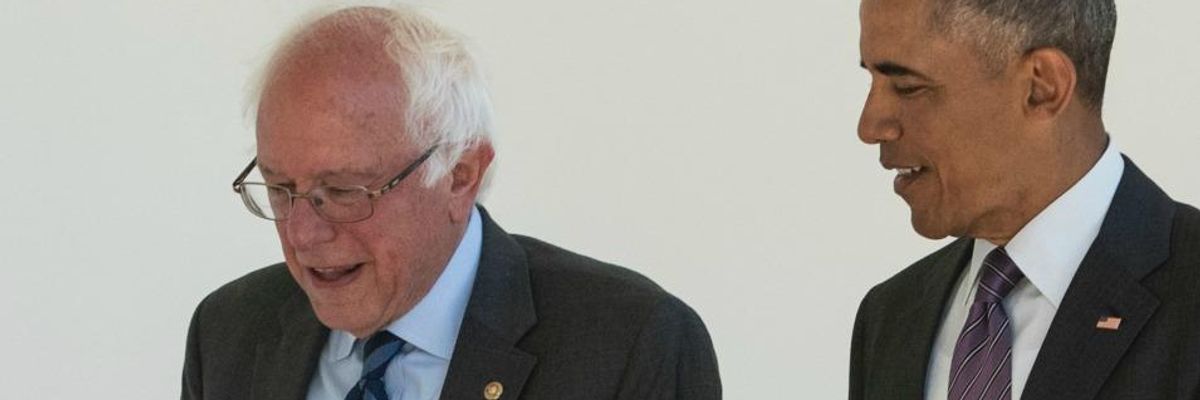
Then-U.S. President Barack Obama walks with Sen. Bernie Sanders (I-Vt.) to a meeting in the Oval Office on June 9, 2016 at the White House in Washington, D.C. (Photo: Mandel Ngan/AFP via Getty Images)
Sen. Bernie Sanders' campaign defended the 2020 presidential candidate's recent comments on the late, former Cuban leader Fidel Castro on Monday as as right-wingers and corporate Democrats whipped up outrage over Sanders' praise for the high literacy rates in Cuba under Castro's leadership, which lasted from 1959 to 2008.
In an interview with Anderson Cooper on "60 Minutes" on Sunday, Sanders said that while he is "very opposed to the authoritarian nature of Cuba" during Castro's regime, "it's unfair to simply say everything is bad."
"When Fidel Castro came into office, you know what he did?" Sanders said. "He had a massive literacy program. Is that a bad thing?"
The Vermont senator's comments were consistent with ones he made during his 2016 presidential campaign. While Castro oversaw an "authoritarian, undemocratic country," he said during a debate, "it would be wrong not to state that in Cuba they have made some good advances in healthcare, they are sending doctors all over the world."
Several of Sanders' 2020 opponents seized on his comments from Sunday. Former South Bend, Indiana Mayor Pete Buttigieg tweeted, "We can't risk nominating someone who doesn't recognize" the need to hold foreign leaders accountable for human rights violations while former New York Mayor Michael Bloomberg mocked Sanders for praising Cuba's literacy rates.
Sanders campaign organizers and other progressives, however, pointed out that the senator's remarks couldn't have been particularly radical--as they echoed comments made by former President Barack Obama when he was in office.
Sanders' speechwriter, David Sirota, tweeted a video of the former president saying in 2016 that the Cuban government had "made great progress in educating young people" and praising its healthcare system.
"Every child in Cuba gets a basic education," Obama said. "Life expectancy of Cubans is equivalent to that in the United States because they have access to healthcare."
"If offering an (accurately) positive assessment of any aspect of an authoritarian communist regime's record is tantamount to endorsing its form of rule, then Barack Obama is an authoritarian communist," wrote Eric Levitz at New York magazine.
Others on social media also pointed out the similarity between Sanders' and Obama's comments and slammed the criticism from Buttigieg, Bloomberg, and many in the corporate media--pointing out that Cuba's strong education and healthcare systems under Castro's government are hardly a secret.
"The notion that Sanders' acknowledgement of the Castro regime's accomplishments betrays his secret sympathy for authoritarian communism is absurd," wrote Levitz. "It is a fact that Cuba has one of the highest-performing education systems in Latin America, while its medical system has enabled its people to enjoy life expectancy and infant mortality rates similar to those of U.S. residents despite the island's relative poverty."
Dear Common Dreams reader, It’s been nearly 30 years since I co-founded Common Dreams with my late wife, Lina Newhouser. We had the radical notion that journalism should serve the public good, not corporate profits. It was clear to us from the outset what it would take to build such a project. No paid advertisements. No corporate sponsors. No millionaire publisher telling us what to think or do. Many people said we wouldn't last a year, but we proved those doubters wrong. Together with a tremendous team of journalists and dedicated staff, we built an independent media outlet free from the constraints of profits and corporate control. Our mission has always been simple: To inform. To inspire. To ignite change for the common good. Building Common Dreams was not easy. Our survival was never guaranteed. When you take on the most powerful forces—Wall Street greed, fossil fuel industry destruction, Big Tech lobbyists, and uber-rich oligarchs who have spent billions upon billions rigging the economy and democracy in their favor—the only bulwark you have is supporters who believe in your work. But here’s the urgent message from me today. It's never been this bad out there. And it's never been this hard to keep us going. At the very moment Common Dreams is most needed, the threats we face are intensifying. We need your support now more than ever. We don't accept corporate advertising and never will. We don't have a paywall because we don't think people should be blocked from critical news based on their ability to pay. Everything we do is funded by the donations of readers like you. When everyone does the little they can afford, we are strong. But if that support retreats or dries up, so do we. Will you donate now to make sure Common Dreams not only survives but thrives? —Craig Brown, Co-founder |
Sen. Bernie Sanders' campaign defended the 2020 presidential candidate's recent comments on the late, former Cuban leader Fidel Castro on Monday as as right-wingers and corporate Democrats whipped up outrage over Sanders' praise for the high literacy rates in Cuba under Castro's leadership, which lasted from 1959 to 2008.
In an interview with Anderson Cooper on "60 Minutes" on Sunday, Sanders said that while he is "very opposed to the authoritarian nature of Cuba" during Castro's regime, "it's unfair to simply say everything is bad."
"When Fidel Castro came into office, you know what he did?" Sanders said. "He had a massive literacy program. Is that a bad thing?"
The Vermont senator's comments were consistent with ones he made during his 2016 presidential campaign. While Castro oversaw an "authoritarian, undemocratic country," he said during a debate, "it would be wrong not to state that in Cuba they have made some good advances in healthcare, they are sending doctors all over the world."
Several of Sanders' 2020 opponents seized on his comments from Sunday. Former South Bend, Indiana Mayor Pete Buttigieg tweeted, "We can't risk nominating someone who doesn't recognize" the need to hold foreign leaders accountable for human rights violations while former New York Mayor Michael Bloomberg mocked Sanders for praising Cuba's literacy rates.
Sanders campaign organizers and other progressives, however, pointed out that the senator's remarks couldn't have been particularly radical--as they echoed comments made by former President Barack Obama when he was in office.
Sanders' speechwriter, David Sirota, tweeted a video of the former president saying in 2016 that the Cuban government had "made great progress in educating young people" and praising its healthcare system.
"Every child in Cuba gets a basic education," Obama said. "Life expectancy of Cubans is equivalent to that in the United States because they have access to healthcare."
"If offering an (accurately) positive assessment of any aspect of an authoritarian communist regime's record is tantamount to endorsing its form of rule, then Barack Obama is an authoritarian communist," wrote Eric Levitz at New York magazine.
Others on social media also pointed out the similarity between Sanders' and Obama's comments and slammed the criticism from Buttigieg, Bloomberg, and many in the corporate media--pointing out that Cuba's strong education and healthcare systems under Castro's government are hardly a secret.
"The notion that Sanders' acknowledgement of the Castro regime's accomplishments betrays his secret sympathy for authoritarian communism is absurd," wrote Levitz. "It is a fact that Cuba has one of the highest-performing education systems in Latin America, while its medical system has enabled its people to enjoy life expectancy and infant mortality rates similar to those of U.S. residents despite the island's relative poverty."
Sen. Bernie Sanders' campaign defended the 2020 presidential candidate's recent comments on the late, former Cuban leader Fidel Castro on Monday as as right-wingers and corporate Democrats whipped up outrage over Sanders' praise for the high literacy rates in Cuba under Castro's leadership, which lasted from 1959 to 2008.
In an interview with Anderson Cooper on "60 Minutes" on Sunday, Sanders said that while he is "very opposed to the authoritarian nature of Cuba" during Castro's regime, "it's unfair to simply say everything is bad."
"When Fidel Castro came into office, you know what he did?" Sanders said. "He had a massive literacy program. Is that a bad thing?"
The Vermont senator's comments were consistent with ones he made during his 2016 presidential campaign. While Castro oversaw an "authoritarian, undemocratic country," he said during a debate, "it would be wrong not to state that in Cuba they have made some good advances in healthcare, they are sending doctors all over the world."
Several of Sanders' 2020 opponents seized on his comments from Sunday. Former South Bend, Indiana Mayor Pete Buttigieg tweeted, "We can't risk nominating someone who doesn't recognize" the need to hold foreign leaders accountable for human rights violations while former New York Mayor Michael Bloomberg mocked Sanders for praising Cuba's literacy rates.
Sanders campaign organizers and other progressives, however, pointed out that the senator's remarks couldn't have been particularly radical--as they echoed comments made by former President Barack Obama when he was in office.
Sanders' speechwriter, David Sirota, tweeted a video of the former president saying in 2016 that the Cuban government had "made great progress in educating young people" and praising its healthcare system.
"Every child in Cuba gets a basic education," Obama said. "Life expectancy of Cubans is equivalent to that in the United States because they have access to healthcare."
"If offering an (accurately) positive assessment of any aspect of an authoritarian communist regime's record is tantamount to endorsing its form of rule, then Barack Obama is an authoritarian communist," wrote Eric Levitz at New York magazine.
Others on social media also pointed out the similarity between Sanders' and Obama's comments and slammed the criticism from Buttigieg, Bloomberg, and many in the corporate media--pointing out that Cuba's strong education and healthcare systems under Castro's government are hardly a secret.
"The notion that Sanders' acknowledgement of the Castro regime's accomplishments betrays his secret sympathy for authoritarian communism is absurd," wrote Levitz. "It is a fact that Cuba has one of the highest-performing education systems in Latin America, while its medical system has enabled its people to enjoy life expectancy and infant mortality rates similar to those of U.S. residents despite the island's relative poverty."