SUBSCRIBE TO OUR FREE NEWSLETTER
Daily news & progressive opinion—funded by the people, not the corporations—delivered straight to your inbox.
5
#000000
#FFFFFF
To donate by check, phone, or other method, see our More Ways to Give page.
Daily news & progressive opinion—funded by the people, not the corporations—delivered straight to your inbox.
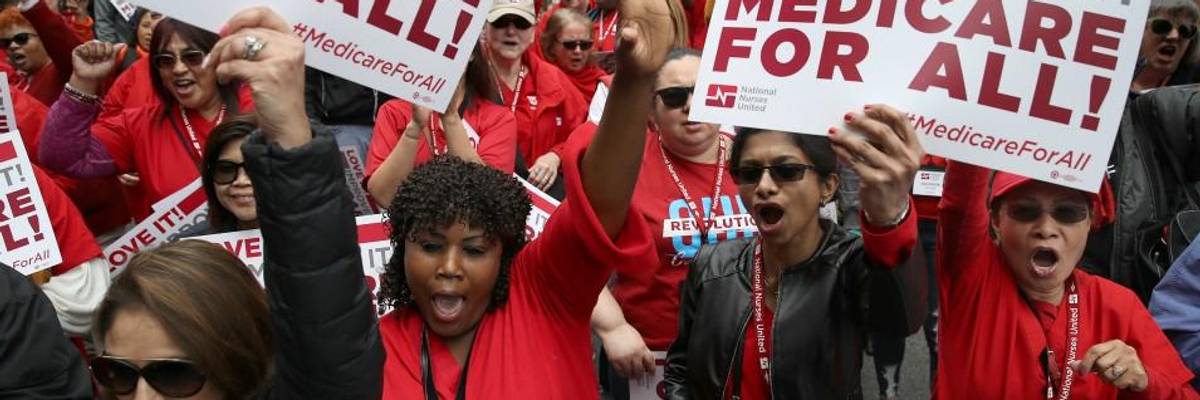
Protesters supporting 'Medicare for All' hold a rally outside PhRMA headquarters April 29, 2019 in Washington, D.C. (Photo: Win McNamee/Getty Images)
Documents obtained by the Washington Post Monday showed that lobbyists helped three state lawmakers draft op-eds this year attacking Medicare for All, a revelation Sen. Bernie Sanders highlighted as further evidence that the healthcare industry is "terrified" of the push for single-payer.
"We are taking on the big-money interests who have an army of lobbyists trying to defeat Medicare for All," tweeted Sanders, a 2020 Democratic presidential candidate. "They are terrified that the American people recognize that healthcare is a human right. They're right to be terrified."
The Post's Jeff Stein reported Monday that Montana state Rep. Kathy Kelker (D), Montana state Sen. Jen Gross (D), and an aide to Ohio state Sen. Steve Huffman (R) admitted in interviews that lobbyists helped craft their recent op-eds criticizing Medicare for All. The three columns appeared in local newspapers; none of them disclosed that they were written with the assistance of lobbyists.
"This is just the latest reason we need to reform this broken system where greedy corporations determine who can get medical treatment in America."
--Wendell Potter, Business for Medicare for All
Kelker and Gross "acknowledged in interviews that editorials they published separately about the single-payer health proposal included language provided by John MacDonald, a lobbyist and consultant in [Montana] who disclosed in private emails that he worked for an unnamed client," Stein reported.
Kathleen DeLand, an Ohio-based lobbyist, assisted Huffman with his September 30 Sidney Daily News op-ed, which criticized Medicare for All as a "one-size-fits-all approach" that "does not work for healthcare."
Huffman's aide told the Post that he believes DeLand was working for the Partnership for America's Health Care Future (PAHCF), an industry front group formed last year to fight Medicare for All.
"DeLand's emails to the Ohio lawmaker's staff include the acronym for the group in the subject line: 'PAHCF op-ed - OH - Huffman[3]. docx,'" Stein reported, citing documents provided to the Post by non-profit advocacy group Medicare for All Now.
MacDonald, who edited the Montana lawmakers' columns, would not confirm to the Post whether he was working for PAHCF.
"The emails appear to show extensive outside involvement in the Montana lawmakers' op-eds," Stein reported. "In a Microsoft Word document, MacDonald removed three paragraphs from a draft of Kelker's op-ed that pointed out that the United States 'clearly spends significantly more on healthcare per capita than other developed nations.' He also deleted a table from the lawmaker's original draft showing that the United States has higher healthcare spending per capita than France, Germany, Norway, and Switzerland."
Wendell Potter, president of advocacy group Business for Medicare for All, said the emails "blow open what I saw firsthand and revealed as a health insurance whistleblower."
"These companies and their lobbyists will stoop to whatever it takes, no matter how grotesque, to deny people the lifesaving coverage they need," Potter, a former health insurance executive, told the Post. "This is just the latest reason we need to reform this broken system where greedy corporations determine who can get medical treatment in America."
In a series of tweets Monday, Potter called on PAHCF to "come clean about any other op-eds secretly authored by the health insurance industry to discredit Medicare for All."
"This move by the industry is built on a decades old corporate playbook used previously by Big Tobacco and the NRA," said Potter. "Placing industry-crafted talking points under the byline of trusted local leaders is a tried and true way to manipulate the public."
Larry Noble, who served as general counsel for the Campaign Legal Center and the Federal Election Commission, echoed Potter's ethical concerns.
"It's disturbing," Noble said of the emails in an interview with the Post. "I think there's a certain ethical obligation to be upfront about who wrote the editorial."
Dear Common Dreams reader, It’s been nearly 30 years since I co-founded Common Dreams with my late wife, Lina Newhouser. We had the radical notion that journalism should serve the public good, not corporate profits. It was clear to us from the outset what it would take to build such a project. No paid advertisements. No corporate sponsors. No millionaire publisher telling us what to think or do. Many people said we wouldn't last a year, but we proved those doubters wrong. Together with a tremendous team of journalists and dedicated staff, we built an independent media outlet free from the constraints of profits and corporate control. Our mission has always been simple: To inform. To inspire. To ignite change for the common good. Building Common Dreams was not easy. Our survival was never guaranteed. When you take on the most powerful forces—Wall Street greed, fossil fuel industry destruction, Big Tech lobbyists, and uber-rich oligarchs who have spent billions upon billions rigging the economy and democracy in their favor—the only bulwark you have is supporters who believe in your work. But here’s the urgent message from me today. It's never been this bad out there. And it's never been this hard to keep us going. At the very moment Common Dreams is most needed, the threats we face are intensifying. We need your support now more than ever. We don't accept corporate advertising and never will. We don't have a paywall because we don't think people should be blocked from critical news based on their ability to pay. Everything we do is funded by the donations of readers like you. When everyone does the little they can afford, we are strong. But if that support retreats or dries up, so do we. Will you donate now to make sure Common Dreams not only survives but thrives? —Craig Brown, Co-founder |
Documents obtained by the Washington Post Monday showed that lobbyists helped three state lawmakers draft op-eds this year attacking Medicare for All, a revelation Sen. Bernie Sanders highlighted as further evidence that the healthcare industry is "terrified" of the push for single-payer.
"We are taking on the big-money interests who have an army of lobbyists trying to defeat Medicare for All," tweeted Sanders, a 2020 Democratic presidential candidate. "They are terrified that the American people recognize that healthcare is a human right. They're right to be terrified."
The Post's Jeff Stein reported Monday that Montana state Rep. Kathy Kelker (D), Montana state Sen. Jen Gross (D), and an aide to Ohio state Sen. Steve Huffman (R) admitted in interviews that lobbyists helped craft their recent op-eds criticizing Medicare for All. The three columns appeared in local newspapers; none of them disclosed that they were written with the assistance of lobbyists.
"This is just the latest reason we need to reform this broken system where greedy corporations determine who can get medical treatment in America."
--Wendell Potter, Business for Medicare for All
Kelker and Gross "acknowledged in interviews that editorials they published separately about the single-payer health proposal included language provided by John MacDonald, a lobbyist and consultant in [Montana] who disclosed in private emails that he worked for an unnamed client," Stein reported.
Kathleen DeLand, an Ohio-based lobbyist, assisted Huffman with his September 30 Sidney Daily News op-ed, which criticized Medicare for All as a "one-size-fits-all approach" that "does not work for healthcare."
Huffman's aide told the Post that he believes DeLand was working for the Partnership for America's Health Care Future (PAHCF), an industry front group formed last year to fight Medicare for All.
"DeLand's emails to the Ohio lawmaker's staff include the acronym for the group in the subject line: 'PAHCF op-ed - OH - Huffman[3]. docx,'" Stein reported, citing documents provided to the Post by non-profit advocacy group Medicare for All Now.
MacDonald, who edited the Montana lawmakers' columns, would not confirm to the Post whether he was working for PAHCF.
"The emails appear to show extensive outside involvement in the Montana lawmakers' op-eds," Stein reported. "In a Microsoft Word document, MacDonald removed three paragraphs from a draft of Kelker's op-ed that pointed out that the United States 'clearly spends significantly more on healthcare per capita than other developed nations.' He also deleted a table from the lawmaker's original draft showing that the United States has higher healthcare spending per capita than France, Germany, Norway, and Switzerland."
Wendell Potter, president of advocacy group Business for Medicare for All, said the emails "blow open what I saw firsthand and revealed as a health insurance whistleblower."
"These companies and their lobbyists will stoop to whatever it takes, no matter how grotesque, to deny people the lifesaving coverage they need," Potter, a former health insurance executive, told the Post. "This is just the latest reason we need to reform this broken system where greedy corporations determine who can get medical treatment in America."
In a series of tweets Monday, Potter called on PAHCF to "come clean about any other op-eds secretly authored by the health insurance industry to discredit Medicare for All."
"This move by the industry is built on a decades old corporate playbook used previously by Big Tobacco and the NRA," said Potter. "Placing industry-crafted talking points under the byline of trusted local leaders is a tried and true way to manipulate the public."
Larry Noble, who served as general counsel for the Campaign Legal Center and the Federal Election Commission, echoed Potter's ethical concerns.
"It's disturbing," Noble said of the emails in an interview with the Post. "I think there's a certain ethical obligation to be upfront about who wrote the editorial."
Documents obtained by the Washington Post Monday showed that lobbyists helped three state lawmakers draft op-eds this year attacking Medicare for All, a revelation Sen. Bernie Sanders highlighted as further evidence that the healthcare industry is "terrified" of the push for single-payer.
"We are taking on the big-money interests who have an army of lobbyists trying to defeat Medicare for All," tweeted Sanders, a 2020 Democratic presidential candidate. "They are terrified that the American people recognize that healthcare is a human right. They're right to be terrified."
The Post's Jeff Stein reported Monday that Montana state Rep. Kathy Kelker (D), Montana state Sen. Jen Gross (D), and an aide to Ohio state Sen. Steve Huffman (R) admitted in interviews that lobbyists helped craft their recent op-eds criticizing Medicare for All. The three columns appeared in local newspapers; none of them disclosed that they were written with the assistance of lobbyists.
"This is just the latest reason we need to reform this broken system where greedy corporations determine who can get medical treatment in America."
--Wendell Potter, Business for Medicare for All
Kelker and Gross "acknowledged in interviews that editorials they published separately about the single-payer health proposal included language provided by John MacDonald, a lobbyist and consultant in [Montana] who disclosed in private emails that he worked for an unnamed client," Stein reported.
Kathleen DeLand, an Ohio-based lobbyist, assisted Huffman with his September 30 Sidney Daily News op-ed, which criticized Medicare for All as a "one-size-fits-all approach" that "does not work for healthcare."
Huffman's aide told the Post that he believes DeLand was working for the Partnership for America's Health Care Future (PAHCF), an industry front group formed last year to fight Medicare for All.
"DeLand's emails to the Ohio lawmaker's staff include the acronym for the group in the subject line: 'PAHCF op-ed - OH - Huffman[3]. docx,'" Stein reported, citing documents provided to the Post by non-profit advocacy group Medicare for All Now.
MacDonald, who edited the Montana lawmakers' columns, would not confirm to the Post whether he was working for PAHCF.
"The emails appear to show extensive outside involvement in the Montana lawmakers' op-eds," Stein reported. "In a Microsoft Word document, MacDonald removed three paragraphs from a draft of Kelker's op-ed that pointed out that the United States 'clearly spends significantly more on healthcare per capita than other developed nations.' He also deleted a table from the lawmaker's original draft showing that the United States has higher healthcare spending per capita than France, Germany, Norway, and Switzerland."
Wendell Potter, president of advocacy group Business for Medicare for All, said the emails "blow open what I saw firsthand and revealed as a health insurance whistleblower."
"These companies and their lobbyists will stoop to whatever it takes, no matter how grotesque, to deny people the lifesaving coverage they need," Potter, a former health insurance executive, told the Post. "This is just the latest reason we need to reform this broken system where greedy corporations determine who can get medical treatment in America."
In a series of tweets Monday, Potter called on PAHCF to "come clean about any other op-eds secretly authored by the health insurance industry to discredit Medicare for All."
"This move by the industry is built on a decades old corporate playbook used previously by Big Tobacco and the NRA," said Potter. "Placing industry-crafted talking points under the byline of trusted local leaders is a tried and true way to manipulate the public."
Larry Noble, who served as general counsel for the Campaign Legal Center and the Federal Election Commission, echoed Potter's ethical concerns.
"It's disturbing," Noble said of the emails in an interview with the Post. "I think there's a certain ethical obligation to be upfront about who wrote the editorial."