SUBSCRIBE TO OUR FREE NEWSLETTER
Daily news & progressive opinion—funded by the people, not the corporations—delivered straight to your inbox.
5
#000000
#FFFFFF
To donate by check, phone, or other method, see our More Ways to Give page.
Daily news & progressive opinion—funded by the people, not the corporations—delivered straight to your inbox.
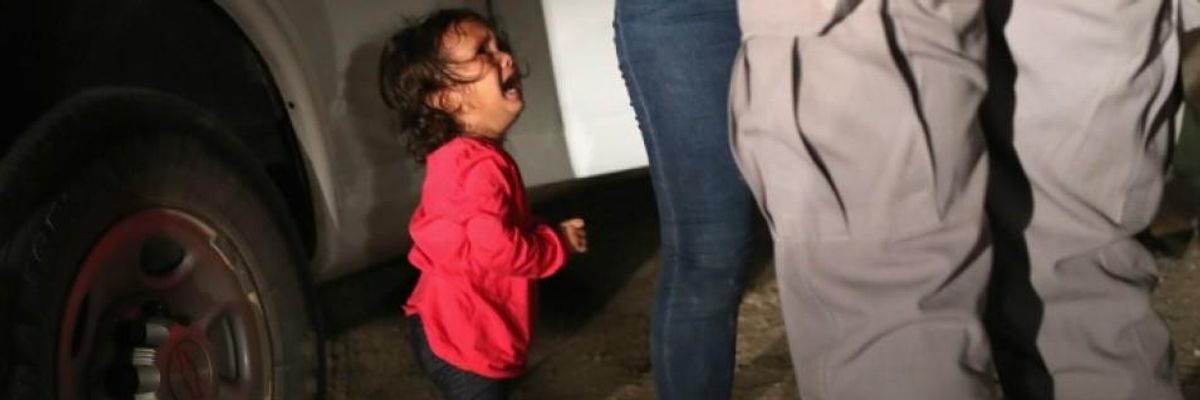
A two-year-old Honduran asylum seeker cries as her mother is searched and detained near the U.S.-Mexico border on June 12, 2018 in McAllen, Texas. The asylum seekers had rafted across the Rio Grande from Mexico and were detained by U.S. Border Patrol agents before being sent to a processing center for possible separation. (Photo: John Moore/Getty Images)
The Trump administration violated international law when it separated migrant children from their families, a United Nations expert said Monday.
That's not all, said Manfred Nowak, the independent expert leading a global study on children deprived of liberty. With over 100,000 children still in migration-related detention, the United States leads the world with the highest number of children in migration-related custody in the world.
Nowak made the remarks to press at the formal launch of the report, the U.N. Global Study on Children Deprived of Liberty, he said has the power to effect positive change.
Referencing the Convention on the Rights of the Child, Nowak said that "the detention of children shall only be a measure of last resort and only if absolutely necessary for the shortest appropriate period of time. That means, in principle, children should not be deprived of liberty."
"Alternatives to detention are usually available," said Nowak, "it's simply a question of politics."
A lack of political will to make that policy change was clear, Nowak suggested, when the Trump administration instituted its so-called zero tolerance policy in which officials separated children from their parents at Southern border.
"There's a lot of evidence...that migration-related detention for children can never be considered as a measure of last resort and in the best interest of the child," he said. "There are always alternatives available, and there a quite a number of states that have decided already that they will not put children any longer in migration-related detention."
"Of course, separating children--as was done by the Trump administration--from their parents, even small children, at the Mexican-U.S. border is absolutely prohibited by the Convention on the Rights of the Child," Nowak continued. "I would call it inhuman treatment for both the parents and the children. And there are still quite a number of children that are separated from their parents--and neither the children know where their parents are and the parents [don't] know where the children are--so that is definitely something that definitely should not happen again."
"We still have more than 100,000 children in migration-related detention" in the U.S., Nowak said, "so that's far more than all the other countries where we have reliable figures." Nowak added that the U.S. "did not respond to our questionnaire" requesting data for the report.
Nowak added the U.S. is detaining high numbers of children in the criminal justice sector as well.
"In general the incarceration rate in the United States is very high," said Nowak.
The United States detains on average about 60 out of 100,000 children--a figure Nowak said was "the highest we could find followed by others like Bolivia or Botswana or Sri Lanka."
Looking at figures by region, North America has the highest rate of incarceration of children, which includes Canada's detention of roughly 14 to 15 out of 100,000 children. In Western Europe, by comparison, the average is just about 5 out of 100,000 children in custody.
"In general we could say that the American hemisphere has the highest rate of children deprived of liberty in the administration of justice," the U.N. expert said. The lowest rate was found in sub-Saharan Africa.
Asked whether the United States--the only U.N. member state not to have ratified the Convention on the Rights of the Child--would face direct consequences of the rights violations, Nowak said direct action from the United Nations was unlikely because the United States is a permanent member of the Security Council
"That's one of the weaknesses of the United Nations," said Nowak.
The United States is party to the Convention on Civil and Political Rights and the Convention on Torture, Nowak noted, and said that the way the Trump administration was "separating infants from their families only in order to deter irregular migration from Central America to the United States of America, for me, constitutes inhuman and degrading treatment. And that is absolutely prohibited by the two treaties."
"I'm deeply convinced that these are violations of international law," Nowak adding, same that the same could be said of the high number of children incarcerated through the U.S. criminal justice system.
Despite likely inaction by the U.N. to make the U.S. face consequences, Nowak said it doesn't mean the continued deprivation of children's liberty would continue unabated.
Nowak expressed hope his new study, like the 1996 report on child soldiers, would have an impact "not because of sanctions but because of its power of facts."
Dear Common Dreams reader, It’s been nearly 30 years since I co-founded Common Dreams with my late wife, Lina Newhouser. We had the radical notion that journalism should serve the public good, not corporate profits. It was clear to us from the outset what it would take to build such a project. No paid advertisements. No corporate sponsors. No millionaire publisher telling us what to think or do. Many people said we wouldn't last a year, but we proved those doubters wrong. Together with a tremendous team of journalists and dedicated staff, we built an independent media outlet free from the constraints of profits and corporate control. Our mission has always been simple: To inform. To inspire. To ignite change for the common good. Building Common Dreams was not easy. Our survival was never guaranteed. When you take on the most powerful forces—Wall Street greed, fossil fuel industry destruction, Big Tech lobbyists, and uber-rich oligarchs who have spent billions upon billions rigging the economy and democracy in their favor—the only bulwark you have is supporters who believe in your work. But here’s the urgent message from me today. It's never been this bad out there. And it's never been this hard to keep us going. At the very moment Common Dreams is most needed, the threats we face are intensifying. We need your support now more than ever. We don't accept corporate advertising and never will. We don't have a paywall because we don't think people should be blocked from critical news based on their ability to pay. Everything we do is funded by the donations of readers like you. When everyone does the little they can afford, we are strong. But if that support retreats or dries up, so do we. Will you donate now to make sure Common Dreams not only survives but thrives? —Craig Brown, Co-founder |
The Trump administration violated international law when it separated migrant children from their families, a United Nations expert said Monday.
That's not all, said Manfred Nowak, the independent expert leading a global study on children deprived of liberty. With over 100,000 children still in migration-related detention, the United States leads the world with the highest number of children in migration-related custody in the world.
Nowak made the remarks to press at the formal launch of the report, the U.N. Global Study on Children Deprived of Liberty, he said has the power to effect positive change.
Referencing the Convention on the Rights of the Child, Nowak said that "the detention of children shall only be a measure of last resort and only if absolutely necessary for the shortest appropriate period of time. That means, in principle, children should not be deprived of liberty."
"Alternatives to detention are usually available," said Nowak, "it's simply a question of politics."
A lack of political will to make that policy change was clear, Nowak suggested, when the Trump administration instituted its so-called zero tolerance policy in which officials separated children from their parents at Southern border.
"There's a lot of evidence...that migration-related detention for children can never be considered as a measure of last resort and in the best interest of the child," he said. "There are always alternatives available, and there a quite a number of states that have decided already that they will not put children any longer in migration-related detention."
"Of course, separating children--as was done by the Trump administration--from their parents, even small children, at the Mexican-U.S. border is absolutely prohibited by the Convention on the Rights of the Child," Nowak continued. "I would call it inhuman treatment for both the parents and the children. And there are still quite a number of children that are separated from their parents--and neither the children know where their parents are and the parents [don't] know where the children are--so that is definitely something that definitely should not happen again."
"We still have more than 100,000 children in migration-related detention" in the U.S., Nowak said, "so that's far more than all the other countries where we have reliable figures." Nowak added that the U.S. "did not respond to our questionnaire" requesting data for the report.
Nowak added the U.S. is detaining high numbers of children in the criminal justice sector as well.
"In general the incarceration rate in the United States is very high," said Nowak.
The United States detains on average about 60 out of 100,000 children--a figure Nowak said was "the highest we could find followed by others like Bolivia or Botswana or Sri Lanka."
Looking at figures by region, North America has the highest rate of incarceration of children, which includes Canada's detention of roughly 14 to 15 out of 100,000 children. In Western Europe, by comparison, the average is just about 5 out of 100,000 children in custody.
"In general we could say that the American hemisphere has the highest rate of children deprived of liberty in the administration of justice," the U.N. expert said. The lowest rate was found in sub-Saharan Africa.
Asked whether the United States--the only U.N. member state not to have ratified the Convention on the Rights of the Child--would face direct consequences of the rights violations, Nowak said direct action from the United Nations was unlikely because the United States is a permanent member of the Security Council
"That's one of the weaknesses of the United Nations," said Nowak.
The United States is party to the Convention on Civil and Political Rights and the Convention on Torture, Nowak noted, and said that the way the Trump administration was "separating infants from their families only in order to deter irregular migration from Central America to the United States of America, for me, constitutes inhuman and degrading treatment. And that is absolutely prohibited by the two treaties."
"I'm deeply convinced that these are violations of international law," Nowak adding, same that the same could be said of the high number of children incarcerated through the U.S. criminal justice system.
Despite likely inaction by the U.N. to make the U.S. face consequences, Nowak said it doesn't mean the continued deprivation of children's liberty would continue unabated.
Nowak expressed hope his new study, like the 1996 report on child soldiers, would have an impact "not because of sanctions but because of its power of facts."
The Trump administration violated international law when it separated migrant children from their families, a United Nations expert said Monday.
That's not all, said Manfred Nowak, the independent expert leading a global study on children deprived of liberty. With over 100,000 children still in migration-related detention, the United States leads the world with the highest number of children in migration-related custody in the world.
Nowak made the remarks to press at the formal launch of the report, the U.N. Global Study on Children Deprived of Liberty, he said has the power to effect positive change.
Referencing the Convention on the Rights of the Child, Nowak said that "the detention of children shall only be a measure of last resort and only if absolutely necessary for the shortest appropriate period of time. That means, in principle, children should not be deprived of liberty."
"Alternatives to detention are usually available," said Nowak, "it's simply a question of politics."
A lack of political will to make that policy change was clear, Nowak suggested, when the Trump administration instituted its so-called zero tolerance policy in which officials separated children from their parents at Southern border.
"There's a lot of evidence...that migration-related detention for children can never be considered as a measure of last resort and in the best interest of the child," he said. "There are always alternatives available, and there a quite a number of states that have decided already that they will not put children any longer in migration-related detention."
"Of course, separating children--as was done by the Trump administration--from their parents, even small children, at the Mexican-U.S. border is absolutely prohibited by the Convention on the Rights of the Child," Nowak continued. "I would call it inhuman treatment for both the parents and the children. And there are still quite a number of children that are separated from their parents--and neither the children know where their parents are and the parents [don't] know where the children are--so that is definitely something that definitely should not happen again."
"We still have more than 100,000 children in migration-related detention" in the U.S., Nowak said, "so that's far more than all the other countries where we have reliable figures." Nowak added that the U.S. "did not respond to our questionnaire" requesting data for the report.
Nowak added the U.S. is detaining high numbers of children in the criminal justice sector as well.
"In general the incarceration rate in the United States is very high," said Nowak.
The United States detains on average about 60 out of 100,000 children--a figure Nowak said was "the highest we could find followed by others like Bolivia or Botswana or Sri Lanka."
Looking at figures by region, North America has the highest rate of incarceration of children, which includes Canada's detention of roughly 14 to 15 out of 100,000 children. In Western Europe, by comparison, the average is just about 5 out of 100,000 children in custody.
"In general we could say that the American hemisphere has the highest rate of children deprived of liberty in the administration of justice," the U.N. expert said. The lowest rate was found in sub-Saharan Africa.
Asked whether the United States--the only U.N. member state not to have ratified the Convention on the Rights of the Child--would face direct consequences of the rights violations, Nowak said direct action from the United Nations was unlikely because the United States is a permanent member of the Security Council
"That's one of the weaknesses of the United Nations," said Nowak.
The United States is party to the Convention on Civil and Political Rights and the Convention on Torture, Nowak noted, and said that the way the Trump administration was "separating infants from their families only in order to deter irregular migration from Central America to the United States of America, for me, constitutes inhuman and degrading treatment. And that is absolutely prohibited by the two treaties."
"I'm deeply convinced that these are violations of international law," Nowak adding, same that the same could be said of the high number of children incarcerated through the U.S. criminal justice system.
Despite likely inaction by the U.N. to make the U.S. face consequences, Nowak said it doesn't mean the continued deprivation of children's liberty would continue unabated.
Nowak expressed hope his new study, like the 1996 report on child soldiers, would have an impact "not because of sanctions but because of its power of facts."