SUBSCRIBE TO OUR FREE NEWSLETTER
Daily news & progressive opinion—funded by the people, not the corporations—delivered straight to your inbox.
5
#000000
#FFFFFF
To donate by check, phone, or other method, see our More Ways to Give page.
Daily news & progressive opinion—funded by the people, not the corporations—delivered straight to your inbox.
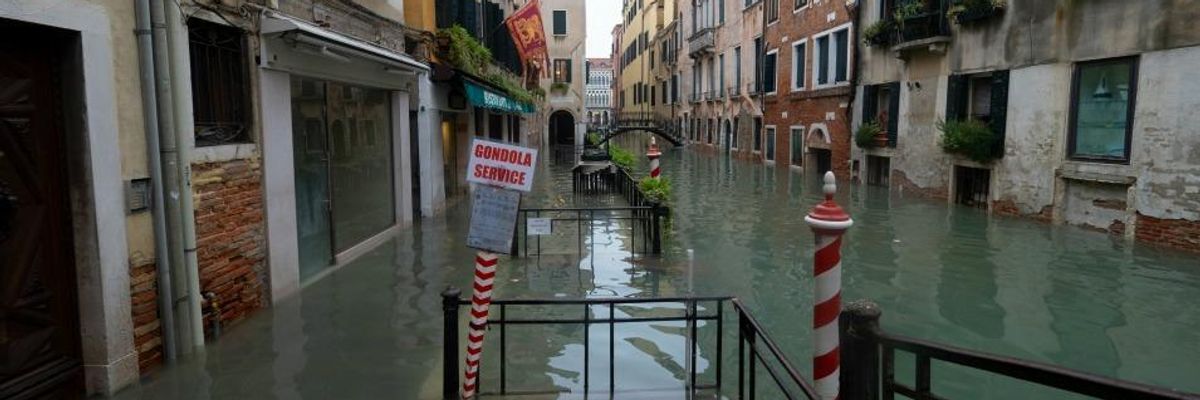
Venice suffered its worst flooding in 50 years on Tuesday. (Photo: Anna Henly/Barcroft Media via Getty Images)
After six feet of water inundated the city of Venice Tuesday, Mayor Luigi Brugnaro declared that the flooding should not be considered normal but rather the result of the climate crisis.
The highest water level in 50 years led Brugnaro to ask Italy's government for assistance and to declare a state of emergency in the city after at least two people were reported dead in the flooding.
"These are the effects of climate change," the mayor tweeted in Italian on Tuesday night.
This week's flooding marked the second-highest water level recorded in Venice since city officials began keeping flood records in 1923. In 1966, the city was overwhelmed by six feet, three inches of rain water flooding the streets.
The ancient cathedral St. Mark's Basilica flooded Tuesday for only the sixth time in 1,200 years, according to the BBC--but church officials said four of those times have been in the last two decades as fossil fuel emissions and sea levels have both gone up.
"I usually associate climate change with dramatic catastrophe like hurricanes and forest fires but this is silent and creeping," one local observer wrote. "Residents are adapting by scheduling meetings earlier or later, shops place wooden barriers to block water and there are ramps in low elevation spaces but it is clear that it is getting worse every winter."
Greenpeace cautioned against dismissing the flooding as the result of Venice's location in the Venetian Lagoon.
"From north to south, Italy has been impacted by a series of extreme climate events," Greenpeace Italy tweeted. "What's happening in Venice is a powerful example. This is not just 'bad weather,' this is a climate emergency."
Climate experts Katharine Hayhoe, Eric Holthaus, and Bill McKibben added that the climate crisis is worsening weather events' effects on the low-lying city.
Climate experts--including Katharine Hayhoe, Eric Holthaus, and Bill McKibben--noted that low-lying cities like Venice are becoming increasingly vulnerable to extreme weather and rising seas caused by rising global temperatures.
The Italian government announced earlier this month that school children would be required starting in 2020 to study the climate crisis as part of their curriculum, in an initiative pushed by Education Minister Lorenzo Fioramonti. But the government is still influenced by the far-right opposition party Lega, led by climate change denier Matteo Salvini, who remains the country's most popular politician.
"Now the government must listen," Brugnaro said.
Dear Common Dreams reader, It’s been nearly 30 years since I co-founded Common Dreams with my late wife, Lina Newhouser. We had the radical notion that journalism should serve the public good, not corporate profits. It was clear to us from the outset what it would take to build such a project. No paid advertisements. No corporate sponsors. No millionaire publisher telling us what to think or do. Many people said we wouldn't last a year, but we proved those doubters wrong. Together with a tremendous team of journalists and dedicated staff, we built an independent media outlet free from the constraints of profits and corporate control. Our mission has always been simple: To inform. To inspire. To ignite change for the common good. Building Common Dreams was not easy. Our survival was never guaranteed. When you take on the most powerful forces—Wall Street greed, fossil fuel industry destruction, Big Tech lobbyists, and uber-rich oligarchs who have spent billions upon billions rigging the economy and democracy in their favor—the only bulwark you have is supporters who believe in your work. But here’s the urgent message from me today. It's never been this bad out there. And it's never been this hard to keep us going. At the very moment Common Dreams is most needed, the threats we face are intensifying. We need your support now more than ever. We don't accept corporate advertising and never will. We don't have a paywall because we don't think people should be blocked from critical news based on their ability to pay. Everything we do is funded by the donations of readers like you. When everyone does the little they can afford, we are strong. But if that support retreats or dries up, so do we. Will you donate now to make sure Common Dreams not only survives but thrives? —Craig Brown, Co-founder |
After six feet of water inundated the city of Venice Tuesday, Mayor Luigi Brugnaro declared that the flooding should not be considered normal but rather the result of the climate crisis.
The highest water level in 50 years led Brugnaro to ask Italy's government for assistance and to declare a state of emergency in the city after at least two people were reported dead in the flooding.
"These are the effects of climate change," the mayor tweeted in Italian on Tuesday night.
This week's flooding marked the second-highest water level recorded in Venice since city officials began keeping flood records in 1923. In 1966, the city was overwhelmed by six feet, three inches of rain water flooding the streets.
The ancient cathedral St. Mark's Basilica flooded Tuesday for only the sixth time in 1,200 years, according to the BBC--but church officials said four of those times have been in the last two decades as fossil fuel emissions and sea levels have both gone up.
"I usually associate climate change with dramatic catastrophe like hurricanes and forest fires but this is silent and creeping," one local observer wrote. "Residents are adapting by scheduling meetings earlier or later, shops place wooden barriers to block water and there are ramps in low elevation spaces but it is clear that it is getting worse every winter."
Greenpeace cautioned against dismissing the flooding as the result of Venice's location in the Venetian Lagoon.
"From north to south, Italy has been impacted by a series of extreme climate events," Greenpeace Italy tweeted. "What's happening in Venice is a powerful example. This is not just 'bad weather,' this is a climate emergency."
Climate experts Katharine Hayhoe, Eric Holthaus, and Bill McKibben added that the climate crisis is worsening weather events' effects on the low-lying city.
Climate experts--including Katharine Hayhoe, Eric Holthaus, and Bill McKibben--noted that low-lying cities like Venice are becoming increasingly vulnerable to extreme weather and rising seas caused by rising global temperatures.
The Italian government announced earlier this month that school children would be required starting in 2020 to study the climate crisis as part of their curriculum, in an initiative pushed by Education Minister Lorenzo Fioramonti. But the government is still influenced by the far-right opposition party Lega, led by climate change denier Matteo Salvini, who remains the country's most popular politician.
"Now the government must listen," Brugnaro said.
After six feet of water inundated the city of Venice Tuesday, Mayor Luigi Brugnaro declared that the flooding should not be considered normal but rather the result of the climate crisis.
The highest water level in 50 years led Brugnaro to ask Italy's government for assistance and to declare a state of emergency in the city after at least two people were reported dead in the flooding.
"These are the effects of climate change," the mayor tweeted in Italian on Tuesday night.
This week's flooding marked the second-highest water level recorded in Venice since city officials began keeping flood records in 1923. In 1966, the city was overwhelmed by six feet, three inches of rain water flooding the streets.
The ancient cathedral St. Mark's Basilica flooded Tuesday for only the sixth time in 1,200 years, according to the BBC--but church officials said four of those times have been in the last two decades as fossil fuel emissions and sea levels have both gone up.
"I usually associate climate change with dramatic catastrophe like hurricanes and forest fires but this is silent and creeping," one local observer wrote. "Residents are adapting by scheduling meetings earlier or later, shops place wooden barriers to block water and there are ramps in low elevation spaces but it is clear that it is getting worse every winter."
Greenpeace cautioned against dismissing the flooding as the result of Venice's location in the Venetian Lagoon.
"From north to south, Italy has been impacted by a series of extreme climate events," Greenpeace Italy tweeted. "What's happening in Venice is a powerful example. This is not just 'bad weather,' this is a climate emergency."
Climate experts Katharine Hayhoe, Eric Holthaus, and Bill McKibben added that the climate crisis is worsening weather events' effects on the low-lying city.
Climate experts--including Katharine Hayhoe, Eric Holthaus, and Bill McKibben--noted that low-lying cities like Venice are becoming increasingly vulnerable to extreme weather and rising seas caused by rising global temperatures.
The Italian government announced earlier this month that school children would be required starting in 2020 to study the climate crisis as part of their curriculum, in an initiative pushed by Education Minister Lorenzo Fioramonti. But the government is still influenced by the far-right opposition party Lega, led by climate change denier Matteo Salvini, who remains the country's most popular politician.
"Now the government must listen," Brugnaro said.